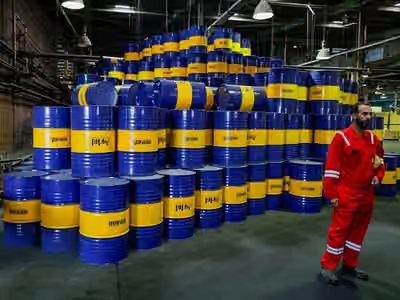
Iran is among the top most gas flaring countries. (file photo)
Iran's gas flaring rose by 19% year-on-year to 20.4 billion cubic meters in 2023, marking the highest recorded level for the Islamic Republic since satellite-based flaring estimates began in 2012, as per a World Bank report.
According to the report, the increased intensity of flaring indicates a lack of investment in gas infrastructure and its utilization.
Iran ranked second globally after Russia in gas flaring levels last year and had the highest increase rate worldwide.
The country has failed to develop and install the necessary equipment to collect associated gas from oil fields over the past two decades.
According to the Oil Ministry's estimates, approximately $5 billion is needed to curb gas flaring, which accounts for about 8.5% of the country’s total gas production. The annual value of this flared gas exceeds $5 billion in regional markets. To compare, Iran's flared gas volume equals 42% of Turkey’s total gas consumption in 2023.
At the same time, natural gas consumption is increasing in the country and supplies get tighter leading to industrial disruptions.
British Petroleum (BP) also released its annual statistical review of world energy this week, reporting that greenhouse gas emissions from flaring in Iran increased by 16.3% year-on-year, reaching 43.1 million tons in 2023.
Iran’s total greenhouse gas emissions reached 927 million tons last year, ranking sixth globally.
Why is Iran’s gas flaring rising?
The World Bank attributes Iran’s increase in gas flaring to a rise in oil production.
In 2017, Iran’s gas flaring volume was just over 17 billion cubic meters when it produced up to 3.8 million barrels of crude oil per day, about 800,000 barrels more than in 2023. The reason for this contradiction is Iran's failure to install equipment at new oil fields.
The increase in flaring resulted from Iran's newly developed oil fields, particularly those managed by domestic companies, including Azadegan, Yadavaran, and Azar. However, unlike older old fields that have gas collection technology, there have been no investments in the new fields.
According to both the Iranian Oil Ministry and the US Energy Information Administration, approximately 80% of Iran’s oil production comes from aging fields that lose 8-12% of their productivity annually.
Iranian domestic companies have developed and partially launched new fields in recent years, resulting in higher gas flaring rates to compensate for declining oil production from aging fields.
In the 2000s, Iran installed associated gas collection equipment on some oil fields, relying on domestic technologies. However, after 2010, investment in oil fields declined significantly, and associated gas collection projects lost priority.
For instance, since 2018, Iran’s total annual investment in upstream oil and gas projects has been around $3 billion, down from over $7 billion in the early 2010s and $18 billion in the 2000s.
Iran suffers not only from high volumes of gas flaring but also significant methane emissions, which increased by 12% to 8.5 billion cubic meters in 2023, according to the International Energy Agency.
A significant portion of Iran's gas leakage is due to its outdated transmission and distribution network.
Iran loses about 29 billion cubic meters of its produced gas (12%) during production, transmission, and distribution stages—equivalent to the country’s total household gas demand.
Due to delays in gas field development and significant gas wastage, Iran faces a substantial gas deficit in winter, leading to increased consumption of polluting mazut and diesel instead of natural gas.
Additionally, Iran's gas exports dropped by a quarter, reaching 14.3 billion cubic meters in 2023, according to BP estimates.