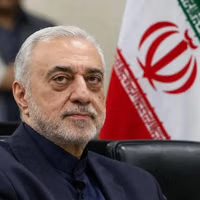
Zarif speaking during the television discussion on June 18, 2024
Former Foreign Minister Mohammad-Javad Zarif’s fiery speech at the end of a televised roundtable discussion of the pro-reform candidate Masoud Pezeshkian has sparked a lot of pro and con reactions.
•
Zarif revealed Tuesday morning that he would accompany Pezeshkian to the roundtable discussion at the national TV.
The former foreign minister, who has consistently maintained that he does not belong to either the reformist or conservative/hardliner camps, remained silent for much of the discussion. However, he broke his silence with a fiery speech in defense of Pezeshkian’s proposed foreign policy advocating improved ties with the West aimed at ending sanctions that have crippled the country's economy.
At the same time, addressing the hardliners who have controlled the government since 2021, Zarif asserted that their ability to sell more oil since 2021 was solely due to US President Joe Biden loosening the sanctions.
The hashtag ‘Zarif’ rose to the top of the trending Persian tweets shortly after the speech.
“Today’s foreign policy roundtable, as expected, came under the sway of Zarif and his fiery speech. The text that Pezeshkian read as an introduction, however, also had passages that could help the audience to understand his political vision. Pezeshkian said the goal of his foreign policy was not just survival, but also the country’s development,” Khabar Online, a news website linked to the moderate conservative former Speaker Ali Larijani wrote.
Candidate Pezeshkian and former foreign minister Javad Zarif meeting on June 13, 2024
In his introduction, Pezeshkian said his future government would aim to revive the 2015 nuclear deal to end sanctions and international banking restrictions and accede to the Financial Action Taskforce (FATF) which has blacklisted the Islamic Republic.
The pro-reform candidate stated that he did not consider diplomacy, negotiation, and reaching an agreement with the West as “humiliation” but as a reasonable and low-cost way to attain dignity. “We don’t have time to stand still and linger, in the best-case scenario, when regional countries are rapidly developing,” he said.
“I don’t want people to keep watching the news to find out if more sanctions are meted out to us or not, whether the dollar exchange rate is going up or not. I want foreign policy to give people stability and psychological security so they can plan their lives for the long term without doubts and anxiety,” Pezeshkian said.
So far, he had remained mostly silent about the Iranian regime's foreign policy and its nuclear program, like the other five hand-picked candidates. However, speaking in favor of talks with the West can be an effective way to obtain support by a large segment of the Iranian population whose financial situation has dramatically worsened since the United States imposed sanctions in 2018 and demanded to re-negotiate the 2015 nuclear accord.
Pezeshkian also contended that Supreme Leader Ali Khamenei draws the general outlines of Iran's foreign policy but “planning and execution” of such policies is a duty that the president and his government carry out based on Khamenei’s three principles of “dignity, wisdom, and expediency” rather than militancy, sloganeering, and damage to national interests. Iranians want respect and dignity but not militancy, he said.
However, evidence does not support Pezeshkian's optimistic interpretation of Khamenei's stance. The Supreme Leader has consistently spoken against the United States, calling it "the enemy" over the years, demanding its expulsion from the Middle East. He also gave a lukewarm blessing to the nuclear deal and allowed hardliners to systematically criticize it.
Iran's ruler Khamenei has forged a close relationship with Putin's Russia in the past two decades.
“I have just one question for Dr. Pezeshkian. I will vote and collect votes for him if the answer is yes,” a tweet addressed to Pezeshkian asked. "Will he pledge to resign if experts assert that negotiation and interaction with the United States is the only way to save Iran, and the Supreme Leader objects?"
Zarif’s speech came after a pro-Jalili ‘expert’ panel member, Foad Izadi, incessantly attacked Pezeshkian’s views and insisted that the disputes between Iran and the United States over the nuclear issue could never be resolved and sanctions would never be lifted unless Iran surrendered and made huge concessions to the West.
In his speech, Zarif defended the Rouhani administration and his own performance regarding the 2015 JCPOA agreement with world powers and its economic outcome.
He also contended that the administration of Joe Biden was prepared to return to the deal that former US President Donald Trump unilaterally withdrew from in 2018. However, according to Zarif, the opportunity was spoiled by both Israel and Iranian hardliners, who pressured the government to escalate the nuclear crisis.
Referring to Pezeshkian’s hardliner rivals, Zarif contended that the competition in these elections was between the discourse of the reformist former President Mohammad Khatami and that of the “Miracle of the Third Millennium”, a clear reference to the populist Mahmoud Ahmadinejad under whose eight years of presidency Iran came under extensive international sanctions.
“No matter how much weaponry you own, you will not attain any results if people are not with you,” Zarif told hardliners while adding that Iran could not “spend $800 billion a year” on its military, a reference to US military spending.
Shortly after the discussion ended, Hassan Rouhani’s minister of communications, Mohammad-Javad Azari-Jahromi released a video on social media urging Iranians not to boycott the elections and to vote for Pezeshkian. “Boycotting means surrendering our share of life to rivals,” he said.
Azari-Jahromi’s tweet was seen 100K times in an hour and is being widely shared by others including Zarif who shared it with the line from a famous song. “Walk along my dear, because this shared pain will never be healed if we go our separate ways,”Zarif tweeted with Pezeshkian’s campaign hashtag “For Iran”.
Other Iranians strongly attacked Zarif, accusing him of trying to "heat up the election" when a large segment of the population has lost trust in the Islamic Republic's stage-managed exercise.
Experiencing tightly controlled and unfree elections for five decades, most voters in Iran have realized since 2020 that they do not have a meaningful role in electing their president or members of parliament.
The most significant reasons for the declining trust include the mass disqualification of candidates by the unelected 12-member Guardian Council, the use of tens of thousands of mobile ballot boxes (up to one-third), voting in military barracks, and the involvement of dirty and non-transparent money.
Although many were aware of the undemocratic nature of elections long before, participation rates in some periods reached more than two-thirds of eligible voters, such as in 1997 and 2013. One of the main reasons for this high participation was the government’s propaganda machine, which effectively "heated up the election."
There are three main methods. The first is dedicating significant airtime on state TV and radio stations, which have dozens of networks, to election-related content to encourage participation. This includes debates between candidates, interviews with them, and election roundtables, all orchestrated by government outlets. For the 2024 elections, the candidates and their consultants have dozens of introductory interviews, and panel discussion programs, other than five collective debates.
A billboard with a picture of the late President Ebrahim Raisi and the presidential candidates is displayed on a street in Tehran, Iran, June 17, 2024.
The second method involves billboards and banners funded by public resources, displayed throughout cities and along roads across the country. These advertisements use quotes from Shia saints, leaders of the Islamic Republic, and celebrities who cooperate with the government to encourage voter participation. These ads are displayed alongside the individual advertisements of the candidates.
However, the most effective method of attracting silent majority voters is to amplify the voices of university professors (especially those residing in Western countries), non-conformist celebrities, and figures occasionally critical of regime policies. This approach helps bring a segment of the undecided population to the polls. Typically, the opinions and positions of these figures, which are not necessarily independent, are not featured by government-controlled outlets during ordinary times.
However, the effectiveness of these methods has waned since the February 2020 parliamentary elections, followed by the presidential vote in 2021 and the second parliamentary election in March 2024. Turnout in these elections was significantly below 50%, according to official figures, which many believe are inflated to portray a more favorable picture.
“A new wave of hope”
During electoral campaigns, supporters of the Islamic Republic have employed three tactics both inside and outside the country to encourage voter turnout.
The first tactic involves instilling misleading hopes in a society desperate for change. "With the announcement of the names of the approved candidates, a new wave of hope has flowed through Iranian society. If political groups use it correctly and follow the right principles, we will have one of the most refreshing choices in the history of Iran since Mr. Khatami," said Saeed Leilaz, a high-ranking member of a 'reformist' party within the Reform Front, supporting the 'moderate' candidate Masoud Pezeshkian.
President Mohammad Khatami (1997-2005) aimed to reform some notorious characteristics and undemocratic practices of the Islamic regime but was stopped by conservatives supported by Supreme Leader Ali Khamenei and the Revolutionary Guard. The same scenario repeated itself during the eight years of relatively moderate Hassan Rouhani (2013-2021), who was constantly pummeled by hardliners.
Leilaz believes 40 million people may participate in this election. Of course, according to the IRNA news agency, based on the content analysis of people's posts on Instagram pages of "about 31 million active users" the electorate has not become mobilized for the election.
Abbas Abdi, one of the leftist figures of the Khomeini era and a leading figure among the students who took the American Embassy staff hostage for 444 days, also repeated the above hope: "The elections of June 28, 2024, can create a social wave with over 60% participation," Abdi predicts, though he does not specify which poll supports this claim. He emphasizes Pezeshkian’s personality rather than his executive performance or experience, which is not particularly notable: "The most important and outstanding feature of him... is that he is an honest person who does not lie, and this is a rare quality among Iranian officials, and people are very hungry for that."
Abdi and Leilaz spent time in prison just for expressing their views in the past, which has made their voices to be heard outside the ruling elite.
“Surprising decision of the Guardian Council”
The second tactic used to stir up election enthusiasm is to portray the Guardian Council's decision to approve Pezeshkian as a surprising move, framing him as a reformist candidate to attract those who still believe in reforms within the regime.
Pezeshkian, who is known more as a ‘reformist’ than a conservative is the only non-hardliner candidate approved by the Guardian Council. All sorts of regime supporters, including some individuals in the United States, portray his candidacy as a good omen showing the Islamic Republic’s goodwill. However, in the past eight days after his candidacy was approved, Pezeshkian has come across more as a conservative loyal to Ali Khamenei than a reformist.
“Not voting is not a political act”
The third tactic is to frame non-participation not as a protest, but as an apolitical act. "I don't consider not voting to be a political act," an American-Iranian supporter of the Tehran government said on social media. This viewpoint fails to distinguish between democratic and totalitarian regimes. In totalitarian regimes, not voting can lead to the loss of certain rights, such as employment in government affairs. Therefore, abstaining from voting is a costly political act. In fact, the decline in election turnout in the past four years has shaken and weakened Islamic Republics claims of legitimacy.
The opinions expressed by the author are not necessarily the views of Iran International.
Iran's ex-foreign minister, Mohammad Javad Zarif, announced plans to support Masoud Pezeshkian, a so-called "reformist" presidential candidate, in an upcoming political roundtable on state television.
Zarif, who was Iran’s top diplomat from 2013 to 2021 and a key figure in the controversial nuclear deal negotiations, declared his intentions through a post on the social networking platform X.
The planned discussion is expected to touch on major national issues under a potential Pezeshkian presidency, though skeptics doubt significant change will occur if he were elected.
The event comes as Iran prepares for unexpected presidential elections on June 28 following the sudden death of President Ebrahim Raisi in a helicopter crash.
Critics fear that the roundtable may simply be another example of Iran’s political theater, aimed at maintaining the status quo under the guise of reform.
Skepticism about Pezeshkian’s potential for genuine reform is growing as he aligns closer to the narrative of the ruling theocratic regime. In a recent televised interview, he focused primarily on economic issues without touching on more contentious subjects such as foreign policy, the nuclear program, or the mandatory hijab law, leaving many supporters feeling disillusioned as the country cries out for change.
In the first debate among Iran’s presidential candidates, hardliners denied the impact of nuclear-related sanctions, while two candidates said improving international ties is crucial for fixing the economy.
The three-hour long debate on Monday among six hand-picked candidates was focused on “controlling inflation and growth of production”. Three of the five televised debates planned before the June 28 elections will focus on economy. The next debate is scheduled for June 20.
In the debates and interviews, former nuclear negotiator Saeed Jalili, incumbent Mayor of Tehran Alireza Zakani, and hardliner Amir-Hossein Ghazizadeh-Hashemi defended the “achievements” of Raisi’s administration. They faced opposition from pro-reform Masoud Pezeshkian, moderate-conservative Mostafa Pourmohammadi, and at times Parliament Speaker Mohammad-Bagher Ghalibaf, who criticized the administration's performance in veiled terms.
Hardliner candidates are acutely aware of the Raisi administration's disastrous economic performance, yet they refuse to take responsibility for it and sometimes even praise it, according to France-based journalist Seraj Mirdamadi. “But they blame [the pro-reform Masoud] Pezeshkian unfairly for the performance of [Hassan] Rouhani’s government.”
Speaking in vague and difficult to understand terms, Jalili, insisted that sanctions did not matter, and that the state of the economy could be improved by relying on “domestic potentials,” an argument often made by loyalists of Supreme Leader Ali Khamenei. According to him, an economic growth rate of eight percent as prescribed by the 7th Development Plan is feasible, while others argue that tens of billions of dollars is needed to achieve such a high rate.
Presidential candidates attend an election debate at a television studio in Tehran, Iran, June 17, 2024.
Ghalibaf, however, prescribed negotiations to lift the sanctions if for every step that Iran took, presumably to limit its nuclear program, the Western side was prepared to provide adequate incentives in return.
Ghalibaf has been criticized for calling the removal of sanctions a priority for his government, while the parliament in December 2020 under his leadership approved a bill hardening Iran’s negotiating position. “Why did you approve the catastrophic ‘Strategic Action Plan to Lift the Sanctions’ to prevent the revival of the JCPOA?” reformist commentator Abbas Abdi asked Ghalibaf in a tweet.
The December 2020 legislation called for reducing Iran's commitments under the 2015 nuclear deal and obliged the government to escalate the nuclear crisis.
All of the four hardliners, including Ghalibaf, insist that the sanctions are “unfair” and “cruel” but also argue that Iran has succeeded in circumventing them and is selling its oil without much trouble.
In a tweet after the debates, political commentator Reza Nasri contended that hardliners’ claims were contradictory. “How can sanctions which ‘are not a problem anymore’ and have been neutralized be ‘cruel’ at the same time?” he asked.
However, there is a major divide between Ghalibaf and Jalili who is the candidate of ultra-hardliners. Their supporters have been highly intolerant of each other, insisting that one must withdraw in favor of the other to ensure the presidency remains within the "revolutionary front."
Zakani and Ghazizadeh-Hashemi, neither of whom has a realistic chance of winning, appeared to play a supporting role for Jalili in the debate. They may withdraw in his favor after the debates, similar to how Jalili withdrew in favor of Raisi in the 2021 elections.
In contrast to the hardliners, pro-reformist Pezeshkian and moderate-conservative Pourmohammadi emphasized the crippling impact of sanctions. They called for improving relations with the international community as a means to help Iran overcome its economic difficulties.
Many observers noted that Pourmohammadi, who spoke more clearly and openly than the other candidates, appeared to be the strongest contender in the debate. But there are no independent opinion polls in Iran, and it is impossible to gauge the impact of the debate.
Pezeshkian emphasized the detrimental impact of sanctions and strained international relations on the country’s economy, asserting that all political groups must collaborate to effectively implement existing economic plans. He argued that what his rivals term 'circumventing sanctions' has often led to corruption.
For the first time in the history of election debates, candidates were shown participating in a group prayer before heading to the studio, where they took their seats assigned by a draw.
Candidates largely avoided seriously challenging each other or criticizing the economic failures of the Raisi administration, following the "recommendation" of Supreme Leader Ali Khamenei.
The state broadcaster had warned the candidates beforehand that any mudslinging or discussion of irrelevant topics during the debate would result in immediate and direct intervention by the Election Campaign Regulation Committee.
According to a telephone poll conducted by Shenakht, a polling agency claiming to be private, between June 15-16 with a sample of 1,000 respondents, Ghalibaf secured the support of 29 percent of voters who were certain or undecided about voting. He was followed by Masoud Pezeshkian with 21 percent and Saeed Jalili with 18 percent. However, different polls conducted by different government or political groups reveal different results. Overall, none of these polls can be considered fully reliable.
Some politicians indicate that discussions are currently taking place between the Ghalibaf and Jalili camps to decide whether one of them should withdraw to counter Pezeshkian's competition.
In response to a question during one of his televised interviews about the possibility of one or more “revolutionary” candidates withdrawing to boost another's votes, Ghalibaf claimed he was “more prepared” than the other candidates, hinting that he expected Jalili to withdraw.
However, on Monday, Jalili’s campaign manager Mohsen Mansouri refuted any possibility of withdrawal unless they determine there is “a candidate better than Mr. Jalili.”
In a rebuke of state-run media practices, the office of Iran’s former President Hassan Rouhani has issued a letter of complaint to the head of the Islamic Republic of Iran Broadcasting (IRIB).
The letter demands fair airtime to counter "claims and accusations" made against Rouhani's administration during recent presidential debate roundtables, accusing the IRIB of perpetuating what it describes as "the illegal spread of lies and defamation".
"By law, the Electoral Commission should allocate a specific time for the absent party to defend themselves," the letter stated.
Rouhani's office criticized the IRIB for its historical bias and its disregard for "the observance of electoral ethics." The letter expresses hope that the state broadcaster will alter its course and allow Rouhani or his representatives to address the doubts and accusations.
The call for fairness comes in the wake of pointed critiques from conservative figures, including Tehran Mayor Alireza Zakani, during the first televised debate. On Monday night he pointed fingers at Rouhani’s government as the root cause of Iran's current economic strife.
However, many lay the blame in the hands of the late president, Ebrahim Raisi, whose tenure since 2021 led to the worst economic crisis since the founding of the Islamic Republic. His sudden death last month in a freak helicopter crash has led to a snap election on June 28.
In the absence of independent election polling in Iran, multiple social media channels have launched their own ad-hoc polls, which reveal totally contradictory results depending on who the followers of each channel are.
Amid apparent voter apathy and anti-government sentiment among Iranians, some insights can still be gleaned from a combination of Google Trends analysis and social media polls with shifting interest in candidates and different results depending on the political orientation of social media followers of different channels.
Reformist groups prefer Masoud Pezeshkian, known as a 'moderate' politician, but exhibiting conservative tendencies during his election campaign. On the other hand, hardliners generally favor Saeed Jalili, a firebrand politician opposed to friendly ties with the West and a nuclear deal limiting Iran's atomic program.
The head of Iran's cyberspace police, Vahid Majid, issued a warning on Sunday, emphasizing the prohibition on publishing unofficial polls about the upcoming presidential elections, as reported by Hamshahri Online in Tehran. Additionally last week, Iran's state-run Islamic Republic of Iran Broadcasting (IRIB) also warned against non-IRIB affiliated polls stating that it only recognizes official polls conducted by its research center, dismissing polls online or other channels.
Despite this restriction, Google Trends data is accessible, and some Iran-based media organizations and news channels have run polls on their Telegram channels. In this report, an analysis of ten Telegram channels with unofficial polls has also been included.
Google Trends Data: Pezeshkian Leads the Way
The Google searches of Iranian internet users reflected in the Google Trends data analysis by Iran-based Khabaronline during the past 7 daysprovides a perspective of Iranian users' indication of curiosity in the candidate.
Google specifically outlines that search data is an indication of curiosity about the subject or candidate and that it should not be considered an indication of voter intent.
Graph 1 - Google Trends Analysis
The first Google Trends graph shows a comparison of Google searches of the six candidates' names made by users in Iran from the afternoon of Sunday, June 9, 2024, to the afternoon of Sunday, June 16, 2024, local time.
The search terms include the names of the six candidates in Persian and color-coded in the graph: Masoud Pezeshkian (blue), Saeed Jalili (red), Mohammad Bagher Ghalibaf (yellow), Mostafa Pourmohammadi (green), Amir-Hossein Ghazizadeh Hashemi (purple) and, Alireza Zakani (purple). Given that Google Trends only allows for up to 5 groups of terms at a time Ghazizadeh and Zakani are marked in purple.
In the first hours following the official announcement of the six presidential candidates, the sole 'reformist' candidate Masoud Pezeshkian emerged as the most searched candidate among Iranian users. He was initially followed by Mostafa Pourmohammadi, with Saeed Jalili and Amir-Hossein Ghazizadeh Hashemi trailing behind, and Mohammad Bagher Ghalibaf and Alireza Zakani coming last in search interest.
However, within two hours, Pourmohammadi was overtaken by Jalili. Over the subsequent seven days, except for certain hours, Pourmohammadi remained in fourth place.
As the initial surprise over Masoud Pezeshkian's candidacy subsided, the gap between him and Saeed Jalili in search interest gradually narrowed. Despite this, Pezeshkian continued to attract more attention overall compared to the other candidates. The peak of searches for Pezeshkian occurred at midnight on June 13, when his appearance on state TV significantly boosted his Google searches.
This pattern of heightened interest following television appearances was observed with other candidates as well. When candidates addressed specific topics on TV, it noticeably influenced the trends of Google searches. This trend is stronger in the case of Jalili and Ghalibaf than in the other three candidates (Pourmohammadi, Ghazizadeh Hashemi, and Zakani).
Provincial Breakdown
The national average (Iran) shows that during the past week, Masoud Pezeshkian leads with a significant 43% of search interest, followed by Saeed Jalili at 23%. Mohammad Bagher Ghalibaf maintains a moderate level of interest with 13%, while Mostafa Pourmohammadi, Amir-Hossein Ghazizadeh Hashemi, and Alireza Zakani receive lower percentages of 9%, 7%, and 5% respectively.
National average (Iran) of the 6 candidates’ names searches from the afternoon of Sunday, June 9, 2024, to the afternoon of Sunday, June 16, 2024, local time.
Masoud Pezeshkian is more popular in the northern and western half of the country in West Azerbaijan Province and Ilam Province, and it is only in the provinces of South Khorasan and Qom that Saeed Jalili has attracted more attention by a small margin. Interestingly, the share of search results to the other 4 candidates (Ghalibaf, Pourmohammadi, Ghazizadeh Hashemi, and Zakani) in the provinces of the country does not show a specific and decisive difference.
Google Analytics Regional Breakdown
Social Media Polls
Examining non-scientific polls from prominent Telegram channels reveals varying degrees of candidate support and voter engagement. Pezeshkian consistently leads in several of these online polls. Saeed Jalili also maintains a strong position. Mohammad Bagher Ghalibaf also emerges prominently in Telegram polls with substantial subscriber bases.
"Do You Know Magazine” Telegram Channel
The "Do You Know Magazine" entertainment Telegram channel, with over 2 million users, conducted a now-deleted non-scientific poll that garnered 64,156 votes. According to the poll results, 71% of participants indicated they would vote for none of the candidates. Among those who expressed a preference, Masoud Pezeshkian received 11% of the votes, followed by Saeed Jalili at 10%, Mohammad Bagher Ghalibaf at 5%, Amir-Hossein Ghazizadeh Hashemi at 2%, Alireza Zakani at 1%, and Mostafa Pourmohammadi did not receive any votes.
Do You Know Telegram Poll
Akharin Khabar
Akharin Khabar’s Telegram channel, with over 2 million subscribers, conducted a poll with 143,669 participants. According to the results, Mohammad Bagher Ghalibaf leads with 32%, followed by Saeed Jalili at 28%. Masoud Pezeshkian garnered 19% of the votes, while Alireza Zakani received 3%. Amir-Hossein Ghazizadeh Hashemi and the "View Results" option, which displays the poll results without being a voting choice, each obtained 2% of the viewership. Mostafa Pourmohammadi did not receive any votes in the poll.
Akharin Khabar Telegram Poll
Khabar Farda
Khabar Farda, a Telegram channel with 780,000 subscribers, conducted a poll with 45,747 participants. The results show Masoud Pezeshkian leading with 27%, followed by Mohammad Bagher Ghalibaf with 16%, and Saeed Jalili with 10%. Amir-Hossein Ghazizadeh Hashemi received 2% of the votes, while Alireza Zakani and Mostafa Pourmohammadi did not receive any votes. Additionally, 45% of participants chose the "View Results" option, which displays the poll results without casting a vote.
Khabar Farda Telegram Poll
Khabar
Khabar, a news Telegram channel with 577,635 subscribers, conducted a poll with 23,940 participants. According to the results, Masoud Pezeshkian received a commanding lead with 64% of the votes, showcasing strong support among the channel's audience. Saeed Jalili followed with 20%, Mohammad Bagher Ghalibaf garnered 8%, Amir-Hossein Ghazizadeh Hashemi obtained 4%, while both Alireza Zakani and Mostafa Pourmohammadi received 2% each.
Khabar Telegram Poll
Masaf Institute
The controversial Masaf Institute, associated with a recent fraud and money laundering scandal and headed by ultra-hardliner politician Ali-Akbar Raefipour, conducted a poll on their Telegram channel, which has 183,990 subscribers. The poll received 65,734 votes, with the following results: Saeed Jalili received the highest support with 65%, followed by Masoud Pezeshkian at 19%, Mohammad Bagher Ghalibaf at 10%, Alireza Zakani at 2%, Amir-Hossein Ghazizadeh Hashemi at 3%, and Mostafa Pourmohammadi at 1%.
Masaf Telegram Poll
Efsha News
Efsha News, an entertainment news channel on Telegram with 184,774 subscribers, conducted a poll that garnered 25,594 votes. According to the results, 57% of participants indicated they would not vote, while Saeed Jalili received 19% of the votes and Masoud Pezeshkian 17%. Mohammad Bagher Ghalibaf garnered 4%, Amir-Hossein Ghazizadeh Hashemi received 2%, and Alireza Zakani obtained 1%. Mostafa Pourmohammadi did not receive any votes.
Efsha Telegram Poll
Entekhab News
Entekhab News, a 'reformist' newspaper with a Telegram channel boasting 155,410 subscribers, conducted a poll that garnered 70,099 votes. According to the results, Masoud Pezeshkian leads with 39% of the votes, indicating significant support among the channel's audience. Saeed Jalili follows closely behind with 36%, positioning him as a strong contender in the poll. Mohammad Bagher Ghalibaf received 7% of the votes, while Alireza Zakani, Mostafa Pourmohammadi, and Amir-Hossein Ghazizadeh Hashemi did not receive any votes. Additionally, 17% of participants indicated they have not yet reached a decision.
Entekhab Telegram Poll
Donyaye Eghtesad
Donyaye Eghtesad (World of Economy), Iran's leading economic newspaper, on Telegram with 61,934 subscribers, conducted a poll that received 11,971 votes. According to the results, Mohammad Bagher Ghalibaf leads with 37% of the votes. Masoud Pezeshkian follows with 21%, while Saeed Jalili received 15% support. Alireza Zakani, Mostafa Pourmohammadi, and Amir-Hossein Ghazizadeh Hashemi did not receive any votes in the poll. Additionally, 27% of participants chose to view the results without casting a vote.
Donyaye Eghtesad Telegram Poll
Presidential Election News Channel
In a poll conducted by this Telegram channel with 106,765 subscribers and 51,157 participants, Masoud Pezeshkian leads with 43% of the votes, followed by Mohammad Bagher Ghalibaf at 32%, and Saeed Jalili with 19%. Amir-Hossein Ghazizadeh Hashemi received 3%, Alireza Zakani 2%, and Mostafa Pourmohammadi obtained 1% of the votes.
Akhbare Entekhabat Riasat Jomhoori Telegram Poll
Shargh News
Shargh News, a prominent Telegram channel with 22,527 subscribers, conducted a poll with 11,597 participants. The results indicate that Saeed Jalili is the frontrunner with 30% of the votes, followed closely by Masoud Pezeshkian with 28%. Mohammad Bagher Ghalibaf garnered 22%, Alireza Zakani received 19%, Mostafa Pourmohammadi 1%, and Amir-Hossein Ghazizadeh Hashemi did not receive any votes.