Centrist daily Ham Mihan also quoted Khatami on Wednesday as having said that Iran has a long way to achieve a standard free, fair and competitive election.
A reformist paper noted that the 80 politicians who registered their candidacy are vastly different from the general population in terms of political views, affiliations, ethnicity, religious values, and lifestyle. In the best-case scenario, they can represent only 30 to 35 percent of the people. The small number—perhaps four to six—whose qualifications will be approved will most certainly be even less representative.
Javad Emam, the spokesperson for the Reform Front, an umbrella organization of several ‘reformist’ groups and political parties, had said earlier that based on the Front's election strategy, the coalition will take part in the election only if one of its nominated candidates receives approval by the Guardian Council.
The 12-member Council, which is under Supreme Leader Ali Khamenei’s control, has rejected hundreds of candidates in parliamentary and presidential elections over the years and specially since 2020. This policy has directly contributed to the dominance of conservatives and hardliners both in the parliament and in the government.
The Reform Front had boycotted the parliamentary election in March and at least one presidential election in 2020 because none of its candidates were endorsed by the conservative-dominated Guardian Council.
Emam who has always been pessimistic about prospects for reformists' participation in the June 28 presidential election accused the Guardian Council in a post on social media platform X on June 5 of violating the Iranian Constitution by usurping Iranians' right to choose their president.
Despite statements by Khatami and Reform Front spokesman Emam, the coalition has not officially nominated any candidates. The press has speculated about potential reformist candidates, including former Roads Minister Abbas Akhundi, former Deputy Intelligence Minister Mohammad Shariatmadari, and moderates such as former Vice President Es'haq Jahangiri and former Majles Speaker Ali Larijani.
However, it remains unclear whether the Reform Front would be satisfied with centrists like Jahangiri or Larijani being approved to run, or if they will demand a more committed reformist to receive approval from the Guardian Council.
This leaves only the outspoken Akhundi who is better known as a moderate figure than a reformist, and Shariatmadari. None of them are known by young pro-reform voters if they ever decide to vote in the June 28 election.
In fact, Iran's reformist figures have long been criticized for failing to train younger cadres over the past 20 years. Even when they held the presidency from 1997 to 2005, Khatami had to select most of his cabinet ministers from his predecessor President Rafsanjani's team of technocrats. Furthermore, under immense pressure from Supreme Leader Ali Khamenei and the hardliner-dominated judiciary, the reformist government was significantly less effective in its second term (2000-2004). Most of its achievements, including relative media freedom, were dismantled, and dozens of journalists and political activists ended up in jail or were forced to flee the country and live in exile.
The question arises: why do reformists, despite the pressures, sometimes accept the humiliating situation imposed on them by hardliners, and why are some so eager to participate in the elections? They certainly know that hardliners will ensure that, even if they must endorse one or two reform-minded candidates, they will choose those with the least popularity among voters.
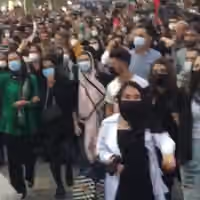
The bigger question is whether voters will support a reformist candidate. Khatami, who has tarnished his reputation by not forcefully opposing a totalitarian government, may not be able to rally support. The embarrassing silence of dozens of reformists in the parliament (2016-2020) during the deadly crackdown on the 2019 protesters further undermines their credibility. It remains to be seen if reformists can convince the new generation of voters to support them.
A still bigger question is why there aren't any younger candidates. Many named as reformist candidates are in their 70s. Is the reform front going to recognize the younger generation of Iranians? Is it aware of the fundamental change in the political narrative and rhetoric after the 2022 Woman, Life, Freedom movement?
It is uncertain if younger voters can identify themselves with politicians such as Khatami, who are still trying to walk a political tightrope with hard core of the Islamist rulers.
Ironically, the same newspaper that carried Khatami's statement ran another story that said most of the candidates in this election are older than 65, and asked: Should there be a retirement age for those interested in executive positions?