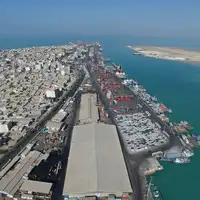
In a joint statement following a conference with Arab states in Beijing on Sunday, China outlined its position on the three disputed islands in the Persian Gulf—Greater Tunb, Lesser Tunb, and Abu Musa—suggesting that the issue should be negotiated with the UAE.
Beijing has not revised its stance, despite drawing anger from the Iranian foreign ministry on Sunday, which summoned the Chinese ambassador to protest China's "repeated support" for the UAE's "baseless claims".
State-controlled Chinese media, however, chose to highlight the robust relationship and economic ties between Beijing and Tehran, echoing the official government stance. Even slightly oppositional media outlets chose to emphasize China's strengths -- suggesting that Tehran ultimately needs Beijing.
Since the British withdrew from what is now the UAE in 1971, the three islands in the Persian Gulf have been disputed. That year, Iran's then-monarch, Mohammad Reza Shah, ordered the country's navy to occupy all three islands. Iranian forces continue to be stationed there, with only Abu Musa having a significant civilian population of several thousand.
The South China Morning Post (SCMP), a Hong Kong-based English-language newspaper, asserted on Tuesday that China's unanimity with Abu Dhabi for discussions over the disputed islands in the Persian Gulf "will not seriously harm its relationship with Iran" since “Iran cannot get away from China.”
“China has a lot of leverage over Iran as its biggest partner,” an analyst told SCMP.
On Monday, Mao Ning, spokeswoman for the Chinese foreign ministry, said that China has maintained a consistent position on the three islands issue, urging both sides to resolve their differences peacefully through dialogue and consultation.”
Yang Wei, a columnist for the Manhattan-based Epoch Times, a media company with outspoken criticism of the Chinese communist party, took a firmer stance in his article that the “CCP and Iran are using each other, and the Middle Eastern countries are fully aware of this. The CCP has no intention of solving the substantive problems in the Middle East, nor can it do so. On the contrary, it has been trying to disrupt the situation and provoke conflicts.”
According to Iranian analysts, the Islamic Republic’s foreign relations strategy is backfiring because it relies heavily on the East rather than the West.
As former Iranian diplomat Hossein Alizadeh pointed out, Iran’s close ties with China and Russia could leave the Islamic Republic vulnerable to potential pressure from these nations at a critical time.
“By limiting its foreign relations to just two countries, the Islamic Republic opens itself up to potential pressure at the most opportune time for these nations,” Alizadeh told Iran International.
Referring to the territorial friction between Taiwan and China, Alizadeh explained that Iran does not engage in a tit-for-tat strategy with China: “Iran could retaliate by recognizing Taiwan's sovereignty against China, but they won’t.” they instead “lie to the nation.”
China issued a similar joint statement in 2022 during a meeting with the leaders of the Gulf Cooperation Council (GCC).
The statement contained several clauses related directly to Iranian affairs, the Iranian nuclear program, and the UAE's claim to three Iranian islands in the Persian Gulf.
Once the joint statement was reported in the media, Iranians reacted strongly, accusing the Islamic Republic of being so weak that its ally China was subtly endorsing the UAE claim.
“At the time, Iranian Foreign Minister Hossein Amir-Abdollahian lied to people, saying they talked to their Chinese allies and they corrected themselves,” Alizadeh said.
Nevertheless, China is not the first Iranian ally to support its adversary.
In December last year, Iranian media similarly and strongly criticized Russia for endorsing the UAE's claims.