This method, widely known as ship-to-ship transfer, has been going on for a while, but Malaysian authorities don’t seem too eager to counter it.
“We conveyed to the US delegates –nicely– that when [it] comes to the issue of sanctions, our position is that we only recognize a sanction imposed by the UN Security Council,” Malaysian Home Minister, Saifuddin Nasution Ismail said in a press conference Thursday.
The minister’s diplomatic rebuke followed a similar albeit subtler message from Malaysia’s prime minister Anwar Ebrahim, who said his country was friends with ‘everyone’ but placed national interest ‘above all else.’
The US delegation had argued that ship-to-ship transfers carry environmental risks, according to Reuters, likely trying to present their request as less political and potentially more palatable for Malaysian authorities.
"Many of these shipments traverse the waters around Malaysia and are loaded onto vessels of questionable legitimacy that may also pose major environmental and safety risks," said Brian Nelson, US Treasury undersecretary for Terrorism and Financial Intelligence.
Nelson took his case to Malaysian lawmakers, who, reportedly, asked for evidence for US claims of illicit activity related to Iranian oil in Malaysian waters.
The Iranian regime had a period of revenue ‘drought’ during President Trump’s “maximum pressure”, but oil sales began growing towards the end of Trump’s term and soared after Joe Biden took office in 2020. In the past year or two, the US treasury has noticed that more money is getting to the regime in Tehran through the Malaysian financial system, Reuters reported last Friday, quoting an unnamed source.
This seems to have happened –partly at least– due to the Biden administration’s reluctance to antagonize the regime in Tehran, which seems to have made the most of its friendly relations with Malaysia in recent years.
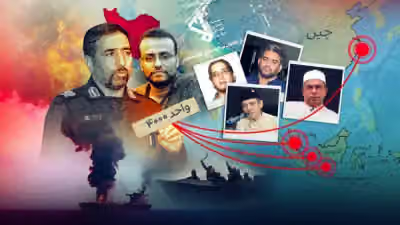
Last year, the US treasury sanctioned Iranian Hossein Hatefi Ardakani for overseeing a “transnational procurement network” spanning the Middle East and East Asia. Ardekani was accused of procuring “servo motors, inertial navigation equipment, and other items” for Iran’s drone program through front companies in Malaysia, Hong Kong, and others.
Critics of the Biden administration say abandoning Donald Trump’s “maximum pressure” policy has not only emboldened the Iranian regime to adopt a clearly more aggressive foreign (and nuclear) policy but has enabled the Revolutionary Guards (IRGC) to implement those policies with more money in their coffers.
But officials have rejected the accusations many times, stating that the administration has sanctioned “over 600 individuals and entities”.
Biden’s critics point out that sanctions are effective only if they are enforced rigorously –and across the board. Iran’s biggest trade partner and main buyer of oil is China. Many experts say it’s hard, if not impossible, for any US administration to sanction China.
The Malaysian government's response to the US Treasury delegation can be a case in point, proving that getting other countries to follow the American lead is easy no more, even when that country is infinitely smaller and weaker than China.