Iran’s FM: Crew of Seized Israel-Linked Vessel Released
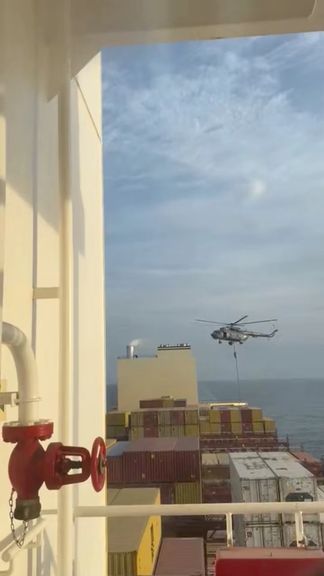
The Iranian government says it has released the crew of a seized Portuguese-flagged ship linked to Israel, though it continues to hold the vessel itself seized last month.
The Iranian government says it has released the crew of a seized Portuguese-flagged ship linked to Israel, though it continues to hold the vessel itself seized last month.
The country’s foreign minister, Hossein Amir-Abdollahian, said the crew of the Portuguese-flagged container ship MSC Aries can return to their respective home countries.
The minister claimed the release of the crew of 25 was a “humanitarian act”, while the ship itself remains under “judicial detention.”
The MSC Aries was seized by the Islamic Revolutionary Guards (IRGC) in the strategic Strait of Hormuz on April 13, shortly after Iran threatened to close the vital shipping route in retaliation for a widely-believed Israeli airstrike on its purported consulate in Damascus.
According to Amir-Abdollahian, the vessel was detained because it "turned off its radar in Iran's territorial waters and jeopardized the security of navigation," the foreign ministry explained in a statement posted on X late Thursday night.
The regime has seized several vessels since 2019 in what some say is a way for Tehran to show its naval might – and to keep pressure on different governments.
The foreign ministry previously cited "violations of maritime laws" as the reason for the Aries' seizure and emphasized its links to Israel. The MSC leases the Aries from Gortal Shipping, an affiliate of Zodiac Maritime, partially owned by Israeli businessman Eyal Ofer.
The seize of the vessel is part of a broader pattern of maritime disruptions, including recent attacks on merchant shipping in the Red Sea and the Gulf of Aden by Yemen’s Iran-backed Houthi rebels.
The attacks, which were reportedly conducted in solidarity with Palestinians amidst Israel's war on Hamas in Gaza, are contributing to significant perturbations in global shipping operations.






British billionaire and Virgin Group founder Richard Branson is adding his voice to high-profile figures condemning the death sentence handed down to Iranian dissident rapper Toomaj Salehi.
In a statement on the Virgin website, Branson expressed support for human rights activists advocating for Salehi’s release and the freedom of all prisoners in Iran.
"Toomaj and so many others must be freed," Branson wrote, emphasizing the importance of artistic freedom, stating that "open artistic expression should be welcomed and celebrated; it gives us opportunities to contemplate, reflect and debate. And it should never be persecuted – in Iran or elsewhere."
Salehi, one of Iran's most prominent rappers and a vocal and long-time critic of the regime, was sentenced to death last week by a non-independent Islamic Revolutionary Court under the charge of "corruption on earth."
The government’s intelligence ministry, which usually takes charge of sentencing dissidents, has historically exploited the vague term to target and silence them.
Salehi's years-long dissent took center stage during the nationwide 2022 anti-regime protests, where his outspokenness positioned him as one of the most prominent icons. For years, his music has resonated with many, particularly the youth who feel oppressed and silenced by the ruling authorities.
Branson’s statement also highlighted the ongoing human rights abuses in Iran, including the recent revelation that Nika Shakarami, a 16-year-old protester, was sexually assaulted and killed by Iranian security forces, contrary to official claims of her suicide.
The billionaire condemned the Iranian regime's continued violence and suppression, emphasizing the devastating impact on the nation's populace.
Branson's commentary also sheds light on the continued use of executions in Iran as a means to stifle dissent – with authorities having executed at least 853 people in 2023, many of whom were non-violent offenders or protesters.
Since the Mahsa protests, Iran's courts have prosecuted dozens of individuals, issuing harsh sentences for alleged leadership of protests and labor strikes, without any basis in existing laws.
Iranian authorities and state media invariably refer to anti-government protests as “riots”, so the accused are always dubbed as “leader of riots” or “leader of strikes”.
Informed sources in Iran say those who are accused of “leadership of riots” are usually held incommunicado for long periods in solitary confinement and are deprived of the right to have legal counsel or phone calls to their families.
In most cases, the accusation of leadership is based solely on participation in anti-government protests, lacking concrete evidence of any unlawful organized activity. Often, the only evidence presented is social media posts calling for peaceful protests on platforms like Instagram.
Earlier this week the BBC published a report about teenage protester Nika Shakarami. The report confirmed allegations that the she was molested by security forces during her arrest and was killed by them.
The report relies on a leaked document purportedly authored by security agents. This document referenced suspicions of the teenage girl being a "leader" of the protests. According to the leaked document cited by the BBC, the arresting team deployed one of its operatives disguised as a protester to confirm Nika's alleged leadership role within the demonstration.
A report by the IRGC-linked Fars News Agency in October 2023, for instance, claimed that journalist Elaheh Mohammadi had “confessed to leadership of street riots”. Fars has close ties with security bodies and access to court documents unavailable to other media.
Mohammadi who was arrested a few days after the protests began in September 2022 for her role in reporting on Mahsa Amini’s death in the custody of the morality police, was accused of collaboration with foreign services including the CIA and “anti-revolutionaries”.
Fars published a wiretapped conversation, acquired from security bodies, between Mohammadi and a friend. In the conversation, Mohammadi mentioned encouraging people to chant "Woman, Life, Freedom" during a protest and discussed making calls to protest with other activists. However, there was no indication of any incitement to riot or engage in armed activity.
“Participation in peaceful protests is not a crime and therefore being a leader in peaceful protests is also not a crime,” Musa Barzin, a Turkey-based human rights lawyer, told Iran International.
Arshia Takdastan, an 18-year-old protester from Nowshahr in northern Iran who was sentenced to death for “war against God” and “corruption on earth” was also dubbed as a “leader of riots” by another IRGC-linked news agency.
Authorities alleged that Takdastan and two others, Javad Rouhi and Mehdi Mohammadifard, had acted as “leaders” and “incited riots” by dancing, clapping, chanting slogans, and burning headscarves of the female protesters for them. The three young men were all sentenced to death. “The activities [of the accused] resulted in the gathering of about 3,000 people” at a protest rally at one of the squares of the city, the court ruling in Takdastan’s case said.
Rouhi who had been subjected to extensive physical and psychological tortures died in suspicious circumstances in prison in August 2023. His lawyer maintained that Rouhi had only danced at a protest gathering and burned the headscarves of some female protesters for them and had no role in organizing protesters.
Any contact with foreign-based Persian language media such as Iran International has also been cited as evidence of being “leader of riots”.
In January 2023, the Public and Revolutionary Prosecutor of Tehran Ali Salehi said one of the “leaders of riots”, a member of the underground United Youth of Iran (UYI), had confessed to “continuous contact” with Iran International TV and foreign intelligence services and alleged that he had been paid money in the form of cryptocurrency to incite riots. The name of the accused was not mentioned and there has been no further reference to the case.
“Leadership” of labor strikes is also considered a crime. “Eight leaders who had a direct role in organizing labor strikes in South Pars and Asalouyeh [gas fields] through social media and their activities have been arrested,” Akbar Pourat, the political-security deputy governor of Bushehr Province, told the media on May 14, 2023.
Iranian authorities claim they have been able to identify “leaders” of protests even outside Iran by conducting extensive surveillance of expatriate Iranians’ rallies in various countries.
Unlike charges of “corruption on earth”, “war against God” and “propaganda against the Islamic government” which have been brought against numerous political prisoners and have clear definitions in the Islamic Penal Code of Iran, there is no reference to “leadership of riots” in the laws.
“Judicial authorities use this vague term to make the crimes allegedly committed by the accused look weighty and significant so they can meet out heavier sentences to them,” Barzin said.
“The term ‘leader of riots’ entered the jargon of courts from security bodies’ reports and is now being routinely used in the rulings of Revolutionary Courts across the country,” he added.
The use of terms like "leader of riots" and "leader of strikes" by Revolutionary Courts was uncommon before the anti-government protests of December 2017-January 2018. These courts were established after the Islamic Revolution of 1979 to handle political, security-related cases, blasphemy, as well as other crimes like drug trafficking and large-scale financial corruption.
On November 30, 2019, the head of the Justice Department of Lorestan Province, Mohammad Razm, told the media that those arrested in the protests were divided into “leaders” as well as, disruptors of public order and those with possible connections with foreign intelligence services. “Severe legal punishments is awaiting the leaders of recent riots,” he said.
US lawmakers Elizabeth Warren (D-Mass.) and Angus King (I-Maine) urged the Biden administration on Wednesday to disclose its strategy for addressing concerns regarding Iran's Bitcoin mining operations, citing potential national security risks.
US lawmakers Elizabeth Warren (D-Mass.) and Angus King (I-Maine) urged the Biden administration on Wednesday to disclose its strategy for addressing concerns regarding Iran's Bitcoin mining operations, citing potential national security risks.
In their letter addressed to Defense Secretary Lloyd Austin, Treasury Secretary Janet Yellen, and National Security Advisor Jake Sullivan, senators requested information about Iran's crypto mining operations since 2021, including details on how the Iranian government has benefited.
Warren and King emphasized that crypto mining, which involves verifying crypto transactions and generating new tokens, has become increasingly "lucrative" for Iran, despite numerous international sanctions imposed on the country due to its nuclear program.
The first study to estimate Iran's potential profits from evading sanctions via cryptocurrency was published in 2021. At the time, Reuters reported that Iran's bitcoin production would generate revenues close to $1 billion a year, which was echoed in the letter.
"One estimate indicates that Iranian Bitcoin mining could have produced as much as $1 billion in revenue in 2021," the letter said, pointing to Bitcoin mining reportedly generating more than $186 million for Iranian crypto platforms between 2015 and 2021, with Tehran being one of the top eight Bitcoin-producing countries at the time, the lawmakers said.
The senators stated that crypto miners in Iran are required to sell their products to the Iranian central bank, which, in turn, enables the Iranian government to evade sanctions.
As experts have often said, the Iranian government has a self-inflicted “muddled relationship with crypto-currencies”, which have served to obscure various forms of trade, aiding in evading sanctions, while simultaneously presenting avenues for illicit activities.
In 2022, the state’s Intelligence Ministry claimed they blocked over 9,000 accounts belonging to 454 individuals used for illegal or undeclared exchanges of currency and digital currency. Based on the exchange rate during that period, the relevant trades amounted to 600,000 billion rials or approximately $2 billion.
Reports in Iranian media suggest that large-scale crypto mining has been taking place by influential or well-connected networks, as well as some Chinese companies that are using cheap and subsidized electricity in mining farms they set up in Iran. This could have been permitted only by Iran's intelligence services and the Revolutionary Guard.
The senators' warning about Iran's use of crypto mining coincides with the Treasury Department's request to Congress in April, urging lawmakers to pass new legislation authorizing the department to intervene in terrorist financing and sanctions evasion methods that utilize cryptocurrency. As part of that Senate hearing session, it was also revealed that the Islamic Revolutionary Guards (IRGC) has been using cryptocurrency to fund Hamas and the Islamic Jihad of Palestine.
The letter from Warren and King also mentions the benefit that Iran's proxies are gaining from this low-profile trade.
"The Iranian military has used crypto to fund known terrorist groups like Hezbollah, the organization believed to be partially responsible for the January 2024 drone strike in Jordan that killed three US service members," officials said. "Unless we take action, Iran will continue to use crypto to fund attacks against Israel."
In their letter, Warren and King asked the officials to "describe the steps the administration is taking to address threats to US national security posed by Iran’s reliance on crypto mining and cryptocurrency more generally to earn revenue and bypass sanctions."
Furthermore, the senators inquire about the Binance fiasco. In 2022, it was reported that the cryptocurrency giant Binance had processed Iranian transactions worth $8 billion since 2018 – despite US sanctions intended to isolate the country from the global financial system.
The founder and former CEO of cryptocurrency exchange Binance was sentenced to four months in prison this week for violating US money laundering law and failing to comply with sanctions against Iran.
Over the course of two weeks, from April 16 to April 30, the Iranian government executed 63 individuals, averaging one execution every five hours, continuing a trend that began last year.
The data presented by the Iran Human Rights Organization (IHRNGO), headquartered in Norway, highlights a broader pattern of capital punishment in Iran.
Since the beginning of 2024, 171 people have been executed across various prisons in the country.
Mahmood Amiry-Moghaddam, the director of IHRNGO, criticized the international community's silence on the issue, stating, "In the last two weeks, the Islamic Republic has executed one person every five hours without any political cost. States that adhere to human rights and have diplomatic relations with Iran must react to the wave of executions in Iran. Silence paves the way for more executions."
The organization's latest figures indicate that at least 71 people were executed in 24 different Iranian prisons during April alone, with 63 of the executions occurring in the latter half of the month. Out of these, 44 were executed for drug-related offenses, 26 faced 'qisas' (retribution-in-kind) for murder, and one for rape.
The surge in executions follows the onset of the Woman, Life, Freedom protests in 2022, after which the Iranian government has significantly increased the pace of carrying out death penalties. In 2023 alone, the country saw at least 834 executions.
An April press release from 82 Iranian and international human rights organizations pointed out that over half of the executions in 2023 involved individuals arrested on drug-related charges. The statement emphasized the low cost of the drug-related executions to the government, signaling a potentially punitive approach towards non-violent offenses.
Iran is one of the world's largest jailers of journalists, cementing itself as one of the most repressive countries for press freedom, according to the 2024 World Press Freedom Index released by Reporters Without Borders (RSF).
The Islamic Republic’s targeted repression of journalists has led to the country's dismal ranking in the RSF Index, placing it 176th out of 180 countries assessed.
Since nationwide anti-regime protests began in 2022, “Iran has reinforced its position as one of the world’s most repressive countries in terms of press freedom,” RSF said.
The regime’s crackdown killed at least 550 and saw the arrest of tens of thousands, including scores of journalists, leading Iran to previously be ranked as the one of the world’s worst jailer of journalists in CPJ’s 2022 prison census.
“Iran – with its mass imprisonment policy – holds on to its extremely low ranking,” the report says.
Since 2002, the Islamic Republic's suppression of dissent has consistently placed the country in the bottom 15 countries on the RSF Index.
“The Islamic Republic continues to exact its revenge against journalists who, since 16 September 2022, have fulfilled their duties in serving the public’s right to news and information,” said the head of RSF’s Middle East desk Jonathan Dagher in 2023.
Today’s RSF ranking places the country below China, and just ahead of North Korea, Afghanistan, Syria and Eritrea.
On the global scale, the RSF report highlights a trend of escalating political attacks on press freedom over the past year, with the Maghreb-Middle East Region having the “worst situation for press freedom.”
Four of the world’s 10 biggest jailers of journalists are in the Middle East. Alongside Iran (176), Israel (100), Saudi Arabia (166) and Syria (179) have perpetuated the detainment and harassment of journalists, contributing to a climate of fear and censorship, the report said.
Iranian Journalists Face Censorship, Suppression
Between 2023 and 2024, there were at least 226 cases of journalists and media in Iran facing suppression by authorities, through detention, trial, legal summons, or legal action, according to a separate annual report by the US-based Midpoint Journalism School.
Suppression methods also involved violent physical encounters such as torture, flogging, shooting, attacking journalists' homes, and detaining family members, particularly in provinces outside Tehran.
The journalism hub, which offers educational resources and courses for aspiring young journalists, also publishes reports focusing on the plight and status of journalists in Iran.
The actual number of cases is likely higher, the report notes, as many instances remain concealed or unreported due to security threats by authorities.
In addition, the media school said that censorship patterns by Iranian authorities have shifted, with security institutions employing newer methods to prevent the free flow of information and manage news content before publication.
Though Tehran saw significant suppression of journalists, the expansion of websites and news channels in provinces has led to increased pressure on journalists outside the capital.
Media coverage of the regime's crackdown on women who refuse to wear mandated hijabs, criticism of the Iranian leadership and government agencies, as well as the disclosure of corruption among officials, constituted the main targets of censorship by Iranian security institutions. Reporting on poverty and suicide were also key subjects subjected to censorship by authorities.