Anti-Regime Sentiments Echo Through Iran's Fire Festival
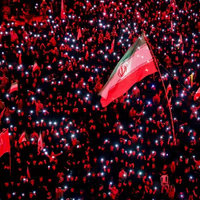
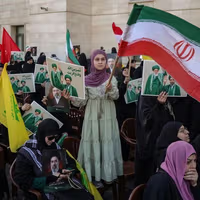
Iranians light fireworks during the Wednesday Fire celebration (Chaharshanbeh Suri in Persian) at a park in Tehran, Iran March 12, 2024.
Iran's annual fire festival, Chaharshanbeh Suri (Charshanbeh Souri), reverberated with chants against the regime in solidarity with the nationwide uprising with multiple deaths amid gatherings.
Celebrated on the eve of the last Wednesday of the year, Chaharshanbeh Suri holds ancient Zoroastrian roots and marks the first festivity of Nowruz, the Iranian New Year.
Despite the festival's traditional origins, this year's event took under a political tone as citizens expressed their discontent with the government. The streets echoed with cries for freedom and support for the ongoing uprising across the country.
The high turnout at the festival ceremonies was accompanied by incidents and accidents. Babak Yektaparast, spokesman for the National Emergency Organization, reported that 15 people lost their lives in incidents related to the festival in recent days, indicating a 20 percent decrease compared to the previous year.
Images and videos captured by Iran International revealed the festival's transformation into a platform for dissent, with many Iranians seizing the opportunity to voice their grievances against the government. Families of those lost in the nationwide uprising also used the occasion to honor the victims of the Women, Life, Freedom movement, sharing their stories through photos and videos.
One citizen reported a symbolic act of protest: the burning of an image of Ayatollah Khomeini, the founder of the Islamic Republic, during the festival.
Throughout the festivities, slogans like "Freedom, freedom, freedom!" in Rasht and "Woman, Life, Freedom" in Tehran resounded, serving as powerful expressions of resistance against the policies of the Islamic Republic.
Videos from the event showcased citizens defiantly dancing and removing their hijabs, a symbol of the uprising which began in 2022 in the wake of the death of Mahsa Amini.
A large Iranian drone named Kaman on display in a parade, in April 2022
Iran has increased arms exports four to five times in the past two years, Minister of Defense Mohammad-Reza Ashtiani was quoted as saying by media in Tehran on Wednesday.
“Certainly, in the future, these exports will increase even more, considering the innovations being made and the new armaments we are pursuing and unveiling,” Ashtiani was quoted as saying by ILNA news website.
A UN Security Council embargo on Iran’s conventional arms trade expired in October 2020, when the United States failed to garner support to extend the restrictions, amid the Trump administration’s “maximum pressure” campaign against Tehran. European allies were not supportive of the administration’s Iran policies, while Russia and China were firmly siding with their ally.
Having been under various Western and UN sanctions for 45 years, the Islamic Republic has developed a domestic arms industry, which has achieved relatively low-tech successes, particularly in the realm of missiles and drones.
Iran's defense minister Mohammad-Reza Ahtiani
Ashtiani boasted that “In the realm of defense capability worldwide, we hold a special position due to reaching a stage in indigenous production where we have manufactured the necessary equipment for our armed forces internally. This has led to our defense capability and the result of which is the national security of our country, with the format of this equipment being in the stage of exports.”
Since mid-2022, Iran has provided hundreds of Shahed Kamikaze drones to Russia that have been used against civilian targets and infrastructure in Ukraine. The drones have also helped swarm Ukrainian air defenses during large-scale Russian missile attacks on cities. Iran still denies supplying the drones, although many parts and downed UAVs have been recovered.
The West is now concerned over emerging signs that Tehran might supply long-range missiles to Russia, which is running low on its own stocks after more than two years of large-scale attacks on targets in Ukraine. European Union leaders are ready to respondwith new and significant measures against Iran amid reports that Tehran may transfer ballistic missiles to Russia for use against Ukraine.
"The European Council calls on third parties to immediately cease providing material support to Russia's war of aggression against Ukraine," said the draft conclusions of a summit to be held next week, Reuters reported this week.
Ukrainian police firing at Iranian Shahed kamikaze drones in Kiev, in October 2022
It is not clear to what extent the Biden administration is concerned about the latest reports of Iran’s missile supplies to Ukraine, as it stands to renew billions of dollars’ worth of sanctions waiversfor Iran, which can partly alleviate Tehran’s lack of financial resources to boost its weapons development.
The danger Iranian weapons pose is not limited to supplying Russia, but most of its production ends up in the hands of rogue forces, such as the Houthi rebels in Yemen. Since November, using an array of Iranian missiles and drones the Houthis have wreaked havoc on international shipping in the Red Sea region, prompting the US and the UK to launch air strikes against targets in Yemen.
Multilateral arms embargos against Iran began in 2006, when the UN Security Council restricted on the export of technology related to nuclear delivery systems to Iran. In 2007, the Council added an embargo on arms exports to Iran, followed by a UN embargo on the sales of major conventional weapons.
These embargos were later wrapped into UNSC Resolution2231 that formalized the 2015 JCPOA nuclear deal with Iran. The agreement set October 2020 for the sunset clause to the conventional weapons embargo, and October 2023 for restrictions to the transfer of goods and technology that could contribute to the development of nuclear weapons delivery systems.
In the wake of the United Nations Fact-Finding Mission’s (FFM) report on human rights violations in Iran, the Human Rights Headquarters of the Judiciary dismissed the charges.
The headquarters instead issued a statement, reiterating accusations against independent media outlets and rejecting charges of pressuring foreign journalists.
However, the Human Rights Headquarters accuses Iran International of inciting “violence” during the 2022 uprising, alleging the outlet provided instructions for making “weapons and bombs” and encouraged attacks on “police and government facilities.”
This comes as the fact-finding mission’s report detailed instances where the Iranian government summoned, threatened, and even arrested family members of journalists to silence reporting on Iran. However, the judiciary dismissed them as “allegations” and accused the committee of “covering up” the "violent content promoted by Iran International and BBC Persian networks."
In its statement, the Human Rights Headquarters repeated Iran's stance on the nature of the protests, rejecting the characterization of the uprising as peaceful and alleging involvement of "rioters" in “terrorist acts”.
Justice for Iran (JFI), a London-based human rights NGO, released a report on March 6 saying Iran deployed special combat forces to suppress protests in 2022, resulting in "crimes against humanity." The report detailed the involvement of 20 military units and 526 individuals in the suppression efforts.
Additionally, the Oslo-based Iran Human Rights Organization reported in September that at least 551 protesters, including 68 children and 49 women, were killed during the Women, Life, Freedom movement.
In the year following the uprising, Reporters Without Borders claimed that Iran had arrested 79 journalists amid mass crackdowns on voices of dissent.
Iranian activist Masih Alinejad warned of a surge in global authoritarianism and the decline of democracy with two thirds of the world living under autocratic regimes.
In a Tuesday press conference with the World Liberty Congress, the dissident now living in exile, said the group, made up of dissidents from 56 autocratic regimes, are calling "to sound the alarm on what we see as a rising tide of authoritarianism across the globe."
Alinejad highlighted the concerning state of democracy worldwide, noting, "Democracy is in recession. More than two thirds of the world’s population live under autocratic regimes." The organization called for an end to political detention and dictatorship, emphasizing the need for legitimate choice in elections.
Alinejad also addressed the recent killing of prominent Russian opposition figure Alexei Navalny, underscoring the heightened danger faced by political prisoners worldwide. "The killing of Alexei Navalny has shown that none of us is safe. Political prisoners’ lives are in more danger than ever since the end of the Cold War," Alinejad remarked.
More than brutal suppression at home, Alinejad, who has been the target of multiple assassination attempts by Iran's security forces abroad, said, "The world’s dictators don’t just repress dissidents internally - they are now murdering on foreign soil, to push the boundaries of what the international community will accept".
In addition to Alinejad's remarks, Garry Kasparov, a vocal critic of the Kremlin and former world chess champion, also part of the World Liberty Congress, urged for a stronger Western response to Moscow's aggression in Ukraine.
"We’re here today to call for an end for political detention, and an end to dictatorship," Alinejad said. Referencing the recent elections in Iran in which turnout was at a record low, she added, "This year, 2 billion people will vote, but 500 million won't have a free choice. “Elections” in countries including Russia and Iran, are nothing of the kind. We demand legitimate choice for all."
People walk in the Tajrish Bazaar during the month of Ramadan in Tehran, Iran, March 11, 2024.
Authorities in Iran are relaxing Ramadan regulations this year as it coincides with the ancient and revered Persian New Year holidays – allowing restaurants to stay open.
Restaurants and eateries, in the already struggling hospitality sector, will be allowed to maintain their usual operating hours to serve customers, the country’s police said.
However, there's a caveat: they must cover their windows to shield the interior from the view of fasting passersby.
The pre-Islamic Persian New Year or Nowruz has been celebrated in Iran for at least 2,500 years, marking the first day of Spring.
Women in the southern port city of Bushehr welcome Nowruz with song and dance.
The lunar Islamic year is shorter than the official solar calendar year, so this year, Ramadan, a month of fasting and reflection for Muslims, begins on March 11th in Iran, just nine days before Nowruz.
The last time these two occasions coincided was in the early 1990s.
While the exact rationale behind the authorities' decision to ease the rules remains uncertain, it comes at a time of unprecedented and widespread discontent with the country's religious regime.
Punitive Ramadan Rules Remain
Despite this year’s ease in regulations, Iranians, including those exempt from fasting, are required to abstain from eating, drinking, and smoking in public, even if they are inside their cars.
Implemented about 12 years after the 1979 Islamic Revolution, Article 638 of the country’s Islamic Penal Code exacts a punishment of 10 to 60 days or up to 74 lashes on those who violate Ramadan fasting regulations. This applies to everyone irrespective of their religion.
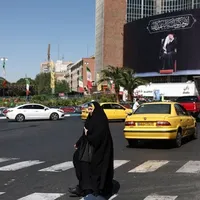
A woman shops during the fasting month of Ramadan in Tehran, Iran, March 11, 2024.
During Ramadan, eateries, including restaurants, cafes, and street food vendors, have typically been prohibited from serving customers from dawn to sunset, aligning with the fasting hours. This restriction has confined business hours to evenings exclusively – though in recent years, some establishments were allowed to provide cold food options or takeaway services during fasting hours.
In addition to the hospitality industry, Ramadan restrictions have a direct or indirect impact on various businesses including cinemas, concert halls, and beauty salons.
Some restaurants along the roads were permitted to remain open due to exemptions outlined in the country's Shia rules. These exemptions apply to individuals traveling approximately 45 kilometers away from home and intending to return within ten days, as well as to frequent travelers such as drivers, who are exempt from fasting.
Widespread Discontent, Economic Turmoil ?
At least 60 percent of eligible Iranian voters displayed their discontent with the regime and loss of hope in the government’s ability to improve their livelihoods when they boycotted the dual March 1st elections for Parliament and the Assembly of Experts.
Adding to that, the escalating depreciation of the national currency, soaring inflation reaching almost 50%, and discontent over social restrictions like hijab enforcement – the police seem to have eased their typically stringent Ramadan measures to prevent further unrest.
The hospitality and tourism sectors, along with various other industries, are grappling with the impact of high inflation, with little hope for improvement in the foreseeable future. Implementing stricter measures during their peak season could significantly disrupt their operations and profitability, at one of the busiest times of the year.
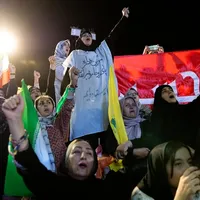
People celebrating Charshanbeh Souri in Tehran (March 12, 2024)
Nowruz Tradition Defies Hardliner Resistance
Religious hardliners in the Islamic Republic consider Nowruz and other ancient festivals pagan and favor the Islamic calendar and its holidays, but have not succeeded in changing Iran's ancient calendar to an Islamic one, so far.
Most Iranians – even those with strong Muslim beliefs – celebrate and cherish Nowruz and other pre-Islamic festivals such as Yalda which marks the Winter Solstice and Charshanbeh Souri bonfire night on the last Tuesday of the year as well as Islamic occasions such as the birthdays of the Prophet Muhammed and Shia imams.
The popularity of Nowruz among Iranians is so profound, that even the country’s ruler, Supreme Leader Ali Khamenei makes an annual live speech immediately after the Spring Equinox – a moment precisely calculated by astronomers.
Though, notably, Khamenei used last year’s remarks to claim that the recent anti-regime protests that swept Iran were part of a global conspiracy aimed at weakening the Islamic Republic.
A session of the Iranian parliament on March 10, 2024
Less than two weeks after the lackluster elections in Iran, hardliners who have claimed victory find themselves embroiled in a contentious battle over the speakership of the parliament.
The struggle for this coveted position commenced months prior to the next parliament's convening. Meanwhile, due to the remarkably low turnout in the capital, more than half of the lawmakers representing Tehran are yet to be determined in April, as many candidates failed to secure at least 20 percent of the total votes in the city.
Amidst this lull, several politicians are fiercely vying for the opportunity to occupy the prestigious Speaker's green seat. Among the most ardent contenders is the incumbent Speaker, Mohammad Bagher Ghalibaf, who perceives his presence in the Majles (parliament) as inconsequential unless he assumes the role of Speaker.
Supreme Leader Ali Khamenei has at least twice warned the winners of the election to avoid controversies and attacks on each other. However, with his influence waning, the power struggle persists both within and outside the parliament. It appears that he has relinquished the idea of intervening in the matter, once being the ultimate authority on all issues. While he continues to express his viewpoints, there seems to be a lack of receptiveness from others to heed his counsel.
However, Some media outlets in Iran contend that a last-minute intervention, often referred to as "blessings in disguise," by Khamenei could aid Ghalibaf in retaining his position. Despite experiencing a significant decline in popularity among voters, with his 2024 vote count dropping to around 400,000 compared to over 1.2 million in 2020, Ghalibaf may still benefit from Khamenei's support. This perspective is underscored by his staunch political rival, the fundamentalist Hamid Rasaei.
A session of the Iranian parliament on March 10, 2024
Other contenders for the position include ultraconservative Mahmoud Nabavian, a member of the Paydari Party and a prominent anti-US figure, who garnered the highest number of votes. Additionally, there's Morteza Agha-Tehrani, another influential member of Paydari. Former Foreign Minister Manouchehr Mottaki is also in the running, speculated by the press to capitalize on the rivalry among ultraconservatives.
Leading up to the election, Ghalibaf faced a significant smear campaign from his rivals, aided by conservative propagandist Ali-Akbar Raefipour, who reintroduced Rasaei to the political arena after four years of isolation. Meanwhile, Ghalibaf finds himself with minimal support in the new parliament, as all his aides must participate in the run-off election before they can exert any influence.
Ghalibaf is expected to vie for the Speaker position without relinquishing all other positions at the presidium of the parliament to Paydari, as he did in the previous Parliament. However, Paydari's influence and astuteness have increased since 2020. Ghalibaf's prospects for this position rely heavily on whether Khamenei, as both a relative and an old ally, is capable and willing to support him. In the meantime, while Rasaei spent Saturday lobbying at the parliament, some of the new members of the Majles appear to be adamant to reject his credentials when the new legislature convenes. In short, the hardline winners have never been as divided as they are now.
Conservative newspapers including Khorasan, Farhikhtegan and Kayhan, joined the IRGC-linked Javan daily to attack Rasaei, but he is still defiant and continues campaigning against Ghalibaf alongside his fundamentalist patrons.
The conflict, at the same time, reveals younger politicians' competition with the old guard. Relatively younger MPs such as Rasaei wish to bring about a change in the government's rigid structure and to open their way to financial resources and political power. That is unlikely to happen unless Khamenei chooses to allow them access to power.
Many in Iran await his traditional [Iranian] New Year address on March 20 to look for a change and a roadmap out of the current and other long-standing crises.
In a commentary in Etemad newspaper and his own Telegram channel, veteran reformist commentator Emadeddin Baghi pointed out that "the low turnout in the recent election had a clear message for Iranian officials [including Khamenei], which has not been taken seriously by them. Ignoring that message will have fateful and punishing repercussions."