Senior Lawmaker Reports Major Violations In Iran's Elections
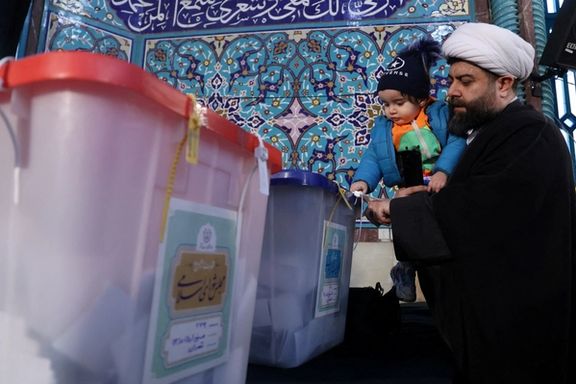
An outgoing Iranian lawmaker said on Saturday that major violations have affected the results of the parliamentary elections held on Friday.

An outgoing Iranian lawmaker said on Saturday that major violations have affected the results of the parliamentary elections held on Friday.
After losing the election in the constituency of Kerman and Ravar, Mohammad-Reza Pour-Ebrahimi stated that “buying and selling votes, giving massive gifts and conducting unlawful campaigns” as some of the widespread violations.
He called on the Guardian Council to carry out an immediate and thorough investigation of the irregularities.
Pour-Ebrahimi is the head of the outgoing Iranian Parliament’s Economic Commission and is considered an influential lawmaker. He has represented Kerman and Ravar in parliament for three consecutive terms.
What some candidates committed definitely affected the results in the constituency, he added in his statement.
Iran’s parliamentary and the Assembly of Experts elections were held simultaneously on Friday, an event which was met with a massive boycott by the public, the opposition and civil and political activists.
Iranian regime media, including IRNA and the IRGC-affiliated Fars news website, claim a voter turnout of more than 40%. However, social media accounts offer a contrasting narrative through videos and images, indicating a much more lackluster participation.
Over the past days, the regime drastically stepped up its measures to lure the unwilling citizens to vote.
In one instance, Iran's infamous police chief Ahmad-Reza Radan said that the soldiers serving in the police force will be granted four days of leave in exchange for participating in the elections.
Iran’s security and intelligence institutions had also mounted pressure to prevent boycott campaigns.
Some activists reported that they received threatening text messages from Iran’s judiciary over launching or supporting boycott campaigns on their social media pages.


While Houthi attacks on shipping have halved grain transit through the Suez Canal, grain ships bound for Iran navigate the Red Sea untroubled, commodities experts say.
Apart from those headed to Iran, grain ships originating from the Black Sea are about the only ones still using the route.
Iran-backed Houthis have effectively closed the Red Sea with their missile and drone strikes on commercial vessels. They maintain that they act in support of Palestinians and target only ships that are somehow related to Israel or its main supporters, US and Britain. But very few transport companies are willing to risk it.
“Just about all (dry bulk grain) vessels going from the Americas and western Europe are avoiding the Red Sea,” according to Reuters. “The only exception is vessels going to Iran, they’re still taking the Red Sea route when shorter.”
The clerical regime in Iran has been the Houthis’ primary supporter for several years now, funding, arming and training their forces and helping the group gain and retain control of large parts of Yemen in the face of a much stronger military alliance led by Saudi Arabia.
Last November, the Houthis began targeting ships in the Red Sea, in what they have always stated to be a response to Israel’s onslaught on Gaza, and claiming that it would end if there were to be a ceasefire in Gaza. However, the attacks began in mid-November after Iran's ruler Ali Khamenei called on Muslims to blockade Israel.
Houthis have disrupted global maritime trade, forcing major operators to re-route and go around the southern tip of Africa, which has increased shipping costs and consequently the price of many consumer goods.
Iranian officials hail the Houthis’ “bravery” but insist that the group is operationally independent. However, a report in Asharq al-Awsat Friday suggested that Iran’s Revolutionary Guard (IRGC) has a dedicated unit directing attacks in the Red Sea.
Quoting an unnamed Yemeni military source. Asharq al-Awsat reported that IRGC and Hezbollah forces “oversee every aspect of the military and political activities of the Houthis,” which includes “assembling missiles and drones, preparing unmanned boats and submarines, and even controlling the release of military information and videos.”
The report confirms a US military assessment two weeks ago that the IRGC has forces “on the ground” in Yemen “serving side by side” by the Houthis.
Shortly after the Houthis started their operations, the United States and some of its allies dispatched warships to the Red Sea to protect commercial vessels. More recently, the US and Britain have been striking Houthi sites inside Yemen, calling it “defensive action” aimed at “degrading” the group’s capabilities.
The strikes seemed to be a success when Houthi attacks ceased for two weeks in February. Later in the month, however, attacks resumed –and with marked increase in intensity.
“It is pretty obvious that the Houthi attacks cannot be stopped easily by military means,” Reuters quoted one grain trader exporting cargoes from Europe. “Many ship owners are still willing to accept the danger to their ships and vessels... Chinese purchases of Ukrainian corn recently are expected to transit the Red Sea.”
President Biden admitted that he didn’t think the airstrikes he authorized could end the Houthi attack, who, undeterred, have threatened to “surprise” the “enemy.”
Biden critics say his administration is to blame for emboldening the Houthis’ and –perhaps more importantly– Iran.
“Iran’s proxies are being emboldened and enriched by the Biden Administration’s appeasement first foreign policy,” Senator Pete Rickets (R-Ne) said in a Senate Committee for Foreign Relations hearing Thursday . “It’s a threat to American national security. More money in Iran’s coffers means more money in the hands of their proxies.”
Senators from both parties seemed to agree with witnesses in the hearing (titled Tehran’s Shadow Army) that existing sanctions on Iran, especially oil sanctions, need to be enforced with determination after a few years of loose (or non-) enforcement –which patently failed to entice the Iranian regime to cede some grounds in its nuclear program.

A recent report has unveiled that almost one in every three Iranians is currently living below the poverty line as a result of very high inflation in the past five years.
The poverty line signifies the minimum income level necessary to sustain an ordinary life, encompassing the total expenditure on essential resources for an average adult over the span of a year. In Iran the minimum monthly income for a family of 3 for basic food and needs is estimated to be around $400.
Highlighting the situation, a report from Eqtesad 24 elaborated on the poverty conditions prevailing in Iranian society. It projected a concerning escalation in poverty rates, foreseeing that by the end of the year 1402 [March 20], “the proportion of individuals below the poverty line could soar to 37 to 40 percent.”
The forecast attributes the surge to the combination of soaring inflation rates and stagnant wages, exacerbating the financial strain faced by many Iranians.
The pervasive poverty has profound implications for Iranians, with a significant portion struggling to afford basic necessities. Compounded by persistently high inflation rates, where the country has endured inflation levels exceeding 40 percent for five consecutive years, the purchasing power of salary earners has been eroded. Despite promises from Islamic Republic authorities to curb inflation, such commitments have often fallen short, echoing past instances of unfulfilled pledges.
The repercussions of escalating poverty are evident in the daily lives of Iranians. The majority of Iranians find themselves unable to afford even basic food items like meat, fruits, and vegetables, with consumption witnessing a decline.

Iran's Cyber-Police (FATA) has warned about a “critical vulnerability” recently discovered in an office automation system used by important public, private and educational institutions in the country.
In a text message FATA police asked online businesses to “act with urgency” to disconnect the Chargoon software from the Internet.
However, no further official details have been released on how the vulnerability has been identified or how it can affect organizations using the automation system.
Publishing an image of the correspondence page of the Chargoon system, a hacktivist group called APT IRAN claimed it infiltrated the software.
The group had previously claimed to have infiltrated other organizations in Iran, including Irancell, one of the two top mobile operators in the country.
In addition to the FATA police, other government agencies have issued similar warnings about the Chargoon automation system.
Kharazmi University, one of Iran’s high-ranking academic institutions, announced that the Chargoon software will no longer be available to users outside the campus. The decision was made with regard to “certain security considerations” and “upstream instructions.”
Charoon lists as its official clients various government institutions, including Iran’s ministries of Sport and Youth, Culture and Islamic Guidance, Health, Roads and Urban Development, and Energy, as well as National Tax Administration and General Inspection Office.
Last month, Amin Sabeti, a cybersecurity specialist, told Iran International that the Iranian regime will continue facing increasing cyberattacks due to “structural defects” in their cyber defense systems.
On February 13, a cyberattack targeted over 600 Iranian government servers, including the Iranian parliament’s media arm. The attack claimed by the hacktivist group Uprising till Overthrow, closely linked with the Albania-based opposition Mujahideen-e Khalq (MEK) organization.
Another cyberattack paralyzed gas stations in Iran in December. Tehran accused Israel of having a part in the operation.

The IRGC-affiliated Fars news website claimed a turnout of more than 40% after polls closed at midnight in Iran's controversial elections, despite numerous reports indicating lackluster participation.
The Fars reportestablished a narrative that other outlets hesitated to challenge. Shortly after vote counting commenced, the state news agency IRNA also claimed a turnout of 41%. Compared to the official participation rate of 42.57% in 2020, the government figures aimed to demonstrate that the Mahsa Movement has had minimal impact on the regime's legitimacy and popularity, even with less than 50% of eligible voters participating.
The regime's propaganda apparatus and election officials had worked diligently to gradually legitimize this inflated number in the public eye. In late February, IRIB reported survey results indicating a 43% voter turnout expectation. ISPA's data three days before election day echoed this sentiment, projecting a 41% turnout. Thus, the claim of "more than 40%" seemed a calculated attempt to maintain the consistency of past rigged elections, without resorting to an overt falsehood like 60%. This modest deception aligns with a regime that boasts of 50 million attendees at its anniversary, presenting a relatively modest distortion.
Just hours before Fars News released its turnout figures, the Tehran governor implicitly threatened to prosecute anyone discussing turnout before the IRGC's outlet did so: "Anyone who comments on the participation rate in the elections is speculating individually and bears the responsibility alone."
However, the claim of "more than 40%" seems dubious for two reasons. First, three pre-election surveys indicated national participation rates of 35% or less. Internal estimates by Mohammad Reza Bahonar put national participation at 35%, with Tehran at 17%. Gamaan's latest survey suggested only 25 to 30% of eligible voters intended to participate. Additionally, Statis Consulting's survey projected a record-low turnout of 34%. The average of these figures, at 33%, is significantly lower than both the Fars News and IRNA numbers, with the margin of error typically between 1-3 percent.
Even the statistics indicating 35%, 30%, or 34% participation in what many view as sham elections should be viewed skeptically. In a police state, where individuals fear surveillance, some may falsely claim participation over the phone, rendering such polls unreliable.
Another reason for skepticism lies in the lack of enthusiasm evident before election day, with reports of empty polling stations during supposed peak times.
Officials maintained the participation rate of Tehran at ballot boxes compared to the previous term (24%), implying political continuity from four years ago. However, the reported increase in participation in Alborz province (up to 30%), adjacent to Tehran, seems implausible given the region's activism during the 2022 protests.
Regarding the new Majles composition, it was evident from the start that the Guardian Council, Khamenei's office, and IRGC sought to maintain the status quo. Disqualifications were intended to secure this outcome, and early results confirm this expectation.
Two unexpected developments emerged: Mohammad Reza Bahonar's loss in Kerman province, potentially challenging parliament speaker Mohammad Bagher Ghalibaf for the speakership, and former president Mohammad Khatami's decision to refrain from visiting polling stations, despite his ongoing encouragement for people to vote following the 2009 presidential elections.

Amid a lackluster turnout in Iran’s elections, the US special envoy for Iran called the vote a "façade of democracy," as crackdown on dissent continues since quashing the 2022 nationwide protests.
The US Deputy Special Envoy to Iran, Abram Paley, pointed out that the Iranian people are deprived of genuine choice at the polls. “As some Iranians vote today in their first parliamentary election since the regime's latest violent crackdown, the world knows the Iranian people do not have a true say at the ballot box.”
Noting that the elections do not represent the Iranian people, he highlighted that thousands of candidates were already barred from running for a seat. “The regime seeks to use these elections as the façade of democracy, but has already disqualified thousands of candidates. The Iranian people know well these elections are unrepresentative, whatever the outcome. And we do too.”
He also referred to the ongoing suppression of dissent, citing the sentencing of singer-songwriter Shervin Hajipour earlier Friday. Hajipour's song, "Baraye," became a symbol of the Iranian protests, winning him a Grammy award and landing him in prison.
Paley also vowed that the United States will relentlessly expose Iranian officials complicit in human rights violations and denying basic freedoms. He concluded with a firm message of solidarity, "We stand with the Iranian people in their struggle for a free and democratic future."
On the eve of elections, the US State Department spokesman Matthew Miller censured Iran’s electoral system as “opaque” and “undemocratic.” "I suspect that a great number of Iranians have no expectation that those elections will be free and fair," the state department said.