Iran Proxies Escalate Attacks On US Troops In Iraq And Syria

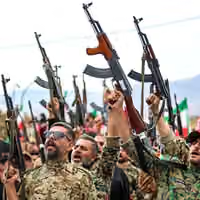
Iran-backed militias in Iraq and Syria launched 10 fresh attacks on US targets Friday, as Tehran uses its proxies in the region to pressure Washington.
Iran-backed militias in Iraq and Syria launched 10 fresh attacks on US targets Friday, as Tehran uses its proxies in the region to pressure Washington.
The militias have carried out more than 80 such attacks since mid-October, when Israel’s onslaught on Gaza began. But the Biden administration has largely avoided retaliation, drawing stark criticism from Congressional Republicans.
“How many attacks on American personnel and facilities by Iranian-backed militias in Iraq and Syria will be tolerated before we hold Iran accountable,” Senator Lindsey Graham asked on his X account.
“We have lost all deterrence as a nation,” he said. “The Biden Administration is letting our men and women in uniform down and putting them at risk by not challenging Iran directly.”
The Biden administration has been trying to avoid conflict with Iran ever since Hamas forces attacked Israel, fearing that the war on Gaza could expand and set the whole region ablaze.
Secretary of defense Lloyd Austin spoke Friday with the Iraqi Prime Minister Mohammed Shia al-Sudani reminding him of Iraq's obligation to protest diplomatic missions and "Coalition advisers and facilities." He emphasized that the US reserved the right to self-defense.
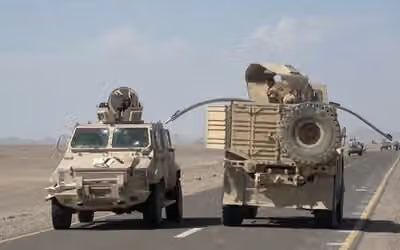
The attacks Friday were a mix of drones and missiles, targeting American bases and the US embassy in Baghdad –a first since October, marking a clear escalation of operations by Iran proxies in Iraq and Syria, who seem to have taken over from Houthis in Yemen.
The Houthis robbed the spotlight last week with several attacks on commercial vessels in the Red Sea and forcing two US warships to engage.
A senior White House official blamed Iran’s Revolutionary Guards (IRGC) for Houthi actions.
"We believe that they are involved in the conduct of these attacks, the planning of them, the execution of them, the authorization of them and ultimately they support them," deputy national security adviser Jon Finer said.
He added that the Biden administration has “not ruled out the possibility of taking military action” against the Houthis.
On Friday, Bloomberg reported that the administration “has been consulting with Gulf allies about potential military action” against Houthis.
The report suggested that the talks were at a “preliminary stage” and both the US and partners still favored diplomacy over direct confrontation, especially since any military action can jeopardize the renewed relationship between Iran and Saudi Arabia, which the Biden administration values as essential to the peace and stability in the region.
It seems unlikely, however, that the regime in Tehran or its regional proxies would change course unless they felt the heat.
“Retaliate yes and soon but the target must be something dear to Iran,” said Douglas London, a former CIA expert and a non-resident scholar at the Middle East Institute’s Countering Terrorism & Extremism program. “Little value in hitting the Houthis or Iraqi proxies apart from capability reduction since their casualties are expendable to Iran.”
The hardliners in Iran –including the Supreme Leader Ali Khamenei himself –believe the recent events to be in line with their interests and their long-term vision for the region.
The ongoing attacks in Iraq, Syria, and the Red Sea are likely intended to push the Biden administration to call for a ceasefire in Gaza. But they may also be intended to wreak havoc in the region, shifting American public opinion and eventually forcing US troops out or at least diminishing their presence.
In all this, the confusion and the dithering of the Biden administration can play the role of an unintended catalyst.