Taliban Turn Back Tankers Carrying Iranian 'Low-Quality Gasoline'

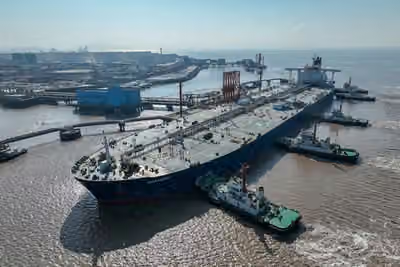
In a bizarre turn of events, the Taliban government's standards office has returned fuel tankers carrying Iranian gasoline, deeming the product below standard.
In a bizarre turn of events, the Taliban government's standards office has returned fuel tankers carrying Iranian gasoline, deeming the product below standard.
In a message on Thursday, November 29, posted on X, the Taliban stated that 24 tankers carrying low-quality Iranian gasoline were returned to Iran through the Farah' border crossing in the previous two days. In the last week, a total of 74 tankers carrying Iranian-produced gasoline have been sent back from Afghanistan.
The Afghan Islamic Emirate Standards Office has warned gasoline importers to avoid purchasing non-standard fuel, or they will face legal consequences. “Our utmost effort is for the people of Afghanistan to consume standard gasoline,” the statement said. Taliban had previously prevented the entry of shipments of non-standard gasoline produced by Iranian refineries into the country. One recent example was the return of 48 tankers carrying Iranian gasoline in September.
According to a confidential document from Iran’s Ministry of Petroleum received by Iran International, about 80% of the country's gasoline production does not meet Euro 4 and Euro 5 standards. Additionally, nearly 10 million liters of chemicals, aromatics, and the carcinogenic substance 'MTBE’ (Methyl-tertiary-butyl ether a gasoline additive--causes testicular and lymphohematopoietic cancers in rats) are mixed into produced gasoline daily. Iran’s gasoline output is around 100-110 million liters per day.
Iran has grappled with a significant gasoline shortage since last summer, prompting the addition of substances to base gasoline in refineries. This adjustment, coupled with increased gasoline combustion, has led to the production of non-standard gasoline. This, along with the consumption of fuel oil and prevalent diesel use in industries and power plants, stands as a primary contributor to severe air pollution in Iran.
Due to the Iranian government’s ban on importing quality vehicles, especially electric cars, compressed natural gas (CNG) vehicles, and the annual addition of 900,000 low efficiency domestically produced cars to the market, Iran faces a gasoline shortage crisis. Consumption has nearly doubled in the past decade, reaching 115 million liters per day.
Since the beginning of this year, the Islamic Republic has initiated limited imports of standard gasoline from Russia and other countries, primarily supplied to major cities.
Iran's refineries are outdated and worn out, converting one-third of the received oil into fuel oil and bitumen. For instance, 47% of the crude oil received by the Abadan refinery, Iran's largest crude oil refinery, almost a century old, is converted into bitumen and fuel oil. The "Global Carbon Project" study claims that throughout the previous 20 years, Iran's greenhouse gas emissions have doubled. According to BP's estimates, Iran produced almost 900 million tons of greenhouse gas emissions in 2022.
Globally, Iran is ranked sixth in term of greenhouse gas emissions level. Only three days of clear air were reported in Tehran last year; similar circumstances prevailed in several other Iranian large cities.
Dr Umud Shokri, Energy Strategist and Senior Visiting Fellow at George Mason University