Iran Tightens Security Around Teacher Recruitment

Teachers in non-government schools must now undergo a six-month selection period, up from the standard 15 days.

Teachers in non-government schools must now undergo a six-month selection period, up from the standard 15 days.
The announcement, made by Ahmad Mahmoudzadeh, an official at the Ministry of Education, came on the back of orders of Supreme Leader Ali Khamenei blaming “seditions, riots and creating insecurity in the streets” after schools and universities have been at the forefront of protests since September.
Mahmoudzadeh said: “After passing a 60-hour course, teachers must attend 60 hours of training related to educational knowledge, as well as general and professional competence within five years. Every year, after passing all these courses, they can get a professional competence card.”
Khamenei had previously demanded that the authorities make sure the "selection rules" of teachers "do not weaken."
The leaders of two Iran-backed Palestinian militant groups fighting against Israel are in Tehran, while tensions are simmering in the West Bank.
Ziyad al-Nakhalah, the leader of the Palestinian Islamic Jihad (PIJ), has been in Iran along with several other senior members and leaders of Palestinian militant groups since last week, culminating in the arrival of Hamas leader Ismail Haniyeh in Tehran on Monday.
The groups, both designated terrorist outfits by the European Union, the US, the UK, Canada, Israel, and several other countries, have been receiving financial support from the Islamic Republic, presumably for wreaking havoc in Israel, or what the regime calls “resistance.”
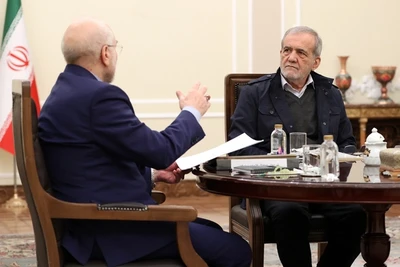
Nakhalah, who has met with several senior Iranian officials since last week, including Supreme Leader Ali Khamenei, expressed gratitude for the Islamic Republic’s support during his Sunday meeting with President Ebrahim Raisi, without elaborating on the amount of support.
According to Israeli Defense Minister Yoav Gallant in April, Iran is the “driving force” of a recent multi-front escalation with Israelis through its proxies across the region, funding Hamas – that rules the Gaza Strip -- with $100 million annually with additional funding worth tens of millions of dollars going to the second largest terror group in the Palestinian enclave, the Palestinian Islamic Jihad. Galant said the regime also provides Hezbollah in Lebanon with $700 million a year, as well as “knowledge and strategic weaponry” such as precision-guided munitions.

The groups regularly send leaders or delegations to Iran to ask for more money than their annual allowance, and usually the tensions heighten around the time of such trips either as complaisance to the Islamic Republic or a gimmick to justify further funding.
Alireza Nourizadeh, a regional analyst, told Iran International that the regime is spending hundreds of millions of dollars to create chaos in Israel, as it views it as its most important enemy. He claimed that the regime is using the social divide in Israel as an opportunity to increase tensions, noting that the policies of Prime Minister Benjamin Netanyahu have created such an opportunity.
Earlier in the day, five Palestinians were killed as heavy clashes broke out between gunmen and Israeli troops in the city of Jenin. An Israeli helicopter gunship carried out strikes in order for seven wounded Israeli soldiers to be evacuated from the battle zone after their vehicle was hit by an explosive device.
Claiming that Palestinians have never been closer to defeating Israel, Iran’s president said during the meeting with Nakhalah that "With Jihad and resistance, we will approach victory against the occupying Zionist regime day by day."
Raisi reiterated the Islamic Republic's support for “the oppressed Palestinian nation and their just cause," which he said, "remains the cause of all Muslims."
Jaber Rajabi, political analyst and activist, told Iran International that although the Islamic Republic seeks to portray itself as sympathetic to the Palestinians and championing their cause, it never supports Palestinians who seek peace and stability, such as the Palestine Liberation Organization, and only supports warmongers.

Rajabi said that the Islamic Republic is not committed to what he describes as the Palestinian cause, noting that the regime views the Palestinian issue as a bargaining chip. Among the few cards that Iran's regime can play in the international arena is by fomenting unrest in Israel, he claimed, adding that the regime believes it can only progress if there is a crisis. And since the détente with Saudi Arabia, Iran has to reduce the level of tensions in the Persian Gulf, so it has to create chaos in Israel.
According to him, the Islamic Republic is against the two-state solution, the only strategy that can reconcile the opposing sides in Israel, and therefore it would not support the Palestinian groups that favor this option, which is also backed by most of the Palestinian civilians.
He added that since Khamenei announced that the West Bank should be armed, the regime is making the best use of tensions there, most notably via the Islamic Jihad group. He is also of the opinion that the reason Nakhalah and Haniyeh are both in Iran is that the regime wants to resolve the differences between the two group so they can unite against Israel, considering the fact that in recent tensions with Israel, Hamas did not engage and the Islamic Jihad was the only group firing missiles towards Israeli cities.

The head of Iran’s oil products exporters union admitted that the Taliban will no longer buy gasoline from Iran due to quality issues.
Hamid Hosseini told Iranian news platform Fararu on Monday that Iraq and Afghanistan now buy higher quality gasoline from Uzbekistan and Russia.
In January, the Taliban's National Standards Authority announced that it has returned 26 tankers of fuel to Iran due to quality issues. Iran’s main exports to Afghanistan are gasoline and gasoil, according to a report released by PetroView, an Iranian oil and gas consultancy and research platform. From May 2020 to May 2021, Iran exported about 400,000 tons of fuel to Afghanistan.
“The higher quality of products [from Uzbekistan and Russia] is the reason for the return of gasoline by the Taliban, and these countries [such as Afghanistan] no longer accept products of any quality,” Hosseini said.
Several petrochemical companies and refineries that produce pyrolysis gasoline have been exporting their product to neighboring countries, including Afghanistan for years. The product by itself cannot be used as fuel and must be modified in a process so that it can be used in vehicles.
In April, Afghan officials said that eight projects are underway to increase the standardization process in the country.

Belgian foreign minister Hadja Lahbib is facing calls for resignation after granting visas to delegations from Iranian and Russian cities to attend a mayors convention in Brussels last week.
Lahbib is under scrutiny for having approved visas for citizens from two countries under international sanctions and only three weeks after Belgian Olivier Vandecasteele was released from an Iranian jail.
Vandecasteele, 42, was arrested on a visit to Iran in February 2022 and sentenced in January to 40 years in prison and 74 lashes on trumped-up charges including spying.
He was freed last month in a prisoner swap with an Iranian diplomat who had been convicted in Belgium for a terror bombing plot in France.
The "Brussels Urban Summit," which took place last week, saw the mayors of more than 300 international cities including Tehran, and also members of the European Commission and the European Parliament, gathering to discuss challenges cities are facing.
Tehran's mayor, Alireza Zakani is a hardliner who was a leader in the Basij student militia.
State secretary for external relations & foreign trade of the Brussels government Pascal Smet resigned on Sunday over the all-expenses paid trip.
Belgo-Iranian lawmaker Darya Safai, from opposition party N-VA, said on Monday the party is asking for Lahbib's resignation.
"We need a minister who accepts her responsibility," Safai told Matin Premiere radio.
"The pending question is why did she agree to give these visas? Why only three weeks after the release of Olivier Vandecasteele, she accepts that terrorists come to Brussels? And why must the name of Belgium always be sullied by foreign relations which it cannot manage to control?" she said.
Belgian lawmakers will meet on June 21 to discuss the issue.
Based on Reporting by Reuters

The number of deaths from consuming bootleg alcohol in Alborz Province west of Tehran has reached 12, medical officials say.
A total of 155 people in the province have also been referred to medical centers for alcohol poisoning symptoms, said Shahram Sayadi, Dean of Alborz University of Medical Sciences.
Meanwhile, five people are hospitalized in the intensive care unit.
Alborz authorities said the alcohol was sold by a body spray factory.
There is a possibility that this number of the deaths will go up as some of those who consumed the poisoned alcohol may have died in their homes, according to a judicial official in the province.
There are reports that some others have lost their vision and kidneys due to the consumption of poisonous alcohol.
Last year, at least eight people died in southern Iran after drinking toxic homemade alcohol.
Alcohol poisoning also caused the deaths of more than 44 people in Iran at the start of the Coronavirus outbreak in March 2020.
Iran has banned alcohol since 1979 and punishes those who violate the ban with floggings and fines. On the black market, however, there are a lot of foreign and homemade alcoholic beverages available.
Despite the Islamic regime’s ban, half of all adults regularly consume alcohol, according to a survey by Iran Open Data. Moreover, the majority prefer homemade beverages.
In 2018, a report by the World Health Organization (WHO) ranked Iran ninth among 189 countries for alcohol consumption per capita.

Dr Fieda Fuchs, independent scholar and former visiting professor at Oberlin College, calls for a full investigation of an Iranian faculty member suspected of covering up mass executions in 1988.
----------------------------------------------------------------------------------------------------------------------------------------------------------------
On March 3, 2023, Ray English, the former Director of Libraries at Oberlin College, responded to our co-authored op-ed published on February 24, 2023 in which English disagrees with our claim that Oberlin College Professor of Religion Mohammad Jaffar Mahallati played a role in covering up the mass execution of political prisoners in his country (the 1988 “prison massacres”) during his tenure as Iran’s UN Ambassador (1988-89). Rehearsing Oberlin’s official response (published on the college website on October 28, 2021), English argues that the allegations against Mahallati are unsupported by evidence. Mahallati’s defenders rest their case on the top-secret nature of the massacres, which allegedly made it impossible for him to have “real time knowledge” of the events.
We do not doubt that Mahallati’s geographical distance from Iran made it difficult for him to know all the details. However, the international press and Amnesty International began reporting about the massacres already in summer 1988. We know that Mahallati officially claimed that these reports were exaggerated or false. We also know that Mahallati went to Iran in late August 1988 where he met with Hashemi Rafsanjani (the second most important political leader after Ayatollah Khomeini).
Mahallati also misled his UN colleagues by claiming that the massacre’s victims were battlefield casualties. The truth is that most of them had been in prison for years prior to their execution. Finally, Mahallati argued that reputable sources with a long history of professional journalism and human rights investigations (The Financial Times, The New York Times, and The Guardian, and Amnesty International) were misled by left-wing guerrilla fighters based in Iraq who were peddling false information.

Ray English highlights Mahallati’s role as a peace broker in the Iran-Iraq war. He argues that Mahallati’s humanitarian impulses are evident from his effort to set up a UN human rights delegation to investigate claims about possible human rights violations. English also tells us that Mahallati was briefly detained after his official term expired because he fell in disfavor with regime hardliners.
A more careful look at the evidence calls into question these claims. In 2018, Mahallati wrote a letter to the President of the Majlis (Iran’s parliament) in which he denied that he had been detained. Instead, he claimed that these rumors were spread by regime hardliners who branded him as an American spy. Mahallati’s proposal to create a UN delegation to investigate the prison massacres was not necessarily borne of humanitarian impulses either. Rather, it was based on a quid pro quo, whereby Iran’s government would agree to the committee if the UN dropped a censure motion against the country for human rights violations.
According to a New York Times article from 26 November 1988, Mohammed Jafar Mahallati told the General Assembly's Third Committee that “Iran would admit a United Nations human rights investigator and cooperate if the resolution is watered down” and that “the committee has to choose between a confrontation or a cooperative approach.” Thirty-seven UN records and international media reports show that Mahallati conditioned visits to Iran by the UN Special Representative on the removal of critical references to the mass executions from the December 1988 resolution of the General Assembly.
When the UN proceeded to censure Iran for human rights violations anyway, Mahallati rescinded his offer. It was only in 1990, a whole year after Mahallati left his post, that Iran finally allowed UN officials to conduct the investigation. However, the three visits UN officials paid to Iran between 1990 and 1992 were highly staged occasions, as often happens in authoritarian regimes.
As internationally renowned human rights lawyer Geoffrey Robertson noted, Iran denied the UN delegation independent access to prisons, prisoners, and potential witnesses. We also know that Mahallati used diplomatic immunity to defend himself against any allegations of wrongdoing, as he did when he attacked minority Baha’i communities or supported the fatwa against Nobel Prize-winning author Salman Rushdie.
Iran’s leaders have deliberately obfuscated the country’s abysmal human rights record for decades now. In this case, the goal is to demonize the 1988 prison massacre victims as violent left-wing terrorists aligned with Israel and American imperialism. Just how plausible is a conspiracy theory in which Islamic Marxist revolutionaries serve as stooges of Zionism and American power? Oberlin College’s administration should not play the role of a fellow traveler for a dictatorship that systematically violates human rights, not the least of Iran’s women who have stood up against dictatorship so bravely in recent months. Nor should it obfuscate, rather than honestly investigate, the role of a professor in covering up the crimes of Iran’s authoritarian and misogynist regime.
(Note: Dr Frieda Fuchs was mistakenly introduced as "Assistant Professor at Oberlin College" when this article was published. Consequently correction was made.)
Opinions expressed by the author do not necessarily reflect the views of Iran International