Team Melli players during a meeting with President Ebrahim Raisi before leaving Iran for Qatar
The presence of Iran’s national football team in Qatar’s World Cup has sparked controversy as the country is convulsed with antigovernment protests and many people expect athletes to support the uprising.
Protests on Tuesday in Iran began at around noon to mark the third anniversary of ‘Bloody November’ in 2019, when the government killed at least 1,500 protesters.
By early evening, protesters had come out at many locations in Tehran, blocking streets and putting large trash containers on fire. Similar scenes were reported from other cities.
The Tuesday protests were widespread and were the largest in the past one month. Still, we do not have a full picture of all gatherings and demonstrations across the country or number of any possible casualties. Two to three protester deaths have been reported but too soon to be certain.
Anonymous activists regularly issuing calls for demonstrations, announced a three-day period of protests starting Tuesday, November 15, the day when in 2019 security forces opened fire with military weapons on young Iranians who had come out to protest a sudden hike in gasoline prices.
In the next 3-4 days, the Revolutionary Guard, its Basij militia and police indiscriminately fired at people in the streets, even killing some bystanders. More than 10,000 were jailed without due process of law. Reuters at the time reported that Iran’s ruler Ali Khamenei had personally authorized security forces to use every means to put down the uprising.
The current protests that started in mid-September after Mahsa Amini, a young woman was killed in the custody of ‘morality police’, have lasted nearly two months, the longest and most serious challenge to the Islamic Republic, which has one of the largest trained and well-equipped suppression machines in the world.
An IRGC commander, Gholamreza Soleimani Tuesday announced the “Week of the Basij” and said 900,000 members of the paramilitary militia will participate in drills. This is an ominous sign of more potential bloodshed as protesters come out to mark the three-day anniversary.
So far, security forces have killed more than 340 protesters, according to human rights monitors and arrested an estimated 14,000 people. Government officials have widely threatened to execute many detainees, and a court in Tehran on Sunday sentenced the first protester to death, without a transparent trial and following due process of law.
By noon on Tuesday, people were demonstrating in Tehran’s bazaar as reports began to pour in about protests and strikes in other parts of the country. But larger protests are expected in the evening, as protesters prefer to gather in darkness.
Below, we will provided live coverage of events, by posting brief updates and videos. We divided content based on provinces to make it easier for you to follow. The most recent events are usually at the top of each heading.
The coverage ended at 01:18 Iran time on Wednesday, November 16.
Students at Chamraz University in Ahvaz, Khuzestan province chanting "Freedom, freedom".
Students at Kermanshah's Razi University, western Iran, protesting on Tuesday, chanting "This is the last message, Target is the whole regime."
Students in Khomeini-Shahr Universiaty, Esfahan Province.
Student protests also took place in Babol University, northern Iran.
Students at Tehran's Polytechnic University began a protest sit-in before noon on Tuesday but at 12:50 they were confronted by campus security that threatened them to end their gathering.
Students at the industrial university in Semnan chanting, "From Zahedan to Tehran, My life for Iran".
Students in a unique sort of protest in Sanandaj University.
According to reports by Hengaw human rights monitoring group two people were shot dead by security forces in the province on Tuesday, One citizen was killed in Sanandaj and another in Kamyaran. Reports say that protesters overran a Basij militia base in Kamyaran.
Protests in the town of Ghorveh in the restive province with a majority of Iranian Kurds.
All markets nd retail businesses on strike in the town of Bukan.
Protesters set fire to the municipal building in the town of Bukan, West Azarbaijan Province.
Protests in Orumiyeh or Urmia. The tweet says, Azaris, Kurds and Armenia hand in hand protest and chant, "This year is the year of blood, Seyyed Ali will be gone."
All retailers and the traditional bazaar on strike in Tabriz.
Reports and images also show extraordinary security measures in Ardebil, northern Iran and a large presence of security forces.
Mostly young protesters in the religious city of Mashhad marching in the streets and chanting, "This year is the year of blood, Seyyed Ali will be gone". Some women in the video are seen without hijab.
In the city of Babol gunshots are heard as people protest despite the deployment of security forces.
Protests in the city of Amol, where residents have been at the forefront of the movement since September. At one point more than 100 security forces attacked protesters with everything even in some instances firing at them. Young protesters tried to spread into small streets and regroup.
Protesters in Qazvin the provincial capital chanting, "This year is the year of blood, Seyyed Ali will be gone," referring to Iran's ruler Ali Khamenei.
Thousands of people protested in a small town near the Persian Gulf, which shows the extent to which the popular unrest has spread throughout the country.
Germany has once again warned the Islamic Republic about issuing death sentences for anti-regime protesters emphasizing that Iranian authorities must be held accountable.
Foreign Minister Annalena Baerbock said Tuesday there is no doubt that the Iranian regime is brutally repressing its own people.
Speaking at the opening of the 8th World Congress Against the Death Penalty in Berlin, Baerbock stated there are reports that Iranian regime has issued the first death sentence against a person who took part in the protests after the death of Mahsa Amini, “who simply wished to live in freedom like many others.”
“The Islamic Republic is threatening many more protestors with the death penalty, underlined the German minister.
On Sunday, a Revolutionary Court in Iran issued the first death penalty against a protester and another court sentenced five others from five to 10 years in jail each.
Baerbock hailed the decision to impose sanctions on Iranian officials on Monday saying the EU sanctions were put in place to target those who are responsible in Tehran.
“We see with great concern how authoritarian regimes use the death penalty to repress political opponents more and more,” she noted.
“They are not carrying out the death penalty for severe crimes such as murder – but they are using it against people simply expressing their feelings such as who they love, people expressing their opinions or celebrating freedom and life, for example with music and dancing,” she underlined.
Iranian security forces have killed at least 340 people including 43 children and 25 women during the ongoing protests.
Reports say the health condition of two detained Iranian activists is deteriorating as the Iranian regime denies proper medical care to them.
Arash Sadeghi, 36, is one of these inmates, whose father on Tuesday warned about his physical condition, saying he was arrested despite suffering from bone cancer and does not have access to medicine and treatment.
In a video published on social media, Hossein Sadeghi also pointed out that “if Arash is not treated for two months, he will not survive.”
“After the start of nationwide protests in Iran, Arash answer my calls, but later on a short call he announced he was arrested and was in ward 209 of Evin Prison which belongs to the intelligence ministry,” added the father.
Reports say Yashar Tahidi, a political prisoner, who was injured by several bullets last month following the disturbances at Evin prison, is denied proper medical care despite his deteriorating physical condition.
According to HRANA News Agency, Yashar is also suffering from “attention deficit disorder” and needs regular medication, but this is not given to him due to shortages.
Yashar Tohidi has been serving his sentence of 2 years and 9 months in Evin prison since June 7, 2022.
The health condition of the well-known political prisoner Hossein Ronaghi is also worsening. His brother Hassan said in a tweet Tuesday that he is in Evin Prison's infirmary on a dry food strike and has not received any treatment yet.
Former US President Bill Clinton has strongly condemned the repression of peaceful protesters by the Iranian regime saying that they must stop abducting and imprisoning demonstrators.
In a video message on Tuesday, he expressed solidarity with Iranians, saying he joins the international calls for the Islamic Republic to immediately stop the abduction of protesters and to release all political prisoners, many of whom require urgent care.
“I've been in awe of the courage the Iranian people have shown, particularly the brave women and girls as they fight for their freedom. The Iranian people's fight is about more than a headscarf. It’s a fight for basic rights: the right to speak, assemble freely, appear unveiled, to realize their dreams... for themselves and their children. The right to a future they can chart,” added the former president.
Addressing the Iranian nation, Clinton noted the world is witnessing their courage adding, “we will stand with you for as long as it takes to achieve your freedom.”
He also addressed the international community, stressing that “the Iranian people need us. They want to be part of our global community.”
Calling Iranians “educated, highly industrious, creative, and sophisticated,” he said they want normal relations with the West, so they deserve to be supported.
Iran International’s correspondent was asked to leave a meeting at the UN headquarters in New York attended by two visiting Islamic Republic officials who apparently were justifying Tehran’s clampdown on protesters.
Amid the global outcry over the Islamic Republic human rights violations, which is also condemned by numerous UN officials, organizers of the meeting made our correspondent Maryam Rahmati and BBC Persian’s Bahman Kalbasi leave the session on the pretext the meeting was held behind closed doors while Iran's state broadcaster was allowed to cover the event.
The event at the UN building was a meeting of the Organization of Islamic Cooperation (OIC). The OIC has permanent delegations to the United Nations and the European Union. The meeting paused and only resumed after all the reporters left the room.
The Iranian officials present at the meeting were Kazem Gharibabadi, the deputy head of the Judiciary who is also secretary of the High Council for Human Rights, and Zohreh Elahian, a member of parliament's National Security and Foreign Policy Committee. Elahian reportedly was one of 227 lawmakers in Iran who recently signed a letter requesting the execution of some protesters.
“Why is your government so scared of us?” asked our correspondent before leaving the room. “If you are not doing anything wrong; if you are not killing the people of Iran, why are you scared of our media outlet?” she said.
She went on to ask Gharibabadi what was wrong with covering the meeting, as he was sitting smugly with a sober face.
The meeting in question was organized at the behest of the Islamic Republic seemingly to provide an opportunity for the regime in Tehran to justify the death sentence that authorities seek for some protesters, or blaming the media for the unrest in the country as they always do.
Later on Monday, Iran’s state media cited Gharibabadi as saying on the sidelines of the meeting that the British government’s support for the “unlawful anti-Iran campaign waged by the Persian-language media outlets” is the root cause of the popular protests that has been going on for the past two months.
Unable to come up with a working proven allegations against Persian-language media outlets, the Islamic Republic has launched a smear campaign against UK-based channels, describing them as terrorist groups.
“In fact, the anti-Iran Persian-language media’s moves are completely contrary to the laws and regulations, and we hold the British government responsible in this regard,” Gharibabadi told reporters in New York.
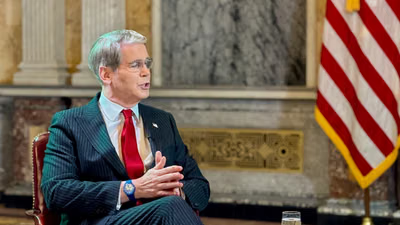
Kazem Gharibabadi in New York, on November 14, 2022
As Western countries seek to ratchet up scrutiny of Tehran’s human rights violations, the UN human rights office called on Iran's government to immediately release thousands of detained protesters, faulting its “increasing harshness”.
At a UN press briefing in Geneva on Tuesday, Spokesman Jeremy Laurence of the office of the UN High Commissioner for Human Rights said it was calling for all charges to be dropped against the demonstrators and cautioned that Iran can only mete out the death penalty for the “most serious crimes" under international law.
“Instead of opening space for dialogue on legitimate grievances, the authorities are responding to unprecedented protests with increasing harshness,” he said.
The UN Human Rights Council plans to hold a special session -- slated for 24 November -- to address “the deteriorating human rights situation.” The special session is being convened following an official request submitted on November 11 by Germany and Iceland, which has been supported by 44 States thus far.
The Iranian squad – nicknamed Team Melli – met with President Ebrahim Raisi hours before departing for Doha, irking many Iranians who did not expect the players to be so blithe about the current uprising across the country. They have been heavily criticized on Twitter since the meeting.
During the nationwide protests on Tuesday, people also set fire to a government banner of the national team.
Declining the invitation, Ali Karimi told President Tamim bin Hamad Al Thani in a letter released on Tuesday that “As you know, the people of Iran are currently going through a very difficult time. The international media largely ignores our struggles. Right now, there are more important issues for me than Football and I want to be with my people and be their voice.”
During a press conference earlier on Tuesday, national team coach Carlos Queiroz claimed the players are free to join in the protests while they are playing at the World Cup in Qatar but must do so within the rules of the tournament.
“You express yourself in football according to those principles and values. Everybody has the right to express themselves,” he said.
Addressing a reporter who asked about the current situation in Iran, Queiroz said, “You guys are used to kneeling in the games and some people agree, some people don't agree with that, and in Iran it's exactly the same, but it is out of question to think that the Iran national team is suffering any sort of issues like that, the players only have one thing in mind, which is to fight for that dream to be in the second round.” The Iranian national team has failed in its five previous World Cup appearances to reach the second round.
Team Melli coach Carlos Queiroz
Queiroz was asked whether he was proud to coach a country that repressed women. In a terse retort, the coach asked the reporter how much he would pay him to answer the question, before adding the reporter should think about the issue of immigration in the UK first.
The Iranian government is extremely worried about protests by fans or even players during the games and wants to make sure people will not see any manifestations on satellite TV. The state broadcaster can always cut away during live matches.
It is most probably for this reason that the Qatari government has denied accreditation to Iran International’s journalists from traveling there to cover the World Cup.
Although FIFA has issued ID cards for our correspondents, the Qatari interior ministry denied accreditation.
Last month, Iranian President Ebrahim Raisi expressed concern over possible problems that may happen during the FIFA World Cup, tacitly referring to people chanting slogans against the Islamic Republic during matches or players making statements about the situations in Iran. Earlier in November, he tasked the Foreign Ministry to contact Qatari officials regarding the issue to find ways “to predict and prevent possible problems."
Team Melli players covered up their national team badge when they played two warm-up internationals in September, which was interpreted as a sign of support for the protests, but other national teams and athletes have been more vocal and direct in their support for the protests.
In less than a month, the pace of the athletes showing support for the protests has accelerated as the Iranian football, beach football, waterpolo, basketball, and sitting volleyball teams refused to sing along with the anthem, which is customary in almost all international competitions. Now with the biggest sporting event on the horizon, the regime is resorting to whatever it can to stifle the voices of dissent. Authorities have made serious threats against athletes and other celebrities to stop them from public displays of solidarity with protesters but to no avail.