Top Cleric, Politicians In Iran Slam The Government Over The Economy

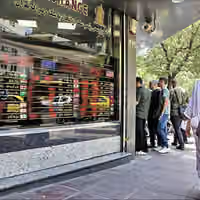
Criticism of Iran’s governing hardliners fills the pages of some local media for failing to manage the economy and making irrational decisions that hurt the people.
Criticism of Iran’s governing hardliners fills the pages of some local media for failing to manage the economy and making irrational decisions that hurt the people.
Responding to Iranian hardliners' insistence on employing clerics to supervise government and private institutions in a wide range of areas from banking to medicine, Iranian lawmaker, Massoud Pezeshkian said that no cleric, judge or government minister would put his life at risk by going to a doctor who is a devout Muslim but does not have the medical qualifications.
He said, on the contrary, many of those officials would go abroad to seek medical assistance for a simple surgical operation but when it comes to taking care of the people, they advise that religious virtues, without the right qualifications, comes over and above their academic credentials.
Pezeshkian, a member of the Iranian parliament's medical committee suggested that in the interest of the people's welfare, the government should prioritize professional abilities in various professions instead of employing zealot Muslims with little qualifications and skills. The lawmaker who is a medical doctor criticized government plans to place clerics in all bank branches as Islamic supervisors.
Criticism of the government in Iran during these days is not limited to lay officials and politicians. Grand Ayatollah Hossein Nouri Hamadani, a source of emulation, one off the highest ranks in the Shiite clerical system, has also called on President Ebrahim Raisi (Raeesi) on September 2, to be serious in tackling inflation.
Didban Iran website quoted Noori Hamadani as saying "It is undeniable that sanctions imposed by the enemies have affected the country's economic situation, but the government should not take advantage of this to justify its failure in controlling the prices and harnessing inflation."
Saying this during a meeting on Friday with the Minister of Industry Reza Fatemi Amin, the grand ayatollah suggested that the government should do its best to provide what the people need by boosting production. He added that "the only sign of the officials' success is the people's happiness. But we see that people find it difficult to buy even a kilogram of fruit."
In another development, lawmaker Behrouz Mohebbi of the Iranian parliament's planning and budget committee, told reporters in Tehran on Friday that government’s decision in early May to cancel import subsidies for food, medicine and animal feed has led to unprecedented inflation.
Meanwhile, he attributed part of the problems people face to the fact that the government always talks about long-term plans and has no short-term planning to solve the country's economic issues. Mohebbi further called on President Ebrahim Raisi to take serious measures to help the underprivileged part of the Iranian society.He criticized Raisi and his ministers for pretending during cabinet meetings that the people's financial situation is improving. Mohebbi reiterated that people find it difficult to make ends meet. They are under immense economic pressure.
Meanwhile, conservative commentator Mohammad Mohajeri, a former editor of hardline daily Kayhan, wrote on his Telegram channel that it appears the government has reduced the individual quota for purchasing gasoline at the subsidized price from 250 to 150 liters per month in what appears to be a prelude to raising fuel prices in Iran.
He added that gasoline rationing cards are likely to be made obsolete soon. According to Iranian media, Iranians consume some 120 to 130 million liters of gasoline every day.