• العربية
  • فارسی
Brand
  • Iran Insight
  • Politics
  • Economy
  • Analysis
  • Special Report
  • Opinion
  • Podcast
  • Iran Insight
  • Politics
  • Economy
  • Analysis
  • Special Report
  • Opinion
  • Podcast
  • Theme
  • Language
    • العربية
    • فارسی
  • Iran Insight
  • Politics
  • Economy
  • Analysis
  • Special Report
  • Opinion
  • Podcast
All rights reserved for Volant Media UK Limited
volant media logo

Kuwait Says Iran Is Not Part Of Disputed Offshore Gas Field

Mar 30, 2022, 17:03 GMT+1
A map from Kuwait's oil ministry showing the Dorra gas field near the tip of the Persian Gulf.

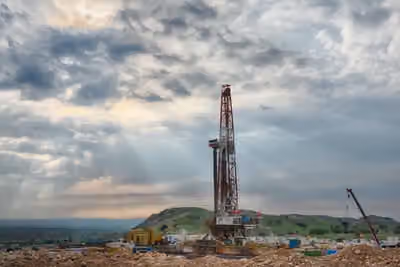
Kuwait says the disputed Arash/Durra gas field in the Persian Gulf is “exclusively owned” by the Persian Gulf nation and its neighbor Saudi Arabia.

Iran “is not part of the gas field” and is not a party to development projects related to it, Kuwait’s official news agency Kuna quoted Foreign Minister Sheikh Ahmad Nasser al-Mohammad al-Sabah as saying in a tweet on Tuesday.

The comments came hours after the minister said that the gas field, located on maritime borders of Iran, Kuwait and Saudi Arabia, was a tripartite issue between these countries.

He later explained that these remarks meant Iran could be involved in talks on the demarcation of the continental shelf where the gas field is located.

Iran has branded "illegal" an agreement reached between Kuwait and Saudi Arabia on March 21 to develop the gas field, insisting on its right to also exploit it.

The Kuwaiti-Saudi move came amid soaring energy prices on world markets following Russia's invasion of Ukraine.

Iranian Oil Minister Javad Owji said Monday that Tehran would soon begin drilling in the area after having completed “comprehensive studies…by drilling exploration wells and conducting seismic surveys”.

The Arash/Durra field, discovered in 1967 where maritime borders are unclear, has reserves of around 20 trillion cubic feet (ft3) of gas, enabling a potential daily output of 1 billion ft3 and 84,000 barrels of condensates.

“Even if the border is not demarcated, the field can be developed jointly using internationally tested models,” Iran’s Deputy Oil Minister for International Affairs Ahmad Asadzadeh said Sunday.

Iran had delayed its development pending a decision on maritime borders, he added.

Most Viewed

US imposes new Iran sanctions as officials say Hormuz deal is near
1

US imposes new Iran sanctions as officials say Hormuz deal is near

2
PODCAST

Ending Iran war could expose regime to its greatest threat yet, experts say

3

Mecca pact ties three Sunni powers together as Iran-backed attacks loom

4

Cleric summoned after calling to replace Islamic Republic with ‘Islamic government’

5
INSIGHT

Iran moves to ratify Caspian Sea pact with seabed rights still unsettled

Banner
Banner
Banner

Spotlight

  • Tehran rents hit three times many workers’ monthly pay

    Tehran rents hit three times many workers’ monthly pay

  • Iran’s reality TV boom abroad captures a generation in limbo
    ANALYSIS

    Iran’s reality TV boom abroad captures a generation in limbo

  • What the Islamic Republic does to its women footballers
    ANALYSIS

    What the Islamic Republic does to its women footballers

  • Iran moves to ratify Caspian Sea pact with seabed rights still unsettled
    INSIGHT

    Iran moves to ratify Caspian Sea pact with seabed rights still unsettled

  • Ending Iran war could expose regime to its greatest threat yet, experts say
    PODCAST

    Ending Iran war could expose regime to its greatest threat yet, experts say

  • US miscalculated Iran’s resilience and hurt deal prospects, expert says
    ANALYSIS

    US miscalculated Iran’s resilience and hurt deal prospects, expert says

  • What the Pentagon learned from the Iran war
    INSIGHT

    What the Pentagon learned from the Iran war