Defection from within Iran’s armed forces could become a serious threat to the Islamic Republic—but only if defectors are given protection, a clear pathway to safety, and a structure they can trust, experts told Iran International.
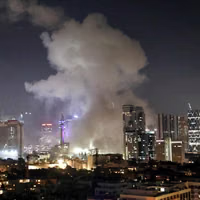
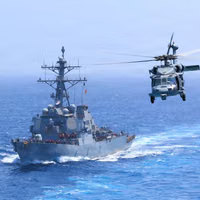
“There was a moment—those 12 days of Israeli and US military strikes—where the regime was on the run,” said Michael Pregent, a former US intelligence officer.
“People were watching closely. There was momentum.” But in the absence of a safe haven or real backing, Pregent said, “those who might have defected were left with nowhere to go.”
This renewed focus on potential defections comes amid a social media statement by exiled Prince Reza Pahlavi, who says that more than 20,000 members of Iran’s military have contacted his office through a digital registration platform expressing interest in defecting.
While the figure has not been independently verified, it has intensified questions about the loyalty of Iran’s security forces and the conditions under which they might break ranks.
Iran’s track record of retaliation remains one of the most significant obstacles to defection.
“The biggest problem usually” is “how are the defectors going to get their families out and their friends out?” said Patrick Clawson of the Washington Institute.
“The Islamic Republic has a long history of taking hostages who are quite unrelated to the offenses... I think we can assume that in the case of defectors, the Islamic Republic would go out to family and friends," Clawson told Iran International.
Defections are unlikely to gain momentum unless members of the security apparatus believe they have a viable future outside the regime, noted Alireza Nader, a senior Iran analyst.
What could shift that equation, according to Pregent, is the creation of safe zones—physical or operational—where defectors can seek protection and regroup.
Drawing on his experience in Iraq, where he worked with tribal leaders and defectors during the US counterinsurgency campaign, he described how trust was built by offering defectors equipment, radio support and armed backing.
That model, he argued, could be adapted to support Iranians who are ready to break with the ruling system.
Trust, he added, depends on action—not words—and on the presence of those “willing to sacrifice their own skin in the game.”
“We’ve seen that with the Israelis... the underground inside of Iran," Pregent added, referring to armed cells who have carried out assassinations and nuclear sabotage in league with Israel. "That’s where the trust is—people that were willing to fight for this, willing to put their lives on the line," Pregent told Iran International.
Israel’s assassinations of IRGC commander Ali Shadmani and Hamas leader Ismail Haniyeh in Tehran make one thing clear: Iranians inside the country are cooperating with Israel. These operations would be impossible without human assets on the ground.
Haniyeh was killed on July 31, 2024, along with his bodyguard, inside a military-run guesthouse in Tehran shortly after attending the inauguration of President Masoud Pezeshkian. The strike, like others before it, demonstrated not only Israel’s superior intelligence-gathering capabilities but also the existence of local informants within sensitive Iranian security and political circles.
When asked how Israel managed to target individuals in their bedrooms in remote parts of Tehran, he replied: "I mean, what would you guess? I think the answer is in the question, and I think it goes back to the original question about how to overcome fear. There are many, many Iranians that are overcoming fear right now. They've overcome fear in the past. They've worked in, in close tandem with forces of good, and they will continue to do so," Yechiel Leiter told Iran International.
Leiter's language—deliberately indirect—nonetheless strongly implies collaboration between Israeli intelligence and Iranian dissidents or insiders.
Legal and diplomatic ambiguity is another deterrent. Potential asylum countries must make clear that not only the defectors, but also their families, would be protected and welcomed. That clarity is missing, both in law and in practice, according to Clawson.
In many cases, intelligence agencies view double agents as more practical and valuable than outright defectors. Rather than extract a source, agencies often persuade them to remain in place and feed intelligence from within, Clawson added.
Nader added that exiled political figures must be judged by action, not intention. Those hoping to gain the trust of Iranians must show they’ve delivered meaningful results—particularly during this moment of regional and domestic upheaval.
Without external support and a clear exit plan, a viable counter-insurgency from within Iran remains unlikely. The regime will continue to maintain its grip so long as those within its ranks see no path out. “That cannot happen if it doesn’t have a safe haven,” said Pregent.