Germany Cracks Down On Hezbollah-Linked Centers, Mosques

Germany has shut down several Islamic associations as well as their affiliate mosques and premises for being affiliated with Iran-backed Lebanese Hezbollah.

Germany has shut down several Islamic associations as well as their affiliate mosques and premises for being affiliated with Iran-backed Lebanese Hezbollah.
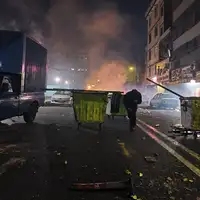
On Thursday, the city-state of Bremen closed the Al-Mustafa Community Center, while Police in Münster, in the North Rhine-Westphalia state, raided the Hezbollah-controlled Imam-Mahdi Mosque and its affiliated center.
Germany’s Federal Interior Ministry outlawed all Hezbollah activities in 2020.
Police spokesperson Antonia Linnenbrink said, “The aim of the mission is to convey the ban. The association’s assets are confiscated. We are also looking for evidence of unconstitutional activities.”
Bremen’s Interior Senator Ulrich Mäurer said that Al-Mustafa “actively propagates and promotes violence or comparably serious acts contrary to international law such as terrorism against the State of Israel. The ban of this association is therefore absolutely necessary.”
He added that “there were anti-Israel books and writings in the association's premises, including, for example, a flyer by the political and religious leader of Iran.”
“There is evidence that the Al-Mustafa Community tried to introduce children to its ideology and thus also to that of Hezbollah at an early age. The association's so-called scout group was also banned.”
Earlier in the year, an Islamic organization in Germany removed the Hamburg Islamic Center from its board of directors on allegations that the center is Iran’s “long terrorist arm” in Europe.

Iran has reportedly signed a deal with Russia to import 20 million tons of basic goods, including vegetable oil, wheat, barley and corn.
NourNews, which is affiliated with the secretary of Iran's Supreme National Security Council (SNSC), Ali Shamkhani, said on Saturday that Iran’s Agriculture Minister Javad Sadatinejad signed the agreement during a visit to Russia last week.
NourNews did not report the monetary value of the deal.
The report said the deal is to address concerns about shortages of basic goods and livestock feed in the next Iranian year, starting on March 21.
Iran eliminated a major subsidy for importing food and animal feed recently, raising fears of rising prices in the new year. According to a report by ISNA on Saturday, out of about $19 billion worth of basic goods imported in the past 12 months nearly $15 billion was subsidized with cheap dollars provided to importers.
Earlier in March, the parliament decided to scrap the multi-billion-dollar subsidy for essential food and medicines, despite warnings of more inflation and hardship.
The idea to eliminate the subsidy emerged after hardliner president Ebrahim Raisi (Raeesi) assumed office in August and could count on backing from conservatives and ultra-conservatives in control of Iran’s parliament.
The deputy head of Iran’s Customs Administration, Foroud Asgari, said about 30 million tons of basic goods have been cleared through customs and entered the country.

Iranian analysts abroad say it is unlikely Tehran would limit activities of the Revolutionary Guard just to have its terror designation lifted by Washington.
Observers in Iran and abroad have been saying during the past weeks that the issue of the IRGC's designation as a foreign terrorist organization (FTO) is the main hinderance to a renewed nuclear agreement between Tehran and Washington.
Mehdi Mahdavi Azad in Germany and Houshang Hassanyari, a military analyst in Canada, expressed skepticism to Iran International TV on Saturday about Iran's willingness to seriously limit the role of IRGC and its Qods Force.
When on Friday reporters asked White House Press Secretary Jen Psaki how far the Biden administration is ready to go in its attempt to salvage the remains of the Obama-era nuclear deal with Iran, she evaded the question.
Psaki said negotiations were still ongoing and had nothing more to offer. Meanwhile, she refused to address their concern about whether secret negotiations with Iran "are turning into negotiations with terrorists."
Mahdavi termed the secret negotiations between Iran and the United States over the IRGC issue, "JCPOA-2". He pointed out that in fact this was the term Supreme Leader Ali Khamenei had used in a March 2016 speech. According to Mahdavi, Khamenei defined JCPOA-2 as a model the United States and other Western states had suggested for reducing tensions in the region. "Khamenei said at the time that if he accepted the idea, the Westerners would then ask for the disbanding of the IRGC Qods Force," Mahdavi said.
The analysts maintained that whatever the world knows as Iran's revolutionary foreign policy fully involves the IRGC and its Qods Force. If Tehran is negotiating with Washington over IRGC’s role, it simply wants to make sure that the terrorist designation is lifted.
Asked if this could change the Islamic Republic's foreign policy, Hassanyari said: "This would be the biggest retreat for the Islamic Republic and its leader Khamenei. The IRGC's role in the region has been one of the most important problems US officials are focused on." Hassanyari agreed with Mahdavi that it is the IRGC carries out the Tehran's regional policy.
Mahdavi said the reason the Islamic Republic has not admitted that talks are taking place about the role of the IRGC, is because people in Iran will ask why Khamenei had not done this during the past ten years and allowed a large part of the population to go into poverty. Naturally, if Khamenei has to negotiate with America, it has to be done secretly. Mahdavi added that the Iranian regime might have to undermine its credibility before its own supporters and give bigger concessions to the West if it feels that it is the only way out of problems it faces.
Hassanyari said that the fate of Iran's proxy groups in the region are also part of the negotiations. This will further humiliate the Islamic Republic both at home and in those countries where it has heavily invested to build influence.
In another part of the interview, Mahdavi said that the Obama administration ignored the demands of regional countries including Israel when it forged the 2015 agreement with Iran. However, the Biden administration is paying more attention to the growing concerns in Israel and Arab countries about a compromise with Tehran particularly as Iran has been launching attacks on some Arab countries and intervening in the affairs of other Arab states.

Iran with a population of 84 million has imported over 18 million mobile phones in the last 12 months, with Samsung and Xiaomi having the largest market share.
The spokesman for the association of mobile phone importers, Mohammadreza Aalian, told IRNA that Samsung had a 48-percent market share with 8,710,000 phones of different models worth nearly $1.88 billion.
Chinese brand Xiaomi had 28 percent of the market with 5,210,000 million cellphones, which totaled about $1.1 billion.
The third brand was Nokia with 12 percent or 2,250,000 that was worth only $54 million because most were simple devices, not smartphones.
Apple had a 6-percent share with 1,030,000 phones worth $1.35 billion, making it the runner-up in terms of the total value.
According to an earlier report by Tasnim news agency, Iran spent $9 billion in foreign currency to import 45 million cellphones in 33 months, until the end of 2021, with a large portion going for “luxury” devices with a price tag of over $600.
According to Tasnim’s data, around one quarter of the money, or about $2.3 billion was spent on importing just two million luxury phones – mainly from the American brand Apple. This is less than five percent of the total number of phones bought by the people. Buying such cellphones is too extravagant for most Iranians with ordinary nine-to-five jobs who are paid about $100 to $200 per month.

Hezbollah leader Hassan Nasrallah has denied reports that any of its forces are fighting alongside Russians in the invasion of Ukraine.
Nasrallah made the remarks on Friday after General Staff of the Armed Forces of Ukraine released a statement saying that around 1,000 fighters from the Iran-backed group and Syria were recruited to fight in Ukraine.
“I categorically deny anything of these claims. These claims are lies that are devoid of truth. No one from Hezbollah, no fighter or military expert, went to this arena or any of the arenas of these war,” Nasrallah said in a televised speech on Al Mayadeen TV.
Hezbollah is believed to have experts and advisors helping Iranian proxies and militias in Iraq and Houthis in Yemen. The Shiite group has also fought in the Syrian civil war for a decade alongside Bashar al Assad's forces.
On March 11, Russian President Vladimir Putin approved deploying up to 16,000 “volunteers” from the Middle East to fight alongside Russian forces.
"If you see that there are these people who want of their own accord, not for money, to come to help the people living in Donbass, then we need to give them what they want and help them get to the conflict zone," Putin said at a televised security council meeting from the Kremlin.

Iran’s Navy announced Saturday it has dispatched two naval vessel on a routine mission to high seas, including the Gulf of Aden.
The Army's 81st naval fleet left the country’s southern port city of Bandar Abbas on Friday after a see-off ceremony attended by the Navy’s commander Rear Admiral Shahram Irani.
Irani said during the ceremony that the mission is aimed at maintaining the Islamic Republic’s sway in international waters and providing security for merchant vessels and tankers in the region.
The fleet is comprised of a logistic ship and the Alborz warship, which is one of Iran’s three Alvand class – aka Saam class frigates that were originally built for the Imperial Iranian Navy. They were renamed after the Iranian Revolution and served in the Islamic Republic of Iran Navy during Iran-Iraq War. A fourth was sunk by the US Navy in 1988.
Iran barely has an ocean-going navy as it has not been able to acquire significant warships from naval powers and has attempted to build or convert commercial vessels to warships.
In May 2021, reports emerged that Iran dispatched two naval vessels to the Western hemisphere and an Iranian official confirmed the destination as Venezuela in June.
Then-commander of the navy, Hossein Khanzadi, said that the presence of its vessels in the Atlantic Ocean “is a response to US claims that Iran would never be able to have a presence in the Atlantic.”