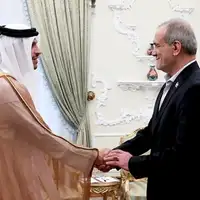
His remarks—particularly his effort to distinguish between the United States and Israel—angered many in the hardline camp. Critics insisted he should have treated the two as a unified threat.
“He should have explicitly named ‘America’ and the ‘Zionist regime’ and treated them as one and the same,” said a commentary in Javan, a newspaper linked to the Revolutionary Guards (IRGC).
The piece also mocked Pezeshkian for “maintaining a distinction between the real Trump and an imaginary one,” referring to his claim that Trump had the potential to “make the Middle East flourish and bring about a bright and peaceful future.”
Among his critics, Pezeshkian’s tone was seen not as strategic but submissive.
Lawmaker Meisam Zohurian argued the president should have portrayed Iran as a wronged but powerful nation, not “a wronged and beaten-down nation forced by fear to take refuge from one tyrant to its accomplice.”
No forgiveness for "God's Enemies"
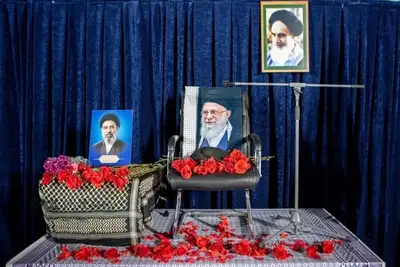
Hardliners also attacked Pezeshkian’s denial of two recent fatwas against Trump and Benjamin Netanyahu, issued after threats to Iran’s Supreme Leader Ali Khamenei.
“This is not specifically about the President of the United States or any other individual,” Pezeshkian told Carlson. “Religious scholars have expressed their scholarly views, but this fatwa in no way implies killing or threats.”
In contrast, the fatwas by Grand Ayatollahs Nasser Makarem Shirazi and Hossein Nouri-Hamedani invite Muslims worldwide to make those who threaten Khamenei and other senior clerics “regret their words.”
A provincial branch of Iran’s Organization for Islamic Propagation later offered a financial bounty for killing Trump.
Both fatwas declare anyone who threatens the Islamic umma (nation) and its leadership as muharib—an “enemy of God.” While not explicitly calling for execution, such a crime carries the death penalty under Iranian law.
Hossein Shariatmadari, Kayhan’s Khamenei-appointed editor-in-chief, dismissed Pezeshkian’s interpretation.
“Your information is flawed and inaccurate,” he wrote in an editorial on Wednesday. “Individuals such as Trump, Netanyahu, and some other U.S. officials fall under this ruling, and their punishment is execution.”
Forever "Death to America"
Pezeshkian was also condemned for softening revolutionary slogans.
Ultraconservative lawmaker Amir Hossein sabeti criticized him for detaching “Death to America” from U.S. leaders: “If this slogan isn’t directed at Trump, then who is it aimed at? A random employee at the New York tax office?”
“American officials issue orders to assassinate our people, officials, and scientists,” Sabeti added, “and you think you can win their hearts with such passive and romantic positions?”
Fereshteh Sadeghi, a hardline journalist, accused Pezeshkian of “degrading Iranian slogans, begging for recognition, whitewashing US crimes, and flattering Trump.”
Moderates' support
Not all responses were critical. Some reformists and moderates praised Pezeshkian’s outreach to the American public—especially Trump’s base.
“He exposed the gap between Trump's promises and performance, and debunked misconceptions in American society about Iranians’ hostility toward the American people,” wrote political analyst Ali Nasri, highlighting the interview’s anti-war message.
The silence of state broadcaster IRIB—dominated by ultraconservatives—also drew comment.
“If Ebrahim Raisi had appeared on Carlson’s show, the national broadcaster would have aired it multiple times across all channels,” said former advisor Abdolreza Davari.
The limited coverage of Pezeshkian’s appearance, he suggested, revealed the establishment’s unease.