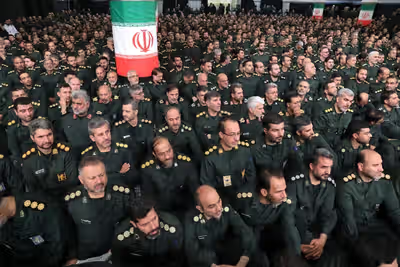
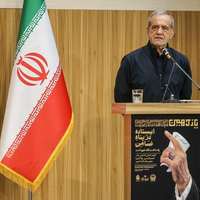
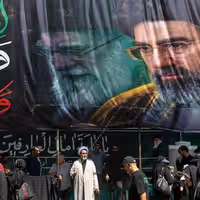
Iran's Supreme Leader Ali Khamenei during his speech. February 17, 2022
Iran's Supreme Leader Thursday suggested negotiators under president Hassan Rouhani had made errors and not heeded his advice when signing the 2015 nuclear deal.
"My criticism regarding the JCPOA (Joint Comprehensive Plan of Action) was that certain points had to be included to prevent problems from occurring in the future,” Ali Khamenei said in a speech video-linked to an audience in East Azarbaijan province.
Khamenei did not explain this advice but probably referred to his argument, first made in public in 2016, that the United States was not carrying out commitments to lift sanctions as required by the JCPOA. The leader’s speech also relates to Iran’s search in Vienna talks over reviving the JCPOA for US assurances that they will not again leave the deal as President Donald Trump did in 2018.
When Donald Trump won the 2016 US presidential election, calling the JCPOA “the worst deal in history,” and suggested in 2017 he would withdraw the US, Khamenei continued to express skepticism. In speeches in 2018 and 2019, he said he had warned the Rouhani administration of dangers in the JCPOA talks, but given the power structure in the Islamic Republic, every significant decision during talks with the West had to be cleared with Khamenei’s office.
In an interview with the Financial Times published Wednesday, Iran's Foreign Minister Hossein Amir-Abdollahian said Tehran had proposedthat the US Congress declare its commitment to a revived JCPOA as way to offer Iran guarantees over US intentions.
Agreement ‘non-binding'
With both Iran and the Biden administration this week signaled that Vienna talks to restore the 2015 deal might be nearing an end, opposition to the JCPOA in both the US and Iran remains live.
An overwhelming majority of Republican lawmakers in the US House of Representatives bluntly rebuffed the suggestion of a Congressional guaranteeover the JCPOA. Nearly 170 House members Wednesday sent a letter to President Joe Biden saying they view "any agreement" reached in Vienna not approved by the US Senate as "non-binding,” even if like the JCPOA ratified by the United Nations security council.
With this clear warning displayed on the billboard, if Khamenei allows an agreement in Vienna, the potential mistake could be worse than with the original JCPOA agreement. In 2015, there was more certainty that an agreement will stick, although there was some Congressional opposition. This time, Iran, including JCPOA opponents, are well aware that Republicans have a fair chance of winning majorities in Congress in November and perhaps the presidency in 2024.
Khamenei gave no indication in his Wednesday speech as to whether he thought a revived deal, restoring limits on Tehran’s nuclear program, was likely.
Hadi Moosavi, an Iranian journalist apparently living outside Iran, tweeted that Khamenei was "again" trying to protect himself by casting the blame on others. "So, what's the Leader's duty? It is against his legal and religious duties if he just sits there and says, 'I had said so'. I wish he would say what exactly was not heeded so we would know whether the current negotiation team is heeding them or not," Moosavi opined.
Khamenei in his speech argued that Iran needs civilian nuclear power for the future, but such a program would not need domestic uranium enrichment, as supplies are abundant on the world market. Russia already helps Iran maintain its power plant in Bushehr and has signed agreement to add new reactors. The Bushehr power plant has not been questioned by the United States and European powers.