Iran's Controversial Labor Minister Proclaims Purge Of Mangers

A cull is underway of 1,000 managers in Iran’s Ministry of Labour, the controversial minister Hojjat Abdolmaleki who is in charge said Saturday.
Iran International

A cull is underway of 1,000 managers in Iran’s Ministry of Labour, the controversial minister Hojjat Abdolmaleki who is in charge said Saturday.
“We estimate based on our evaluations that we need to remove around 1,000 individuals,” he told the official news agency (IRNA). “So far 350 of them have been removed or replaced but this will take time.” The minister suggested the ministry was top heavy in noting that there were 2,000 people “at the rank of director general and above in this organization.”
Abdolmaleki said that the administration of President Hasan Rouhani had hired people in the ministry with “connections to the media” and on the basis of their politics rather than qualifications.
The minister told Iran newspaper that security forces had supplied him with the names of over 100 journalists and social-media activists given jobs in entities under the ministry's control as board members or executive managers. He told the newspaper these included some found guilty by courts over the 2009 “sedition" – unrest following the disputed presidential re-election of Mahmoud Ahmadinejad – while others had been involved with a parliamentary ‘sit in’ by reformist deputies after the disqualification of around 4,000 candidates by the Guardian Council in the 2004 parliamentary election.
Abdolmaleki, who served as an economic adviser to Ahmadinejad when president, said those removed would inevitably stir up media controversy. "One of our investigations revealed the corruption of 92 percent of those who were in in managerial and higher positions," he said, adding that 120 cases had been prepared for the judiciary.
Hardliner media often refer to the populist Abdolmaleki, an alumni of the Revolutionary Guards (IRGC) Imam Sadegh University, as a "theoretician of resistance economy" and "expert in Islamic economy".
Abdolmaleki has proved a controversial minister. On January 15, the parliament’s presidium for the second time in less than a month blocked a motion to impeach him, brought from within the conservative camp that generally backs the Raisi administration. Lawmakers behind the two motions accused him of giving top jobs to political allies, mis-using ministry resources, and failing to deliver on promises of creating jobs.
State broadcaster IRIB has confirmed that Abdolmaleki allocated ministry money to a program on its Channel 3. The issue had been raised by parliament member Ahmad Alirezabeigi and some media outlets, who said this had come about after the minister had been invited to speak on the program several times.
There have been rumors of the Raisi administration intending to purge non-hardliners from government jobs. Last month, three university professors were fired for no real cause.

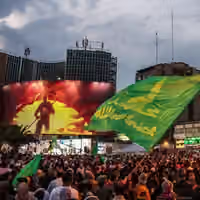
Iran’s President Ebrahim Raisi has thanked the people for their “enthusiastic” participation in the revolution day rallies, while evidence suggests otherwise.
Most photos and videos published by government-controlled media on Friday, the main day of celebrations for the 43rd anniversary of the 1979 revolution, showed no sign of hundreds of thousands of people that filled the streets in years past.
It has been common knowledge for Iranians for a long time that the government spends tremendous efforts to ensure a large turnout on revolution day, by forcing tens of thousands of state employees, students, soldiers, and paramilitary personnel to attend street marches. But this year, citing the danger of the Covid pandemic people were encouraged to come out with cars and motorcycles. As a result, participation dwindled.
But government-controlled media and officials praised the “epic” celebration of the revolution, a claim which is vitally important for regime insiders to show that the Islamic Republic is still relevant.
Videos published on social media showed Tehran residents shouting anti-regime slogans from their windows Thursday night, one day before the government-sponsored celebrations.
Critics of the Islamic Republic took this as a sign of the regime’s weakening legitimacy, especially considering last June’s presidential election, which had the lowest turnout in the 43-year history of the clerical government.
Persian social media became abuzz with posts mocking the regime for the sparse crowds at revolution day events, with photos and videos shared to show well-known venues being almost empty.
One Twitter user posted a photo of a crowd gathered to meet an Instagram celebrity in Kerman, next to a photo of a Tehran street on Friday and quipped that the crowd in the small provincial city was larger than the number of marchers in a main Tehran thoroughfare.
Another user tweeted the video of an imported sports car participating in the convoy of cars displaying flags on Friday and said that “Children of clerics are showing off their cars,” and added that they are displaying the fruits of their corruption and thievery.
A man sent a video to US-financed Persian broadcaster Radio Farda showing convoys of cars driving by and saying that regime loyalists are showing their expensive cars while people are hungry and look for food in garbage containers.
Ehsan Sam-Rajabi, an international judo champion tweeted that when he was a young member of the national team, the government bussed them to revolution day rallies to show numbers and that is what they do with all athletes, who are under the control of Revolutionary Guard personnel. Sam-Rajabi emigrated to the United States more than a decade ago and campaigns for athletic freedom as the Islamic Republic bans Iranians to compete against Israelis in sports.

Iran’s Azad University has fired 325 professors and lecturers in recent months and has decided now to dismiss 1,500 more, Iran International TV reported.
According to information received by the station, about 40 of the professors were from the southwestern province of Kurdistan while more professors were fired in provinces with substantial religious and ethnic minorities. The university has dozens of campuses around the country.
The former head of the recruitment board at the Islamic Azad University, who resigned in September wrote in his resignation letter that about 1,800 people were referred to the authorities for severance pay, and 325 were let go.
While many critics see the layoffs as further political cleansing of academia that has accelerated since Ebrahim Raisi took office, others point to the decrease in the number of university applicants in general because of the existing economic crisis and high inflation that has impoverished the middle classes.
However, in January other Iranian universities fired three distinguished professors in what was clearly seen as apolitical move against independent academic figures.
The Islamic Republic has conducted several ‘cleansing’ operations in universities, firing professors that it has deemed not committed to the regime. The most widespread firings took place right after the 1979 revolution and repeated during the presidency of Mahmoud Ahmadinejad, who forced many professors into retirement.

China’s large-scale efforts to control the Internet has become a viable conceptual and technical model for authoritarian regimes, like Iran's Islamic Republic.
China has combined legislative actions and technological enforcement to regulate the Internet domestically, deeming it “The Great Firewall” of China. Cybersecurity expert, Robert Potter, has said in a joint report, "China is known to be building a techno-surveillance authoritarian state domestically."
The Islamic Republic of Iran follows China’s lead in systematic oppression techniques. Shargh newspaper, a moderate publication by Iran’s authoritarian standards reported, Iran’s parliament is in the final stages of passing a bill called the ‘Cyberspace Users Rights Protection and Regulation of Key Online Services Bill’. Contrary to its name, this bill will restrict the internet and allow the Islamic Republic to gather and store citizens’ data. Under this legislation, Iran’s intelligence services and military will have authorized access to user’s data.
The Chinese Communist Party’s pursuit of surveillance is no secret. China is creating a global communications network to track and store sensitive security data. Business, intelligence, and military communications will increasingly go through an interconnected Chinese-built system. Huawei, the world’s largest telecom equipment maker, has deep ties to China’s government.
China’s second-largest telecom equipment maker, ZTE, sells to more than 500 carriers in more than 160 countries, 60 of which have questionable human rights records. In addition to selling services, China provides training programs that include subjects like ‘manipulating public opinion.’ One could China is strengthening authoritarianism in the digital age.

During a briefing at an annual security conference in Munich, United States’ officials have warned that China will use Huawei’s presence in future communication networks to steal corporate secrets, censor content, and track dissidents. Critics of China say the rapid rise of these tech companies stems from the theft of intellectual property. Huawei has done business with North Korea, helped Iran spy on their citizens, and created ‘back doors’ for easier intellectual property theft.
According to Zhenhua data leak, Chinese companies have harvested information from millions of foreigners on behalf of Beijing’s intelligence services. Having access to and embedding their equipment in Iran’s communication infrastructure allows China to intercept information, putting Iran’s security at risk. Data can be extremely valuable, as it lays the grounds for a country’s intelligence services’ decision-making. Chinese technology companies have reassured the public on multiple occasions that they would never share the data with the Chinese government. They may not have a choice in the matter. Article 7 of China’s National Intelligence Law requires organizations and citizens to, “support, assist and cooperate with the state intelligence work.” This law gives the Chinese government unauthorized access to data, undermining whatever assurance Chinese tech companies may make.

While some countries have erected barriers to contain China’s security threat and ‘hybrid warfare’, Iran’s regime has opened its arms to Chinese technology and embraced China’s utilization of technology against citizens. Chinese technology will bring more digital forms of oppression and surveillance to Iran, further worsening human rights issues.
China has been enabling heavier digital oppression in Iran since 2010. The timing was no coincidence. Following the 2009 disputed elections in Iran, widespread anti-government protests threatened to overthrow Iran’s regime. China’s assistance helped the Islamic Republic double down against dissent. Suppression of an ever-increasing number of critics is at the center of Iran’s domestic policies and the regime’s very survival. Iran’s notorious Revolutionary Guard in cooperation with the clergy have turned the country into a military-religious state determined to keep the ruling elite in power, looking to combine its system of oppression with technology.
Enter China. Iran’s regime looks up to China as the perfect prototype. China saw the opportunity in 2010 to provide a solution. A report by Reuters shows ZTE, sold Iran’s largest telecoms firm (TCI)a “powerful surveillance system capable of monitoring landline, mobile, and internet communications.” Iran’s regime has used these technologies on numerous occasions. The internet was shut down during a water crisis in Khuzestan and Esfahan. Internet shutdowns will limit the population’s ability to express discontent or communicate with each other and the outside world.
ZTE’s marketing team refers to this spying as a “turnkey solution for lawful interception.” A new system called ZXMT was installed into ZTE’s network, which helps utilize a “deep packet inspection”—a powerful and intrusive technology that can be used to track internet users, search for, and reconstruct email messages, block types of traffic, and even deliver web pages to users. In a 91-page document called, “Talking to the Future”, ZTE notes ZXMT systems can be utilized for military and national security agencies, adding that it would also be, “invisible to targets.” In other words, the Iranian government can trace every online request to blocked websites back to the user, without the user’s knowledge. Andrew Lewman, the executive director of The Tor Project, which helps dissidents in countries like Iran and China surf the internet undetected said, “Iran has been using deep packet inspection since 2010 to monitor and block internet traffic.”

Iran and China renewed their ties in 2022 by signing a 25-year strategic cooperation agreement. China plans to invest $400B in Iran, which includes a 4G-5G network, most likely provided by Huawei. Saeid Golkar, an expert on Iranian security, points out that Iran will either duplicate or buy these systems from China. He adds “As Iran becomes more digitized, I’m sure that we will see more digital forms of oppression and surveillance.”
China’s tech companies have targeted dictatorships and democracies alike. Britain has taken the financial bait, undermining its national security by trying to save money on a less expensive Chinese infrastructure. Thousands of public institutions in Britain currently have Chinese-owned security systems, like camera surveillance, watching students, government workers, and citizens. Britain’s Metropolitan Police, hospitals, and universities use Hikvision cameras—the same company enabling police agencies in Xinjiang to detain an estimated 3 million Muslim Uyghurs. A Chinese official anonymously leaked a 403-page set of internal papers to The New York Times hoping that it spreads the word. China runs over 1,000 concentration camps in Xinjiang, as part of a “People’s War on Terror,” where they have been accused of torture, sexual abuse, widespread sterilization, and the killing of detainees. Leaked files show that in one town alone, more than 400 children have lost one or both parents to some form of internment. China has denied all accusations of human rights abuses in Xinjiang and insists the detainees are in “vocational training” facilities. British officials and human rights campaigners say Chinese state-owned companies such as Hikvision and Dahua provide the “technological infrastructure” for the oppression of Muslim Uyghurs in China.
IPVM, the world's leading surveillance information source, reports Tiandy, another massive Chinese tech company linked to the oppression of Uyghurs, sells surveillance equipment to Iran’s government to be used in its military and law enforcement. Tiandy cameras are equipped with “facial recognition” as well as “ethnicity tracking” technology. The infamous “tiger chair,” a documented torture device, has been linked to Tiandy’s “smart” interrogation technology. The device is widely used on Uyghur detainees in Xinjiang. Uyghur survivors have confirmed these allegations in British courts. Families of those who speak on these crimes soon vanish or are apprehended. Authoritarian countries use these fear techniques to harass activists and stop the tales of their tyranny from being broadcasted to the world.
These surveillance systems are usually framed as necessary for combating rising crime and terrorism to keep citizens safe. However, these technological advancements are more often used to empower state crime and terror against citizens. The step-by-step guide to an authoritarian regime’s survival in the 21st century is to spy on, gather data from, censor and control knowledge of, and ultimately score citizens. Censorship and surveillance are not the Islamic Republic’s only two technological aspects of interest. Iran’s regime has implemented the Chinese “social credit” system, which is used to rate citizens based on their behavior, activities, and finances. China uses this system to blacklist millions of its own citizens and take away rights from citizens as they please. Individuals can be banned from flying, getting health insurance, and in some cases, getting fined to the point of financial ruin.Maya Wang, a senior China researcher for Human Rights Watch, says, “The social credit system gives a very powerful weapon to officials, in a country with very unbalanced relations between citizens and the government.” Iran’s regime shares this characteristic with China. The Islamic Republic’s record of crimes against humanity raises concerns, as China continues to enable them to rule with impunity.
To vividly illustrate how the Islamic Republic operates domestically, compare the severity of different types of crimes in the eyes of the Islamic Republic of Iran. According to a women’s rights NGO in Ahvaz, 60 women have fallen victim to ‘honor killings’ in the past two years in Iran. None of the perpetrators have been brought to justice, as most honor killings go unpunished. Rokna, the website that reported a recent honor killing of a 17-year-old in Ahvaz, was taken down by the government due to “publishing images and issues that violated public decency.” While the killers of the victims roam free, three Iranian women are serving 55-year sentences for disobeying the Islamic Republic’s dress code. They were charged for, "disrespecting compulsory hijab… assembly and collusion to act against national security… [and] encouraging and preparing the grounds for corruption and prostitution." In another case, a mother and daughter were jailed for 9 years for giving out flowers without headcovers as a form of peaceful protest to compulsory hijab. Providing a regime that implicitly condones ‘honor killings’, and peaceful protests as “crime” with the latest technology will only lead to catastrophe for their people.
There is no arguing technological advancements are extraordinary and humans have come a long way, but our future is in danger of being hijacked. China’s methods are spreading around the world and their propaganda machine is going to be embedded in democracies as well as dictatorships. China has already meddled in both the 2016 and 2020 U.S. Presidential elections. Facial recognition technology helps authoritarian leaders identify and prevent the organization of protests, and blacklist protestors. Authoritarian regimes will censor information, and brainwash citizens. Reporting on humanitarian issues in these countries will no longer be possible. Information will be controlled, and reality skewed. Authoritarians are using this technology to wage a war on our very basic freedoms. These leaders are behind disinformation campaigns that distract from the underlying truth that they see their people as an expendable human stock. Yeonmi Park, a North Korean survivor explains how China has enabled North Korea’s crimes for years in her book, In Order to Live. When she finally escaped North Korea, she said, “It amazed me how quickly a lie loses its power in the face of truth.”

There has always been controversy surrounding a picture of Ayatollah Ruhollah Khomeini disembarking from a plane in Tehran in February 1979, after a 15-year exile.
The plane brought Khomeini as well as over 100 of his close aides and as many reporters to a city that was less than two weeks away from a revolution that had started months ago and 10 days later toppled Mohammad Reza Shah, ending Iran 2,500-year-old monarchy.
Once in every few years, with the elimination of one or more of those seen alongside and behind Khomeini from the aircraft to the airport tarmac, the picture was doctored by in the Iranian press. This was repeated so many times that in some versions Khomeini was almost alone on the steps.

Several well-known political figures can be seen in various versions of the picture taken within seconds of each other before the ayatollah stepped onto the tarmac. Some of those who accompanied Khomeini ended up in tragic deaths. These include Dariush Forouhar who was slain with his wife Parvaneh in 1998 by Iranian intelligence officers at their home for opposing the clerics. He was labor minister in the first revolutionary government.
Abolhassan Banidsadr, one of the ayatollah's hosts in France, became Iran's president but was ousted a year later and fled to France where he died in 2021. Ayatollah Hassan Lahouti whose sons were married to former President Akbar Rafsanjani's daughter was reportedly killed in a prison in Tehran and his death was portrayed as suicide by prison wardens. Sadeq Qotbzadeh, the first head of Iran's state TV in the Islamic Republic was executed on charges of plotting to kill Khomeini and overthrow his regime only a few years later. Ayatollah Morteza Motahari, the chairman of the revolutionary council and a close Khomeini aide was killed in the street only a few months after the revolution.

Khomeini's other companions had a better fate. Sadegh Tabatabai, whose sister was the wife of Khomeini's son, Ahmad, was the spokesman of the first Islamic government. Later, as war broke out with Iraq he was reportedly involved in purchasing weapons for Iran and in one incident he was arrested in Germany for being in possession of a large amount of narcotics. But his case was later dismissed by a German court. He died in Germany of cancer in 2010.
Mohammad Ali Sadoughi, also seen in most pictures became the Friday Prayer Imam of Yazd in central Iran and died of natural causes in 2011. Meanwhile, Mohammad Musavi-Khoiniha, a young cleric who was the leader and mentor of the young students who occupied the US embassy in Tehran in November 1979 was also among Khomeini's companions. He held several government positions until he reportedly stopped his political activities in 1990 when the Guardian Council barred him from the assembly of experts.
Khomeini's son, Ahmad, who also accompanied his father in this journey and was his confidant until the ayatollah's death, died in a mysterious incident in 1995 that was reported as a heart attack. Recently an Iranian journalist, Hossein Dehbashi, wrote on social media that the cause of his death was drug abuse. The journalist was forced to withdraw the post after a day. Another journalist, Emad Baghi, quoted regime insiders as having said that Ahmad was killed by Iranian intelligence officers.
Finally, was the French-Algerian Captain who ushered Khomeini into Tehran's Mehrabad airport. Khomeini probably did not want to be helped by any of the Iranians around him to avoid lending unnecessary prominence to anyone among his aides. It was later disclosed, but not verified, that the captain was married to an Iranian woman and the couple's two children still frequently visit Iran. Rumor has it that he stayed in Tehran until 2015 when he died. Some reports have said that he was among the security agents the French government had assigned to protect Khomeini while he was in France.

Iran relies on its own abilities and resources and does not pin “hopes on Vienna and New York,” President Ebrahim Raisi said during Friday Prayers in Tehran.
The president was speaking on the 43rd anniversary of the 1979 revolution on February 11, as government-organized marches and rallies took place across the country. The anniversary coincided with Friday prayers and Raisi delivered a speech at the venue of the weekly gatherings in Tehran University.
The celebrations were a hodgepodge of motorcycles and cars driving in streets and people marching on foot, although crowds were smaller than in previous years apparently because of the Covid-19 pandemic, although the government had not announced any restrictions.
Raisi emphasized economic self-reliance and diplomatic “balance” condemning any tilt towards the West. Self-reliance has been a persistent tenet of the Islamic Republic since its establishment in 1979, as its founder, Ayatollah Ruhollah Khomeini campaigned against Iran’s alliance with the United States during the monarchy.

As relations deteriorated with Washington with the taking of US diplomats hostage in Tehran in November 1979, the motto of self-reliance became an alternative to maintaining cordial relations with the West. But its economic cost has been incalculable, with anemic growth for four decades and eventually confrontation over its nuclear program and severe sanctions.
Raisi’s remark about not pinning hopes on Vienna could be directed at the United States, as Washington warns little time remains for an agreement to revive the 2015 nuclear agreement. Iran’s economic situation in February 2022 is much worse than during any previous anniversary of its revolution. A nuclear agreement in Vienna could lift sanction imposed by former president Donald Trump and provide billions of dollars to the embattled government in Tehran.
Raisi’s remark about Vienna was not mentioned by state-controlled media immediately after his speech, but later they added the sentence to their reports. Videos showed that the president tried to sound decisive when he uttered the sentence.
No one knows what he meant when he mentioned New York alongside Vienna. Some began joking on social media that he probably meant Washington DC, but New York came to his mind as the capital of the United States.
Raisi came to office six months ago with lofty promises to improve the economy despite sanctions, but nothing has changed on the ground as high inflation and soaring food prices continue.
Iranian pundits and politicians have been warning of a social explosion if economic conditions do not improve in coming months. On Thursday, videos emerged of people shouting anti-regime slogans from their windows at night. “Death to Khamenei” chants were broadcast by loudspeakers in the bazaar in Mashhad on Thursday, as the PA system was apparently hacked, and a recording of incendiary slogans rang out for a while. Videos showed bewildered shopkeepers and shoppers listening to chants.
Raisi also emphasized “economic independence” but acknowledged that Iran has a long way ahead to achieve economic security. He emphasized the need for investments, while even in case of a nuclear agreement, large corporations would hardly take risks to invest because of a state-controlled economy, corruption and risk of sanctions returning.