Sri Lanka To Barter Tea To Settle $250 Million Iran Oil Debt

To settle its $251 million debt to Iran, Sri Lanka will barter tea in monthly instalments of $5 million, because of United States sanctions on Iranian banking.

To settle its $251 million debt to Iran, Sri Lanka will barter tea in monthly instalments of $5 million, because of United States sanctions on Iranian banking.
Head of Iran’s Trade Promotion Organization, Alireza Peyman-Pak and Sri Lanka Minister of Plantation, Ramesh Pathirana signed the barter agreement in Colombo on Tuesday.
Pathirana said that the deal makes it possible for the Ceylon Petroleum Corporation to settle its debts with the National Iranian Oil Company without violating US sanctions.
“This scheme will not violate any UN or US sanctions since tea has been categorized as a food item on humanitarian grounds while none of the black-listed Iranian banks will be involved in the equation,” read a statement by Sri Lanka’s plantation ministry.
According to the agreement, Sri Lanka’s Treasury will release equivalent of $5 million in rupees every month to the Sri Lanka Tea Board - a state-run industry regulator– that will then pay individual exporters in rupees at the central bank’s exchange rate.
Iran is among the top 10 importers of Ceylon Tea for the past several decades although purchases have declined following US sanctions.
Iran is trying to increase barter deals amid sanctions. “We have the lower hand and we have to make concessions, which means we have to accept any goods at any price”, Hamidreza Salehi, a member of Tehran’s Chamber of Commerce, has said.
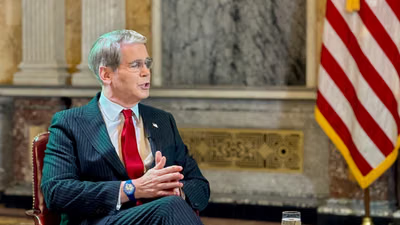
A senior Iranian politician has called for closer cooperation with Taliban, saying the Islamic Republic should have a key role in aiding Taliban’s intelligence.
Mohammad-Javad Larijani, who was a top advisor to Supreme Leader Ali Khamenei in foreign affairs and a former head of Iran’s High Council for Human rights, made the remarks in an interview published on Wednesday.
He said cooperation with the Taliban government is an opportunity for Iran that shouldn’t be missed.
He told Tasnim news agency, affiliated to Iran’s Revolutionary Guard Corps, that Iran’s good relations with the late anti-Taliban leader Ahmad Shah Massoud -- also known as the Lion of Panjshir -- is not a reason to support Ahmad Massoud, the son of the veteran guerrilla commander who has vowed to continue resistance against Taliban.
Larijani, who is currently the chairman of the Iranian Institute for Research in Fundamental Sciences, acknowledged that there are a lot of bad beliefs in Taliban’s ideology, saying that “this new modernized version of Taliban seems to give up on some of their bad ideas because they are not practical, at least temporarily”.
Taliban's victory in August was welcomed by Iran's hardliners as a big defeat for the United States, although some criticized calls to cooperate with "reformed" Taliban.

Food and housing expenses in Iran have increased between 300 to 740 percent in the past six years, while wages went up by around 270 percent, a new report says.
The comparison between prices in December 2015 and now is revealing in one important respect. Iran was still under international sanctions six years ago after the nuclear agreement was concluded but economic restrictions were officially still in place. Prices did not change much after sanctions were lifted in early 2016 until the United States imposed new sanctions in 2018, with a devastating impact on the country’s economy.
Fararu website in Tehran has compared prices for this period, without any commentary but the comparison is interesting in the sense that rising prices are closely linked with the fall in the value of Iran’s currency.
The rial has dropped by 732 percent in six years, or rather from December 2017, when it became apparent that Donald Trump was likely to pull out of Barack Obama’s nuclear deal with Iran and impose sanctions.
One can argue that Iran had held up much better during international economic sanctions from 2011-2015, compared with how it has coped with Trump 'maximum pressure'. One reason could be that around the time when international sanctions were imposed global oil prices were hovering around $100-110 a barrel, which provided Iran with a cushion of dollar reserves. In contrast, Trump imposed sanctions on Iran’s oil exports when the average price was $70 a barrel in 2018.
The oil price of $100 in early 2010s was equivalent to 120 dollars in 2018. So, Iran was earning substantially more from its oil exports around 2010 than it did in 2018 after a big price collapse that had started in 2014.
While the US dollar rose 730 percent, housing costs climbed 740 percent on average. This has put a tremendous pressure on wage earners as in some cases rents eat up almost all of a worker's salary.
The main reason why housing costs have increased in par with the value of the dollar is that Iranian real estate owners regard their investment as a hedge against devaluation and ask prices and rents that keeps their income intact in dollars. Sale of properties can decrease, but no one is willing to sell homes and apartments at a loss calculated in dllars. Rents are a different story, as owners ask for more knowing that renters have no other choice.
Beef and chicken prices have also increased by over 300 percent, while Iranian-produced rice, which is a main food staple, has gone up by 500 percent.
The Fararu report calculates that in contrast with much higher prices, wages and salaries have increased by around 270 percent in six years, reaching a maximum of around $140 per month. There is little difference of income between a factory worker and an office employee or a young professional.
In fact, the income of workers in large industrial companies is safer than in smaller services firms which in many instances pay less to employees.
Iranian labor groups say that the minimum monthly salary needed for a family of 3.3 persons should be $400 to afford basic food and housing.
The economic hardship people face has created a potentially explosive political environment where a repeat of mass protests can take place at any moment, according to even government-controlled media in Iran.

More than 20 people were injured as two metro trains collided in the Iranian capital Tehran on Wednesday.
The accident occured on the Line 5 of the Tehran metro on the Karaj-Golshahr railway when a high-speed train enroute to Sadeqieh station hit a slow-moving local train near the Chitgar station. Line 5 of the metro stopped operating after the incident.
Mojtaba Khaledi, the spokesman for the national emergency services, said that 22 people sustained injuries in the incident and ambulances that were dispatched to the site of the accident transferred 11 people to nearby hospitals. Two of of the injured are in critical conditions. He added that about 20 other people had been stuck in the wagons but were moved out by rescue workers.
Tehran Mayor Alireza Zakani said there are some speculations about the cause of the collision, but further investigation is needed to find out exactly how it happened.
According to Mojtaba Shafi’i, the deputy for transportation in Tehran’s municipality, the wagons are being removed from the railway so that the lines become operational as soon as possible, suggesting that trains can be back on track about noon.

Iran has begun preparations to deal with the Omicron Covid-19 variant a top health official said Wednesday and added that its impact will be felt next week.
Nader Tavakoli, the deputy of the coronavirus task force in Tehran said hospitals and clinics are on alert and are expanding emergency room services in anticipation of more infections with Omicron.
Tavakoli said that because of the much faster infection rate of this variant, hospitals will set up quick examination facilities outside emergency rooms. He added that so far there is no uptick in patient visitations because the Omicron virus “has entered the country only recently”.
Iran confirmed the first Omicron case on Sunday, December 19, saying that two more suspected cases were under investigation. Tavakoli said that there are not sufficient kits to test every suspected case.
Iran has reportedly vaccinated about 60 percent of its 84-million population with two doses of Covid vaccines, mainly the Chinese-made Sinopharm and the Russian Sputnik-V.
Although fatal cases have been decreasing during the past few weeks due to vaccination, the Omicron may push the death rate to a new peak in the upcoming cold winter months. A new study has indicated that Sinopharm and Sputnik vaccines are weaker against Omicron.

Visiting US National Security Adviser Jake Sullivan and Israeli Prime Minister Naftali Bennett discussed Iran and the ongoing nuclear talks in a meeting on Wednesday.
Bennett's office, which issued video of the meeting, said in a statement that the two discussed Iran and world powers' efforts to renew the 2015 nuclear deal.
"What happens in Vienna has profound ramifications for the stability of the Middle East and the security of Israel for the upcoming years," Bennett told Sullivan, referring to the site of the negotiations with Iran.
Israel is not a party to those talks. It has long hinted that, should it deem diplomacy a dead end, it could resort to military force to prevent Iran gaining the means to make a bomb.
Iran denies seeking nuclear weapons.
Sullivan said he had been sent to Israel by President Joe Biden "because at a critical juncture for both our countries on a major set of security issues, it's important that we sit together and develop a common strategy, a common outlook".
Top-selling Israeli newspaper Yedioth Ahronoth ran an interview with the country's incoming air force chief in which he was asked if his corps was poised to attack Iran "tomorrow", if required. "Yes," responded Major-General Tomer Bar.
Reuters report