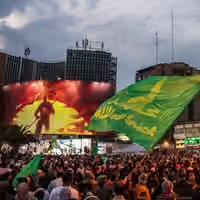
Blast At US Outpost In Syria, No American Injuries -US Officials

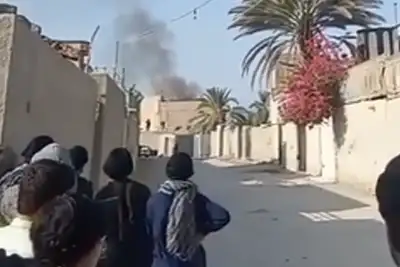
A US outpost in southern Syria was attacked on Wednesday, but there were no reports of any American casualties from the blast, US officials told Reuters.

A US outpost in southern Syria was attacked on Wednesday, but there were no reports of any American casualties from the blast, US officials told Reuters.
The officials, speaking on the condition of anonymity, said it was too early to say who was responsible for the attack.
One of the officials said it was believed to have been a drone attack.
The garrison, known as Tanf, is located in a strategic area near Syria's Tanf border crossing with Iraq and Jordan.
The garrison was first set up when Islamic State fighters controlled eastern Syria bordering Iraq but since the militants were driven out, it is seen as part of the larger US strategy to contain Iran's military reach in the region.
Tanf is the only position with a significant US military presence in Syria outside the Kurdish-controlled north.
While it is not common for attacks on the US troops at the outpost, Iranian-backed forces have frequently attacked American troops with drones and rockets in eastern Syria and Iraq.
Report by Reuters

US special envoy for Iran Rob Malley met the Saudi foreign minister to assess the talks between Iran and world powers aimed at reviving the 2015 nuclear deal.
Rob Malley had earlier been to Qatar in a tour conferring with Arab Gulf states. The Saudi news agency SPA reported the envoy met with Prince Faisal bin Farhan al-Saud, Saudi foreign minister, in Riyadh on Wednesday to discuss both the nuclear talks and "joint action to stop Iranian support for terrorist militias."
In an interview October 13 Malley reiterated that the US wanted to revive the 2015 deal − the JCPOA, the Joint Comprehensive Plan of Action − in its original form rather than attach new conditions over regional defense and security.

Saudi Arabia, which opposed the JCPOA and backed former president Donald Trump in leaving the deal in 2018, wants the US to introduce new issues, including Iran’s missile program and links with regional allies. Saudi Arabia and Iran have backed opposing sides in Syria and Yemen, and Riyadh has never reconciled itself to Iran’s increased influence in Iraq since the US-led 2003 invasion topped Saddam Hussein.
Saudi Arabia has tempered its approach since US president Joe Biden took office in January committed to restoring the JCPOA and has held a series of exploratory talks with Iran in Baghdad designed to explore easing tensions.
But with JCPOA talks in Vienna suspended since June, first for Iran’s presidential election and then the transition, and with the difficulties the talks had faced in reaching agreement, Saudi Arabia and the US may be mulling alternatives should the talks fail.
Malley has said Washington is ready to consider "all options," while Prince Faisal last week warned of a "dangerous" acceleration in Iran's nuclear program.
The Vienna talks struggled to agree which US sanctions − including the ‘maximum pressure’ sanctions levied by Trump in 2018 − violate the JCPOA and exactly how Iran should bring back within JCPOA limits its nuclear program, which it has expanded quantitatively and qualitatively since 2019.
Analysts’ chatter around the talks has suggested that the US might look to include Iran’s regional role in talks, or at least seek Tehran’s commitment to ‘follow-on’ talks. There have also been reports that Tehran wants concrete guarantees that the US would not again walk away from an agreement it first signed and then voted for in the United Nations Security Council.

A bomb attack on an army bus in Damascus on Wednesday killed at least 14 people, followed by army shelling in rebel-held Idlib that killed 11 civilians.
The attack on the rebel-held town of Ariha, which took place shortly after the Damascus bombing, had caused the biggest civilian death toll in the Idlib area since March 2020, the Syrian Observatory for Human Rights said.
There was no immediate claim of responsibility for the Damascus bombing, which hit a bus carrying army personnel in the middle of the city at around 6:45 a.m. (0345 GMT), state television reported.
A military source quoted by state media said the bus was blown up by two bombs that had been attached to the vehicle in advance. A third device was defused by an army engineering unit.
Attacks in Damascus have been rare since the army crushed rebel enclaves around the city with backing from Russia and Iran-backed forces in 2018.
Islamic State militants still operate in the deserts of central and eastern Syrian desert, where they have mounted several attacks this year on army vehicles.
Northwestern Syria is the last major stronghold of rebels fighting Assad. The witnesses and rescue workers said shelling struck residential areas of the rebel-held town of Ariha shortly after the Damascus bomb attack.
Turkey's state-run Anadolu Agency said government forces and Iran-backed groups targeted a marketplace in the Ariha town center.
Reporting by Reuters

Israeli Defense Minister Benny Gantz has appeared before a key Knesset committee to argue for a higher defense budget, citing Iran as the major threat.
Gantz said the most significant threat Israel faces is Iran and its nuclear program, adding the armed forces need the means to confront the danger.
“We see that Iran is advancing toward the level of enrichment that would allow it, when it wished, to become a threshold state — and we are making every effort to prevent that. We will invest in our offensive and defensive capabilities, improve our technological superiority, and accelerate our efforts to ensure that — even though Iran is foremost a global and regional challenge — Israel will always have the ability to defend its citizens with its own forces,” The Times of Israel quoted him as saying.
Israel’s channel 12 reported Monday that a budget of roughly $1.5 million is being allocated to procure the necessary weapons to confront Iran if it refuses to return to nuclear talks with Western powers.
Gantz also said that a higher budget is needed for a two-front war, a possible reference to a conflict with Palestinian groups in Gaza or with the Lebanese Hezbollah, both backed by Tehran.

The leader of Lebanon's Iran-backed Hezbollah has declared for the first time on Monday that his powerful militant group has 100,000 trained fighters.
Hassan Nasrallah disclosed the size of the Shiite group's militant arm in his first speech since seven people were killed in gun battles on the streets of Beirut on Thursday.
The confrontation erupted over a long-running probe into last year's massive port blast in the city.
Verifying the numbers of the largely secretive militant group is difficult. If true, it would be larger than Lebanon's armed forces, estimated to at about 85,000. Nasrallah’s claim could also be a scare tactic against opponents in Lebanon.
Hezbollah is also present in Syria, where it has been fighting as part of an array of Iranian-backed forces to help save Bashar al-Assad from his opponents in the civil war.
Thursday's clashes saw gunmen battling each other for several hours with automatic rifles and rocket-propelled grenades in the streets of Beirut.
It was the most violent confrontation in the city in years, echoing the nation's darkest era of the 1975-90 civil war.

Mahmoud Ahmadinejad ended his Dubai trip on Sunday after the Iranian Consulate prevented him from holding a press conference, sources told Iran International.
Officials blocked reporters entering the venue, the Iranian Club Dubai, the sources in the United Arab Emirates said. The Iranian Club Dubai is a luxury hospitality center belonging to the state-affiliated ‘charitable’ Mostazafan Foundation. Later in the evening Ahmadinejad returned to Tehran prematurely.
This was the former president's first visit abroad since his second term ended in 2013. Media supporting Ahmadinejad had said that he was going to visit Expo 2020, a trade fair.
Principlist media claimed that Ahmadinejad had been deported by UAE police. It had become clear he was up to "political games and populist activities" that would undermine Expo 2020, Jahan News wrote Monday.
The reason for his early departure is not clear. It could have been a request by Emirati authorities or an order from Tehran for him to return.
The Revolutionary Guards-affiliated Fars news agency Sunday called Ahmadinejad's trip a "desperate attempt to be seen" that ended when he was "advised by UAE authorities" to return to Tehran.
Ahmadinejad's trip was well publicized by supporters and had sparked speculation a foreign travel ban had been lifted. Ahmadinejad criticized Supreme Leader Ali Khamenei for calling the June 18 presidential election an "epic" event, after he was barred from the poll. Ahmadinejad’s presidency saw him disagree with Khamenei, notably when heboycotted government meetingswhen the leader insisted that Heydar Moslehi remain intelligence minister.
Ahmadinejad gave an interview in Dubai to Independent Persian website covering relations with the United States, the Taliban, Saudi Arabia, the nuclear issue, Syria, and Yemen.
In the interview Ahmadinejad said he would not call himself an opposition figure. "I'm an Iranian and like any other Iranian I have a right to live and to express my views," he said. "If now someone is sitting at the head of the state, the country is not his, the country belongs to everyone and everyone has a right to express their views.”
In a video taken at Tehran's International Imam Khomeini Airport after his return, Ahmadinejad said he had intended to stay in Dubai three days but had extended his visit for two more. He promised "a full report” on his visit.
Some Iranian media last week published photos of Ahmadinejad with a woman claiming it was taken at the Israeli pavilion at the trade fair, while pro-Ahmadinejad media denounced this as a trick to tarnish Ahmadinejad's image. "Whoever says Ahmadinejad visited the Zionist regime's pavilion is a Mossad agent," Mohammad-Hossein Heydari, a pro-Ahmadinejad journalist tweeted.
Pro-Ahmadinejad lawmaker Ahmad Alireza-Beigi, who accompanied him to Dubai, dismissed an attempt to mislead the public. "The publication of this type of misinformation proves that Ahmadinejad's international popularity has worried those who lack such popularity and don't have similar travel chances," he said.