• العربية
  • فارسی
BrandBrand
  • Iran Insight
  • Politics
  • Economy
  • Analysis
  • Special Report
  • Opinion
  • Podcast
  • Live TV
  • Iran Insight
  • Politics
  • Economy
  • Analysis
  • Special Report
  • Opinion
  • Podcast
  • Live TV
  • Theme
  • Language
    • العربية
    • فارسی
  • Iran Insight
  • Politics
  • Economy
  • Analysis
  • Special Report
  • Opinion
  • Podcast
  • Live TV
All rights reserved for Volant Media UK Limited
volant media logo

Iran’s navy chief says multiple operations planned to break US naval blockade

Nov 28, 2026, 06:15 GMT+0

Iran has planned to carry out multiple military operations to break the US naval blockade, the commander of its navy said on Friday evening.

“Not just one operation, but multiple operations lie ahead that will make this happen,” Shahram Irani said in a televised interview.

He added that the ultimate goal of the operations was not to break the blockade but to drive US forces out of the entire Middle East, saying they must also leave the Indian Ocean.

He added that the United States had effectively blockaded itself and accused Washington of disrupting regional security.

Most Viewed

Iran rapidly builds underground complex near nuclear sites – US institute
1

Iran rapidly builds underground complex near nuclear sites – US institute

2

Trump deploys extra aircraft carrier, says Iran is making ‘big mistakes’

3

Iran faces global condemnation over Kuwait attack that killed two Italians

4

Iranian truckers’ strike spreads to more cities on fifth day, union says

5

Syria seizes Revolutionary Guards weapons bound for Lebanon, CENTCOM says

Banner
Banner
Banner
Banner
Banner
Banner
Banner

Spotlight

  • Iran cries wolf over nuclear treaty withdrawal
    ANALYSIS

    Iran cries wolf over nuclear treaty withdrawal

  • Who flogs a singer? The ‘public decency’ case against Parastoo Ahmadi
    PODCAST

    Who flogs a singer? The ‘public decency’ case against Parastoo Ahmadi

  • A dark, cold office: Pezeshkian's austerity gesture backfires

    A dark, cold office: Pezeshkian's austerity gesture backfires

  • Iranian women break silence on a lifetime of violence
    VOICES FROM IRAN

    Iranian women break silence on a lifetime of violence

  • Too poor to marry, young Iranians are offered religious workarounds
    INSIGHT

    Too poor to marry, young Iranians are offered religious workarounds

  • Iran faces year-end cash squeeze if US blockade holds
    INSIGHT

    Iran faces year-end cash squeeze if US blockade holds

  • A broken leg and broken trust: Violence in Iran’s schools
    VOICES FROM IRAN

    A broken leg and broken trust: Violence in Iran’s schools

•
•
•

More Stories

Iran cries wolf over nuclear treaty withdrawal

Nov 28, 2026, 03:57 GMT+0
•
Behrouz Turani
100%
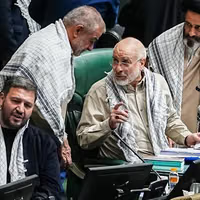
Iranian parliament speaker Mohammad Bagher Ghalibaf (center) speaks with fellow lawmakers during a session of the Majlis in Tehran, November 21, 2026

Another bill to withdraw Iran from the Nuclear Non-Proliferation Treaty was introduced in parliament this week, as repeated threats to abandon the treaty appear to be losing their force.

The double-urgency bill, registered by MP Mohammad Manan Raisi on November 22, would automatically trigger withdrawal if Iran's nuclear facilities were attacked again, without requiring a further parliamentary vote.

It is the latest in a series of initiatives. Ebrahim Rezaei, spokesman for the Majlis National Security Committee, has said at least ten withdrawal bills have been registered. None has reached a floor vote.

Six years of stalled motions

The pattern goes back to January 2020, when a withdrawal motion was tabled after the E3 triggered the JCPOA dispute mechanism. Foreign Minister Mohammad Javad Zarif warned that Iran would leave the treaty if its nuclear file were referred to the UN Security Council.

The warnings resurfaced after the June 2025 war. In September, following the activation of snapback sanctions, one MP declared a withdrawal motion "finalized and ready for a vote".

In March 2026, as US and Israeli strikes resumed, Malek Shariati submitted a triple-urgency bill. Six months later, 32 former officials signed an open letter calling for withdrawal.

Each effort stalled. One MP complained that the Majlis presiding board had blocked the bill last year. The Supreme National Security Council has never endorsed withdrawal.

Asked earlier this week whether Iran would leave the NPT, Foreign Ministry spokesman Esmaeil Baghaei replied: "So far no decision on this has been communicated to us."

Former foreign minister Manouchehr Mottaki, a supporter of withdrawal, said all 290 MPs would vote in favour if the Supreme Leader approved. His remark underscored the central reality: parliament makes the threats, but the decision rests elsewhere.

A diminishing threat

Iran's restrictions on international nuclear inspections have also complicated the significance of any formal withdrawal.

The IAEA has been unable to verify Iran's near-weapons-grade uranium stockpile since the June 2025 bombing campaign. Before inspections were disrupted, Iran had about 440 kilograms of uranium enriched to 60%, potentially enough for ten nuclear weapons if further enriched and weaponized, according to IAEA Director General Rafael Grossi.

With inspectors already denied access to much of Iran's nuclear programme, withdrawal would not necessarily change monitoring immediately. But it would mark a significant legal and diplomatic break.

Even some opponents of withdrawal favour maintaining treaty membership without restoring inspections. Tehran MP Mohammad Seraj argues that Iran should remain in the NPT while refusing IAEA inspectors access.

Critics inside the system

Seraj told Khabaronline that leaving would signal an intention to acquire a nuclear weapon and cause Iran to "lose our friends". He noted that the United States, Russia and China all oppose such a move.

Ali Jannati, culture minister during Hassan Rouhani's presidency, told Jamaran that advocates of withdrawal fail to understand how profoundly it conflicts with Iran's national interests. Even discussing the idea, he argued, could increase the risk of war.

Former MP Heshmatollah Falahatpisheh has argued that withdrawal would conceal parts of the nuclear programme without serving any national objective.

Esmail Gerami Moghaddam of the Etemad-e Melli party called the bill a trap that would strengthen claims Iran seeks a bomb.

Others object to the timing. Ahmad Bakhshayesh Ardestani, a member of the National Security Committee, has argued that Iran should leave only after acquiring a nuclear weapon. Announcing withdrawal beforehand, he says, would impose the costs without delivering any deterrent benefit.

The case for withdrawal

Advocates of withdrawal remain vocal.

Hossein Shariatmadari, the leader-appointed chief of hardline daily Kayhan, argues there is no reason for Iran to remain in the treaty after attacks on its nuclear sites.

IRGC-linked Tasnim News maintains that withdrawal would not signal a pursuit of nuclear weapons but would end what it calls "espionage" under the cover of IAEA inspections.

The ultraconservative Paydari Front has called for withdrawal, while the Assembly of Experts recently described a review of NPT membership and Iran's defence doctrine as "an unavoidable necessity".

Calls now come from Friday prayer pulpits, state television and the Expediency Council. Yet none of the parliamentary initiatives has secured the political approval needed to proceed.

What an exit would cost

Tehran's strongest argument abroad is that it is a treaty member whose nuclear facilities came under attack while subject to international safeguards. Leaving would weaken that argument and strengthen the case advanced by the United States and Israel.

It would also strain relations with important partners. The Kremlin has publicly opposed withdrawal.

The NPT requires three months' notice for withdrawal. Such an announcement could increase pressure on Washington and Israel to consider military action before Iran's departure took effect.

Withdrawal could also make a negotiated settlement, and the prospect of sanctions relief, considerably more difficult.

Iran is already subject to UN sanctions and a US-led oil embargo. Producer inflation reached 120% during the summer, while quarterly growth is estimated at minus 14%. Further isolation would add to the pressure on an already strained economy.

A warning sign, not leverage

Raisi's bill is therefore best understood as an attempt to deter further attacks and an instrument in the Majlis's internal factional battles, rather than a clear roadmap to withdrawal.

The repeated initiatives have produced no change in Iran's treaty status, while exposing disagreements within the Islamic Republic over whether abandoning the NPT would strengthen national security or undermine it.

The threat's remaining significance lies less in its deterrent value than in the possibility that it could help trigger the very conflict its supporters claim to be trying to prevent.

Hezbollah-linked plot in Jordan points to wider Iranian ambitions, researcher says

Nov 28, 2026, 02:56 GMT+0
100%
A Jordanian flag flies over the capital city, Amman, Jordan. REUTERS

A Jordanian court has upheld a six-year sentence with hard labor against a man convicted over an equestrian club project funded by Iran-backed Hezbollah, a case an Israeli researcher says points to Tehran’s ambitions in the kingdom.

Jordan’s Court of Cassation unanimously upheld the conviction of Yasser Marji, a Lebanese-French national, for acts threatening public order and endangering public safety and security, Jordanian news agency Madar Al-Saa reported on Tuesday, citing a ruling it had exclusively obtained.

The court found that Hezbollah had provided around $430,000 to establish an equestrian club and academy in the southern port city of Aqaba as a cover for illegal activities.

Hezbollah denied the allegations on Wednesday, saying it had no involvement in the case and accusing its detractors of seeking to portray the group as a threat to the security and stability of Arab countries.

According to the ruling, Marji had maintained ties with Hezbollah operatives for several years and received military and security training in Lebanon.

He established a company and entered into business agreements with Jordanian partners who were unaware of the source of the funding. Jordanian intelligence arrested him in June 2025.

Marji argued on appeal that the project was a legitimate investment and challenged the court’s reliance on statements he made during the investigation.

The court rejected his arguments, ruling that witness testimony, business agreements and evidence concerning financial transfers supported his conviction under Jordan’s anti-terrorism law.

The current management of the Aqaba Equestrian Club also distanced itself from the case, saying the investigation concerned a previous venture and that the club now operates under Jordanian ownership and management.

Iran’s ambitions in Jordan

The Hezbollah official identified by the Jordanian court as having assigned Marji the task in late 2023 was Hassan Badir, who was killed in an Israeli airstrike in Beirut on April 1, 2025.

The Israeli military said at the time that Badir belonged to Hezbollah’s Unit 3900 and Iran’s Quds Force, the overseas operations arm of the Islamic Revolutionary Guard Corps (IRGC).

In a report published Thursday, Tal Beeri of Israel’s Alma Research and Education Center argued that Badir’s involvement pointed to a wider Iranian effort to gain a foothold in Jordan.

The reported court findings, however, do not establish that Tehran directly ordered or financed the Aqaba operation.

Beeri said the fall of Bashar al-Assad in Syria in December 2024 and the military setbacks suffered by Iran-backed Hezbollah in Lebanon could make Jordan increasingly important to Tehran as a potential front against Israel and a means of supporting Palestinian armed groups in the West Bank.

More than a year earlier, in September 2025, Jordanian security sources told Iran International that Iranian recruitment and financing activities in the kingdom had intensified.

In April 2025, Jordan announced the arrest of 16 people accused of involvement in a security plot. A Jordanian security source subsequently told Iran International that Hamas members had conducted training in Lebanon while Hezbollah had provided facilities and expertise.

The same source said Tehran had sought to establish a front in Jordan even before Hezbollah suffered major losses in Lebanon.

A senior Jordanian official, however, drew a distinction between Iran’s ambitions and its ability to pursue them, saying the setbacks in Syria and Lebanon had weakened Tehran’s capacity to act against Jordan.

Iran violently arrests Oscar-nominated writer, tortures him for confession

Nov 28, 2026, 01:35 GMT+0
100%
Mehdi Mahmoudian

Iranian authorities transferred journalist, human rights activist and Oscar-nominated screenwriter Mehdi Mahmoudian to Greater Tehran Prison after severely beating and torturing him in an attempt to extract a confession, according to his mother and his Telegram channel.

In recent months, Mahmoudian had used his channel, Khabaraneh-ha, to report on political prisoners and impending executions. On Tuesday, a day before his arrest, he published an execution notice for Milad Armoon and Navid Najaran, two political prisoners detained in connection with the 2022 Woman, Life, Freedom uprising.

Mahmoudian co-wrote Iranian director Jafar Panahi’s It Was Just an Accident, which won the Palme d’Or at the 2025 Cannes Film Festival.

Security agents raided Mahmoudian’s home on Wednesday, seized his electronic devices, including his phone and laptop, and took him to a security police facility, Khabaraneh-ha reported.

Officers repeatedly slapped Mahmoudian across the face with such force that he struck nearby doors and walls, the channel said.

They repeatedly placed plastic bags over his head in an attempt to force him to confess, causing his body to shake violently. Several bags tore and were replaced, the channel said.

Officers also forced Mahmoudian’s head between his legs and beat him, according to the report. He lost consciousness, and emergency medical personnel took him to hospital.

After several hours in hospital, Mahmoudian was returned to the detention facility. The channel said the judge on duty mocked his account of the torture, disregarded his physical condition and took no action to investigate the officers’ conduct.

Mahmoudian’s mother, Fatemeh Alvandi, gave further details in a video posted on Khabaraneh-ha on Friday. She recounted a phone conversation with her son after hours of uncertainty about where he was being held.

She said officers had tried to suffocate him during his arrest by placing a plastic bag over his head and twisting it around his neck. She said he lost consciousness after a blow to the chest and spent four to five hours at Sajjad Hospital before being returned to custody.

The Committee to Protect Journalists (CPJ), citing a source close to Mahmoudian, said he told his family in a brief phone call on Thursday that beatings by security forces had left him with visible injuries.

Reporters Without Borders (RSF) condemned Mahmoudian’s arrest and reported torture and called for his immediate release.

“Journalism saves lives, and Mehdi Mahmoudian’s courage deserves to be celebrated,” Jonathan Dagher, head of RSF’s Middle East desk, said Thursday.

Oslo-based Iran Human Rights on Friday expressed grave concern over Mahmoudian’s condition and called for his immediate and unconditional release, independent medical care and unrestricted access to a lawyer.

Its director, Mahmood Amiry-Moghaddam, said Mahmoudian’s reporting had helped halt the two executions and urged the international community to demand accountability for his torture.

Arrest follows publication of execution notice

The new case against Mahmoudian stems from his publication of the execution notice for Armoon and Najaran, who were sentenced to death in what is known as the Ekbatan case. Judicial authorities described the document as confidential.

Mahmoudian was formally charged with “propaganda against the state” and “spreading falsehoods” before his transfer to Greater Tehran Prison.

In his Tuesday post, Mahmoudian denounced the death sentences as unjust and urged lawyers, journalists, civil society groups and the international community to intervene.

“Tuesday may be the last chance to save their lives,” he wrote.

Relatives and friends of the two prisoners gathered outside Ghezel Hesar Prison in Karaj that evening to protest the planned executions. Iranians abroad held similar demonstrations.

Mohammad Hossein Aghasi, Armoon’s lawyer, said early Wednesday that his client’s execution had been halted. Dadban, a legal aid and education organization, separately cited a source who said Najaran had been returned to the prison’s general ward.

The judiciary’s Mizan news agency said Wednesday that both death sentences remained in force. It also warned lawyers and political activists pursuing the case that authorities were monitoring their activities.

Alvandi said she was proud of her son’s efforts to prevent the executions and questioned why he was being punished for trying to save lives.

“My son’s crime was saving two young men from execution. Is that such a terrible crime?” she said.

Citing Mahmoudian’s injuries, loss of consciousness and hospitalization, Khabaraneh-ha called for immediate access to independent medical care, a forensic medical examination to document evidence of torture and access to a lawyer.

Greater Tehran Prison, which holds hundreds of political prisoners and detained protesters, has faced persistent overcrowding, food and drinking water shortages, poor sanitation and restricted access to medical care. Some prisoners have been forced to sleep on the floor.

Nearly two decades of reporting on abuses

Mahmoudian’s recent work on Khabaraneh-ha has included documenting death sentences handed down to people detained during the January 2026 protests, examining legal inconsistencies in the sentences of Armoon and Najaran and publishing articles opposing capital punishment.

On January 28, Mahmoudian and Panahi were among 17 Iranian activists, filmmakers and lawyers who signed a public statement condemning Supreme Leader Ali Khamenei and the violent crackdown on anti-government protesters. Mahmoudian was arrested on January 31 and released on February 17, according to CPJ.

On August 13, Mahmoudian said an eight-month prison sentence for “propaganda against the state” had been upheld. He said he had already spent eight years and three months in prison and did not expect justice from a court that had sentenced dozens of young people to death.

His latest arrest came a month after a Tehran court sentenced Panahi to five years and one month in prison and ordered the confiscation of his assets.

In a separate post on Tuesday, Mahmoudian said authorities at Tehran’s Darvazeh Dowlat metro station had searched passengers’ phones, including his own. He warned that searches long used against activists and journalists had become part of daily life for ordinary Iranians.

Over nearly two decades of reporting and advocacy, Mahmoudian has exposed the torture of detainees at the Kahrizak detention center, reported on conditions at Evin Prison and documented the obstacles members of Iran’s Baha’i community face in burying their dead.

He has also condemned the crackdown on the November 2019 protests, spoken out over the Revolutionary Guards’ downing of a Ukrainian passenger plane and sought accountability for Iranian officials’ handling of the COVID-19 pandemic.

OPEC+ set to keep oil output targets steady amid Iran war uncertainty

Nov 28, 2026, 01:11 GMT+0
100%
Oil/Chemical Tanker "Bald Man" at the Port of Fujairah, as the U.S.-Israel conflict with Iran limits marine traffic in the Strait of Hormuz, in Fujairah, United Arab Emirates, May 6, 2026. REUTERS

OPEC+ has reached a preliminary agreement to keep oil production targets unchanged in the first quarter of 2027 amid uncertainty over the Iran war and disagreements over members’ production capacity, Reuters reported Friday.

Oil ministers from the group, which includes OPEC members and allies such as Russia, are due to meet Sunday to discuss production policy for next year.

The meeting comes amid renewed attacks on tankers in the Strait of Hormuz and Saudi energy infrastructure, raising concerns over further disruptions to global oil supplies.

Brent crude recorded its first weekly gain in November despite falling 1.2% on Friday to $95.44 a barrel.

Energy consultancy Rapidan Energy Group expects OPEC+ to leave production targets unchanged on Sunday, citing uncertainty over the duration of the Iran war and its impact on crude production and exports.

Despite the risk of further supply disruptions, Rystad Energy forecasts a global oil surplus of around five million barrels per day in 2027, equivalent to roughly 5% of global demand, even if Persian Gulf supplies recover only partially.

The International Energy Agency said last week that the war had already resulted in cumulative losses of 2.8 billion barrels of oil supplies from the Persian Gulf.

The agency also said stronger energy-security measures in response to the war could reduce global oil demand by more than 4% by 2035 compared with its scenario based on governments’ stated policies.

Differences over how much individual members should be allowed to produce have also complicated negotiations over next year’s output targets.

OPEC+ had planned to use the findings of its first review of members’ production capacity to help set quotas for 2027, but several countries are seeking higher capacity estimates.

Iraqi Oil Minister Basim Mohammed Khudair said Friday that Baghdad was negotiating with OPEC for a higher production quota to support the development of its energy infrastructure.

Iraq, OPEC’s second-largest producer, is dissatisfied with a preliminary assessment putting its production capacity at 4.9 million barrels per day. Kazakhstan is also seeking a higher estimate, Reuters reported earlier this week.

Russian Deputy Prime Minister Alexander Novak said Wednesday that the capacity review would be completed by the end of the year.

Iraq has warned it could leave OPEC unless its quota is raised, following the United Arab Emirates’ withdrawal from both OPEC and OPEC+ earlier this year over longstanding disagreements about its production quota. Angola left OPEC in early 2024.

Baghdad has also faced pressure from Washington over its membership. In a separate report Friday, Reuters said the Trump administration had encouraged Iraq and Venezuela to consider leaving OPEC earlier this year.

Who flogs a singer? The ‘public decency’ case against Parastoo Ahmadi

Nov 27, 2026, 21:55 GMT+0
•
Negar Mojtahedi
100%
Parastoo Ahmadi is an Iranian artist and singer.

A woman can sing a wordless melody in some settings in Iran. When she sings lyrics, authorities can weigh whether her voice might arouse men. That’s how music researcher Siavash Rokni explains the religious thinking behind restrictions on women’s singing.

Parastoo Ahmadi’s case shows how Iran enforces its rules on public decency. A court deemed her concert video obscene and immoral. Ahmadi and four men who helped stage the concert each received 74 lashes.

Ahmadi performed without a hijab at the historic Deir-e Gachin Caravanserai near Qom in December 2024. There was no audience in the courtyard. The recording drew millions of views online.

In June, a Qom court convicted Ahmadi and eight members of her concert team of “offending public decency” by producing and publishing the video. It sentenced all nine to 74 lashes each and barred them from leaving Iran or pursuing artistic and musical activities for two years.

On November 23, authorities carried out the floggings of Ahmadi and four of the men at the prosecutor’s office in Qom, their lawyer Mostafa Nili said. He identified the men as concert organizer Mohsen Lashkari and musicians Soheil Faghih-Nasiri, Amin Taheri and Amirali Pirnia.

Who decides when a woman’s voice is ‘indecent’?

Iranian authorities generally bar women from singing solo before audiences that include men. Women can sing in a chorus or perform solo for women-only audiences. They have also sung lullabies and children’s songs on television and performed at some regional folk music festivals.

In an interview with Eye for Iran, Rokni traced the distinction to the writings of Ayatollahs Ruhollah Khomeini and Ali Khamenei. “The voice of woman is not haram,” he said, describing their interpretation. “It is when the voice of women incites excitement that it becomes haram.”

A male countertenor can sing in the same range as a woman and be permitted to perform, Rokni said. The distinction he described turns in part on who is singing, whether she is singing words and how authorities judge the effect of her voice on a listener.

Rokni said the definition of public indecency gives judges room to decide what crosses the line. In Ahmadi’s case, the charge concerned the production and publication of the concert video.

The men who stood with her

“When we’re dealing with flogging, this is a form of torture or other cruel, inhuman, or degrading punishment. There is an absolute prohibition,” international human rights lawyer Gissou Nia told Eye for Iran.

Nia pointed to the International Covenant on Civil and Political Rights, which binds Iran. The UN Human Rights Committee has said the treaty’s prohibition on torture and cruel, inhuman or degrading punishment extends to corporal punishment.

The punishment of the four men, Nia said, shows how a system she describes as gender apartheid also harms men who challenge it. They helped put a woman onstage and received the same number of lashes she did.

“It’s really important to remember that men are victims of these gender crimes as well,” Nia said. “The bravery of them in expressing that solidarity with their bodies is quite significant.”

In March 2025, Iranian singer Mehdi Yarrahi also received 74 lashes, his lawyer Zahra Minooei said. He was arrested in 2023 after releasing Rousarieto, or “Take Off Your Headscarf,” a protest song challenging compulsory hijab. After Ahmadi and her team were flogged, Yarrahi shared footage of her concert in solidarity.

The fear a flogging can spread

Azadeh Afsahi, a psychotherapist and founder of Iran House who works with survivors of political violence, said the punishment was meant to instill fear and shame in people who step outside the rules. Flogging can damage a person’s sense of agency, she said, and signal to others what they risk when they speak up or support someone who does.

In Ahmadi’s case, Afsahi saw people rally around the singer. She said the men who helped stage the performance reflected a shift she has seen since the Woman, Life, Freedom movement, with men more willing to take risks in support of women’s freedom.

Afsahi said both trauma and resilience can pass from one generation to the next.

Kiyah Willis, an American fellow at the Objective Standard Institute who made videos about Ahmadi’s case, said she spoke out because Iranian women’s experiences are often overlooked in US conversations about women’s rights. Some viewers had assumed Iranian women broadly supported compulsory hijab, she said. For those viewers, Willis said, the flogging showed how far the state would go to enforce its rules.

“These Iranian stories don’t get told,” Willis said.

Condemnation abroad and a father’s pride

Amnesty International had urged Iran to halt the floggings. After the sentences were carried out, France condemned the punishment, UN human rights chief Volker Türk called it “abhorrent,” and US Ambassador to the UN Mike Waltz called it “pure medieval barbarism.”

Ahmadi’s father, Amir Ahmadi, said he was proud of his daughter’s courage. He described the flogging as a symbol of oppression against art and the women of Iran.

You can watch Eye for Iran on YouTube or listen on any podcast platform.