Iran to halt regional oil exports if it cannot export its own, deputy speaker says
Smoke rises in the Fujairah oil industry zone, caused by debris after interception of a drone by air defenses in the United Arab Emirates on March 14, 2026.
Iran’s deputy parliament speaker threatened on Thursday to block oil exports from across the region if Iran’s own exports are halted, saying the only way to confront the United States was “a blockade for a blockade.”
“If Iran’s oil is not exported, no oil will leave the region,” Hamidreza Hajibabaei said.
He warned that if countries in the region helped the US in the Strait of Hormuz or elsewhere in the Persian Gulf, “the Islamic Republic will target that entire area.”
Hajibabaei said Tehran would consider any attempt to export oil by bypassing the Strait of Hormuz “a legitimate target” for attack if the aim was to bring down oil prices and help the US and Europe.
“Anyone who takes such action to help the US economically is at war with the Islamic Republic,” he said.
He also raised the possibility of a change in Iran’s defense doctrine. “If necessary, we will change our defense doctrine,” he said.
“In the event of any new aggression, we will use all legitimate means and capabilities at our disposal to strike our enemies anywhere in the world,” the MP said.
Former military chief Gadi Eisenkot, Israeli Prime Minister Benjamin Netanyahu, heads of parties and other Israeli officials gather for a family photo on the day of the inauguration of Israel's 26th parliament, at the Knesset in Jerusalem, November 10, 2026. REUTERS/Ronen Zvulun
Israeli opposition leader and former military chief Gadi Eisenkot has intensified his warnings against renewed military strikes on Iran as interim Prime Minister Benjamin Netanyahu presses US President Donald Trump to resume the war, The Washington Post reported on Wednesday.
Netanyahu will convene his security cabinet on Thursday evening amid Israeli and US preparations for a possible military operation against Iran, The Times of Israel reported, citing the office of an Israeli government minister.
The meeting also comes amid warnings that Iran could launch a surprise attack on Israel, the report said.
“I see no direct and immediate threat from Iran today that would require Israel to act before a new government is formed,” Eisenkot said Monday at a party meeting in parliament.
Eisenkot accused Netanyahu last week of blurring the distinction between national security and his own political survival, warning that Israel was entering dangerous territory.
Netanyahu on Monday accused his political opponents of downplaying security threats for political reasons and renewed his call for a national unity government.
Netanyahu believes Iran is seeking to replenish its missile stockpiles and rebuild its air defenses and that the country is particularly vulnerable to renewed military action, a person familiar with deliberations inside his office told The Washington Post.
Netanyahu has repeatedly contacted Trump and dispatched senior officials to Washington to make the case for renewed strikes on Iran, according to the report.
Mossad chief Roman Gofman traveled to Washington this month for talks with CIA Director John Ratcliffe and White House envoy Steve Witkoff, presenting Israeli intelligence on alleged Iranian efforts to develop chemical weapons and pressing for a resumption of the war, Axios previously reported.
However, officials in Mossad’s research division have found no immediate need for military action against Iran in several recent discussions, according to Israeli newspaper Haaretz.
Eisenkot acknowledged that Iran continued to pose serious security threats to Israel but said the priority should be addressing Tehran’s remaining stockpile of 440 kilograms of enriched uranium, which has yet to be destroyed or removed.
The dispute comes as Eisenkot seeks to form a governing coalition following Israel’s October 27 election, which left Netanyahu without a parliamentary majority.
Netanyahu’s critics accuse him of using the prospect of renewed war to pressure Eisenkot into forming a national unity government or derail coalition negotiations and force another election.
Eisenkot’s bloc holds 48 of the Israeli parliament’s 120 seats. He has until December 6 to form a government, with a possible two-week extension.
If Eisenkot fails, Netanyahu could be given an opportunity to form a government. If neither succeeds, Israel would face another election, with Netanyahu remaining caretaker prime minister in the interim.
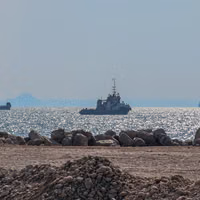
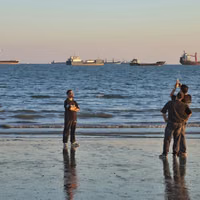
Vessels in the Strait of Hormuz, Persian Gulf. (ISNA)
Iranian economists have warned that alternative trade routes and domestic economic measures cannot fully offset the loss of oil revenues caused by the US naval blockade, despite assurances from Tehran that the country can withstand the pressure.
The warnings come as Washington points to the growing impact of the blockade on Iran’s oil exports.
US Treasury Secretary Scott Bessent said Wednesday that Iran had exhausted its floating oil stocks and had not loaded a tanker since Washington launched Operation Economic Outcast in August.
US Secretary of State Marco Rubio recently said the economic damage inflicted by the blockade had been so significant that President Donald Trump no longer saw a need for a large-scale military operation.
Oil exports suffer as Iran seeks alternative routes
Before Washington first imposed its naval blockade in April, Iran exported approximately 1.5 million barrels of crude oil a day to China, its largest customer. The United States reinstated the blockade in July.
In recent months, Iran has reportedly exported limited quantities of petroleum products, including fuel oil and liquefied petroleum gas (LPG), by road to neighboring countries such as Pakistan and Afghanistan. Some natural gas and jet fuel have also reportedly been transferred through ship-to-ship operations east of the Strait of Hormuz.
Writing in the economic daily Donya-ye Eqtesad on October 18, economic analyst Hamid Mollazadeh argued that these limited exports could not compensate for the loss of crude oil shipments.
Iranian officials and some Iranian media outlets have promoted land routes as an alternative for exporting oil and importing goods, but economists have warned of their limited capacity.
Energy expert Hamid Hosseini wrote in the reformist newspaper Shargh on November 2 that potential exports to Tajikistan, Uzbekistan, Pakistan, Turkey, and Iraq’s Kurdistan Region could collectively reach no more than 250,000 to 300,000 barrels a day.
That would amount to no more than a fifth of Iran’s previous crude exports to China.
Hosseini argued that overcoming the blockade would require a diplomatic solution.
Pouya Jabal Ameli, editor-in-chief of Donya-ye Eqtesad, warned in a September 21 editorial that even with alternative export routes, Iran’s foreign currency revenues could fall to approximately one-fifth of their pre-blockade levels.
He said oil revenues had previously accounted for around 35% of government funding, making it difficult to cover the shortfall in the near term without resorting to inflationary policies.
Jabal Ameli estimated that even under the most optimistic assessments, 40% of Iran’s population was already living below the poverty line before the blockade because of sanctions.
He warned that the latest restrictions could push at least two more income deciles into poverty by the end of the Iranian calendar year in March 2027.
In a separate October 5 article published by Eghtesad Ba Ma, he argued that monetary and foreign exchange policies alone could not resolve the crisis and that improving Iran’s international relations was necessary to give businesses a clearer economic outlook.
Economists warn of mounting pressure on government finances
The economic consequences extend beyond lost oil revenues.
Economist Morteza Afghah told Shargh last week that the prolonged military standoff and continuing blockade would put further pressure on Iran’s economy and government finances.
He said the mere prospect of war created uncertainty and discouraged investment, while actual trade restrictions and the naval blockade compounded the damage.
Afghah said short-term measures such as selling state-owned companies, borrowing from the Central Bank and issuing government bonds, all used under former President Hassan Rouhani, could not replace oil revenues in the long run.
Others argue that Iran can cushion some of the economic damage.
Saeed Leilaz, an economist affiliated with the centrist Executives of Construction Party who opposes concessions to Washington, told state television’s Jahan Ara program on Tuesday that the blockade represented the greatest economic shock in Iran’s history.
He said the blockade should be treated like a military conflict but argued that Iran could withstand its effects through sound economic policies and efforts to combat corruption.
Disruptions to imports raise concerns
Beyond disrupting maritime trade, the blockade has also restricted Iran’s access to the foreign currency needed to finance imports.
At least 75% of Iran's foreign trade was previously conducted by sea. The blockade has effectively eliminated the possibility of importing nonessential goods by sea.
Officials have sought to ease concerns over supplies, pointing to strategic reserves and alternative routes for imports.
On Wednesday, First Vice President Mohammad Reza Aref sought to reassure the public, saying increased cargo unloading and customs clearance at border crossings outside southern Iran showed the country could withstand the US naval blockade.
He said stocks of essential and strategic goods were in good condition and called for measures to prevent prices of basic goods from rising for at least three months.
Consumer prices in October were 88.7% higher than a year earlier, while food and beverage prices rose 112.6% year-on-year, according to the Statistical Center of Iran.
To illustrate the capacity of Iran’s land borders, Leilaz cited official estimates putting annual smuggling at $35 billion. He argued that the figure could reach $50 billion without intervention by law enforcement authorities.
Although he acknowledged that shortages and difficulties were inevitable in some sectors, he maintained that a country with thousands of kilometers of land borders could not face a severe import crisis.
Washington has also announced Task Force Iron Gate, an initiative aimed at restricting the movement of weapons and sanctioned materials across Iran’s land borders and the Caspian Sea.
Foreign Minister Abbas Araghchi said Monday that Iran’s size and extensive cross-border trade made a land blockade nearly impossible to enforce.
Hardliners call for military action to break blockade
Hardliners, meanwhile, have called for military action to break the blockade rather than relying on alternative trade routes or negotiations.
The hardline newspaper Kayhan has described negotiations with Washington as an “operation of deception,” arguing that military action is needed to break the blockade.
The newspaper has called for Iranian attacks on oil facilities and US companies in the region in response to the blockade, arguing that such action could increase pressure on Washington from regional countries.
In an October 21 article, Jam-e Jam, a newspaper affiliated with state broadcaster IRIB, argued that breaking the blockade could both restore oil revenues and end the prolonged military standoff.
The competing approaches highlight the divisions within Iran over how to respond to Washington's pressure: whether to rely on economic adaptation and diplomacy, or to pursue a more confrontational strategy aimed at forcing the United States to reconsider the blockade.
B‑1B Lancer bomber at the RAF Fairford airbase, after police declared a major incident at the base after several men were arrested on suspicion of offences under the Explosives Act, in Fairford, Gloucestershire, Britain, September 28, 2026. REUTERS/Toby Shepheard
Britain’s Royal Air Force (RAF) is moving military aircraft into hangars and hardened shelters at night to protect them from potential drone attacks amid growing security threats, including suspected Iranian plots targeting British airbases, Sky News reported on Wednesday.
The RAF is also reportedly considering installing anti-drone netting to protect aircraft that remain exposed at military bases.
Iran is suspected of plotting to target RAF Fairford in Gloucestershire, an airbase used by US bombers during the war with Iran. The threat prompted the Pentagon to evacuate bomber aircraft from the facility.
The United States has also relocated military aircraft from a second British airbase following reports of another suspected Iranian threat.
British and US authorities have brought charges against five men in connection with the suspected IRGC-linked plot targeting RAF Fairford in September.
On November 10, US prosecutors announced charges against three men, including a suspect accused of coordinating activities through coded telephone calls while detained in a New York jail. Two other men have been charged in Britain in connection with the suspected plot.
British authorities assessed the suspected Fairford plot as highly likely to have been coordinated in Iran and almost certainly directed by the IRGC, Parliament was told on October 12.
Iranian Foreign Minister Abbas Araghchi rejected Britain’s accusations in a September 30 post on X, pointing to the release on bail of suspects arrested in connection with the Fairford incident.
“I can confirm Iran's belief that releasing supposed terrorists working for foreign states really says it all,” Araghchi wrote, adding: “You're barking up the wrong tree.”
RAF chief Air Chief Marshal Harv Smyth said on Tuesday that the air force was preparing for a scenario where “there is no sanctuary at home, you are fighting from the UK but you need to get on the move.”
Smyth stressed the importance of dispersing military aircraft across multiple locations and maintaining operational readiness in the event of a conflict.
The measures also come amid concerns over Russian sabotage. Britain’s domestic intelligence agency MI5 and the Ministry of Defence warned British companies supplying military equipment to Ukraine on Tuesday that they faced an increased risk of Russian sabotage.
Members of the Iraqi armed group Kataib Hezbollah stand, in Jurf al-Sakhar, Babil province, Iraq, November 20, 2026. REUTERS/Alaa Al-Marjani TPX IMAGES OF THE DAY
Iran-backed Kataib Hezbollah has moved military equipment and established new positions in western Iraq for a possible renewed US-Iran war, while retaining its strongholds despite a government withdrawal order, according to Iraqi media and US think tanks.
Iraqi newspaper Al-Mada reported on Wednesday, citing informed sources, that Kataib Hezbollah had transferred large quantities of military equipment to western Iraq and established new military positions.
The Institute for the Study of War (ISW) and the Critical Threats Project (CTP) said in a separate report that Iran-backed Iraqi militias had threatened and reportedly drawn up plans in recent weeks to attack US assets if the United States and Israel resumed strikes on Iran.
Esmail Qaani, commander of the Islamic Revolutionary Guard Corps (IRGC) Quds Force, traveled to Baghdad last week and held talks with senior Iraqi militia leaders in an effort to defuse tensions between Kataib Hezbollah and the Iraqi government.
A senior member of Iraq’s Iran-backed Badr Organization previously told Iraqi Kurdish media that Iraqi Prime Minister Ali al-Zaidi and Qaani had reached a written draft agreement to redeploy some Kataib Hezbollah forces to western Anbar province, ISW-CTP said.
The institutes also assessed that Iran-backed Iraqi militias were almost certainly behind drone surveillance of the US Embassy in Baghdad in October, describing it as an attempt to deter Washington from striking Iran.
Militia retains control of Jurf al-Sakhar
Iraqi government security forces had not entered the core areas controlled by Kataib Hezbollah in Jurf al-Sakhar, five days after Iraqi forces began deploying to the area, Al-Mada reported.
The militia had received fresh reinforcements, while Iranian and Houthi advisers remained in the area, according to the report.
The newspaper said the Iraqi army’s deployment had been limited and that federal police had merely reorganized their existing presence without taking control of additional territory.
Zaidi last week ordered Kataib Hezbollah to withdraw from Jurf al-Sakhar, which the militia has controlled since 2014, after Iraqi officials accused the group of operating an oil-smuggling network that diverted hundreds of millions of dollars’ worth of state-owned oil.
Kataib Hezbollah denied the allegations, describing them as part of a campaign to force it to surrender its weapons.
Iraqi security forces began deploying to the area on Friday under a negotiated compromise aimed at averting an armed confrontation. Under the agreement, Kataib Hezbollah fighters were expected to withdraw to other parts of Iraq.
Militia fighters integrated into state forces
More than 2,000 Kataib Hezbollah members have been incorporated into the militia-affiliated 72nd and 79th brigades of Iraq’s Popular Mobilization Forces (PMF), according to Al-Mada.
Previously paid directly by the militia, the fighters will now receive state-funded salaries and benefit from official institutional protection, the sources told Al-Mada.
ISW-CTP said integrating the fighters into the PMF did not reduce the threat they posed to US interests, arguing that brigades controlled by Iran-backed Iraqi militias answer to Tehran rather than the Iraqi prime minister.
The institutes assessed that the integration may be part of Zaidi’s efforts to balance US demands for the disarmament of militias with Kataib Hezbollah’s insistence on retaining its weapons.
Designated a terrorist organization by the United States, Kataib Hezbollah is among Iran’s most powerful militia allies in Iraq and has resisted calls to disarm amid mounting US pressure on Baghdad to bring armed factions under state control.
The group is among several Iraqi militias that have claimed attacks on US forces in Persian Gulf states since the start of the US-Israeli war against Iran.
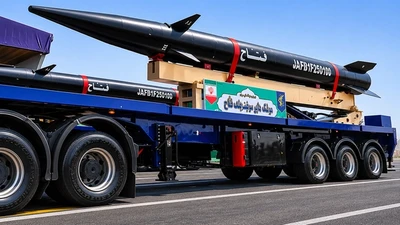
Visitors walk among missiles on display at the Islamic Revolutionary Guard Corps (IRGC) Aerospace Park, which opened to the public in November.
Iran stepped up its warnings against the United States, Israel and Arab countries in the Persian Gulf on Wednesday, threatening new military capabilities and demanding compensation from regional states it accused of facilitating attacks on its territory.
The combative rhetoric came as US officials claimed their blockade and sanctions campaign had brought Iranian oil exports to a standstill, depriving Tehran of a vital source of revenue.
Hassan Hassanzadeh, commander of the Islamic Revolutionary Guard Corps (IRGC) in Greater Tehran, said Iran's defense, missile and drone capabilities were “increasing day by day.”
“If the United States and Israel make another mistake, they will witness the unveiling of new targets, weapons and offensive plans,” he said.
Iran also directed its warnings at Arab countries in the Persian Gulf, accusing several of knowingly facilitating US and Israeli attacks by providing access to their territory, airspace, military facilities and logistical resources.
Iran's representative to the United Nations said those countries were legally obliged to compensate Tehran fully for the resulting damage.
US Treasury Secretary Scott Bessent said Wednesday that Iran had exhausted its floating oil stocks and failed to load a single tanker since Washington launched Operation Economic Outcast in August.
“The Iranian regime is a sinking ship,” Bessent wrote on X, adding that Iran “doesn’t have a drop of oil on the water left to sell.”
The economic pressure has also been reflected in Iran's currency, which fell to another record low on Tuesday, with the dollar reaching 2.856 million rials on Tehran's open market after Washington imposed fresh sanctions on Iranian financial networks.
But Revolutionary Guards spokesman Hossein Mohebbi said statements by American military commanders showed Washington was struggling to sustain the blockade.
He predicted that military exhaustion and mounting financial costs would force the United States to abandon its blockade and withdraw its forces from the region.
Mohebbi, however, said Washington would soon discover that its blockade was futile. He said Iran's armed forces remained fully prepared in equipment, resources and morale.
Meanwhile, China urged Washington and Tehran to keep the door to negotiations open, with Beijing's ambassador to Iran, Cong Peiwu, saying Wednesday that de-escalation and a return to talks should be the immediate priorities.
Cong said China supported a diplomatic settlement of the nuclear dispute and efforts to reach a comprehensive agreement over the Strait of Hormuz.