Eisenkot sees no urgency to strike Iran, Netanyahu pushes for renewed war
Former military chief Gadi Eisenkot, Israeli Prime Minister Benjamin Netanyahu, heads of parties and other Israeli officials gather for a family photo on the day of the inauguration of Israel's 26th parliament, at the Knesset in Jerusalem, November 10, 2026. REUTERS/Ronen Zvulun
Israeli opposition leader and former military chief Gadi Eisenkot has intensified his warnings against renewed military strikes on Iran as interim Prime Minister Benjamin Netanyahu presses US President Donald Trump to resume the war, The Washington Post reported on Wednesday.
Netanyahu will convene his security cabinet on Thursday evening amid Israeli and US preparations for a possible military operation against Iran, The Times of Israel reported, citing the office of an Israeli government minister.
The meeting also comes amid warnings that Iran could launch a surprise attack on Israel, the report said.
“I see no direct and immediate threat from Iran today that would require Israel to act before a new government is formed,” Eisenkot said Monday at a party meeting in parliament.
Eisenkot accused Netanyahu last week of blurring the distinction between national security and his own political survival, warning that Israel was entering dangerous territory.
Netanyahu on Monday accused his political opponents of downplaying security threats for political reasons and renewed his call for a national unity government.
Netanyahu believes Iran is seeking to replenish its missile stockpiles and rebuild its air defenses and that the country is particularly vulnerable to renewed military action, a person familiar with deliberations inside his office told The Washington Post.
Netanyahu has repeatedly contacted Trump and dispatched senior officials to Washington to make the case for renewed strikes on Iran, according to the report.
Mossad chief Roman Gofman traveled to Washington this month for talks with CIA Director John Ratcliffe and White House envoy Steve Witkoff, presenting Israeli intelligence on alleged Iranian efforts to develop chemical weapons and pressing for a resumption of the war, Axios previously reported.
However, officials in Mossad’s research division have found no immediate need for military action against Iran in several recent discussions, according to Israeli newspaper Haaretz.
Eisenkot acknowledged that Iran continued to pose serious security threats to Israel but said the priority should be addressing Tehran’s remaining stockpile of 440 kilograms of enriched uranium, which has yet to be destroyed or removed.
The dispute comes as Eisenkot seeks to form a governing coalition following Israel’s October 27 election, which left Netanyahu without a parliamentary majority.
Netanyahu’s critics accuse him of using the prospect of renewed war to pressure Eisenkot into forming a national unity government or derail coalition negotiations and force another election.
Eisenkot’s bloc holds 48 of the Israeli parliament’s 120 seats. He has until December 6 to form a government, with a possible two-week extension.
If Eisenkot fails, Netanyahu could be given an opportunity to form a government. If neither succeeds, Israel would face another election, with Netanyahu remaining caretaker prime minister in the interim.
Vessels in the Strait of Hormuz, Persian Gulf. (ISNA)
Iranian economists have warned that alternative trade routes and domestic economic measures cannot fully offset the loss of oil revenues caused by the US naval blockade, despite assurances from Tehran that the country can withstand the pressure.
The warnings come as Washington points to the growing impact of the blockade on Iran’s oil exports.
US Treasury Secretary Scott Bessent said Wednesday that Iran had exhausted its floating oil stocks and had not loaded a tanker since Washington launched Operation Economic Outcast in August.
US Secretary of State Marco Rubio recently said the economic damage inflicted by the blockade had been so significant that President Donald Trump no longer saw a need for a large-scale military operation.
Oil exports suffer as Iran seeks alternative routes
Before Washington first imposed its naval blockade in April, Iran exported approximately 1.5 million barrels of crude oil a day to China, its largest customer. The United States reinstated the blockade in July.
In recent months, Iran has reportedly exported limited quantities of petroleum products, including fuel oil and liquefied petroleum gas (LPG), by road to neighboring countries such as Pakistan and Afghanistan. Some natural gas and jet fuel have also reportedly been transferred through ship-to-ship operations east of the Strait of Hormuz.
Writing in the economic daily Donya-ye Eqtesad on October 18, economic analyst Hamid Mollazadeh argued that these limited exports could not compensate for the loss of crude oil shipments.
Iranian officials and some Iranian media outlets have promoted land routes as an alternative for exporting oil and importing goods, but economists have warned of their limited capacity.
Energy expert Hamid Hosseini wrote in the reformist newspaper Shargh on November 2 that potential exports to Tajikistan, Uzbekistan, Pakistan, Turkey, and Iraq’s Kurdistan Region could collectively reach no more than 250,000 to 300,000 barrels a day.
That would amount to no more than a fifth of Iran’s previous crude exports to China.
Hosseini argued that overcoming the blockade would require a diplomatic solution.
Pouya Jabal Ameli, editor-in-chief of Donya-ye Eqtesad, warned in a September 21 editorial that even with alternative export routes, Iran’s foreign currency revenues could fall to approximately one-fifth of their pre-blockade levels.
He said oil revenues had previously accounted for around 35% of government funding, making it difficult to cover the shortfall in the near term without resorting to inflationary policies.
Jabal Ameli estimated that even under the most optimistic assessments, 40% of Iran’s population was already living below the poverty line before the blockade because of sanctions.
He warned that the latest restrictions could push at least two more income deciles into poverty by the end of the Iranian calendar year in March 2027.
In a separate October 5 article published by Eghtesad Ba Ma, he argued that monetary and foreign exchange policies alone could not resolve the crisis and that improving Iran’s international relations was necessary to give businesses a clearer economic outlook.
Economists warn of mounting pressure on government finances
The economic consequences extend beyond lost oil revenues.
Economist Morteza Afghah told Shargh last week that the prolonged military standoff and continuing blockade would put further pressure on Iran’s economy and government finances.
He said the mere prospect of war created uncertainty and discouraged investment, while actual trade restrictions and the naval blockade compounded the damage.
Afghah said short-term measures such as selling state-owned companies, borrowing from the Central Bank and issuing government bonds, all used under former President Hassan Rouhani, could not replace oil revenues in the long run.
Others argue that Iran can cushion some of the economic damage.
Saeed Leilaz, an economist affiliated with the centrist Executives of Construction Party who opposes concessions to Washington, told state television’s Jahan Ara program on Tuesday that the blockade represented the greatest economic shock in Iran’s history.
He said the blockade should be treated like a military conflict but argued that Iran could withstand its effects through sound economic policies and efforts to combat corruption.
Disruptions to imports raise concerns
Beyond disrupting maritime trade, the blockade has also restricted Iran’s access to the foreign currency needed to finance imports.
At least 75% of Iran's foreign trade was previously conducted by sea. The blockade has effectively eliminated the possibility of importing nonessential goods by sea.
Officials have sought to ease concerns over supplies, pointing to strategic reserves and alternative routes for imports.
On Wednesday, First Vice President Mohammad Reza Aref sought to reassure the public, saying increased cargo unloading and customs clearance at border crossings outside southern Iran showed the country could withstand the US naval blockade.
He said stocks of essential and strategic goods were in good condition and called for measures to prevent prices of basic goods from rising for at least three months.
Consumer prices in October were 88.7% higher than a year earlier, while food and beverage prices rose 112.6% year-on-year, according to the Statistical Center of Iran.
To illustrate the capacity of Iran’s land borders, Leilaz cited official estimates putting annual smuggling at $35 billion. He argued that the figure could reach $50 billion without intervention by law enforcement authorities.
Although he acknowledged that shortages and difficulties were inevitable in some sectors, he maintained that a country with thousands of kilometers of land borders could not face a severe import crisis.
Washington has also announced Task Force Iron Gate, an initiative aimed at restricting the movement of weapons and sanctioned materials across Iran’s land borders and the Caspian Sea.
Foreign Minister Abbas Araghchi said Monday that Iran’s size and extensive cross-border trade made a land blockade nearly impossible to enforce.
Hardliners call for military action to break blockade
Hardliners, meanwhile, have called for military action to break the blockade rather than relying on alternative trade routes or negotiations.
The hardline newspaper Kayhan has described negotiations with Washington as an “operation of deception,” arguing that military action is needed to break the blockade.
The newspaper has called for Iranian attacks on oil facilities and US companies in the region in response to the blockade, arguing that such action could increase pressure on Washington from regional countries.
In an October 21 article, Jam-e Jam, a newspaper affiliated with state broadcaster IRIB, argued that breaking the blockade could both restore oil revenues and end the prolonged military standoff.
The competing approaches highlight the divisions within Iran over how to respond to Washington's pressure: whether to rely on economic adaptation and diplomacy, or to pursue a more confrontational strategy aimed at forcing the United States to reconsider the blockade.
Members of the Iraqi armed group Kataib Hezbollah stand, in Jurf al-Sakhar, Babil province, Iraq, November 20, 2026. REUTERS/Alaa Al-Marjani TPX IMAGES OF THE DAY
Iran-backed Kataib Hezbollah has moved military equipment and established new positions in western Iraq for a possible renewed US-Iran war, while retaining its strongholds despite a government withdrawal order, according to Iraqi media and US think tanks.
Iraqi newspaper Al-Mada reported on Wednesday, citing informed sources, that Kataib Hezbollah had transferred large quantities of military equipment to western Iraq and established new military positions.
The Institute for the Study of War (ISW) and the Critical Threats Project (CTP) said in a separate report that Iran-backed Iraqi militias had threatened and reportedly drawn up plans in recent weeks to attack US assets if the United States and Israel resumed strikes on Iran.
Esmail Qaani, commander of the Islamic Revolutionary Guard Corps (IRGC) Quds Force, traveled to Baghdad last week and held talks with senior Iraqi militia leaders in an effort to defuse tensions between Kataib Hezbollah and the Iraqi government.
A senior member of Iraq’s Iran-backed Badr Organization previously told Iraqi Kurdish media that Iraqi Prime Minister Ali al-Zaidi and Qaani had reached a written draft agreement to redeploy some Kataib Hezbollah forces to western Anbar province, ISW-CTP said.
The institutes also assessed that Iran-backed Iraqi militias were almost certainly behind drone surveillance of the US Embassy in Baghdad in October, describing it as an attempt to deter Washington from striking Iran.
Militia retains control of Jurf al-Sakhar
Iraqi government security forces had not entered the core areas controlled by Kataib Hezbollah in Jurf al-Sakhar, five days after Iraqi forces began deploying to the area, Al-Mada reported.
The militia had received fresh reinforcements, while Iranian and Houthi advisers remained in the area, according to the report.
The newspaper said the Iraqi army’s deployment had been limited and that federal police had merely reorganized their existing presence without taking control of additional territory.
Zaidi last week ordered Kataib Hezbollah to withdraw from Jurf al-Sakhar, which the militia has controlled since 2014, after Iraqi officials accused the group of operating an oil-smuggling network that diverted hundreds of millions of dollars’ worth of state-owned oil.
Kataib Hezbollah denied the allegations, describing them as part of a campaign to force it to surrender its weapons.
Iraqi security forces began deploying to the area on Friday under a negotiated compromise aimed at averting an armed confrontation. Under the agreement, Kataib Hezbollah fighters were expected to withdraw to other parts of Iraq.
Militia fighters integrated into state forces
More than 2,000 Kataib Hezbollah members have been incorporated into the militia-affiliated 72nd and 79th brigades of Iraq’s Popular Mobilization Forces (PMF), according to Al-Mada.
Previously paid directly by the militia, the fighters will now receive state-funded salaries and benefit from official institutional protection, the sources told Al-Mada.
ISW-CTP said integrating the fighters into the PMF did not reduce the threat they posed to US interests, arguing that brigades controlled by Iran-backed Iraqi militias answer to Tehran rather than the Iraqi prime minister.
The institutes assessed that the integration may be part of Zaidi’s efforts to balance US demands for the disarmament of militias with Kataib Hezbollah’s insistence on retaining its weapons.
Designated a terrorist organization by the United States, Kataib Hezbollah is among Iran’s most powerful militia allies in Iraq and has resisted calls to disarm amid mounting US pressure on Baghdad to bring armed factions under state control.
The group is among several Iraqi militias that have claimed attacks on US forces in Persian Gulf states since the start of the US-Israeli war against Iran.
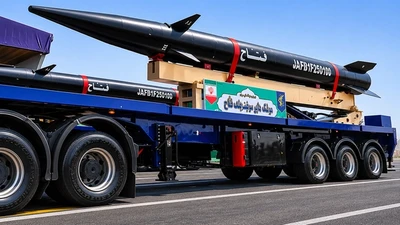
Visitors walk among missiles on display at the Islamic Revolutionary Guard Corps (IRGC) Aerospace Park, which opened to the public in November.
Iran stepped up its warnings against the United States, Israel and Arab countries in the Persian Gulf on Wednesday, threatening new military capabilities and demanding compensation from regional states it accused of facilitating attacks on its territory.
The combative rhetoric came as US officials claimed their blockade and sanctions campaign had brought Iranian oil exports to a standstill, depriving Tehran of a vital source of revenue.
Hassan Hassanzadeh, commander of the Islamic Revolutionary Guard Corps (IRGC) in Greater Tehran, said Iran's defense, missile and drone capabilities were “increasing day by day.”
“If the United States and Israel make another mistake, they will witness the unveiling of new targets, weapons and offensive plans,” he said.
Iran also directed its warnings at Arab countries in the Persian Gulf, accusing several of knowingly facilitating US and Israeli attacks by providing access to their territory, airspace, military facilities and logistical resources.
Iran's representative to the United Nations said those countries were legally obliged to compensate Tehran fully for the resulting damage.
US Treasury Secretary Scott Bessent said Wednesday that Iran had exhausted its floating oil stocks and failed to load a single tanker since Washington launched Operation Economic Outcast in August.
“The Iranian regime is a sinking ship,” Bessent wrote on X, adding that Iran “doesn’t have a drop of oil on the water left to sell.”
The economic pressure has also been reflected in Iran's currency, which fell to another record low on Tuesday, with the dollar reaching 2.856 million rials on Tehran's open market after Washington imposed fresh sanctions on Iranian financial networks.
But Revolutionary Guards spokesman Hossein Mohebbi said statements by American military commanders showed Washington was struggling to sustain the blockade.
He predicted that military exhaustion and mounting financial costs would force the United States to abandon its blockade and withdraw its forces from the region.
Mohebbi, however, said Washington would soon discover that its blockade was futile. He said Iran's armed forces remained fully prepared in equipment, resources and morale.
Meanwhile, China urged Washington and Tehran to keep the door to negotiations open, with Beijing's ambassador to Iran, Cong Peiwu, saying Wednesday that de-escalation and a return to talks should be the immediate priorities.
Cong said China supported a diplomatic settlement of the nuclear dispute and efforts to reach a comprehensive agreement over the Strait of Hormuz.
Workers aboard the Indian-flagged tanker Desh Garima as it unloads crude oil at a terminal in Mumbai, India, after passing through the Strait of Hormuz, April 30, 2026. (Reuters)
Oil exports from Persian Gulf producers outside Iran have nearly returned to prewar levels despite attacks on shipping in the Strait of Hormuz, with Saudi Arabia and the United Arab Emirates surpassing their prewar crude and condensate export volumes, Kpler data show.
Across the Persian Gulf, producers outside Iran had nearly restored prewar export volumes, helped by the diversion of oil through pipelines.
Their combined exports averaged just under 14 million barrels a day in September and October, compared with 14 million before the war. Kuwait and Qatar remained below their prewar levels, Homayoun Falakshahi, head of crude oil analysis at Kpler, told Iran International.
The recovery contrasts with the sharp decline in Iran’s own oil exports, with the US naval blockade effectively halting its main crude trade with China, according to maritime sanctions expert Charlie Brown.
“We see the market pay more attention to fundamentals now than to headlines,” Falakshahi said.
Why November’s figures could rise
Kpler’s preliminary November estimate fell to about 12 million barrels a day. Falakshahi said tracking data for the most recent seven to 10 days tend to undercount shipments, meaning the November figure could be revised upward.
One reason is that more ships are crossing Hormuz with their tracking signals switched off, said Iman Nasseri, senior vice president for the Middle East and Asia at FGE NexantECA.
“Traffic might not have necessarily dropped but the behavior of the vessels and ship owners have changed,” Nasseri told Iran International.
Tracking firms can identify additional cargoes later, including when oil is loaded onto other vessels outside the strait. Nasseri said estimates for the first half of November had already been revised upward by more than 3 million barrels a day. He said he expected further revisions in December as more cargoes were identified.
Crude is in surplus while fuel supplies remain tight
Energy analysts who spoke to Iran International estimated that the global crude market was already in surplus by roughly 1 million to 2 million barrels a day in the fourth quarter.
Falakshahi said the global crude surplus could average around 2 million barrels a day in 2027 if export flows hold up. Without a fresh escalation, he saw little room for crude prices to rise.
Nasseri estimated that around 12 million barrels a day of oil had continued to flow through Hormuz since September, including roughly 10 million barrels a day of crude.
Refined product exports through the strait were running at about 1.5 million to 2 million barrels a day, down from around 5 million before the war.
Lower product exports and weaker refinery activity have kept diesel and jet fuel prices above prewar levels, he said.
Tehran threatens tighter restrictions
Iranian army chief Amir Hatami ordered tighter restrictions on shipping through Hormuz until Washington meets Tehran’s demands.
He warned that renewed US strikes would draw a more severe response that could extend beyond the region. Parliament Speaker Mohammad Bagher Ghalibaf also said Tehran was prepared to use military means to break the blockade.
Mohsen Rezaei, secretary of Iran’s Supreme National Security Council, said Tuesday that Tehran was determined to break the US naval blockade and would respond with full force to any renewed attack. In a post on X, he called the Trump administration’s blockade plans “delusional and futile.”
The warnings followed remarks by US President Donald Trump on Sunday that strikes could resume after the new year if no deal was reached. Trump also warned that Iranian vessels attempting to breach the blockade would be sunk.
The United Kingdom Maritime Trade Operations (UKMTO) said Tuesday that three vessels had been struck by unidentified projectiles while sailing east through the Strait of Hormuz on Monday. All three continued their journeys, and all crew members were accounted for.
The Islamic Revolutionary Guard Corps (IRGC) separately claimed three tankers caught fire after hitting mines despite US protection. The Joint Maritime Information Center said claims of tankers hitting mines were unconfirmed.
How Gulf exporters kept oil moving
The UAE was among the first countries to coordinate tanker convoys with the United States, Falakshahi said.
Charlie Brown, a senior adviser to United Against Nuclear Iran who focuses on maritime sanctions enforcement and illicit shipping, said Persian Gulf countries found shipowners willing to sail and took on some of the insurance risk themselves. US military support helped vessels get through, he said.
Crews still face the risk of attack. TradeWinds reported at least 64 strikes on ships near Hormuz since the end of September, with vessels operated by Sinokor, ADNOC Logistics & Services and Kuwait Oil Tanker Company among those most frequently targeted.
Iran’s crude exports remain squeezed
Falakshahi said Kpler was seeing no new Iranian crude or condensate exports. Some Iranian oil was already outside the blockade zone, while smaller shipments of refined products, liquefied petroleum gas (LPG) and petrochemicals continued to get through. He estimated those shipments at 120,000 to 150,000 barrels a day in recent months, down from around 800,000 before the war.
Falakshahi also disputed reports that a tanker carrying Iranian oil had breached the blockade, saying the purported ship’s tracking signal had been fabricated. He said satellite imagery showed a group of ships but gave him no evidence that they were moving through the blockade as a flotilla.
Iranian state media and officials later walked back reports of an imminent convoy operation. TankerTrackers said one of the purported vessels, called Line Breaker, did not exist.
Brown said the blockade had halted Iran’s main crude trade from Kharg Island to China. Other Persian Gulf exporters have found ways to keep shipping, he said, and the crews making those voyages are still putting their lives at risk.
“The real unsung heroes, even more so, are the seafarers themselves,” Brown said.
A man looks at foreign currency exchange rates displayed outside an exchange shop in Iran. (ISNA)
Dwindling oil receipts and new US sanctions on Iran’s shadow banking networks could deepen Tehran’s foreign-currency squeeze in December.
Data analytics firm Kpler warned in October that Iran’s crude and condensate revenues could dry up by mid-December if the US naval blockade holds. Chinese buyers typically pay one to two months after delivery, Kpler said, allowing income from earlier shipments to continue arriving after exports have been disrupted. The loss of those receipts would increase the importance of earnings from petrochemicals, metals and other exports.
Those are among the financial flows Washington is seeking to disrupt. The US Treasury on Monday sanctioned 22 entities and eight individuals under Operation Economic Outcast, targeting exchange houses, financial intermediaries and overseas companies it accused of helping Iran move money despite sanctions.
The measures could therefore compound the pressure from the blockade by making the proceeds of remaining trade harder to collect and use. For Tehran, the challenge is sustaining access to foreign currency while both its income and the channels available to move it come under strain.
Pressure on payments
The latest targets included the Iran Center for Exchange of Currency and Gold, Mellat Exchange, an intermediary linked to Bank Sarmayeh, and companies in the United Arab Emirates, Hong Kong and Turkey.
Treasury says Iranian exchange houses and bank-linked intermediaries use overseas front companies to receive and make payments for clients, including petrochemical exporters and Iran’s copper industry. The exchange center helps direct foreign currency earned by exporters to importers who need it to buy goods abroad.
In a separate report released Monday, Treasury’s Financial Crimes Enforcement Network identified about $14.7 billion in financial activity potentially linked to Iranian shadow banking between January 2025 and August 2026. Its findings draw on reports from US financial institutions, which FinCEN cautioned do not themselves establish illegality.
Central Bank Governor Abdolnasser Hemmati dismissed the measures in an interview with Tasnim on Tuesday, arguing that Washington had exhausted its options if it was targeting the exchange center.
He described it as a platform for recording transactions and questioned how an institution with a public address, visible signage and an accessible website could be portrayed as part of a shadow banking network.
Costs at home
The rial weakened on Tuesday. AFP reported that the dollar traded at around 2.82 million rials on the unofficial market, up about 5% from 2.68 million a day earlier.
A further loss of foreign-currency income would make it harder to finance imports and support the rial. For households, a weaker currency raises the local cost of imported goods and materials, while more expensive or unreliable payment channels could add to those pressures.
Businesses may face difficulties completing transactions even where buyers and suppliers remain willing to trade. Intermediaries could demand higher fees, withdraw from transactions or take longer to settle payments.
Foreign banks also risk secondary sanctions, including restrictions on access to the US financial system, for certain dealings with designated entities. That exposure can discourage companies outside the United States from handling Iranian business.
US rules retain authorizations for certain humanitarian trade, including food and medicine, but those permissions do not guarantee that banks will process payments.
The measures build on a broader campaign. Washington expanded its sanctions authority over sectors including aviation, shipping and digital assets in August, then added automotive and rail businesses in October. It also suspended authorizations for certain remittances and some academic, educational and sporting exchanges in August.
Limited alternatives
Iran can seek replacement intermediaries and new front companies, but rebuilding payment networks requires willing partners and can increase fees and the risk of funds being lost or withheld. By August, Treasury said it had carried out eight actions targeting Iran’s shadow banking apparatus that year, illustrating the continuing cycle of sanctions and adaptation.
Settling more trade in yuan or rubles is another option. Treasury says the Central Bank uses bonds issued by the currency and gold exchange center to facilitate such transactions. Using a different currency, however, does not by itself protect participating banks from US secondary sanctions.
Cryptocurrency offers another channel, but it also faces enforcement pressure. Washington sanctioned operators of the Shelbit exchange and the Iranian platform Aban Tether in August.
Maritime evasion methods face a separate constraint in the naval blockade. Treasury’s November 4 sanctions targeted an India-based network accused of supplying false flags and maritime certifications.
Land routes and barter offer other possibilities. Foreign Minister Abbas Araghchi said Monday that Iran’s border provinces and embassies were working to expand trade with neighboring countries and find new markets.
Those routes still require ways to settle payments. In October, Treasury sanctioned Iraq’s International Development Bank for Investment and Finance, accusing it of helping Iran obtain dollars. Greater reliance on neighboring countries therefore shifts some of the financial risk to partners that Washington can also target.
These alternatives may help preserve some trade, but payment arrangements cannot replace the income lost when oil exports stop. Their value depends both on how much business Iran can sustain and whether it can access the proceeds.
Pressure and diplomacy
The prospect of a sharper revenue squeeze increases the potential value of economic relief in negotiations, while giving Tehran further reason to resist appearing to yield under pressure.
Araghchi said Monday that Iran would continue pursuing negotiations to lift sanctions while strengthening its ability to withstand them.
The terms remain disputed. In an interview published Saturday, he ruled out transferring Iran’s stockpile of uranium enriched to 60% purity abroad. Tehran has also made reopening the Strait of Hormuz conditional on Washington meeting its demands, including sanctions relief and an end to the blockade.
Democratic control of Congress from January could bring greater scrutiny of the confrontation. But the latest designations draw on existing executive orders, and a change in congressional control would not automatically lift them.
A limited arrangement linking safer passage through Hormuz to partial easing of the blockade remains one possible route to de-escalation. It would require agreement on the sequence and verification of concessions while leaving the dispute over Iran’s nuclear program unresolved.
If Kpler’s forecast materializes, Tehran would face those choices with less oil income and greater pressure on its other sources of foreign currency. The resulting squeeze could increase the urgency of negotiations without determining whether Iran chooses compromise or further escalation.