• العربية
  • فارسی
BrandBrand
  • Iran Insight
  • Politics
  • Economy
  • Analysis
  • Special Report
  • Opinion
  • Podcast
  • Live TV
  • Iran Insight
  • Politics
  • Economy
  • Analysis
  • Special Report
  • Opinion
  • Podcast
  • Live TV
  • Theme
  • Language
    • العربية
    • فارسی
  • Iran Insight
  • Politics
  • Economy
  • Analysis
  • Special Report
  • Opinion
  • Podcast
  • Live TV
All rights reserved for Volant Media UK Limited
volant media logo

Saudi Arabia condemns Iran attacks on civilian facility in Bahrain

Nov 22, 2026, 09:24 GMT+0

Saudi Arabia strongly condemned Iranian attacks on a civilian industrial facility in Bahrain on Sunday and said Iran would bear the consequences if such attacks continued.

The Saudi Foreign Ministry expressed full solidarity with Bahrain and support for measures to protect its security and stability.

It accused Iran of continuing behavior that threatens regional security, including attacks on civilian facilities, and said these actions violated international law, the UN Charter and principles of good neighborliness.

Most Viewed

Iran hardliners push tanker convoy to defy US blockade
1

Iran hardliners push tanker convoy to defy US blockade

2

Iran readies tankers to run US blockade, threatens Persian Gulf oil if fired on

3
ANALYSIS

War damage leaves Iran with few options to avert winter gas crunch

4

Who is Mohammad Javad Bavand, the ex-IRGC official sanctioned by US?

5

Iran signals readiness for Hormuz showdown despite US buildup

Banner

Spotlight

  • ‘The city smelled of blood’: Witness recalls Iran protest crackdown

    ‘The city smelled of blood’: Witness recalls Iran protest crackdown

  • Iran-linked hackers posed as US expert to target Australian broadcaster
    PODCAST

    Iran-linked hackers posed as US expert to target Australian broadcaster

  • Who gets to be a journalist? Iran seeks greater control over press
    INSIGHT

    Who gets to be a journalist? Iran seeks greater control over press

  • Iran hardliners push tanker convoy to defy US blockade

    Iran hardliners push tanker convoy to defy US blockade

  • War damage leaves Iran with few options to avert winter gas crunch
    ANALYSIS

    War damage leaves Iran with few options to avert winter gas crunch

Banner
Banner
Banner
Banner
Banner
Banner
•
•
•

More Stories

Three die, 66 poisoned by homemade alcohol in Iran

Nov 22, 2026, 07:58 GMT+0
100%
A patient receives treatment in a hospital intensive care unit in Iran. (File photo)

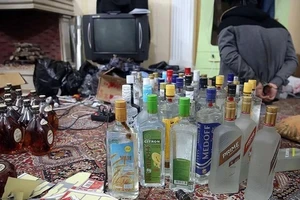
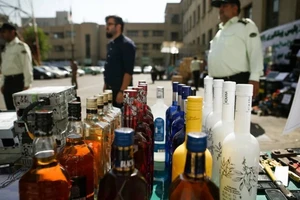
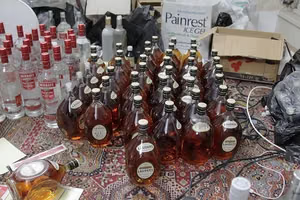
Three people died and 66 were poisoned after consuming counterfeit alcohol in the northeastern Iranian city of Neyshabur, health officials said, as police identified eight suspects linked to its production and distribution.

The number of people poisoned rose from 33 to 66, with the death toll remaining at three, according to updated figures from Neyshabur University of Medical Sciences.

Of those affected, 47 were hospitalized, eight were transferred to a hospital in Mashhad and seven were discharged after receiving treatment.

Eight patients were intubated, and one case of brain death was reported, health officials said.

Neyshabur's police chief said eight suspects had been identified in connection with the production and distribution of the contaminated alcohol.

Repeated cases of alcohol poisoning

The deaths are the latest in a series of mass poisonings linked to counterfeit or homemade alcohol in Iran.

In July 2025, 31 people sought hospital treatment after consuming counterfeit alcohol in Dezful. One person died and five were admitted to intensive care.

  • Bootleg alcohol identified as top cause of deaths from poisoning in Iran

    Bootleg alcohol identified as top cause of deaths from poisoning in Iran

In November 2025, eight people died from alcohol poisoning in separate cases in Iranshahr and Bampur. Reports also showed that one person lost their sight and three others were hospitalized in critical condition.

Official figures may underestimate the scale

The actual number of alcohol poisonings in Iran could be up to 10 times higher than emergency department figures suggest, Deputy Health Minister Alireza Raisi said in October 2025.

Some people avoid seeking medical treatment because of fear or other concerns.

  • Who is behind the sale of lethal bootleg alcohol in Iran?

    Who is behind the sale of lethal bootleg alcohol in Iran?

Methanol, an industrial alcohol sometimes found in counterfeit alcoholic drinks, can cause blindness, organ damage and death. Health officials in Neyshabur have not identified the substance responsible for the latest poisonings.

100%
Medical personnel in Iran attend to a patient on a stretcher in a hospital emergency ward. (File photo)

Alcohol sales are prohibited in Iran, fueling a widespread black market in which homemade and counterfeit alcoholic drinks have repeatedly caused mass poisonings.

  • Bootleg Alcohol Claims One Life, Poisons 28 at Shiraz Gathering

    Bootleg Alcohol Claims One Life, Poisons 28 at Shiraz Gathering

Raisi also described high per-capita alcohol consumption as a public health challenge in September 2025 and called for expanding alcohol treatment centers.

Iranian news website Rouydad24 reported later that month that alcohol consumption had increased significantly, citing field reports and addiction treatment center data showing that admissions involving alcohol dependence had risen by as much as 50% over the preceding five years.

Iran couldn’t execute them for murder, but found grounds on another charge

Nov 22, 2026, 04:35 GMT+0
•
Mahdi Amiri
100%
Milad Armoon (left) and Navid Najjaran, two Iranian political prisoners sentenced to death in Tehran's Ekbatan protest case.

Two Iranian political prisoners whose death sentences for murder had been overturned were moved to solitary confinement on Saturday, raising fears among their families that they could soon be executed on separate security-related charges.

Navid Najjaran and Milad Armoon were transferred to solitary cells at Ghezel Hesar Prison near Tehran after Iran’s Supreme Court upheld the death sentences imposed by a Revolutionary Court and referred them for enforcement, according to Dadban, a collective of pro bono lawyers in Iran.

Exiled prince Reza Pahlavi’s office published a video from Tehran’s Ekbatan neighborhood on Saturday night, saying residents chanted “Death to the Islamic Republic” amid fears for the two men.

The case began with the death of Arman Aliverdi, a member of the Basij, the Revolutionary Guards’ paramilitary force, during the Woman Life Freedom protests in Ekbatan in 2022. Security forces detained more than 50 young residents, and prosecutors brought charges against 14.

In 2024, a criminal court sentenced six defendants, including Najjaran and Armoon, to death for murder. The Supreme Court overturned those sentences in 2025. At retrial, the criminal court found that the evidence did not establish who had struck the fatal blow to Aliverdi’s head, according to the Iranian news outlet Rokna.

It acquitted Najjaran of participation in intentional murder. Armoon received five years in prison and was ordered to pay a share of the blood money.

Three days after the retrial verdicts, Judge Abolghassem Salavati sentenced Najjaran, Armoon and two other defendants to death in a parallel security case before Branch 15 of Tehran’s Revolutionary Court.

Rokna reported that the Revolutionary Court imposed the four death sentences for efsad-fil-arz, or “corruption on earth.” The rights group Iran Human Rights also identified it as the charge on which Najjaran and Armoon were sentenced to death.

Dadban gave a different account. It said the charge changed during the proceedings from moharebeh, or “waging war against God,” to “corruption on earth,” but that the final rulings were based on moharebeh.

Armoon’s lawyer, Mohammad Hossein Aghasi, told Emtedad in May that the court summoned his client from prison and told him orally that he had been sentenced to death for moharebeh. Aghasi attended the hearings but was absent when the sentence was announced. Another of Armoon’s lawyers, Ali Sharifzadeh, said he had been barred from the hearings.

“We don’t know what the ruling says or what the judge relied on,” Aghasi said at the time. “We haven’t even seen the ruling.”

Iran International has reported accounts of torture and coerced confessions in the case. In footage broadcast on state television, Armoon repeatedly denied killing anyone. A criminal court judge also found that police interrogations and the defendants’ statements against one another were insufficient proof.

In April, judiciary chief Gholamhossein Mohseni Ejei called for faster sentencing of those he described as “enemy agents.” He said, “In cases where confiscation and execution sentences must be issued against enemy agents, the process should be expedited.”

Mohammad Oliaei-Fard, a lawyer and one of the directors of the One Word Lawyers Network, told Iran International on November 21 that a court could still halt the executions by granting a retrial, even at the last moment.

He said some officials wanted to “close the case with a sacrifice” because they would see it as a defeat if no one were put to death over the Basij member’s killing.

“These executions, these prison terms and these sentences all stem from political issues and the pressure the Islamic Republic is under,” Oliaei-Fard said. He said the authorities were putting pressure on the public to buy time because they could offer no meaningful response to people’s demands.

“The Islamic Republic uses this policy to suppress people for fear that their demands will again lead to protests,” he said. “It is trying to buy time while refusing to make even the slightest change in its behavior.”

Slain dissidents' daughter says Iran judiciary threatened memorial attendees

Nov 22, 2026, 02:35 GMT+0
100%
An AI-assisted enlargement of a photograph of Dariush and Parvaneh Forouhar displayed in their Tehran home.

Iranian human rights activist Parastou Forouhar says an Iranian judiciary official warned her that everyone attending a memorial for her murdered parents would face prosecution if authorities deemed her remarks “problematic.”

Forouhar, an artist who lives in Germany, has returned to Tehran each year to commemorate her parents, Dariush and Parvaneh Forouhar, at the home where they were stabbed to death in 1998.

Writing on Instagram on Saturday evening, Forouhar said the caller accused her of painting a bleak picture of Iran and speaking “against the system” at last year’s memorial. If she made similar remarks this year, the caller warned, those who came to listen would also be punished.

“For me to speak and for others to be punished for the crime of listening to me is a new form of bullying,” she wrote. She said she would limit her remarks to thanking those who attend.

Forouhar said the memorial would go ahead despite the warning. “This year, too, we will hold it together, calmly, with resolve and solidarity,” she wrote.

Authorities have repeatedly tried to stop the gatherings. In 2013, security forces blocked the street and prevented guests from entering the house, the Center for Human Rights in Iran reported.

The 1998 chain murders

Dariush Forouhar led the banned Iran Nation Party and had served as labor minister in the provisional government formed after the 1979 revolution. His wife, Parvaneh Eskandari Forouhar, was a political activist and the party’s spokesperson. Both were outspoken critics of the Islamic Republic.

Human Rights Watch said the authorities tapped their phone and monitored visitors to their Tehran home.

The couple were found stabbed to death at home on November 22, 1998. In the weeks that followed, dissident writers Mohammad Mokhtari and Mohammad Jafar Pouyandeh were also killed. The deaths became known as the “chain murders,” a term associated with a broader series of killings of Iranian dissidents and intellectuals.

In early 1999, Iran’s Intelligence Ministry acknowledged that its own agents had carried out the killings. The ministry said they had acted on their own. Parastou Forouhar and her brother later appealed to the UN high commissioner for human rights to investigate.

Iranian hijab policymaker and ex-IRGC officer to keynote UK Islamophobia event

Nov 22, 2026, 01:26 GMT+0
100%
A former IRGC member, Saied Reza Ameli has been announced as one of the keynote speakers at the Islamic Human Rights Commission's (IHRC) thirteenth annual conference.

A London gallery canceled its booking for an Islamophobia conference featuring a senior Iranian hijab and internet censorship policymaker and former IRGC commander, organizers said, adding that the event would still go ahead with him delivering a keynote by video from Iran.

The Islamic Human Rights Commission (IHRC) said P21 Gallery cited a meeting with Britain’s Charity Commission about Saied Reza Ameli’s participation when it explained its decision.

The IHRC accused the regulator of pressuring the gallery to withdraw and said it would announce a new venue for the December 13 conference on artificial intelligence and Islamophobia.

Ameli served as secretary of Iran’s Supreme Council of the Cultural Revolution from 2019 to 2023 and remains a member. In 2019, the council approved tougher guidelines setting out how state agencies should enforce compulsory hijab.

Ameli defended the stricter rules at the time, saying they were needed for “social health, protection of the family”.

The IHRC said in a statement to the Daily Mail that Ameli had publicly opposed compulsory veiling and defended his invitation on the strength of what it called his academic work on Islamophobia and artificial intelligence.

Ameli was still council secretary in September 2022 when Mahsa Amini, 22, died in custody after Iran’s morality police detained her over her hijab. Her death sparked nationwide protests.

Canada sanctioned Ameli in February 2023 as part of measures targeting Iranian officials over human rights violations. Britain sanctioned the cultural council that July for its role in setting and enforcing mandatory dress codes for women, citing the use of unreasonable force. The IHRC said Ameli himself faces no British sanctions.

Ameli served as deputy commander of the Imam Sadeq Brigade in the Revolutionary Guards’ Seyyed al-Shohada Division, according to the human rights database Faces of Crime. In 2015, then-Supreme Leader Ali Khamenei appointed him to the Supreme Council of Cyberspace, which oversees Iran’s internet policy and strict censorship of social media.

A University of Tehran professor, Ameli helped establish the London-based IHRC in 1997. British company records show he served as one of its directors from 2006 until December 2022.

Family source recounts Iranian girl's alleged killing by father

Nov 21, 2026, 20:59 GMT+0
100%
16-year old Sogand Sayyadi died on November 14

A 16-year-old Iranian girl whose death has prompted a criminal investigation was beaten by her father at school and later thrown from a fifth-floor window after the principal accused her of having a boyfriend, a person close to the family told Iran International.

Sogand Sayyadi died on November 14 in the western city of Kermanshah. Her father, Keyumars Sayyadi, has been detained on suspicion of assault and murder, while the school's principal has been arrested on suspicion of negligence.

The account, provided to Iran International by a person familiar with the family, describes years of domestic violence and threats against the teenager, who had hoped to attend university, become a dentist and build a life independent of her father.

The allegations have not been independently verified. Sogand's father denies killing her, and judicial authorities say they are investigating the circumstances of her death, including the possibility of suicide.

Hamidreza Karimi, Kermanshah's prosecutor, told the judiciary-affiliated Mizan news agency that the father was under investigation on charges including assault and murder.

A childhood marked by violence

Sogand was originally from Alirezavandi, a village in Gilan-e Gharb county in western Iran, but lived in the provincial capital, Kermanshah.

Her parents, Keyumars and Tayebeh, separated when she was four. Their divorce proceedings lasted several years, after which her father was awarded custody.

Despite that arrangement, Sogand lived with her paternal aunt, Rakhshandeh, until a few months before her death.

The person close to the family described her as a quiet, reserved girl who worked hard at school and looked forward to becoming financially independent. Neither parent, the source said, provided her with sufficient emotional support.

The source alleged that Sogand had repeatedly been beaten by her father, who objected to her friendship with a female classmate because of the girl's appearance and makeup.

He had threatened to kill Sogand unless she ended the friendship, the source said, adding that the relationship was not romantic.

A private diary reaches the principal

Several days before Sogand's death, photographs of pages from her private diary were reportedly passed to the school's principal, Ghamarnaz Amiri, by someone connected to the family.

The pages apparently contained remarks that displeased Amiri, who, according to the source, already had a strained relationship with the teenager.

After receiving the photographs, Amiri allegedly telephoned Sogand's father, told him his daughter had a boyfriend and instructed him to come to the school to address the situation.

The Iranian news outlet Rokna previously reported that school officials had informed Sogand's father about a matter concerning her private life. It said he subsequently visited the school and took his daughter home.

From the classroom to a fifth-floor window

On November 14, Sogand's father received a call about his daughter, according to the family acquaintance. He went to her school, where he allegedly beat her in front of staff and other students.

The source said he then collected Sogand's school records, took her home by force and continued assaulting her before allegedly throwing her from a window of their fifth-floor apartment.

The human rights news agency HRANA, citing local sources, also reported that Sogand's father threw her from a fifth-floor window following an altercation at home.

According to the family acquaintance, the father prevented people at the scene from calling an ambulance and instead demanded that municipal workers come to collect and bury his daughter's body.

The newspaper Haft Sobh reported that he told investigators, "I am not my daughter's killer," and maintained that her fall from the fifth floor was accidental.

Questions over evidence and the funeral

According to the source, a family member gathered the teenager's personal belongings, including her diary, packed them and removed them from the house.

The source believed the removal of those items was an attempt to destroy evidence of longstanding abuse, particularly because members of the family had initially sought to portray her death as suicide.

That allegation has not been independently substantiated.

The source also said people who attended the washing of Sogand's body before burial had reported seeing fractures to her arms, legs, neck and skull.

Kermanshah's forensic authorities determined that she died from multiple injuries caused by a fall from a height.

According to the source, Sogand's father initially wanted to bury her in the courtyard of his village home, but senior family members objected. She was eventually buried in the cemetery of Dartut Sayyadi village.

Conflicting accounts have emerged about whether her father attended the funeral.

The family acquaintance said relatively few members of his side of the family attended and that some younger relatives stayed away because of his presence.

Judicial investigations into the circumstances of Sogand's death and the school principal's alleged negligence remain underway.