Slain dissidents' daughter says Iran judiciary threatened memorial attendees
An AI-assisted enlargement of a photograph of Dariush and Parvaneh Forouhar displayed in their Tehran home.
Iranian human rights activist Parastou Forouhar says an Iranian judiciary official warned her that everyone attending a memorial for her murdered parents would face prosecution if authorities deemed her remarks “problematic.”
Forouhar, an artist who lives in Germany, has returned to Tehran each year to commemorate her parents, Dariush and Parvaneh Forouhar, at the home where they were stabbed to death in 1998.
Writing on Instagram on Saturday evening, Forouhar said the caller accused her of painting a bleak picture of Iran and speaking “against the system” at last year’s memorial. If she made similar remarks this year, the caller warned, those who came to listen would also be punished.
“For me to speak and for others to be punished for the crime of listening to me is a new form of bullying,” she wrote. She said she would limit her remarks to thanking those who attend.
Forouhar said the memorial would go ahead despite the warning. “This year, too, we will hold it together, calmly, with resolve and solidarity,” she wrote.
Authorities have repeatedly tried to stop the gatherings. In 2013, security forces blocked the street and prevented guests from entering the house, the Center for Human Rights in Iran reported.
The 1998 chain murders
Dariush Forouhar led the banned Iran Nation Party and had served as labor minister in the provisional government formed after the 1979 revolution. His wife, Parvaneh Eskandari Forouhar, was a political activist and the party’s spokesperson. Both were outspoken critics of the Islamic Republic.
Human Rights Watch said the authorities tapped their phone and monitored visitors to their Tehran home.
The couple were found stabbed to death at home on November 22, 1998. In the weeks that followed, dissident writers Mohammad Mokhtari and Mohammad Jafar Pouyandeh were also killed. The deaths became known as the “chain murders,” a term associated with a broader series of killings of Iranian dissidents and intellectuals.
In early 1999, Iran’s Intelligence Ministry acknowledged that its own agents had carried out the killings. The ministry said they had acted on their own. Parastou Forouhar and her brother later appealed to the UN high commissioner for human rights to investigate.
A former IRGC member, Saied Reza Ameli has been announced as one of the keynote speakers at the Islamic Human Rights Commission's (IHRC) thirteenth annual conference.
A London gallery canceled its booking for an Islamophobia conference featuring a senior Iranian hijab and internet censorship policymaker and former IRGC commander, organizers said, adding that the event would still go ahead with him delivering a keynote by video from Iran.
The Islamic Human Rights Commission (IHRC) said P21 Gallery cited a meeting with Britain’s Charity Commission about Saied Reza Ameli’s participation when it explained its decision.
The IHRC accused the regulator of pressuring the gallery to withdraw and said it would announce a new venue for the December 13 conference on artificial intelligence and Islamophobia.
Ameli served as secretary of Iran’s Supreme Council of the Cultural Revolution from 2019 to 2023 and remains a member. In 2019, the council approved tougher guidelines setting out how state agencies should enforce compulsory hijab.
Ameli defended the stricter rules at the time, saying they were needed for “social health, protection of the family”.
The IHRC said in a statement to the Daily Mail that Ameli had publicly opposed compulsory veiling and defended his invitation on the strength of what it called his academic work on Islamophobia and artificial intelligence.
Ameli was still council secretary in September 2022 when Mahsa Amini, 22, died in custody after Iran’s morality police detained her over her hijab. Her death sparked nationwide protests.
Canada sanctioned Ameli in February 2023 as part of measures targeting Iranian officials over human rights violations. Britain sanctioned the cultural council that July for its role in setting and enforcing mandatory dress codes for women, citing the use of unreasonable force. The IHRC said Ameli himself faces no British sanctions.
Ameli served as deputy commander of the Imam Sadeq Brigade in the Revolutionary Guards’ Seyyed al-Shohada Division, according to the human rights database Faces of Crime. In 2015, then-Supreme Leader Ali Khamenei appointed him to the Supreme Council of Cyberspace, which oversees Iran’s internet policy and strict censorship of social media.
A University of Tehran professor, Ameli helped establish the London-based IHRC in 1997. British company records show he served as one of its directors from 2006 until December 2022.
A 16-year-old Iranian girl whose death has prompted a criminal investigation was beaten by her father at school and later thrown from a fifth-floor window after the principal accused her of having a boyfriend, a person close to the family told Iran International.
Sogand Sayyadi died on November 14 in the western city of Kermanshah. Her father, Keyumars Sayyadi, has been detained on suspicion of assault and murder, while the school's principal has been arrested on suspicion of negligence.
The account, provided to Iran International by a person familiar with the family, describes years of domestic violence and threats against the teenager, who had hoped to attend university, become a dentist and build a life independent of her father.
The allegations have not been independently verified. Sogand's father denies killing her, and judicial authorities say they are investigating the circumstances of her death, including the possibility of suicide.
Hamidreza Karimi, Kermanshah's prosecutor, told the judiciary-affiliated Mizan news agency that the father was under investigation on charges including assault and murder.
A childhood marked by violence
Sogand was originally from Alirezavandi, a village in Gilan-e Gharb county in western Iran, but lived in the provincial capital, Kermanshah.
Her parents, Keyumars and Tayebeh, separated when she was four. Their divorce proceedings lasted several years, after which her father was awarded custody.
Despite that arrangement, Sogand lived with her paternal aunt, Rakhshandeh, until a few months before her death.
The person close to the family described her as a quiet, reserved girl who worked hard at school and looked forward to becoming financially independent. Neither parent, the source said, provided her with sufficient emotional support.
The source alleged that Sogand had repeatedly been beaten by her father, who objected to her friendship with a female classmate because of the girl's appearance and makeup.
He had threatened to kill Sogand unless she ended the friendship, the source said, adding that the relationship was not romantic.
A private diary reaches the principal
Several days before Sogand's death, photographs of pages from her private diary were reportedly passed to the school's principal, Ghamarnaz Amiri, by someone connected to the family.
The pages apparently contained remarks that displeased Amiri, who, according to the source, already had a strained relationship with the teenager.
After receiving the photographs, Amiri allegedly telephoned Sogand's father, told him his daughter had a boyfriend and instructed him to come to the school to address the situation.
The Iranian news outlet Rokna previously reported that school officials had informed Sogand's father about a matter concerning her private life. It said he subsequently visited the school and took his daughter home.
From the classroom to a fifth-floor window
On November 14, Sogand's father received a call about his daughter, according to the family acquaintance. He went to her school, where he allegedly beat her in front of staff and other students.
The source said he then collected Sogand's school records, took her home by force and continued assaulting her before allegedly throwing her from a window of their fifth-floor apartment.
The human rights news agency HRANA, citing local sources, also reported that Sogand's father threw her from a fifth-floor window following an altercation at home.
According to the family acquaintance, the father prevented people at the scene from calling an ambulance and instead demanded that municipal workers come to collect and bury his daughter's body.
The newspaper Haft Sobh reported that he told investigators, "I am not my daughter's killer," and maintained that her fall from the fifth floor was accidental.
Questions over evidence and the funeral
According to the source, a family member gathered the teenager's personal belongings, including her diary, packed them and removed them from the house.
The source believed the removal of those items was an attempt to destroy evidence of longstanding abuse, particularly because members of the family had initially sought to portray her death as suicide.
That allegation has not been independently substantiated.
The source also said people who attended the washing of Sogand's body before burial had reported seeing fractures to her arms, legs, neck and skull.
Kermanshah's forensic authorities determined that she died from multiple injuries caused by a fall from a height.
According to the source, Sogand's father initially wanted to bury her in the courtyard of his village home, but senior family members objected. She was eventually buried in the cemetery of Dartut Sayyadi village.
Conflicting accounts have emerged about whether her father attended the funeral.
The family acquaintance said relatively few members of his side of the family attended and that some younger relatives stayed away because of his presence.
Judicial investigations into the circumstances of Sogand's death and the school principal's alleged negligence remain underway.
Iran's northern city of Rasht became a battlefield as security forces opened fire on unarmed protesters during January's anti-government demonstrations, leaving people lying in the streets, former political prisoner and protester Masoud Bidarigh told Iran International.
"It was really like a war," Masoud Bidarigh told Iran International, recalling the crackdown by state security forces during nationwide anti-government protests on January 8 and 9.
Bidarigh, a former boxing champion, described witnessing the shooting of a young man by security forces firing from a passing car near Somayeh Park in Rasht on January 9.
"I was just crying. There was nothing I could do," he said.
"People had come onto the streets empty-handed," he added, describing scenes of unarmed protesters collapsing amid gunfire and screams coming from nearby alleyways.
Bidarigh said large crowds gathered across Rasht on January 8 following a call for nationwide demonstrations by Iran’s exiled Prince Reza Pahlavi.
He described joining protesters as they moved through central Rasht, chanting against the Islamic Republic.
‘Gunfire across Rasht’
As demonstrators approached Municipality Square, security forces fired tear gas to disperse the crowds, he said.
Bidarigh said he heard gunfire near the municipality's clock tower and believed armed personnel were shooting from elevated positions.
The shooting intensified as demonstrators moved toward Pol-e Iraq bridge.
"When we reached Pol-e Iraq, the gunfire started," he recalled, describing sustained bursts of automatic weapons fire.
Protesters turned and fled as people fell to the ground, he said.
"The people were empty-handed. They had no weapons, nothing to defend themselves with."
Bidarigh described groups of 15 to 20 motorcyclists charging into crowds near Farhang Square, attacking and dispersing demonstrators.
He said the violence was particularly intense around Falakeh-ye Gaz, where he saw people lying in the streets and heard cries and screams from surrounding alleyways.
Security forces continued pursuing protesters through the streets, he said, as parts of the city were plunged into darkness after streetlights were switched off.
Rasht's historic bazaar engulfed in flames
Bidarigh also described scenes around Rasht's historic bazaar, which was devastated by fire during the January 8 crackdown.
He said he was on Shariati Street, near one of the market's entrances, and saw armed personnel positioned around the surrounding streets.
The market's narrow passageways and limited access routes made it difficult for people to escape or emergency vehicles to enter, he said.
Bidarigh said security forces prevented people from approaching the burning market to help those trapped inside.
"Nobody was allowed to do anything, neither to put out the fire nor to help people," he said.
He accused security forces of responsibility for fires across the city.
Iran International's May 28 investigation, based on testimony from witnesses in Rasht, reported that protesters fleeing gunfire were driven into narrow market passages as flames spread.
Witnesses described security forces blocking market exits and shooting at people attempting to escape. The investigation also documented allegations of delayed firefighting operations and restrictions on emergency personnel.
In a separate June 6 investigation, Iran International reported witness accounts of bloodstains and bloody handprints on buildings in central Rasht following the crackdown.
Armed Toyota vehicles deployed across Rasht
Bidarigh said state security forces deployed large numbers of armed Toyota vehicles across Rasht on January 9.
He said he witnessed a convoy traveling from the direction of Razi toward the city center at approximately 3 p.m.
He estimated that more than 100 vehicles were involved, some carrying masked armed men and weapons mounted on their rear cargo beds.
An October 29 Reuters investigation found that Iran had imported thousands of Toyota Hilux and Land Cruiser vehicles through a defense procurement agency identified as MOD 346428.
Reuters reported that the Islamic Revolutionary Guard Corps (IRGC) and allied groups modified the vehicles to mount heavy machine guns on their rear cargo beds.
The investigation also identified footage from the January protests showing security forces carrying machine guns in a convoy of Land Cruisers in Tonekabon, another northern Iranian city.
Bidarigh said he saw the convoy passing his supermarket before closing the shop at approximately 4 p.m.
He described a significant escalation in violence after 8 p.m., with armed security forces moving through the city on motorcycles, on foot and in vehicles.
"There was no mercy for anyone," he said.
"Gunfire could be heard across the whole of Rasht."
Bidarigh described motorcyclists on Saadi Street chanting "Heydar, Heydar" while firing toward people.
"Blood was smeared across the streets and walls of Rasht," he said.
"The whole city smelled of blood."
From boxing champion to political prisoner
Before his imprisonment, Bidarigh was a competitive boxer in Iran's northern Gilan province. He was also involved in political activism, distributing leaflets and writing anti-government slogans.
Bidarigh said six security personnel assaulted and arrested him on August 12, 2024, while he was distributing leaflets and writing slogans in Rasht's Golsar neighborhood.
He described being beaten and sprayed with pepper spray during the arrest.
Bidarigh said he spent 25 days in Intelligence Ministry custody, subjected to repeated interrogations, physical abuse and solitary confinement.
He described being kept in a small, dark cell, sometimes blindfolded and handcuffed, while interrogators beat and verbally abused him.
Security personnel also searched his supermarket and home, confiscating electronic equipment and approximately 5,000 political leaflets, he said.
He subsequently spent 38 days in Lakan Prison's Meysagh Ward before being released on bail.
Bidarigh said he was later sentenced to one year in prison following proceedings at which he was denied access to a lawyer.
The Iran Human Rights Society previously reported that Branch 3 of the Rasht Criminal Court, presided over by Judge Mehdi Rasekhi, sentenced him on charges including propaganda against the Islamic Republic, insulting Supreme Leader Ali Khamenei and disrupting national security.
The rights group also reported that Bidarigh publicly protested outside Lakan Prison in February 2025 against a death sentence issued for political prisoner Manouchehr Fallah, whom he had met during his imprisonment.
A prison document reviewed by Iran International lists September 6, 2024, as Bidarigh's detention date, 25 days after his reported arrest. Bidarigh said he spent those 25 days in Intelligence Ministry custody. Human Rights Watch has documented Iranian intelligence agencies holding detainees in unofficial facilities without formal registration.
Bidarigh said he returned to prison on April 6, 2025, to serve his sentence and was released on December 13, 2025.
Less than a month later, on January 6, around 10 security personnel confronted and assaulted him in Rasht's Sabzeh Meydan, he said. He was released after approximately 90 minutes.
The lasting toll of the crackdown
Bidarigh said continued threats from security authorities and fears of rearrest forced him to leave Iran in mid-2026.
Months after the January protests, he said he remained haunted by the violence he witnessed security forces inflict on protesters in Rasht.
"Every day, these scenes come back before my eyes," he said.
"I don't know how we survived. I really don't know."
Young Iranians socialize at a café, reflecting a generation navigating personal relationships and social expectations in a country where family attitudes toward dating and intimacy can differ sharply.
Some young Iranian women are leading private lives their families know little about, hiding relationships, sex and personal choices from parents, while an economy that keeps them at home and laws that punish private life leave them nowhere else to go.
Ladan’s mother knows she has a boyfriend. Her father doesn’t.
When the 21-year-old leaves home to meet him, her mother sometimes tells her father that she is going out with university friends.
It is a secret mother and daughter share. But there is another secret Ladan keeps from both parents.
She wants to have sex with her boyfriend before marriage.
“My mother knows I have a boyfriend, but if she found out I wanted to have sex with him, she would probably react very differently. My family doesn’t understand why I should wait for something that might never happen,” Ladan said.
In Ladan’s family, a boyfriend is something her mother can quietly tolerate, as long as her father doesn’t know. Sex is another matter. In families like hers, she said, a daughter’s virginity is still tied to the family’s honor, and a relationship parents might reluctantly accept can become a source of conflict if they believe it involves sex.
Many of her friends no longer see virginity as a measure of a woman’s worth, she said. They regard sex as a personal decision, not something that must wait until marriage.
The state does not. Under the Islamic Republic’s penal code, sex outside marriage is a crime. And Ladan worries about contraception and unintended pregnancy in a country that has made both harder to manage: a 2021 law meant to raise the birth rate ended the free distribution of contraceptives through public health services and tightened the already strict limits on abortion.
She also worries about what would happen if her family discovered her plans. Her mother has accepted one part of her private life and helps hide it from her father. Ladan fears that revealing the rest could cost her that support.
Ladan is one of five young women in Tehran who told Iran International about the parts of their lives they hide from their families. They spoke on condition that their identities be protected. Their names and some personal details have been changed.
Their secrets differ. But all five are hiding from the same two things: their families’ expectations, and a state that writes those expectations into law and has left them too poor to live anywhere else.
Two young people embrace during a nighttime gathering in Tehran.
Yasaman is 24. She works and earns her own money, but still cannot afford to move out of her parents’ home.
Her mother wants to know why she has not married. Yasaman’s answer is simple: she cannot afford it.
But there is another question nobody asks at home. What is she supposed to do about wanting emotional and sexual intimacy before marriage?
“I also need to have an emotional relationship with someone and feel close to him. But I’m not in a position to get married, and I don’t have a private space where I can spend time with someone I love without worrying,” Yasaman told Iran International.
In Iran, unmarried young adults commonly live with their parents. For many women, that reflects family expectations, but also the cost of living alone. With inflation near 89 percent and rents rising with it, a salary like Yasaman’s does not stretch to a home of her own. Moving out before marriage can also raise questions in more traditional families.
The state’s answer is marriage. It offers young couples marriage loans and urges them to have children. But Yasaman does not want to marry simply to have sex, and she does not have the money to set up a household.
She wants intimacy without being pushed into a marriage she is not ready for.
Yet she cannot afford the privacy that would let her have a relationship on her own terms.
For another of the women, the problem goes beyond finding somewhere private to meet a partner.
She cannot even tell her family whom she loves.
A young man and woman stand together outside a café in Iran at night.
More than a friend
Bahar’s family knows her closest female friend. She visits their home regularly and is one of the most important people in Bahar’s life.
What her parents don’t know is that the two women are in a romantic and sexual relationship.
Bahar is 27, and her family still asks why she has no plans to get married.
“My mother is always asking why I don’t have a boyfriend. I can’t tell her I have a girlfriend. I want to fall in love and live with someone I love, too. But the person I love is a woman,” Bahar said.
Her parents imagine a future in which she meets a man and marries him. Bahar wants to build a life with a woman they already know.
She was reluctant to speak at first, and agreed only after discussing how her identity would be protected.
Both Bahar and her partner live with their families. Neither can afford to rent a home of her own. Even a few hours together without worrying about who might walk in are hard to find.
The law offers them nothing and threatens them with a great deal. Under Iran’s penal code, sexual relations between women are punishable by flogging, and by death after a fourth conviction. Same-sex marriage is not recognized.
Two young women embrace on a street in Iran, where same-sex relationships remain socially sensitive and subject to legal restrictions.
For Bahar, revealing her relationship could mean facing her family’s expectations without the money to leave home.
“If I earned enough to have my own place, maybe I wouldn’t have to hide everything. But right now, if my family finds out, I don’t even know where I would go,” Bahar said.
The woman Bahar wants to share her future with can visit her family home. But in the eyes of Bahar’s parents, she must remain just a friend.
A secret too big to tell
Taraneh, 25, has a job. Last year, when her period was late, she took a pregnancy test.
The result was positive.
She was unmarried, and her boyfriend did not have a steady job. Neither was ready to have a child.
But before she could think about the pregnancy itself, she thought about her father.
“When I saw the test result, the first thing that came into my mind was what would happen if my father found out. Then I started thinking about where I could get the money to end the pregnancy,” Taraneh told Iran International.
She decided to end the pregnancy without telling her family. She did not have enough money to cover the cost, so she borrowed it from a friend.
In Iran, abortion is legal only in narrow cases, such as a serious threat to the mother’s life or a severe fetal abnormality, and only with official approval. The 2021 population law made even those harder to obtain. Women in Taraneh’s position are left with unlicensed clinics or pills bought on the black market, with no one to turn to if something goes wrong.
For an unmarried woman, seeking help with an unintended pregnancy can also mean revealing a sexual relationship her family knows nothing about, and one the law punishes.
Taraneh ended the pregnancy in secret.
Afterward, she worried about her health for some time. But she still could not bring herself to tell her mother.
Her mother had always told her she could come to her with any problem.
This time, asking for help would mean revealing the relationship, the pregnancy and the abortion.
“If I could have talked to my mother, maybe I wouldn’t have felt so alone. But at that moment, all I wanted was for nobody to find out,” Taraneh said.
Her family never found out, even when she was worried about her health.
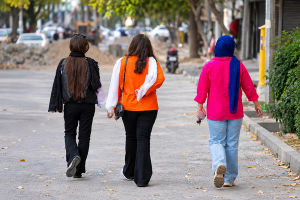
Young women walk along a shopping promenade in Iran.
The forbidden drawer
Not every secret carries consequences as serious as Taraneh’s.
For Sara, 20, secrecy begins with something much smaller: underwear.
She lives with her family and likes decorative lingerie. She says it is a matter of personal taste and does not necessarily have anything to do with having a sexual partner.
Her mother sees it differently.
Two young women walk together through a shopping mall in Iran.
“I even have to be careful about buying something I wear underneath my clothes. My mother thinks that kind of underwear is only for married women, but I want to decide for myself what I wear,” Sara said.
Her mother sometimes looks through her drawers and wardrobe while tidying her room. So Sara keeps some of her things where her mother is unlikely to look.
She is not hiding a relationship or a pregnancy. She simply wants to choose what she wears without having to justify it.
In a country where the state decides what women must wear in public, Sara is fighting for the last place it does not reach: a drawer that nobody opens without permission.
The weight of silence
In these homes, everyday life goes on. Parents ask their daughters where they are going, when they will marry and what they plan to do with their futures.
The daughters answer, but not always with the whole truth.
For some, the silence protects a relationship. For others, it hides a decision about sex, a medical experience or even an item of clothing.
Since the Woman, Life, Freedom protests of 2022, many young Iranian women have openly defied the state’s rules on how they dress and live. At home, the struggle is quieter. Some mothers have already crossed over, covering for their daughters, keeping their secrets, promising they can come to them with anything.
But each of these five women still has to decide how much of her private life she can share with the people she lives with.
And sometimes, the person she most needs to talk to is the one she cannot tell the truth to.
A woman checks her smartphone on a street in Iran at night.
A bill before Iran’s parliament would require online service providers to verify their users’ identities, making it easier for the state to trace anonymous accounts in a country where social media posts have led to prison terms and even death sentences.
Under the Cyberspace Regulation Bill, which is still under review by lawmakers, providing a digital service to anyone whose identity has not been verified would become a violation.
Users would not have to show their real names in public. But accounts run under pseudonyms could be linked to real people through the data providers collect, and handed to regulators on request.
For Iranians who write under pseudonyms, the difference is between being anonymous to the public and being anonymous to the state. The bill would remove the second.
What the bill would change
Companies that offer services before verifying users would face penalties including advertising bans, a ban on registering new users, fines of up to 10 percent of annual revenue, and suspension or loss of their licenses, according to details published by the Shargh daily in late August.
Failing to hand over information requested by regulators would also count as a violation.
The bill would also strengthen the Supreme Council of Cyberspace, Iran’s highest internet policymaking body, and its executive arm, the National Cyberspace Center.
The latest draft drops an earlier clause that would have made using a VPN a crime, though the state’s powers to block content remain.
‘James the Faithless’
The case of Amirhossein Mousavi shows what can happen once the state puts a name to an account.
Mousavi ran an account on X called James Bidin, a play on the name of the American actor James Dean. In Persian, “bidin” means “faithless” or “without religion.”
A Revolutionary Court sentenced him to death for “corruption on earth” over his online activity, his lawyer, Reza Shafakhah, said on November 4. He also received five years in prison for insulting religious sanctities.
Mousavi, held since December 2024, faced several charges over posts attributed to his account, including national security offenses and alleged cooperation with Israel.
In a letter from Tehran’s Evin prison, he rejected the charges and said his televised confessions had been extracted under pressure from interrogators.
The new bill played no part in his case. It would make the first step, identifying the person behind the account, routine.
Two men use their smartphones on a street in Iran.
The bill follows earlier attempts to tighten state control of the internet. The Internet Protection Bill, known in Iran as the Sianat plan, sought more control over foreign platforms and online communications but stalled after widespread opposition.
The government of President Masoud Pezeshkian withdrew a separate bill on “combating the dissemination of false content in cyberspace” in July 2025 after criticism.
Iran has repeatedly cut off the internet during unrest and war, including during the January massacre and for 88 days after the US and Israel launched their war on Iran on February 28, cutting millions of Iranians off from independent news and from the outside world.
Major international platforms remain blocked, and many Iranians rely on VPNs to get online.
Iran International has documented cases of people whose SIM cards were blocked after political posts or interactions on social media.
Some who tried to have their service restored were asked for personal details, home addresses and the names of their social media accounts.