Iranian student who condemned girl's killing dies by suicide
Shadi Kheyri, 22, was an engineering student at Tehran's prestigious Sharif University of Technology
A 22-year-old student at Iran's prestigious Sharif University of Technology has died by suicide after reportedly experiencing severe psychological distress, according to a student news outlet.
Shadi Kheiri, a final-year chemical engineering student, died Friday night at the university's Tarasht women's dormitory in Tehran, United Students reported Saturday, citing accounts it had received.
The circumstances surrounding her death could not be independently verified.
Kheiri, who graduated from Farzanegan High School in the western city of Malayer, had enrolled at Sharif University in 2023.
In a message posted to her personal channel before her death, she had condemned the killing of Sogand Sayyadi, a 16-year-old girl in the western city of Kermanshah whose death has sparked outrage over violence against women and failures in child protection.
"How many more lives must be sacrificed before we finally break our silence?" Kheiri wrote. "Sometimes tragedy is not merely the result of a killer's hand. It is also the result of closed mouths and silent consciences that have stood by watching for years."
Sayyadi's father was arrested on charges including assault and provisionally murder, while her school principal was detained on suspicion of negligence, Kermanshah prosecutor Hamidreza Karimi said on November 17.
Accounts of the case suggested that Sayyadi had warned school officials she might not survive if she was sent home, prompting questions about whether authorities had failed to act on signs that she was in danger.
Forensic authorities said Sayyadi died from injuries sustained in a fall from a height.
Women's rights advocates criticized what they described as broader institutional failures to protect girls facing violence at home.
The case has renewed scrutiny of legislation intended to protect women against violence, which remains unapproved after more than 15 years of disputes between Iranian authorities.
At least 84 women and girls were killed in Iran between late March and October 13, including 12 minors, according to figures published by the Emtedad website on November 16. The figures, compiled from media reports, may not capture the full extent of such killings.
Young Iranians socialize at a café, reflecting a generation navigating personal relationships and social expectations in a country where family attitudes toward dating and intimacy can differ sharply.
Some young Iranian women are leading private lives their families know little about, hiding relationships, sex and personal choices from parents, while an economy that keeps them at home and laws that punish private life leave them nowhere else to go.
Ladan’s mother knows she has a boyfriend. Her father doesn’t.
When the 21-year-old leaves home to meet him, her mother sometimes tells her father that she is going out with university friends.
It is a secret mother and daughter share. But there is another secret Ladan keeps from both parents.
She wants to have sex with her boyfriend before marriage.
“My mother knows I have a boyfriend, but if she found out I wanted to have sex with him, she would probably react very differently. My family doesn’t understand why I should wait for something that might never happen,” Ladan said.
In Ladan’s family, a boyfriend is something her mother can quietly tolerate, as long as her father doesn’t know. Sex is another matter. In families like hers, she said, a daughter’s virginity is still tied to the family’s honor, and a relationship parents might reluctantly accept can become a source of conflict if they believe it involves sex.
Many of her friends no longer see virginity as a measure of a woman’s worth, she said. They regard sex as a personal decision, not something that must wait until marriage.
The state does not. Under the Islamic Republic’s penal code, sex outside marriage is a crime. And Ladan worries about contraception and unintended pregnancy in a country that has made both harder to manage: a 2021 law meant to raise the birth rate ended the free distribution of contraceptives through public health services and tightened the already strict limits on abortion.
She also worries about what would happen if her family discovered her plans. Her mother has accepted one part of her private life and helps hide it from her father. Ladan fears that revealing the rest could cost her that support.
Ladan is one of five young women in Tehran who told Iran International about the parts of their lives they hide from their families. They spoke on condition that their identities be protected. Their names and some personal details have been changed.
Their secrets differ. But all five are hiding from the same two things: their families’ expectations, and a state that writes those expectations into law and has left them too poor to live anywhere else.
Two young people embrace during a nighttime gathering in Tehran.
Yasaman is 24. She works and earns her own money, but still cannot afford to move out of her parents’ home.
Her mother wants to know why she has not married. Yasaman’s answer is simple: she cannot afford it.
But there is another question nobody asks at home. What is she supposed to do about wanting emotional and sexual intimacy before marriage?
“I also need to have an emotional relationship with someone and feel close to him. But I’m not in a position to get married, and I don’t have a private space where I can spend time with someone I love without worrying,” Yasaman told Iran International.
In Iran, unmarried young adults commonly live with their parents. For many women, that reflects family expectations, but also the cost of living alone. With inflation near 89 percent and rents rising with it, a salary like Yasaman’s does not stretch to a home of her own. Moving out before marriage can also raise questions in more traditional families.
The state’s answer is marriage. It offers young couples marriage loans and urges them to have children. But Yasaman does not want to marry simply to have sex, and she does not have the money to set up a household.
She wants intimacy without being pushed into a marriage she is not ready for.
Yet she cannot afford the privacy that would let her have a relationship on her own terms.
For another of the women, the problem goes beyond finding somewhere private to meet a partner.
She cannot even tell her family whom she loves.
A young man and woman stand together outside a café in Iran at night.
More than a friend
Bahar’s family knows her closest female friend. She visits their home regularly and is one of the most important people in Bahar’s life.
What her parents don’t know is that the two women are in a romantic and sexual relationship.
Bahar is 27, and her family still asks why she has no plans to get married.
“My mother is always asking why I don’t have a boyfriend. I can’t tell her I have a girlfriend. I want to fall in love and live with someone I love, too. But the person I love is a woman,” Bahar said.
Her parents imagine a future in which she meets a man and marries him. Bahar wants to build a life with a woman they already know.
She was reluctant to speak at first, and agreed only after discussing how her identity would be protected.
Both Bahar and her partner live with their families. Neither can afford to rent a home of her own. Even a few hours together without worrying about who might walk in are hard to find.
The law offers them nothing and threatens them with a great deal. Under Iran’s penal code, sexual relations between women are punishable by flogging, and by death after a fourth conviction. Same-sex marriage is not recognized.
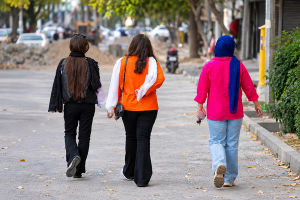
Two young women embrace on a street in Iran, where same-sex relationships remain socially sensitive and subject to legal restrictions.
For Bahar, revealing her relationship could mean facing her family’s expectations without the money to leave home.
“If I earned enough to have my own place, maybe I wouldn’t have to hide everything. But right now, if my family finds out, I don’t even know where I would go,” Bahar said.
The woman Bahar wants to share her future with can visit her family home. But in the eyes of Bahar’s parents, she must remain just a friend.
A secret too big to tell
Taraneh, 25, has a job. Last year, when her period was late, she took a pregnancy test.
The result was positive.
She was unmarried, and her boyfriend did not have a steady job. Neither was ready to have a child.
But before she could think about the pregnancy itself, she thought about her father.
“When I saw the test result, the first thing that came into my mind was what would happen if my father found out. Then I started thinking about where I could get the money to end the pregnancy,” Taraneh told Iran International.
She decided to end the pregnancy without telling her family. She did not have enough money to cover the cost, so she borrowed it from a friend.
In Iran, abortion is legal only in narrow cases, such as a serious threat to the mother’s life or a severe fetal abnormality, and only with official approval. The 2021 population law made even those harder to obtain. Women in Taraneh’s position are left with unlicensed clinics or pills bought on the black market, with no one to turn to if something goes wrong.
For an unmarried woman, seeking help with an unintended pregnancy can also mean revealing a sexual relationship her family knows nothing about, and one the law punishes.
Taraneh ended the pregnancy in secret.
Afterward, she worried about her health for some time. But she still could not bring herself to tell her mother.
Her mother had always told her she could come to her with any problem.
This time, asking for help would mean revealing the relationship, the pregnancy and the abortion.
“If I could have talked to my mother, maybe I wouldn’t have felt so alone. But at that moment, all I wanted was for nobody to find out,” Taraneh said.
Her family never found out, even when she was worried about her health.
Young women walk along a shopping promenade in Iran.
The forbidden drawer
Not every secret carries consequences as serious as Taraneh’s.
For Sara, 20, secrecy begins with something much smaller: underwear.
She lives with her family and likes decorative lingerie. She says it is a matter of personal taste and does not necessarily have anything to do with having a sexual partner.
Her mother sees it differently.
Two young women walk together through a shopping mall in Iran.
“I even have to be careful about buying something I wear underneath my clothes. My mother thinks that kind of underwear is only for married women, but I want to decide for myself what I wear,” Sara said.
Her mother sometimes looks through her drawers and wardrobe while tidying her room. So Sara keeps some of her things where her mother is unlikely to look.
She is not hiding a relationship or a pregnancy. She simply wants to choose what she wears without having to justify it.
In a country where the state decides what women must wear in public, Sara is fighting for the last place it does not reach: a drawer that nobody opens without permission.
The weight of silence
In these homes, everyday life goes on. Parents ask their daughters where they are going, when they will marry and what they plan to do with their futures.
The daughters answer, but not always with the whole truth.
For some, the silence protects a relationship. For others, it hides a decision about sex, a medical experience or even an item of clothing.
Since the Woman, Life, Freedom protests of 2022, many young Iranian women have openly defied the state’s rules on how they dress and live. At home, the struggle is quieter. Some mothers have already crossed over, covering for their daughters, keeping their secrets, promising they can come to them with anything.
But each of these five women still has to decide how much of her private life she can share with the people she lives with.
And sometimes, the person she most needs to talk to is the one she cannot tell the truth to.
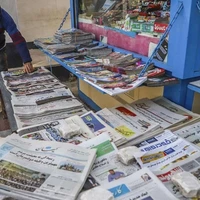
File photo: A man browses newspapers at a newsstand in Iran.
Iran is moving to tighten controls on journalists at home while threatening to pursue exiled media figures abroad, as lawmakers revive a controversial licensing proposal and the judiciary seeks to enlist Interpol in its crackdown on dissidents.
The proposed legislation would require journalists to obtain government-approved licenses to work, potentially placing their professional credentials under direct state oversight.
The proposal, first introduced in 2014, was shelved following strong opposition from journalists and media professionals. Hardliners in parliament revived it last week.
Babak Negahdari, head of the Majles Research Center, was quoted by the hardline news outlet Young Journalists Club as saying the proposal "has been finalized as a bill" and would be brought to a parliamentary vote within the next three months.
The legislation calls for the creation of a "Journalism Organization" modelled on the Iranian Medical Council, which regulates the licensing and professional practice of physicians.
Critics argue that the proposed body would undermine press freedom by placing journalists' professional credentials under state control.
Media lawyer Kambiz Nowrouzi said this week that the bill remains "the same 2014 draft with the same serious problems and fundamental flaws."
In an editorial in the moderate daily Shargh, he argued that the proposed Journalism Organization would effectively function as a government body, creating "a double filter for greater control over professional press organisations."
When introduced in 2014, the proposal was described as "abnormal" and "catastrophic" by journalism professor Hassan Namakdust, who warned it would leave "nothing of journalists' independence, status, and dignity."
Public reaction to its revival has so far been muted, possibly because of the intense security pressures facing journalists today.
The political environment has also changed. Parliament is dominated by hardliners, and the latest proposal originates from lawmakers rather than a government ministry.
Chasing exiled dissidents
Meanwhile, Iran's judiciary has announced efforts to pursue the arrest and extradition of dissidents and media figures living abroad through Interpol, alongside the confiscation of their assets inside Iran.
At a November 17 press briefing, Judiciary Spokesman Asghar Jahangir said authorities had confiscated assets belonging to a number of Iranians living abroad whom Tehran accuses of "treason" and other offences.
He said the judiciary was working through Interpol and its International Affairs Department to secure their arrest and extradition.
Although Jahangir did not release a full list of names, state television and affiliated outlets have repeatedly singled out exiled journalists working for Persian-language broadcasters such as Iran International, BBC Persian and VOA Persian when threatening asset confiscation, consular restrictions and Interpol Red Notices.
However, Article 3 of Interpol's Constitution prohibits the organisation from undertaking activities of a political, military, religious or racial character.
An Interpol Red Notice is also not an international arrest warrant, and Western host countries routinely reject extradition requests based on political or speech-related charges.
Nevertheless, the announcement has heightened concerns among Iranian journalists in Europe and the United States, some of whom fear questioning or delays at border crossings and airports when travelling internationally.
Other restrictive bills
The revived Journalism Organization Bill is the third in a series of legislative initiatives that critics say are intended to restrict freedom of expression and tighten state control over information.
The first two were the Foreign Influence Bill and the Bill to Organise Cyberspace.
The Foreign Influence Bill, which would criminalize interviews and other forms of contact with foreign-based media outlets, received initial parliamentary approval on August 16 by 183 votes to four, with five abstentions.
President Masoud Pezeshkian's cabinet formally opposed the legislation on August 23, but the government has no veto over parliamentary bills. The measure still requires a final parliamentary vote and Guardian Council approval.
The Bill to Organise Cyberspace, also known as the Protection (Sianat) Bill, was submitted to parliament on August 26.
Critics have described it as a rebranded version of the previously shelved Sianat internet bill. Among other measures, it would require internet service providers to identify and verify their users.
The legislation must undergo review by parliament's Social Commission before a floor vote and final consideration by the Guardian Council.
Together, the three proposals would expand state oversight of traditional and digital media, while the judiciary's latest announcement signals continued pressure on Iranian journalists abroad. Whether the revived licensing bill becomes law remains uncertain, but it is now being considered by a hardline-dominated parliament alongside other measures aimed at tightening controls on information.
Siyavush, on the black horse at center, plays polo as the Turanian king Afrasiyab watches. The painting, attributed to Qasim ibn Ali, was made in Tabriz around 1525–30 for Shah Tahmasp’s copy of Ferdowsi’s Shahnameh (Book of Kings). (The Metropolitan Museum of Art, public domain)
A Toronto-based Iranian software engineer has used Claude to explain more than 1.6 million Persian couplets in modern Persian, an effort to help readers understand poetry they still quote and turn to for advice.
One verse about a lavish dowry shows what Arman Nejad hoped to fix. An AI-generated note on Ganjoor, a popular free online library of Persian poetry, had mistaken Delaray, a woman’s name, for the word “dollar.” Readers who turned to the note for help were told the verse described a rise in the value of the US currency.
Errors like that posed a problem for Nejad, who had built a search engine called Ganjoorjoor, roughly “Ganjoor Finder,” for readers who remember what a poem says but have forgotten the words. The search engine draws on Ganjoor’s explanations to find matching verses. A note about exchange rates could send someone looking for poetry about a dowry to the wrong place.
A Persian-language post on X mocks Ganjoor's earlier AI-generated note, which read the name Delaray as the word "dollar" and described a rise in the US currency.
On a sleepless night on November 9, Nejad estimated it would cost about $3,000 to redo the notes and appealed for help on X. By the next morning, he said, the post had drawn 10,000 views and offers of support. Two AI platforms, mana.space and zharf.ai, donated credits, and he covered the rest himself.
By November 16, Nejad had finished the new notes for works by all 245 poets in the collection, from Rudaki to Shahriar. Ganjoor had been using AI-generated notes for about two years. By Nejad’s count, only about 1.5 percent of its couplets had explanations written by people.
Ganjoor said Friday it had published Nejad’s poem summaries and plain-language explanations on its website and in its public data repository. It kept the notes readers had already edited.
Putting AI through Iran’s university entrance exam
To decide which model to trust with the poetry, Nejad gave several of them the first booklet from the humanities track of Iran’s national university entrance exam, known as the Konkour. The exam offered freshly written questions in Persian and an answer key he could use to score each model.
Of the 80 multiple-choice questions, 30 tested Persian language and literature, 20 covered mathematics, and 15 each covered social sciences and psychology. Each model received the same text and images with web access disabled. Nejad tested each at three settings that varied how much processing it could devote to an answer.
Accuracy of each AI model and setting on the 80-question Konkour exam booklet. Claude Opus 5.5 (medium) and Gemini 3.8 Flash (highest) tied at 74 of 80.
Anthropic’s Claude Opus 5.5, on its medium setting, tied for first overall with Google’s Gemini 3.8 Flash on its highest setting. Each answered 74 of 80 questions correctly. On the literature questions, which mattered most to Nejad, Claude came first with 27 out of 30.
Nejad then tested 23 sets of instructions for Claude. He selected 160 poems with human annotations, using half to compare the instructions and reserving the other half to check the winner. Two AI judges, one from Anthropic and one from OpenAI, compared Claude’s explanations with the human notes. The finalists scored between 97.4 and 97.9 percent, so Nejad chose the cheapest to run.
On the 30 Persian literature questions, Claude Opus 5.5 (medium setting) came first, answering 27 correctly.
The instructions gave Claude the poet’s name, the book, the chapter and the surrounding lines. “You don’t need to teach Opus how to read Persian poetry,” Nejad wrote in an essay about the project. “You just need to tell it what it’s reading.”
The full run took about 155,000 requests over several days, Nejad said. It used 566 million tokens, the units of text a language model processes, and cost roughly $3,100.
Majnun’s uncle and Khayyam’s wine
In Nezami’s Leyli and Majnun, an old man named Salim goes looking for Majnun each month to bring him food and clothes. The poet calls him Majnun’s khal, a Persian word for a maternal uncle that can also mean a beauty mark. The old note gave Salim a mole on his forehead. The new one introduces him as Majnun’s uncle and picks up Nezami’s play on both meanings later in the passage, Nejad wrote.
In Nezami’s 12th-century epic Haft Peykar, the word gur can mean both “grave” and “wild ass.” The old note had a man stepping into a grave as a lion approached carrying a bow. In the new reading, King Bahram holds the bow and rides in pursuit of wild asses. It is Bahram whom the poet likens to a lion.
An AI-generated illustration of the corrected reading of Nezami's Haft Peykar, in which King Bahram, bow in hand, gallops after wild asses.
In a quatrain attributed to Omar Khayyam, the earlier note advised readers to keep wise company and avoid pleasure. The new one reads the verse as an invitation to drink wine. Those who spent their lives puzzling over philosophical questions, in this reading, were like sour grapes that shriveled into raisins before they ever ripened.
Nejad said reviewers compared the old and new explanations for 500 randomly selected couplets, reading each alongside its neighboring verses. They preferred the new note in 413 cases, favored the old one in four and judged the two about the same in the remaining 83.
Beyond Hafez
On Yalda, the longest night of the year, many Iranian families make a wish, open the collected poems of the 14th-century poet Hafez at random and read the poem they land on as his answer.
“Hafez left us more than six hundred years ago, and Iranians still ask him for advice,” Nejad wrote. “Getting an answer has never been the hard part. Understanding it is.”
Readers of Hafez have centuries of commentary to draw on. In Istanbul in 1594, the scholar Sudi finished a verse-by-verse commentary on his collected poems for Ottoman readers. For a sense of what readers face elsewhere in the collection, Nejad pointed to Waqif Lahori, who died in 1776. Until this month, Nejad said, none of Waqif’s 12,312 couplets on Ganjoor had an explanation.
“Sudi did Hafez,” Nejad wrote. “In 2026, we did everyone.”
A 23-year-old woman was shot dead at her own birthday party in Iran’s northern Gilan province by a former boyfriend after she refused to marry him, local media reported, days after a 16-year-old girl’s killing by her father set off a national outcry.
Sadaf Haghbin was killed in the early hours of Thursday in Choukam, in Khomam county near the road between Rasht and the Caspian port of Bandar Anzali.
A 29-year-old man walked into the party armed, locked the guests in a room and took Haghbin upstairs, local media in Gilan reported. The Kurdish rights group Hengaw, citing sources close to the family, said he beat her and pressed her to call her parents and say she agreed to marry him. When she refused, he shot her several times.
He shot her first in the heart, then in the face and finally in the head, the local outlet Hirkani reported, citing an informed source, before fleeing. He had a history of violence and abuse toward her, Hengaw said.
Khabaronline reported that her refusal of his proposal was the likely motive, though police have not confirmed it.
The police chief of Khomam county, Iman Jahandideh, said without naming Haghbin that a 29-year-old man had shot a 22-year-old woman with a hunting rifle over “personal disputes” and fled.
He was arrested a few hours later with the rifle, confessed and was handed to the judiciary, the police chief said.
Two killings in four days
Haghbin’s death came four days after Sogand Sayadi, a 16-year-old schoolgirl in the western city of Kermanshah, died after falling from the fifth floor of a building on November 15. Rights groups say her father threw her.
The day before, administrators at her girls’ high school had summoned her father over her relationship with a young man he opposed.
According to rights groups, he beat her in front of her classmates and school staff, after she had warned teachers that her father would kill her if they sent her home with him.
Kermanshah’s prosecutor opened an investigation, and her father was arrested on charges including assault and murder, along with the school principal, on charges of negligence. Iran’s main teachers’ union network condemned the school’s handling of the case.
A petition launched on Tuesday demanding a tough sentence for her father and a change to the law that shields him has gathered more than 220,000 signatures.
A law that protects fathers
Under Article 301 of Iran’s Islamic Penal Code, a father or paternal grandfather who kills his child cannot face qisas, or retribution in kind, the punishment for most murders. He faces at most a prison term, and in practice often a short one.
The rule has been at the center of Iran’s most notorious cases. In May 2020, 14-year-old Romina Ashrafi was beheaded with a sickle by her father in Talesh, also in Gilan province, after she ran away with a man he opposed.
He was sentenced to nine years. In February 2022, 17-year-old Mona Heydari was beheaded by her husband in Ahvaz, in the southwest, who walked through the streets with her head. Each case set off outrage online and calls for reform that were never met.
A bill to protect women from violence has been stuck for about 16 years between the government, parliament and other state bodies and has still not become law.
At least 84 women and girls
At least 84 women and girls were killed in Iran between March 21 and October 13, 12 of them under 18, the Emtedad news site reported on Monday, citing cases reported in the media. Eight of the underage victims were killed by fathers, brothers or other blood relatives.
In August, another 16-year-old in Kermanshah, Hana Rakan, was shot in the head by her father while she slept, Hengaw reported.
The Shargh newspaper reported on Thursday that 125 women and children had died from domestic violence between late March and November. Both counts rely on reported cases and are likely to understate the real number.
After Haghbin’s death, users on social media posted the names of women and girls killed by family members or partners in recent weeks.
Promotional displays for the upcoming video game "Grand Theft Auto VI" (GTA 6) ahead of its scheduled release on November 19 inside a Saturn electronics store in Berlin, Germany, November 17, 2026
The release of Grand Theft Auto VI has sparked excitement, frustration and political satire among Iranian gamers, who face soaring prices, slow internet speeds and barriers to international payments.
For many Iranian gamers, the challenge goes beyond affording the game, with slow internet connections making downloading its roughly 200 gigabytes another obstacle.
"I really want to buy and download GTA, but when I think about having to download 200 gigabytes with this miserable internet speed and all the frustration that comes with it, I give up for now," one user wrote on X.
Another joked about the time required to download the game.
"With Iran's internet speed, I think my 200-gigabyte GTA download will finish by the time the next GTA comes out," the user wrote.
A game priced beyond many gamers' reach
GTA 6 costs an estimated 210 million rials in Iran, compared with 1.9 million rials for GTA 5 in 2013 and just 400,000 rials for GTA 3 in 2001.
That makes the latest installment more than 110 times as expensive as GTA 5 was 13 years ago and over 500 times the price of GTA 3 in 2001.
The increase largely reflects the rial's depreciation against the dollar. The US currency has risen from around 8,000 rials to 2.66 million rials on Iran's free market, an increase of more than 33,000%, while the game's international price has risen by just 60%, from $50 to $80.
For some gamers, purchasing the game is only part of the financial challenge.
"I want to play GTA, but I don't have the console. I'm just 1.9 billion rials short," one user joked, posting a bank account number alongside the message.
Another described the difficulties of buying the game legally through a gift card because Iranian consumers lack ordinary access to international credit cards and payment networks.
"I really went through hell to buy it. I wish we could use credit cards and the global financial system as easily as everyone else," the user wrote.
Promotional displays for the upcoming video game "Grand Theft Auto VI" (GTA 6) ahead of its scheduled release on November 19 inside a Saturn electronics store in Berlin, Germany, November 17, 2026
The gamer said the purchase had eventually succeeded after a complicated process, adding that alternatives existed but they wanted to experience buying a game the way people with international credit cards do.
Download speeds expose digital divide
The game's large download size has also highlighted the difference between internet access inside Iran and abroad.
One Iranian user living outside the country posted that downloading approximately 210 gigabytes had taken just 32 minutes.
The post prompted a wave of responses from gamers inside Iran comparing their much longer download times.
"My download speed is great too," one user joked, sharing a screen showing 15 hours remaining.
Another user said downloading the game over an ADSL connection would take 72 hours, while a third reported an estimated 27 hours.
Gamers turn frustration into political satire
The excitement surrounding GTA 6 has also inspired digitally created images combining the game's release with jokes about Iran's political leadership and internet restrictions.
One satirical image shows Mojtaba Khamenei, Iran's supreme leader, reflected in a television displaying a PlayStation download screen for GTA 6.
Another manipulated screenshot replaces the game's estimated download time with the words "Until Mojtaba shows up," referring to new supreme leader’s continued absence from public view since the death of his father, Ali Khamenei, and his subsequent rise to power.
Other posts focused on the country's internet speeds, including a fabricated download screen estimating that the game would take 86 years and 22 days to download.
"I think the timing is perfect. By then, I'll have saved enough money to buy it, and we can play together," one commenter responded.
"Maybe in the next life, God willing," another wrote.
Excitement meets frustration
Despite the financial and technical barriers, anticipation for the game has remained high among Iranian social media users.
Some celebrated finally purchasing it, while others expressed disappointment at being unable to afford the necessary hardware or even watch gameplay videos online.
"The whole world is playing GTA 6 and having fun," one user wrote, describing their frustration with internet access in Iran.
"I don't even have enough internet to watch it in 240p," the user added.