Analysts say the crackdown on everyday freedoms, alongside the continued execution of protesters, serves several purposes: intimidating a discontented population, reassuring loyalists and demonstrating that the authorities remain firmly in control.
"I think they feel cornered and they feel threatened by the impending military conflict with the US and Israel," Shahin Milani, executive director of the Iran Human Rights Documentation Center, told Iran International.
"They just want to tell the population that we're staying here, we're not going to go anywhere."
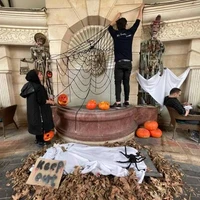
On October 30, Basij paramilitary forces and plainclothes security personnel broke up Halloween celebrations on Tehran's Iranshahr Street, beating and detaining people and forcing nearby cafes to close, witnesses told Iran International.
Families spending the evening at nearby Artists Park were also ordered to leave.
The crackdown extended to other cities, where authorities shut down businesses and initiated legal proceedings against organisers of Halloween celebrations.
Social control as a means of survival
Roya Boroumand, executive director of the Abdorrahman Boroumand Center for Human Rights in Iran, said the repression reflects a longstanding feature of the Islamic Republic rather than a new wartime strategy.
She pointed to the years following the 1979 revolution, when authorities targeted cinemas, alcohol sales and women who refused compulsory veiling, even as Iran faced war with Iraq.
"They focused on these issues because this is how they keep people in their place," she told Iran International.
Omid Memarian, an Iran analyst with DAWN, said sweeping social changes in recent years have unsettled the government's conservative base, prompting hardline institutions to enforce restrictions that reassure their supporters.
"These performative acts, which might cost some Iranian citizens their time and their life and their freedoms, [are] designed to satisfy the base, the very hardline base that has been supporting the government over the past seven months," Memarian said.
He distinguished between the civilian government and powerful hardline institutions, including the judiciary, which continue to enforce ideological restrictions.
No respite from executions
The policing of social freedoms comes alongside an escalating campaign of executions following January's nationwide anti-government uprising.
On November 3, Iranian authorities executed Amirhossein Maleki and Amirhossein Ebrahimi, both 19, at Isfahan Central Prison.
Iran Human Rights said the executions brought to nine the number of defendants put to death in the Alikhani Square case, which has been marred by allegations of torture, forced confessions and serious violations of due process.
Three other defendants remain at grave risk of execution.
At least 36 protesters have been executed in connection with the January uprising since March, according to Iran Human Rights.
"They want to intimidate people and just send the message that nothing is going to change and that they're not going to give up an inch," Milani said.
Boroumand argued that international attention to military developments has given the authorities greater room to pursue repression.
"Of course, that's why they are executing so many political prisoners and protesters, because the world is focused on fuel prices and the Strait of Hormuz," she said.
But Boroumand stressed that repression is an existential issue for the Islamic Republic, regardless of whether the country is at war.
A show of strength with limits
Milani cautioned against assuming that every restriction reflects a coordinated national strategy.
"Just because the regime is dictatorial and authoritarian doesn't necessarily mean that it is efficient, even in repression," he said.
Decisions can be arbitrary, he explained, with local officials sometimes imposing restrictions independently of senior authorities.
Memarian said hardline institutions are attempting to demonstrate strength at a time when the government faces unprecedented external pressure.
But he questioned whether they could reverse the social changes that have already taken place, arguing that enforcing restrictions on the scale seen in previous decades has become increasingly difficult.
Milani pointed out that intimidation continues to have devastating consequences for families. Many who have lost children or have loved ones imprisoned may remain silent out of fear that speaking publicly could endanger other loved ones.
Boroumand warned that the consequences of January's crackdown must not disappear from international attention as the war dominates headlines.
"The war is very important, but it should not overshadow the massive and unprecedented killings of January and the repression that Iranians have been experiencing since," she said.
She also pointed to the continuing arrests of lawyers and the difficulties protesters face in securing legal representation.
For the Islamic Republic, repression remains a means of asserting authority. But while it can intimidate citizens into silence, whether it can reverse the social changes that have transformed Iranian society is another matter.