German FM says G20 largely united on need for Iran negotiations
Most G20 countries agree that Iran must return to negotiations to address the ongoing crisis, German Foreign Minister Johann Wadephul said Friday, also calling for an end to Houthi attacks.
“Most of the G20 share our view: Iran must come to the negotiating table, the Houthis must cease their attacks, and Russia must stop driving global food security towards collapse with its attacks in the Black Sea,” Wadephul said in remarks published on the German Foreign Office's X account.
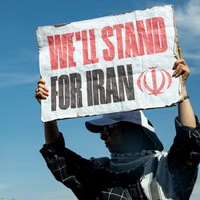
A participant holds a placard reading “We’ll stand for Iran” at a state-organized rally in Arak, central Iran, October 21, 2026
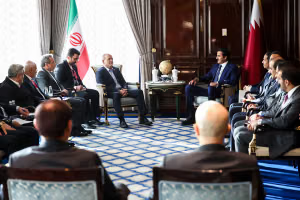
Qatari mediators returned to Tehran on Friday, barely a day after leaving the Iranian capital following the reported rejection of their latest peace proposal, as Washington and Tehran remained divided over which side should make the first concessions.
The delegation's swift return suggested that diplomatic efforts were continuing despite reports by Iranian news agencies that senior officials had rejected key provisions of the Qatari-mediated proposal.
On Friday, as the Qatari delegation, led by a senior adviser to Qatar's prime minister, held talks with Iranian diplomats headed by Foreign Minister Abbas Araghchi, Tehran's Friday prayer leader, Mohsen Haj Ali Akbari, poured cold water on the prospect of a breakthrough with Washington.
He said past experience showed Washington's offers of talks could coincide with more serious threats than its public military warnings suggested.
More notably, he lent weight to calls for a revision of Iran's nuclear doctrine, arguing that they were neither a fringe position nor merely an emotional reaction.
On Thursday, Araghchi said Tehran remained committed to the Islamabad Memorandum of Understanding (MoU) as the basis for further negotiations.
He rejected proposals requiring Iran to reopen the Strait of Hormuz as a unilateral confidence-building measure before the verified lifting of naval restrictions and the release of $24 billion in frozen Iranian assets.
‘War is certain’
The disagreement over which side should act first remains a central obstacle to negotiations, even as regional mediators continue efforts to prevent another round of fighting.
A separate diplomatic initiative by US Vice President JD Vance has also yet to produce a formal Iranian response.
Iranian media have confirmed receipt of a letter from Vance to security chief Mohsen Rezaei, but officials have not commented on its contents, insisting instead that Tehran's conditions for an agreement remain unchanged.
Former parliamentary national security committee chairman Heshmatollah Falahatpisheh offered a far more pessimistic assessment of the renewed mediation efforts.
"The mediators' visits to Tehran are a sign that war is certain, not that diplomacy is being revived," he wrote on X on Friday, arguing that only a regional agreement involving the United States and China could now prevent a fourth war.
Economic costs
In an article published Thursday, the reformist newspaper Shargh also expressed grave concern about the diplomatic deadlock..
It warned that celebrating mine attacks and escalating regional tensions while Iran's economy faced severe shortages of essential inputs could prove a potentially fatal mistake.
The conservative newspaper Khorasan offered a more measured assessment of the diplomatic difficulties, while supporting Araghchi's rejection of proposals requiring Iran to de-escalate before Washington lifted restrictions on shipping.
While some commentators warn that prolonged confrontation is deepening Iran's economic problems and increasing the danger of war, others argue that making concessions under military and economic pressure would weaken Tehran's position in any eventual agreement.
Who moves first?
The discussions appear to be focused on establishing a framework for renewed negotiations rather than resolving every outstanding issue in a comprehensive peace agreement.
Vance's letter, according to US media reports, sought to restart talks with Iran's nuclear program included from the outset. Tehran, meanwhile, insists that steps to ease the naval blockade and release frozen assets must precede substantive nuclear negotiations.
The disagreement is reflected in a proposed seven-day framework. Washington wants nuclear discussions to begin on the first day, while Tehran insists they should begin on the seventh, after other measures have been implemented.
Although the proposed timetable separates the two positions by six days, the dispute is about more than timing. Each side wants the other to demonstrate its commitment before taking what it considers a significant political risk.
The stakes remain high. US officials have warned of possible renewed military operations after the November 3 midterm elections, while Tehran continues to reject proposals it regards as requiring unilateral concessions.
For now, the return of the Qatari mediators shows that diplomatic contacts remain active. Whether those contacts can prevent another round of fighting depends on finding a sequence of steps that both Washington and Tehran are prepared to accept.
Vessels at the Strait of Hormuz, as seen from Musandam, Oman, October, 2026.
A small boat attached two explosive devices to a tanker in the Strait of Hormuz, causing an engine-room fire and temporarily disabling the vessel, the United Kingdom Maritime Trade Operations (UKMTO) said on Friday, providing new details about an attack the previous day.
The incident occurred on Thursday about 25 nautical miles (46 km) northeast of Khasab, Oman. UKMTO said the boat approached the tanker's port side and attached the explosives to its hull above the waterline.
The agency said the fire had been extinguished, all crew members were safe and there was no environmental damage. The vessel was continuing to its next port of call.
Three maritime security sources identified the tanker as the Panama-flagged Louise 1 and said the devices were limpet mines, Reuters reported.
Iran says it destroyed US unmanned vessel
In a separate development on Friday, Iran's navy said it had destroyed a US unmanned vessel in the eastern Strait of Hormuz, according to Iranian state media.
There was no immediate confirmation from the US military.
The report came amid continued maritime tensions between Washington and Tehran, with commercial shipping facing repeated attacks and disruptions since the US war with Iran began in February.
First successful limpet mine attack since war began
The attack on the Louise 1 marked the first known successful use of limpet mines against a tanker in the area since the war began, according to two maritime security sources cited by Reuters.
The sources said a similar attempt in September had failed when the devices did not detonate.
Limpet mines are explosive devices attached directly to a ship's hull. They differ from sea mines placed in the water, which can detonate when vessels pass over or near them.
"The apparent ability of a small craft to approach a transiting tanker, deploy explosive devices and withdraw presents a significant security concern, particularly in the Strait's congested shipping lanes," Greece-based maritime risk management company Marisks said on Friday.
Marisks said such explosives were inexpensive and could be deployed using small boats. It said limpet mines had been used against tankers in the region in previous years.
Iran reports three tankers struck sea mines
Iran's Islamic Revolutionary Guard Corps (IRGC) said on Thursday that three tankers had struck sea mines, exploded and caught fire while attempting to leave the Strait of Hormuz through a southern route it described as unauthorized.
The IRGC navy said the vessels had switched off their radar and navigation systems and ignored warnings from Iranian forces. It said the tankers were left along the strait's southern coast.
The UKMTO advisory described an attack involving explosives attached directly to a tanker's hull. It remains unclear whether the Louise 1 was among the three vessels mentioned by the IRGC.
The Strait of Hormuz connects the Persian Gulf with the Gulf of Oman and is a critical route for international oil and gas shipments.
Tanker previously targeted in Black Sea
The Louise 1 was previously struck by Ukrainian naval drones in the Black Sea in July, according to Reuters.
Ukraine's SBU security service said the tanker was targeted over its alleged role in transporting Russian oil as part of Moscow's so-called shadow fleet, a network of vessels used to maintain oil exports despite Western sanctions.
The tanker's Panama-based operator, Aquarius Maritime Ventures, could not immediately be reached for comment, Reuters reported.
An Iranian Baha’i photojournalist sentenced to 26 years in prison has been denied the right to a standard appeal, a source close to his family told Iran International on Friday, as authorities continued to put pressure on members of the religious minority.
The restrictions on Artin Ghazanfari's appeal come as a court upheld another Baha’i man's prison sentence in northern Iran and security agents seized belongings from three Baha’i homes in the central city of Isfahan.
Ghazanfari, held at Greater Tehran Prison, can challenge his sentence only through the Supreme Court rather than a regular appeals court, the source said.
The developments are the latest in a series of judicial and security measures involving Iran's Baha’i community, the country's largest non-Muslim religious minority, whose faith is not officially recognized by the Islamic Republic.
Journalist sentenced to 26 years, denied medical care
Ghazanfari was sentenced by Branch 15 of Tehran's Revolutionary Court, presided over by Judge Abolghasem Salavati, according to the Human Rights Activists News Agency (HRANA).
His sentence includes 20 years for "media-related activities," five years for "assembly and collusion" and one year for "propaganda against the state."
A source close to his family said the judge applied Iran's law on increased espionage penalties to impose a 20-year sentence for an offense that would otherwise carry a 10-year prison term.
The source said Ghazanfari was given only 10 days instead of the usual 20 to challenge the ruling and was required to choose a lawyer from a list approved by the head of the judiciary.
His lawyer was also denied an opportunity to speak with the judge, according to the source.
Ghazanfari, who was arrested at his Tehran home in January, has also been barred from joining political groups, engaging in social media activities and leaving the country. Authorities ordered the confiscation of his mobile phone.
HRANA reported that Ghazanfari suffers from heart failure, high blood pressure and asthma but has been denied specialist medical treatment outside prison despite recommendations from prison doctors.
Noyan Hejazi and his wife
Court upholds sentence over Baha’i religious activities
In a separate case, the ninth branch of the Mazandaran Court of Appeals upheld a sentence of seven months and 16 days in prison against Noyan Hejazi, a Baha’i resident of Jouybar in northern Iran, sources familiar with the case told Iran International.
The court also upheld a ban on exercising social rights for 10 years and one day.
Hejazi was convicted of "promoting the Baha’i faith" and "propaganda against the Islamic Republic" on social media.
Court documents cited activities including organizing recreational camps and music classes for young people, possessing Baha’i religious books and publishing material critical of the Islamic Republic online.
The appeals court rejected his objections and upheld the lower court's ruling. It also cited his lack of cooperation during questioning and what it described as ineffective denials of the accusations.
Security forces arrested Hejazi at his home in June 2025 without presenting a judicial warrant, according to sources familiar with the case. He was released on bail in August.
His wife was also detained while seeking information about him at a detention center in Sari and was later released on bail.
Security agents seize jewelry and belongings from three homes
In Isfahan, 10 plainclothes agents raided three homes belonging to Baha’i families on October 27, seizing jewelry, cash, electronic devices and household belongings, sources told Iran International.
The homes belonged to Raouf Rouhani Najafabadi, his mother Ferdous Ferdousian and his mother-in-law Forough Darab.
According to the sources, the masked agents spent six hours searching the properties and removed nine mobile phones, three televisions, three laptops, cameras, four musical instruments, more than 15 suitcases and bags, and over 30 million tomans in cash.
They also seized gold and jewelry, along with household items including a bag of sugar, an air pump and a ladder.
The sources said agents used pliers to cut two gold bracelets from the wrist of a woman in the family and removed a necklace belonging to an elderly relative.
The agents told Rouhani Najafabadi and his daughter that they would contact them later, according to the sources.
Days before the raids, Rouhani Najafabadi's wife, Taraneh Khosravani, had received a summons to appear before a court handling property confiscation cases under Article 49 of Iran's Constitution.
The court deals with confiscation proceedings and is linked to the Execution of Imam Khomeini's Order, an organization that manages extensive assets in Iran.
Sources said dozens of Baha’i families in Isfahan had received similar court notices over the past year, while raids and property seizures had increased.
International concern over treatment of Bahais
The cases come as Iran faces renewed international criticism over its treatment of religious minorities.
Representatives of Britain and Italy condemned discrimination and repression against ethnic and religious minorities, including Bahais, during a meeting of the UN General Assembly's Third Committee on October 28.
Iran's Baha’i population is estimated at more than 300,000, making it the country's largest non-Muslim religious minority.
Unlike Christianity, Judaism and Zoroastrianism, the Bahai faith is not recognized under Iran's constitution.
Since the 1979 Islamic Revolution, Bahais have faced restrictions on education, employment, religious activities and property ownership, according to human rights organizations.
In September, a spokesperson for the Baha’i International Community told Iran International that pressure on Bahais had intensified, describing the judiciary as a tool for persecuting religious minorities.
Iranian authorities have long rejected accusations of systematic religious persecution, maintaining that prosecutions involving Bahais concern security or legal offenses rather than religious beliefs.
US Vice President JD Vance delivers remarks during a midterm campaign rally at JRJ Construction in Weatherford, Texas, US, October 29, 2026.
US Vice President JD Vance has offered to meet Iran's top security official Mohsen Rezaei to discuss ending the war, the Washington Post reported, as Qatari mediators returned to Tehran on Friday to pursue a deal.
Vance sent a letter last week to Rezaei, secretary of Iran's Supreme National Security Council and a former commander of the Islamic Revolutionary Guard Corps (IRGC), outlining the interests of both countries in possible negotiations, the newspaper reported on Thursday, citing a US official familiar with the discussions.
The letter stressed that Washington's main objective was to prevent Iran from obtaining a nuclear weapon, while recognizing Tehran's interests in rebuilding its economy and preserving its national sovereignty.
The vice president also told Iran it needed to appoint representatives authorized to negotiate over its nuclear program, according to the report.
Istanbul or Doha could host a meeting between Vance and Rezaei if the two sides agree to direct talks, the official said.
The Washington Post reported that US officials regarded Rezaei as an important contact because of his influence within Iran's security establishment and his access to Supreme Leader Mojtaba Khamenei.
Qatar returns to Tehran for new talks
Qatari mediators returned to Tehran on Friday to advance efforts toward an agreement between Iran and the United States, Reuters reported, citing an official briefed on the negotiations.
The mediators have been coordinating their efforts with Washington as they seek to narrow differences over the nuclear program and the economic restrictions imposed on Iran.
The two sides remain divided over the order of steps needed to reach an agreement. Washington wants nuclear issues addressed from the outset, while Tehran insists that the US first end its naval blockade and lift restrictions on Iranian oil exports.
Qatar presented Iran with a draft peace plan on Sunday, but a senior Iranian official subsequently described the ideas as unacceptable and said Tehran would not change its position on the nuclear issue.
Iranian Foreign Minister Abbas Araghchi said on Wednesday that Tehran was consulting closely with intermediaries on ideas for implementing its own seven-day proposal to end the war.
The Washington Post reported that Qatari representatives have maintained regular contact with Rezaei and other senior Iranian officials.
According to the newspaper, Iranian leaders regarded Vance's direct letter as a sign of respect, although there was no indication they had changed their nuclear position.
Washington sees Rezaei as central to negotiations
The Trump administration believes Rezaei could help secure support within Iran's leadership for a nuclear agreement, the Washington Post reported, citing the US official.
US intelligence officials believe Rezaei has maintained regular contact with Supreme Leader Mojtaba Khamenei, including discussions in recent days after receiving Vance's letter.
Rezaei, a former commander of the IRGC, has gained influence within Iran's political and security establishment and maintains connections with officials overseeing the economy, according to the report.
The newspaper said US officials viewed him as someone capable of securing agreement among Iranian leaders on sensitive nuclear issues.
Vance previously led US negotiations with Iran, including an April meeting in Islamabad with Iranian Parliament Speaker Mohammad Bagher Ghalibaf.
Those discussions involved possible sanctions relief and economic cooperation in exchange for a nuclear agreement, but they failed to produce a lasting settlement.
The Washington Post reported that US officials believe the opportunity to reach an agreement without further military action could be narrowing.
Trump says contact focused on medical supplies
US President Donald Trump confirmed Wednesday that he had approved Vance's outreach to Iran but said the contact concerned medical supplies rather than instructions to restart peace negotiations.
"They need help with medical supplies and various things. He asked me what I thought. I said, 'if you want to do that, that's OK,'" Trump told reporters.
"Basically, it's getting supplies in to help people that are not well," he added.
The Wall Street Journal first reported the letter to Rezaei, saying the contact was intended to explore whether Washington and Tehran could agree on a framework for negotiations.
Axios separately reported that Vance stressed the need for any renewed negotiations to address Iran's nuclear program.
The discussions come as Trump considers possible renewed strikes against Iran after the November 3 US midterm elections, according to reports by US media outlets.
Vance says Trump will not allow prolonged Iran war
Speaking at a Fox News town hall in Fort Worth, Texas, on Thursday, Vance said Trump would not allow the conflict with Iran to become a prolonged US military engagement.
"We've been involved in Iran in some form for seven months. The United States has been dealing with Iran for 47 years, and I promise you that Donald Trump is not going to let Iran become a forever war," Vance said.
He said opposing lengthy military interventions did not mean ruling out the use of force.
"I think there's a difference between criticizing foreign military misadventures and saying that you can never ever use the American military," he said.
"He's going to accomplish America's objectives, and then we're going to focus on the other things that we're doing," Vance added.
His comments came as US military officials prepared options for possible further strikes against Iran, with Trump yet to announce a decision.
Prison air is “fetid” and “suffocating,” Mahvash Sabet writes in her new memoir, Open Wide the Doors, offering a rare account by a Baha’i prisoner of life inside Iran’s prisons and the persecution of the country’s religious minority.
The book, launched in London on October 21, was written inside prison “on scraps of newspaper and tissue paper and whatever else she could find,” according to Payam Akhavan, the international human rights lawyer who hosted the event.
The fragments were later smuggled out of Iran and assembled by Azita Mottahedeh, a scholar, and writer Bahiyyih Nakhjavani., the book’s translators
Sabet trained as a teacher and was a member of the “Yaran,” or “Friends” of Iran, a group tasked, with the government's knowledge, with caring for the Baha’i community’s basic needs.
More than 200 Baha’is were executed after the 1979 Islamic Revolution, and the community continues to face widespread discrimination and persecution.
After Sabet’s arrest in 2008, the other six members of the Yaran were also detained. All seven were jailed for a decade on charges including conspiring against national security. Their former lawyer, Nobel Peace Prize laureate Shirin Ebadi, has said no evidence was presented to substantiate the charges.
Released in 2017, Sabet was arrested again in 2022 and sentenced to another decade in prison alongside fellow former Yaran member Fariba Kamalabadi. She is currently on medical furlough but could be recalled to prison at any time.
The book offers an unflinching account of prison conditions. In solitary confinement, the stench is so “noxious” that Sabet tries to breathe through a slit in her door. Other prisoners’ faeces lie in piles in her cell, and cockroaches crawl across the floor.
Remembering hours of blindfolded questioning early in her detention, Sabet writes that “the hair rose on the back of my neck” each time her interrogator drew close.
But alongside the degradation and violence, the memoir describes Sabet’s efforts to preserve compassion for those around her, including fellow prisoners and even her jailers.
At the London launch, two former cellmates and another former prisoner spoke about Sabet’s influence on their lives.
Roxana Saberi, a journalist imprisoned in Evin in 2009, recalled being “dumbfounded” when Sabet and Kamalabadi told her they were “trying to turn their experiences [in prison] into an opportunity.”
As Sabet showed “kindness and compassion to everyone, from her fellow cellmates to her captors,” Saberi came to believe that such an approach could help lay the foundations for “democracy, freedom and understanding” in Iran.
One episode in the memoir captures that compassion. When an “emaciated” crack addict, with “a head like a prop for an anatomy class … eyes set back in deep rings of darkness,” reaches toward Sabet from a lower bunk, she climbs down to hold the woman’s hand.
Although Sabet has only just secured a bed in an overcrowded ward, she also holds the woman’s wounded, “festering” feet, describing how her heart breaks and fills with love.
Sabet does not conceal her own suffering. After a brutal interrogation in which she endures insults and blows from six “sweating, stinking” men, she recalls how “desperate” she had been for “fresh air.”
Iqan Shahidi, an Iranian Baha’i imprisoned between 2012 and 2017, described Sabet as “like a light in the darkness for me.”
Now an academic in the United Kingdom, Shahidi said he had studied at the informal Baha’i university where Sabet taught before her imprisonment.
The institution illustrated how Baha’is responded to persecution, he said. Rather than resorting to political confrontation or violence, “instead they built something,” providing education to young Baha’is barred from public universities.
“Mahvash kept everybody so hopeful through very simple things in life,” said Nazanin Zaghari-Ratcliffe, the Iranian-British former prisoner who spent six years in detention.
Every year in prison, Zaghari-Ratcliffe recalled, Sabet invited the entire ward to a Nowruz feast. Tables were pushed together, and Sabet supervised the careful slicing of potatoes for traditional Persian dishes.
She continued paying for the annual celebration even after her release, sending money to jailed activist and future Nobel Peace Prize laureate Narges Mohammadi.
For Zaghari-Ratcliffe, the gatherings represented something larger than a shared meal.
Iran’s political prisoners, drawn from different ethnic and religious communities and political backgrounds, were forced to live together for years despite their differences.
Sabet, she said, would “make sure that we [were] all part of the same community.”
“We are against this oppression that has put us in this place … regardless of our differences, we are all one.”
That commitment extended even to prison staff.
Sabet recounts returning to a jail where she had previously been held and receiving a warm welcome from guards. One officer, who tells her that “all my life I have been a good Muslim,” confesses that he has come to hate religion and works for the government only to support his family.
Sabet tries to reassure him, expressing her belief that Iran has a better future and that its people will one day rebuild the country together.
The officer says he wishes he could believe her.
“So allow yourself to,” Sabet replies, “instead of wasting energy on your doubts!”
In the book’s final pages, Sabet recalls an unexpected encounter in prison with Jamaloddin Khanjani, the eldest member of the Yaran.
“The sheer wonder of what had happened felt like a recompense for all the beatings, a reward after all that solitude; it was like breathing fresh air in the suffocating corridors of Evin.”