IRGC-linked outlet promotes nuclear bomb as popular demand
A woman holds a poster depicting the Islamic Republic's three Supreme Leaders, during a state-organized rally in Bojnourd, Iran, October 27, 2026
The Revolutionary Guards-affiliated Fars news agency has promoted calls for Iran to build an atomic bomb through a video of street interviews, presenting nuclear armament as a popular demand.
“The most frequently repeated demand among Iranians these days: Why should America and Israel have atomic bombs while we don't?” Fars said in its description of the video, circulated on X and Telegram.
The agency presented the selected interviews as evidence of public support for nuclear weapons, although they provide no reliable measure of how widely that view is shared.
The message echoes arguments advanced by several Iranian lawmakers and other establishment figures following the wars with Israel and the United States.
From warnings to calls for a bomb
Discussion of changing Iran's nuclear doctrine predates the wars. In May 2024, former foreign minister Kamal Kharrazi, who later advised Supreme Leader Ali Khamenei, said Iran could reconsider its nuclear doctrine if Israel attacked its nuclear facilities or threatened the country's existence.
Kharrazi died in April 2026 from injuries sustained in a US-Israeli strike on his home in Tehran.
In August, Supreme National Security Council Secretary Mohsen Rezaei argued that international non-proliferation commitments had failed to protect Iran from military attack.
“When America is waging such a war, people naturally ask: Why shouldn’t we pursue nuclear weapons ourselves?” Rezaei told state television, suggesting that the attacks had strengthened arguments for acquiring an atomic deterrent.
Some lawmakers have gone further. On October 18, Ahmad Naderi, a member of parliament's presiding committee, said he had advocated nuclear testing and developing an atomic bomb for more than a decade.
Naderi also suggested that Supreme Leader Mojtaba Khamenei might take a different position from his late father, Ali Khamenei, who maintained that his religious ruling prohibited nuclear weapons.
Lawmaker Ahmad Bakhshayesh Ardestani called in July for Iran to manufacture nuclear weapons, arguing that the country had already paid the price for its nuclear program.
The conservative newspaper Vatan-e Emrooz also endorsed nuclear armament this month, featuring the headline “Iran Should Build a Bomb” and arguing that a nuclear deterrent could prevent further US and Israeli attacks.
Former Iranian foreign ministers Mohammad Javad Zarif (R) and his predecessors Ali Akbar Velayati and Kamal Kharrazi next to him, in a meeting with Supreme Leader Ali Khamenei on July 21, 2018.
Attempts to portray nuclear weapons as a popular demand predate the latest Fars video.
In September 2025, state television aired a commentator's claim that nearly 90% of Iranians favored building a bomb following the 12-day war, without providing verifiable polling methodology.
Former Foreign Minister Mohammad Javad Zarif has argued that nuclear weapons cannot guarantee a country's security or survival, drawing criticism from hardliners who see them as necessary to deter future attacks.
Iranian President Masoud Pezeshkian meets Qatar’s Emir Sheikh Tamim bin Hamad Al Thani on the sidelines of the 8th Gas Exporting Countries Forum summit in Moscow, October 27, 2026.
A senior Iranian official said on Wednesday that Qatar had presented Tehran with ideas that were unacceptable rather than a new peace proposal, casting doubt on diplomatic efforts to end the US-Israeli war on Iran as Washington weighs further military action.
The unnamed official told Reuters that Tehran would show no flexibility on the nuclear issue, a key point of dispute in efforts to reach an agreement.
The remarks came hours after Reuters cited another unnamed official briefed on the negotiations as saying that Qatari mediators had presented Iran with a new draft agreement in Tehran on Sunday, with a response expected by the end of the week.
Qatar pushes seven-day agreement
According to the official briefed on the negotiations, the draft sets out a seven-day timeline to address concerns on both sides, requiring each side to take daily confidence-building steps.
The process could begin early next week, while several countries would act as guarantors of the agreement. The official also said there had been concerns ahead of Sunday's meeting in Tehran that Israeli Prime Minister Benjamin Netanyahu could resume attacks on Iran this week.
US President Donald Trump on Wednesday declined to rule out further strikes on Iran after the November 3 US midterm elections, saying "anything is possible."
"I can't tell you that," Trump told reporters at Joint Base Andrews in Maryland when asked whether he planned to attack Iran after the elections. "But anything is possible."
Trump said Iran wanted an agreement and might be waiting until after the elections, but warned that delaying a deal "is not going to help."
"We've decimated their military. We've decimated the finances. They have no money. They have inflation the highest in the world, 300 percent. The government is gone. But we'll see what happens," Trump said.
His remarks came as the Wall Street Journal reported that Washington had warned several Arab states in the Persian Gulf to prepare for a possible short, intense military campaign against Iran after the elections.
US and Israel prepare for possible strikes
The United States has sent warnings through diplomatic and military channels as Washington and Israel prepare for a possible new round of attacks aimed at weakening Tehran and pushing it toward negotiations, the Journal reported, citing people briefed on the discussions.
The US military is moving a Patriot missile defense system from Texas to strengthen regional defenses and has relocated troops from vulnerable bases in preparation for a possible escalation, according to the report.
US forces have also been replenishing munitions, while bombers and fighter jets are being prepared for potential operations.
An additional aircraft carrier strike group and a Marine expeditionary unit are expected to join roughly 20 US warships in the Middle East next month, although some vessels could rotate out, the Journal reported.
Trump has not made a final decision but is leaning toward a large-scale attack after the elections that could target Iranian infrastructure and nuclear facilities, the newspaper said, citing people familiar with his thinking.
Israel has also prepared plans and identified targets for possible strikes, while Netanyahu has pushed for renewed military action against Iran, according to the report.
The White House declined to comment on "sensitive military plans that may or may not exist," but said Trump "keeps all options on the table to ensure that Iran can never have a nuclear weapon."
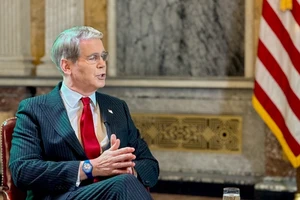
Tong Zhao, a senior fellow at the Carnegie Endowment for International Peace, speaks in an interview with Iran International's Kambiz Tavana (right) in Washington DC on Oct. 22, 2026.
China regards its relationship with Iran as largely transactional and is not firmly committed to defending the current Iranian government, according to Tong Zhao, a senior fellow at the Carnegie Endowment for International Peace.
Speaking to Iran International, Zhao said Beijing shares Iran’s “common displeasure” with the United States and Western systems and values Iran’s geographic position for the Belt and Road Initiative.
Yet he described the partnership as driven by energy security, economic interests and longer-term geopolitical calculations rather than ideological solidarity.
“There is some long-term interest in there for sure,” Zhao said. “But it is a transactional relationship.”
China has become Iran's main economic lifeline under US sanctions, buying nearly all of its exported oil, while Tehran has increasingly looked to Beijing alongside Moscow for diplomatic support in the face of Western pressure.
Energy interests come first
Energy security has provided one of the clearest illustrations of the limits of that partnership.
In a recent meeting between Presidents Xi Jinping and Donald Trump, both sides publicly underscored that the Strait of Hormuz should remain open without any toll system.
“China is protecting its own economic and energy interest first and foremost,” Zhao said. “We do see China’s position evolving when its own domestic calculations about energy and overall supply chain security change over time.”
The 25-year comprehensive strategic partnership signed by China and Iran in 2021 has also under-delivered. Reports at the time suggested Chinese investment of roughly $400 billion, or about $20 billion annually.
Actual flows have been “at least one order of magnitude smaller,” Zhao said, as Chinese banks and companies have sought to avoid US secondary sanctions.
Nuclear weapons, regime change
Zhao said Beijing has come to value nuclear non-proliferation more as its global influence has grown, in part because of its experience with North Korea.
“China doesn’t want Iran to have nuclear weapons, but China eventually is sympathetic to Iran’s cause,” he said. “It thinks that Iran’s need for deterrence, including nuclear deterrence, is ultimately driven by American hostile policy.”
Beijing does not see its role as changing Iran’s calculations and has been reluctant to threaten economic or military cutoffs, Zhao said. Instead, it has emphasized that the US and Israel should alter their policies to reduce Tehran’s incentives for nuclear deterrence.
Opposition to externally imposed regime change is a higher priority for Beijing than the nuclear file itself, he said.
“China’s primary security concern is its own regime security, so it doesn’t want to see the norm of allowing foreign countries interfering in other countries’ internal affairs and toppling governments that they don’t like.”
Beijing’s initial criticism of the US-Israeli war against Iran focused heavily on the killing of the supreme leader, which China viewed as a violation of international norms.
But Zhao suggested Beijing's opposition had limits and would depend in part on whether efforts to remove Iran's government violated what China regarded as established international norms.
Influence at the lowest cost
Beijing has cultivated ties with Saudi Arabia, including joint military exercises and involvement in its missile and nuclear programs, partly as a hedge against uncertainty elsewhere in the region.
China and Russia have meanwhile provided Tehran with diplomatic cover at the UN Security Council, disputing the reimposition of UN sanctions on Iran and most recently opposing efforts to restore international monitoring of their implementation.
Yet China has shown little appetite for becoming a security guarantor for Iran or other regional partners, Zhao said, including through proposals that Iran transfer enriched uranium to Chinese custody.
“China is keenly aware of the potential risks and burdens to play a greater security role,” he said. “Its approach is to develop relations, increasing Chinese influence at the lowest cost.”
That calculation could change as the conflict develops. Zhao said China and Russia could influence its trajectory by supplying air-defense systems or missile-related materials that would help Iran deter or survive future strikes.
But he declined to predict how the confrontation over Iran's nuclear program and the Strait of Hormuz would ultimately end.
“I generally don’t have good answers about how this war will end in the long run,” Zhao said.
Iranian Parliament Speaker Mohammad Bagher Ghalibaf visits the grave of former Iraqi paramilitary commander Abu Mahdi al-Muhandis in Najaf, Iraq, on August 21, 2026 (Reuters)
A current within Iran’s conservative establishment associated with Parliament Speaker Mohammad Bagher Ghalibaf favors maintaining military and economic leverage while keeping open the possibility of a negotiated end to the war with the United States.
Ghalibaf has played a leading role in negotiations. The position reflected in the conservative newspapers Khorasan and Sobh-e No rejects both indefinite confrontation and a settlement on US terms, favoring preparations for renewed fighting, retaining Iran’s strategic leverage and keeping open the possibility of a negotiated settlement.
The divisions are also reflected in Iran’s media landscape, with outlets including Kayhan, Javan and Tasnim taking more confrontational positions, while Shargh and Sazandegi have generally favored diplomacy.
Commentaries and an interview published by Khorasan on October 18 illustrate the argument emerging from conservatives associated with Ghalibaf.
Hormuz as negotiating leverage
In “Ambiguity: The New Battlefield”, Khorasan argues that diplomatic contacts do not mean the military threat has disappeared. Uncertainty itself, the commentary suggests, can wear down Iran’s psychological and operational readiness, making continued vigilance necessary even while negotiations remain possible.
A second article, “The Puzzle of Iranian and American Resilience”, develops the economic case for resistance. It acknowledges Iran’s severe inflation and financial pressures but questions whether the United States can necessarily outlast Iran simply because its economy is larger. American debt, exposure in financial markets, borrowing costs and the economic consequences of disruption around the Strait of Hormuz are presented as potential weaknesses.
Taken together, the Khorasan articles present the Strait of Hormuz as a source of bargaining power that Iran should retain during negotiations. They do not address how long Iran could sustain disruption or whether the economic costs to its adversaries would outweigh those to Iran.
A negotiated exit
The articles leave room for diplomacy. “Ambiguity” refers to a seven-day proposal transmitted through Qatar under which maritime traffic could resume if specified conditions were met.
In a separate interview, political analyst Ehsan Salehi, an adviser to former President Ebrahim Raisi, argues that the diplomatic outcome associated with the Islamabad understanding should have been presented to the public as a potential achievement. Otherwise, negotiations risk becoming synonymous with betrayal.
Salehi also warns against labeling officials as traitors without evidence, arguing that disagreements over diplomacy should not divide the country.
The arguments point toward a conditional settlement addressing Iran’s security concerns and providing economic or political benefits that could be presented domestically as the result of resistance. The articles do not establish whether this faction would accept particular compromises on the nuclear program, sanctions or control of Hormuz. Those questions remain unresolved.
How the faction differs from its rivals
The clearest contrast is with the more confrontational conservative current associated with the Paydari (Steadfastness) Front. Paydari figures have generally resisted concessions to Washington and challenged negotiators when agreements fall short of maximalist demands.
The position associated with Ghalibaf is more transactional, treating military pressure as potential leverage for an agreement and diplomacy as a means of securing gains that military action alone may not deliver. The disagreement is less about whether Iran should resist American pressure than about how that resistance should end and what would constitute an acceptable outcome.
Reformist and pragmatic voices have placed greater emphasis on ending the conflict, reducing sanctions and easing economic pressure, contrasting with conservatives who argue that Iran should retain leverage while negotiating. Ghalibaf’s camp, by contrast, insists that distrust of Washington and the possibility of renewed attacks must shape any agreement.
Salehi’s interview adds a domestic dimension. His calls for broader political representation, stronger parties and a more inclusive state broadcaster suggest that national resilience requires political reform as well as military strength.
Parliamentary influence and its limits
Ghalibaf has considerable institutional weight. He was re-elected speaker in May 2026 with 235 votes, following his 198-vote victory in 2024. The results show that his parliamentary support extends beyond a narrow personal faction, although they do not establish that those lawmakers share his foreign-policy positions.
His former senior role in the Revolutionary Guards also gives him military credentials and connections that many civilian politicians lack. But these should not be confused with command over the armed forces. Parliament can influence political debate, scrutinize ministers and shape legislation, but it does not independently determine questions of war and peace.
The Supreme National Security Council brings together the presidency, parliament, the armed forces and other centers of power. Its decisions require the Supreme Leader’s approval. Ghalibaf can influence deliberations but cannot guarantee that the military establishment or the supreme leadership will accept his preferred compromise.
The political test
The faction’s broader influence across Iranian society is harder to establish. Salehi argues that wartime solidarity will not last if citizens who defended the country feel excluded from political life. This is a strategic argument, not evidence that Ghalibaf’s faction commands majority public support.
The immediate political question is whether conservatives advocating this approach can present a negotiated settlement to their rivals as the result of resistance rather than its abandonment.
The unresolved question is whether Iran can retain the Strait of Hormuz as negotiating leverage while pursuing an agreement that ends the conflict without deepening its own economic pressures.
French riot police run amid clashes with protesters in Paris as part of nationwide protests against the cost of living and rising fuel prices called by the "Yellow Vests" movement, joined by French high school and university students, teachers and parents demanding better school conditions and government action, as well as labour unions, workers, farmers and retirees, France, October 17, 2026. REUTERS/Abdul Saboor
Iran is seeking to amplify unrest in France through online influence campaigns and alleged links to hard-left groups, The Times reported on Tuesday, citing researchers who accused Tehran and Moscow of exploiting student protests to weaken Western democracies.
The report also cited claims that President Emmanuel Macron blocked publication of a French government assessment of Iranian interference to avoid antagonizing Tehran.
The protests began last month over education funding and discrimination, before spreading and descending into violence in Paris and other cities. The Times said there was no evidence foreign powers initiated the movement.
French Foreign Minister Jean-Noël Barrot said last week that the demonstrations had been exploited by hostile narratives from Russia, China, Iran and the US MAGA movement, according to the newspaper.
France Culture separately cited police and intelligence sources alleging that foreign-backed bloggers and influencers had amplified the unrest. Officials or state-aligned media in the countries accused have rejected the allegations, The Times said.
Claims of infiltration and payments
David Colon, a historian at Sciences Po who studies disinformation, told The Times that Iran, Russia and Algeria were exacerbating tensions. He argued that Iran had been particularly effective because of its penetration of far-left groups.
Franco-Iranian journalist Emmanuel Razavi alleged that Iranian intelligence cultivated ties with those groups and encouraged them to promote the Palestinian cause. He linked the presence of Palestinian flags at protests to those efforts, although the flags themselves do not establish Iranian involvement.
Razavi also said Iranian agents were suspected of paying unemployed youths a few hundred euros to cause disorder in Paris. He said those allegedly paid represented only a small minority of participants in the October 17 unrest.
He further alleged that the Revolutionary Guards’ Quds Force operated troll farms and recruited influencers, including on Telegram. The report did not present documentary evidence substantiating his claims about payments or operational links.
Colon cited a Franco-Iranian influencer convicted of inciting terrorism who was now posting about French police violence, arguing that he understood how to maximize online visibility.
Report allegedly withheld
Citing French outlet La Lettre, The Times said Barrot received a government report describing Iranian disinformation campaigns and cyberattacks, including activity around the 2024 Paris Olympics and subsequent French protests.
Barrot wanted it published, but Macron refused while seeking to maintain diplomatic distance from both Tehran and Washington during the Iran war, according to the account.
La Lettre’s publicly accessible summary says the Élysée blocked disclosure of evidence compiled by French security bodies and ordered a restrained response to Tehran.
Previous influence campaigns
Iran International reported in October 2024 that Microsoft had identified an operation targeting Israel’s participation in the Paris Olympics by Cotton Sandstorm, a group Microsoft described as directed by the Revolutionary Guards.
Earlier that year, Iran International covered Microsoft’s findings that Iranian actors operated covert news websites targeting Americans across the political spectrum, including left-leaning Nio Thinker and conservative Savannah Time. Tehran denied interfering in US elections.
On October 9, Iran International reported OpenAI’s disclosure of an Iran-origin campaign using seven fictitious journalist identities to place nearly 100 articles in foreign outlets and generate hostile replies to Iran International posts.
OpenAI said the social media activity gained little traction and that it could not identify the organization behind the campaign. Those findings document separate influence efforts, rather than establish responsibility for the current French unrest.
Hussain Abdul-Hussain in an interview with Iran International's Kambiz Tavana (right) in Washington DC
Saudi Arabia should join forces with the United States, Israel and the United Arab Emirates to help bring about political change in Iran, rather than continue policies that have failed to contain Tehran's regional influence, an analyst told Iran International.
The Islamic Republic's support for Yemen's Houthis has exposed the limits of Saudi military power and diplomacy, making a broader coalition against Iran necessary, said Hussain Abdul-Hussain, a research fellow at the Foundation for Defense of Democracies.
“I'm not saying the Marines should land anywhere in Tehran,” Abdul-Hussain said. “I'm just saying push the regime enough so that the other Iranians can take over.”
The proposed strategy, he said, would draw on the US-led coalition that expelled Iraqi forces from Kuwait in 1991, with Saudi Arabia providing regional political support for a campaign aimed at weakening the Islamic Republic and enabling Iranians to determine their country's political future.
Such a coalition could fundamentally alter the regional balance of power and influence the calculations of China and Russia, Abdul-Hussain added.
Iran's Houthi leverage
The Houthis have emerged as one of the Islamic Republic's most effective regional allies, maintaining their military capabilities despite years of Saudi-led operations and pressure on other Iran-backed armed groups.
Their geographical distance from Israel has also made them more difficult to weaken than Hezbollah in Lebanon or Iran-aligned militias in Iraq, according to Abdul-Hussain.
The challenge, he said, has become more pronounced since the withdrawal of Emirati forces from Yemen following divisions within the Saudi-led coalition.
Pro-UAE militias had provided some of the coalition's most effective ground forces, leaving Saudi Arabia increasingly dependent on air power and Yemeni government forces weakened by corruption, inflated troop numbers and divisions, Abdul-Hussain said.
Airstrikes alone cannot defeat an armed group operating from mountainous terrain and fortified positions, he argued, drawing comparisons with Israel's experience fighting Hezbollah in 2006 and 2023.
The absence of reliable ground partners has therefore allowed the Houthis to remain a persistent military challenge despite Saudi Arabia's superior conventional capabilities.
The group's operations also serve Iran's wider regional strategy by placing Saudi energy infrastructure and shipping routes within reach of an Iranian ally.
Recent Houthi advances and strikes on Saudi territory reflect a broader Iranian message that disruptions to its own oil exports could be accompanied by pressure on other regional producers, particularly as Saudi Arabia shifts exports toward the Bab el-Mandeb shipping route, Abdul-Hussain added.
Saudi diplomatic failures
Saudi Arabia's continued diplomatic engagement with the Islamic Republic has failed to reduce the security challenge posed by Iran's regional allies, Abdul-Hussain said.
Maintaining an ambassador in Tehran and inviting Revolutionary Guards officials to Saudi National Day celebrations, even as Saudi energy infrastructure faces missile strikes, sends a message of weakness rather than diplomatic pragmatism, he argued.
Armed Houthi fighters carry rocket-propelled grenade launchers in Yemen.
The UAE, despite its smaller size and closer geographical proximity to Iran, had previously demonstrated greater willingness to sever diplomatic relations with the Islamic Republic, according to Abdul-Hussain.
Saudi Arabia's diplomatic outreach to Turkey and Pakistan has also produced limited practical support against the Houthis and the Revolutionary Guards, he said.
Abdul-Hussain attributed part of the problem to a Saudi leadership structure in which advisers are reluctant to challenge prevailing assumptions, leaving decision-makers without a credible alternative to their existing strategy.
“They have to swallow their pride with the Emiratis and the Israelis,” Abdul-Hussain said. “This is the key.”
Restoring cooperation with Abu Dhabi and establishing open relations with Israel would provide the foundation for a more effective regional alignment against Iran, he added.
Such cooperation would need to be public rather than confined to private security arrangements, particularly because Israeli participation could expose Israeli shipping to additional Houthi operations.
Saudi Arabia's decision to condition normalization with Israel on Palestinian statehood has further complicated the formation of an anti-Iran coalition, Abdul-Hussain said.
The shift, he noted, has moved Riyadh away from Crown Prince Mohammed bin Salman's earlier emphasis on prioritizing Saudi national interests, without producing corresponding security benefits for the kingdom.
Coalition against Iran
A coalition modeled on the international military campaign that expelled Saddam Hussein's forces from Kuwait in 1991 could provide a framework for confronting the Islamic Republic without a US ground invasion of Iran, Abdul-Hussain said.
Saudi Arabia played a central role in assembling regional support for that campaign, lending political legitimacy to a military operation led by the United States.
A similar alignment involving Washington, Riyadh, Abu Dhabi and Israel could apply sustained pressure on Iran's ruling establishment while leaving the ultimate outcome to Iranians themselves, according to the analyst.
“Throw all the chips behind President Trump and the war on Iran, and push for regime change,” Abdul-Hussain said.
The proposed approach would mark a departure from Saudi Arabia's efforts to balance diplomatic relations with Iran against military operations targeting its regional allies.
Rather than continuing to absorb the costs of confronting the Houthis without weakening their principal backer, Saudi Arabia should help organize a broader campaign directed at the Islamic Republic itself, Abdul-Hussain argued.
The central objective, in his view, would not be a foreign occupation of Iran but sufficient external pressure to create an opportunity for Iranians to replace the country's ruling establishment.