'Bully at home, victim abroad': Iranians on Pezeshkian's UN speech
Masoud Pezeshkian told the UN that Iran would not accept the language of force. Iranians writing to Iran International had one reply: that is the only language his government uses at home. Their messages picked apart what he said, what he left out, and how he said it.
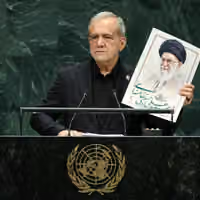
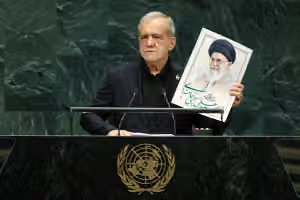
Speaking at the 81st General Assembly on Wednesday, the president said Tehran was ready for dialogue but rejected "the language of force," called Donald Trump's words a sign of "the character of a bully and the logic of force," and held up photographs of the late Ali Khamenei and of schoolchildren killed in the strike on Minab in the war's first hours.
Iran's President Masoud Pezeshkian addresses the 81st United Nations General Assembly (UNGA) at UN headquarters in New York City, US, September 23, 2026.
Masoud Pezeshkian told the UN that Iran would not accept the language of force. Iranians writing to Iran International had one reply: that is the only language his government uses at home. Their messages picked apart what he said, what he left out, and how he said it.
Speaking at the 81st General Assembly on Wednesday, the president said Tehran was ready for dialogue but rejected "the language of force," called Donald Trump's words a sign of "the character of a bully and the logic of force," and held up photographs of the late Ali Khamenei and of schoolchildren killed in the strike on Minab in the war's first hours.
Three things drew the messages: the gap between the president's posture abroad and the state's conduct at home; the crackdown of January that he did not name; and the way he spoke.
The most frequent reaction set the president's words in New York beside the state's words in Iran.
"The Islamic Republic wants dialogue with anyone stronger than itself," one wrote, "and bullies its own defenseless people."
Another pointed to Pezeshkian's repeated use of the word force: inside Iran the state threatens America, he wrote, and in New York it asks "why are you bullying us."
The president's own language on the January protests was not far from writers' minds. In August he called the protests a "riot" and described those who reported the killings as "cowards and traitors," remarks that had drawn an earlier wave of messages. On January 11, days after the killings, he had called the protesters "terrorists" and demanded a "decisive" response from the security forces.
One writer put it in a single line: for 47 years the Islamic Republic has been busy with terror, and now Pezeshkian comes to play the victim.
Another watched the delivery rather than the text. "People like Pezeshkian only claim power and swagger in front of us," he wrote. "From the trembling voice, the stumbles and the level of stress in his speech, it was clear how brave he is in front of real superpowers."
Pezeshkian never used the word protests. The Iranians he described in the streets these past seven months were the crowds at the state's own rallies, organized by the Revolutionary Guards and the Basij, out at night, in his telling, to defend the country against people "America and Israel had incited and put guns in the hands of."
The millions who came out against the state, and the tens of thousands killed, did not appear in the speech at all.
A writer from Qeshm, the island in the Strait of Hormuz, said the president had repeated the state's version of the protests instead of speaking about Iran's own victims, including those killed on January 8 and 9 and in earlier crackdowns.
Others treated the speech as an occasion to list what it omitted: the protests of December 2017 and January 2018, Bloody November in 2019, the Woman, Life, Freedom uprising of 2022, the January 2026 uprising, and the poisoning of girls' schools in 2022 and 2023.
The messages came days after the UN fact-finding mission on Iran presented its latest report. Its chair, Sara Hossain, said the January crackdown had met protests with an "extremely violent" response, and that many of the violations, including killings and imprisonment, amounted to crimes against humanity.
Several writers said that Iranians themselves had been pushed to the margins of the speech. "Pezeshkian was more a defender of the Revolutionary Guards and of Palestine," one wrote, "than someone who wanted to say anything about the people of his own country."
How he said it
The third and most personal thread was the president's manner: his walk, his delivery, his command of his own text.
Many described his bearing as a street tough's swagger and compared him to Shaban Bi-Mokh, the Tehran strongman whose mobs helped bring down the government in the 1953 coup and whose nickname means "the brainless." Writers said his grip on the speech was so weak that a passerby pulled off the street and put at the UN lectern would have spoken more fluently and said more.
A writer from Tehran said he had been ashamed to watch Pezeshkian represent Iran, in a speech he found empty of manners, culture or "any diplomatic decorum."
"Why can't he speak properly?" another asked. "He talked as if someone had a gun to his head."
One writer compared the speech to those of Mohammad Reza Shah Pahlavi and said the level of language from the president of the Islamic Republic had left him astonished.
Several concluded that the delivery reflected the office. Pezeshkian, they wrote, has no authority of his own; he reads what is written for him and handed to him.
"That is why they made him president," one wrote. "The text they write for him usually has a fixed structure, and it is on file at the foreign ministry and the presidency."
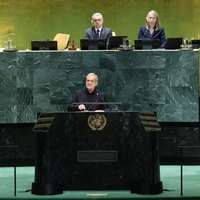
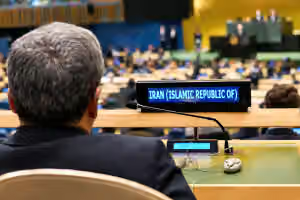
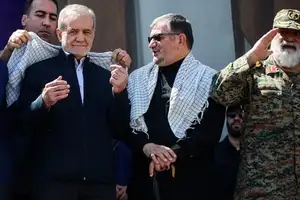
Foreign Minister Abbas Araghchi, seen from behind, listens as President Masoud Pezeshkian addresses the UN General Assembly in New York on September 23, 2026.
Iranians writing to Iran International this week did not see a diplomatic visit. They saw the men they hold responsible for January's massacre walking free in New York, and they asked the city's mayor, who once promised to arrest Netanyahu, why.
As President Masoud Pezeshkian and Foreign Minister Abbas Araghchi arrived for the UN General Assembly, the messages came in with a phrase that recurred until it became the story's own name: the "killers in suits." The demand attached to it was the same almost every time. Arrest them.
Voices from Iran draws on messages sent to Iran International by people inside the country. Names are withheld for their safety.
Foreign Minister Abbas Araghchi (left) and other members of Iran's delegation in the General Assembly hall listen as President Masoud Pezeshkian speaks in New York on September 23, 2026.
The demand
A writer from Fardis, on the western edge of Karaj, pointed to the latest human rights reports and asked why officials responsible for crushing 40,000 protesters in January were not being detained in New York.
Another wrote simply that now they were there, this was a good chance to arrest Pezeshkian and Araghchi.
The UN fact-finding mission on Iran said in its new report that many of the violations committed in the crackdown on the January 2026 protests, including murder, imprisonment and severe deprivation of liberty, amounted to crimes against humanity. Its chair, Sara Hossain, said the true number of victims could be "significantly" higher than the government's own figure.
One writer suggested that while the officials were at the United Nations, footage and documents of the killings should be handed to the same body. Others addressed Donald Trump directly, asking him to act on the crackdown rather than host or negotiate with the delegation.
And several turned to Zohran Mamdani, who as a candidate for mayor of New York said he would have Benjamin Netanyahu arrested if the Israeli prime minister set foot in the city, citing the International Criminal Court warrant against him.
"The mayor of New York who wanted to arrest Netanyahu," one wrote, "does he by any chance not intend to arrest the criminals in suits who sit on the Supreme National Security Council and whose signatures are on the massacre of January 8 and 9?"
The visas
A second thread was anger at what writers called the West's double standard: condemning the repression while receiving the men accused of it.
"My question is this," one wrote. "Didn't Mr. Trump always talk about the January massacre? So why has he given visas to the ringleaders of the killers of Iran's children?"
The State Department has said that admitting the core members of the Iranian delegation was an obligation Washington carries as host of the United Nations, and that the delegation's movements were restricted. The US government also agreed to Araghchi's request for a security detail during his stay.
"Bodies attached to the United Nations say the leaders of the Islamic Republic have committed crimes against humanity," another writer addressed the president. "Why are they now freely, and even under your escort, in America and at the UN?"
Not everyone expected an arrest. One writer said it was probably beyond the West to detain the officials, and proposed instead that Iranians abroad gather outside UN headquarters.
'A puppet'
The other constant in the messages was that Pezeshkian does not decide anything, and that his presence at the UN is a performance of the system that does.
Writers called him a marionette, a wind-up doll, and the tea boy of the power mafia, and called the trip a circus staged for legitimacy.
Some pointed to how little it achieved. One wrote that for years the Islamic Republic's only gain from attending the UN had been shopping in New York, and that Trump had taken even that away.
Last September the State Department restricted the Iranian delegation's access to wholesale and luxury stores during its stay.
Beneath the mockery ran a fear. Several writers worried that a deal might be struck, and that the file on the killings would be pushed aside for it.
File photo: Passengers check in for flights at Tehran’s Imam Khomeini International Airport
Expanding US pressure on Iran's aviation sector is bringing a class dimension to the debate over the costs of the country's growing isolation, with some Iranians welcoming restrictions they say are finally reaching the better-off.
Washington has threatened sanctions against airports and companies that provide services to Iranian carriers as international travel options are already narrowing.
Mahan Air has suspended flights to Turkey and Oman, while Georgia has announced a halt to flights by all Iranian airlines.
Iran International asked its Instagram audience what they thought about the growing restrictions. Responses ranged from support for measures seen as increasing pressure on the state to concern about their consequences for medicine, essential goods and family travel.
“At last, the water has reached the upper decks,” one respondent wrote.
The phrase captured a recurring argument among those who welcomed the restrictions: hardships that have long affected ordinary Iranians may now be reaching wealthier or better-connected sections of society.
Others argued that air travel had already become unaffordable for much of the population and said they were prepared to tolerate further restrictions if they increased the economic and political cost for the authorities or made it more difficult for officials and those close to them to travel abroad.
The responses do not constitute a representative survey of Iranian public opinion, but they point to a revealing tension over who bears the cost of external pressure.
‘The issue isn't just travel’
US Treasury Secretary Scott Bessent said Iranian airlines would effectively be shut out of international operations from September 23, warning that airports and companies providing them with services could themselves face US sanctions.
The restrictions do not amount to the closure of Iranian airspace or automatically prohibit foreign airlines from flying to Iran. But the threat of sanctions could make it increasingly difficult for Iranian carriers to operate abroad.
For some respondents, that raised concerns extending well beyond passenger travel to medicine, raw materials, spare parts and other goods entering Iran by air.
“Everyone is thinking about passenger flights, but the real problem that will emerge is cargo flights,” one wrote.
“The issue isn't just travel,” another respondent wrote. “A lot of goods reached Iran by air, such as medicine … what is supposed to happen to patients now?”
Others pointed to higher ticket prices, longer journeys involving indirect routes and increasing difficulties visiting relatives abroad. Some feared higher import costs would feed into inflation, further squeezing household finances.
“In the war and confrontation between the government and America, it is the people who are being crushed,” one respondent wrote.
Some also pointed to congestion at land crossings such as Bazargan and Razi, fearing that further disruption to air travel would push more passengers onto already strained overland routes.
Where does tolerance for pressure end?
The responses also revealed differing interpretations of what Washington is trying to achieve.
Some saw the aviation restrictions as another sign of escalating confrontation, while others interpreted them as an attempt to increase pressure on Tehran to reach an agreement.
Several said years of sanctions and economic crisis had left society increasingly accustomed, or even numb, to new restrictions.
Measures perceived as restricting officials, state institutions or wealthier Iranians attracted support from many of those who responded to Iran International.
But that support became less straightforward when people contemplated medicine and essential goods becoming harder to obtain, more expensive travel, separation from relatives or further increases in household costs.
The responses suggest tolerance for outside pressure can be easier to sustain when its costs appear concentrated on the state. Once those costs become tangible in everyday life, the calculation becomes more complicated—even among Iranians who want greater pressure on Tehran.
Women are seen at an outdoor market in Iran without the mandatory hijab in September 2026.
Four years after the Woman, Life, Freedom protests, Iran International asked women on Instagram to describe the first time they went out without a headscarf. The answers came back in the same four registers: fear, freedom, grief and solidarity.
“I felt like a human being, that I had the right to choose and that others could no longer decide for me,” one woman wrote.
Most of the responses portrayed removing the headscarf not simply as a change in clothing, but as an emotional experience accompanied for many by anxiety over possible consequences.
Freedom and fear
Words including freedom, relief, lightness and power appeared repeatedly in the responses. Some said going without a headscarf gave them a sense of making their own decisions about their bodies and clothing.
But many described fear alongside that sense of freedom.
Some others said they initially carried a headscarf in their bags, repeatedly looked around while walking or worried about being confronted.
One woman recalled leaving home without carrying a scarf for the first time in November 2022.
“I was wearing a hooded puffer jacket so I could do something if I had to. It was the first time I had left home without taking a scarf with me, and my heart was racing with fear the whole time. But now wearing a headscarf feels unusual to me,” she wrote.
Another respondent said seeing other women without headscarves gradually reduced her anxiety.
“I was extremely afraid, but seeing people like me made me less frightened and gave me more courage,” she wrote.
Public defiance of compulsory hijab expanded after the death of 22-year-old Mahsa Amini in September 2022, three days after her detention by Iran’s morality police, triggering the nationwide Woman, Life, Freedom protests.
‘When the wind touched my hair’
Several focused on physical sensations that had previously been denied to them in public, including feeling wind in their hair or cool air on their face and neck.
Iranian women without the mandatory hijab browse stalls at an outdoor market in August 2026.
One woman said going completely without a scarf and feeling the wind in her hair was so different that she regretted experiencing it at 40 rather than 20.
“The first time I sat behind the wheel wearing a T-shirt, I was about to cry,” another woman wrote. “Why did we have to wear so many clothes and suffocate in the heat? When the air touched me, I felt light.”
Another wrote: “When the wind touched my hair, face and neck, I enjoyed feeling it without having to fix my headscarf afterward or untangle the hair underneath it.”
The accounts come as messages sent to Iran International in recent days described the return of morality patrols and increased pressure on women in cities including Isfahan, Rasht, Fuman, Mashhad and Neyshabur.
Gholam-Ali Haddad-Adel, a member of Iran’s Expediency Council, another the Supreme Leader Mojtaba Khamenei’s father-in-law said on September 9 that the Islamic Republic could not enforce its hijab requirements as extensively as it wanted because of “war conditions,” describing the situation as more difficult than in 1980s.
Grief and solidarity
For some, taking off the headscarf brought the dead with it.
One woman wrote that the experience did not bring a sense of freedom because she remembered the “heavy price” young people had paid. Others recalled crying or experiencing happiness and grief simultaneously.
Solidarity between women also featured prominently.
A middle-aged woman in Pardis, near Tehran, said she was among the first women of her age there to remove her headscarf.
Another recalled girls periodically giving her chocolates with notes thanking her for her courage.
“I will never forget the smile I had at that moment,” she wrote.
Others described smiles and encouragement from women they did not know, while some said simply seeing others without headscarves helped their fear subside.
For some women, there was no defining first time. Years of gradually pushing back against compulsory hijab had blurred that boundary, while others said workplace rules, restrictions on clothing or decades of habit still kept them from abandoning the headscarf altogether.
The responses also showed how the experience stretched across generations. A 70-year-old woman said she had stopped wearing a headscarf completely at 60. Another, born in the 1960s, described removing it as unexpectedly recovering a piece of her youth.
“I couldn’t believe I was feeling like a teenager again,” she wrote.
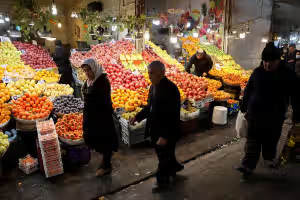
Iranians are struggling to afford basic food as bread prices rise sharply and citizens describe soaring costs for vegetables, snacks and other everyday purchases, according to an local media report and messages sent to Iran International on Monday.
Bread prices in the Iranian capital have risen sharply without official authorization, putting even bread and cheese beyond the means of some workers, labor-focused ILNA news agency reported.
“Things are very bad with bread, and the unofficial increase in bread prices has become staggering. There was a time when a worker could at least count on bread and cheese, but today they can no longer afford even that,” Ali Torkashvand, executive secretary of the Workers’ House, told ILNA.
The pressure comes as Iran’s official minimum wage stands at about 166.3 million rials per month, equivalent to roughly $72 at the open-market exchange rate.
Messages sent separately to Iran International describe sharp increases across basic food and household purchases. One citizen said several kilograms of vegetables had cost 25 million rials, equivalent to about 15% of the monthly minimum wage.
“Damn the Islamic Republic for making people suffer this much. We really can’t afford to buy anything anymore,” the citizen said.
A packet of meat-flavored instant noodles cost 900,000 rials, another citizen said.
“I bought a few food and hygiene products and it came to 20 million rials,” another citizen told Iran International, a sum equivalent to about 12% of the monthly minimum wage.
Bread moves beyond reach
ILNA linked the rising cost of essentials to repeated currency depreciation and increases in energy prices, saying shocks to fuel and foreign-exchange costs feed through to food, medicine, housing and other necessities.
Wages and pension payments had failed to keep pace with rising prices, leaving workers struggling to meet basic household expenses, Torkashvand said.
The latest pressure follows the government’s decision to double Iran’s third-tier gasoline price to 100,000 rials per liter from September 8.
Higher gasoline prices could drive up the cost of other goods and services through increased transportation and production expenses, Torkashvand said.
Iran’s economy has come under mounting pressure from international sanctions and restrictions on trade and finance, the economic fallout from war and US efforts to block Iranian oil exports and other revenue streams, alongside declining investment and domestic economic mismanagement.
Workers were struggling with rising prices even before the latest gasoline increase, Ali Zamiri, a labor activist, told ILNA.
“Under the present circumstances, there is no longer any clear order or pattern to prices, while workers’ incomes have not changed in line with these rising costs,” Zamiri said.
Food prices outpace wages
Prices for some staples have risen far faster than overall inflation, with rice increasing by more than 200% and cooking oil by more than 300%, Majid Rahmati, a member of Tehran province’s Islamic Labor Councils board, told ILNA.
Rahmati called for increased food subsidies and higher wages and benefits during the second half of the Iranian year to offset some of the loss in purchasing power.
The strain has also forced some families to seek credit for basic food. ILNA reported on Sunday that people in poorer areas of Tehran were asking neighborhood stores to let them buy groceries, meat, prepared meals and even bread on credit.
Shopkeepers themselves were finding it increasingly difficult to continue extending credit as their own costs rose, according to ILNA.