The price of US pressure moves up Iran’s social ladder
Expanding US pressure on Iran's aviation sector is bringing a class dimension to the debate over the costs of the country's growing isolation, with some Iranians welcoming restrictions they say are finally reaching the better-off.
Washington has threatened sanctions against airports and companies that provide services to Iranian carriers as international travel options are already narrowing.
Mahan Air has suspended flights to Turkey and Oman, while Georgia has announced a halt to flights by all Iranian airlines.
Iran International asked its Instagram audience what they thought about the growing restrictions. Responses ranged from support for measures seen as increasing pressure on the state to concern about their consequences for medicine, essential goods and family travel.
“At last, the water has reached the upper decks,” one respondent wrote.
The phrase captured a recurring argument among those who welcomed the restrictions: hardships that have long affected ordinary Iranians may now be reaching wealthier or better-connected sections of society.
Others argued that air travel had already become unaffordable for much of the population and said they were prepared to tolerate further restrictions if they increased the economic and political cost for the authorities or made it more difficult for officials and those close to them to travel abroad.
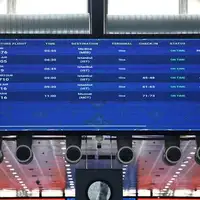
File photo: Passengers check in for flights at Tehran’s Imam Khomeini International Airport
Expanding US pressure on Iran's aviation sector is bringing a class dimension to the debate over the costs of the country's growing isolation, with some Iranians welcoming restrictions they say are finally reaching the better-off.
Washington has threatened sanctions against airports and companies that provide services to Iranian carriers as international travel options are already narrowing.
Mahan Air has suspended flights to Turkey and Oman, while Georgia has announced a halt to flights by all Iranian airlines.
Iran International asked its Instagram audience what they thought about the growing restrictions. Responses ranged from support for measures seen as increasing pressure on the state to concern about their consequences for medicine, essential goods and family travel.
“At last, the water has reached the upper decks,” one respondent wrote.
The phrase captured a recurring argument among those who welcomed the restrictions: hardships that have long affected ordinary Iranians may now be reaching wealthier or better-connected sections of society.
Others argued that air travel had already become unaffordable for much of the population and said they were prepared to tolerate further restrictions if they increased the economic and political cost for the authorities or made it more difficult for officials and those close to them to travel abroad.
The responses do not constitute a representative survey of Iranian public opinion, but they point to a revealing tension over who bears the cost of external pressure.
‘The issue isn't just travel’
US Treasury Secretary Scott Bessent said Iranian airlines would effectively be shut out of international operations from September 23, warning that airports and companies providing them with services could themselves face US sanctions.
The restrictions do not amount to the closure of Iranian airspace or automatically prohibit foreign airlines from flying to Iran. But the threat of sanctions could make it increasingly difficult for Iranian carriers to operate abroad.
For some respondents, that raised concerns extending well beyond passenger travel to medicine, raw materials, spare parts and other goods entering Iran by air.
“Everyone is thinking about passenger flights, but the real problem that will emerge is cargo flights,” one wrote.
“The issue isn't just travel,” another respondent wrote. “A lot of goods reached Iran by air, such as medicine … what is supposed to happen to patients now?”
Others pointed to higher ticket prices, longer journeys involving indirect routes and increasing difficulties visiting relatives abroad. Some feared higher import costs would feed into inflation, further squeezing household finances.
“In the war and confrontation between the government and America, it is the people who are being crushed,” one respondent wrote.
Some also pointed to congestion at land crossings such as Bazargan and Razi, fearing that further disruption to air travel would push more passengers onto already strained overland routes.
Where does tolerance for pressure end?
The responses also revealed differing interpretations of what Washington is trying to achieve.
Some saw the aviation restrictions as another sign of escalating confrontation, while others interpreted them as an attempt to increase pressure on Tehran to reach an agreement.
Several said years of sanctions and economic crisis had left society increasingly accustomed, or even numb, to new restrictions.
Measures perceived as restricting officials, state institutions or wealthier Iranians attracted support from many of those who responded to Iran International.
But that support became less straightforward when people contemplated medicine and essential goods becoming harder to obtain, more expensive travel, separation from relatives or further increases in household costs.
The responses suggest tolerance for outside pressure can be easier to sustain when its costs appear concentrated on the state. Once those costs become tangible in everyday life, the calculation becomes more complicated—even among Iranians who want greater pressure on Tehran.
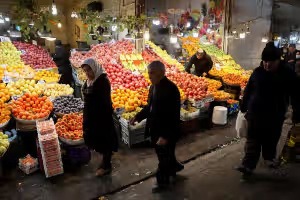
Women are seen at an outdoor market in Iran without the mandatory hijab in September 2026.
Four years after the Woman, Life, Freedom protests, Iran International asked women on Instagram to describe the first time they went out without a headscarf. The answers came back in the same four registers: fear, freedom, grief and solidarity.
“I felt like a human being, that I had the right to choose and that others could no longer decide for me,” one woman wrote.
Most of the responses portrayed removing the headscarf not simply as a change in clothing, but as an emotional experience accompanied for many by anxiety over possible consequences.
Freedom and fear
Words including freedom, relief, lightness and power appeared repeatedly in the responses. Some said going without a headscarf gave them a sense of making their own decisions about their bodies and clothing.
But many described fear alongside that sense of freedom.
Some others said they initially carried a headscarf in their bags, repeatedly looked around while walking or worried about being confronted.
One woman recalled leaving home without carrying a scarf for the first time in November 2022.
“I was wearing a hooded puffer jacket so I could do something if I had to. It was the first time I had left home without taking a scarf with me, and my heart was racing with fear the whole time. But now wearing a headscarf feels unusual to me,” she wrote.
Another respondent said seeing other women without headscarves gradually reduced her anxiety.
“I was extremely afraid, but seeing people like me made me less frightened and gave me more courage,” she wrote.
Public defiance of compulsory hijab expanded after the death of 22-year-old Mahsa Amini in September 2022, three days after her detention by Iran’s morality police, triggering the nationwide Woman, Life, Freedom protests.
‘When the wind touched my hair’
Several focused on physical sensations that had previously been denied to them in public, including feeling wind in their hair or cool air on their face and neck.
Iranian women without the mandatory hijab browse stalls at an outdoor market in August 2026.
One woman said going completely without a scarf and feeling the wind in her hair was so different that she regretted experiencing it at 40 rather than 20.
“The first time I sat behind the wheel wearing a T-shirt, I was about to cry,” another woman wrote. “Why did we have to wear so many clothes and suffocate in the heat? When the air touched me, I felt light.”
Another wrote: “When the wind touched my hair, face and neck, I enjoyed feeling it without having to fix my headscarf afterward or untangle the hair underneath it.”
The accounts come as messages sent to Iran International in recent days described the return of morality patrols and increased pressure on women in cities including Isfahan, Rasht, Fuman, Mashhad and Neyshabur.
Gholam-Ali Haddad-Adel, a member of Iran’s Expediency Council, another the Supreme Leader Mojtaba Khamenei’s father-in-law said on September 9 that the Islamic Republic could not enforce its hijab requirements as extensively as it wanted because of “war conditions,” describing the situation as more difficult than in 1980s.
Grief and solidarity
For some, taking off the headscarf brought the dead with it.
One woman wrote that the experience did not bring a sense of freedom because she remembered the “heavy price” young people had paid. Others recalled crying or experiencing happiness and grief simultaneously.
Solidarity between women also featured prominently.
A middle-aged woman in Pardis, near Tehran, said she was among the first women of her age there to remove her headscarf.
Another recalled girls periodically giving her chocolates with notes thanking her for her courage.
“I will never forget the smile I had at that moment,” she wrote.
Others described smiles and encouragement from women they did not know, while some said simply seeing others without headscarves helped their fear subside.
For some women, there was no defining first time. Years of gradually pushing back against compulsory hijab had blurred that boundary, while others said workplace rules, restrictions on clothing or decades of habit still kept them from abandoning the headscarf altogether.
The responses also showed how the experience stretched across generations. A 70-year-old woman said she had stopped wearing a headscarf completely at 60. Another, born in the 1960s, described removing it as unexpectedly recovering a piece of her youth.
“I couldn’t believe I was feeling like a teenager again,” she wrote.
Iranians are struggling to afford basic food as bread prices rise sharply and citizens describe soaring costs for vegetables, snacks and other everyday purchases, according to an local media report and messages sent to Iran International on Monday.
Bread prices in the Iranian capital have risen sharply without official authorization, putting even bread and cheese beyond the means of some workers, labor-focused ILNA news agency reported.
“Things are very bad with bread, and the unofficial increase in bread prices has become staggering. There was a time when a worker could at least count on bread and cheese, but today they can no longer afford even that,” Ali Torkashvand, executive secretary of the Workers’ House, told ILNA.
The pressure comes as Iran’s official minimum wage stands at about 166.3 million rials per month, equivalent to roughly $72 at the open-market exchange rate.
Messages sent separately to Iran International describe sharp increases across basic food and household purchases. One citizen said several kilograms of vegetables had cost 25 million rials, equivalent to about 15% of the monthly minimum wage.
“Damn the Islamic Republic for making people suffer this much. We really can’t afford to buy anything anymore,” the citizen said.
A packet of meat-flavored instant noodles cost 900,000 rials, another citizen said.
“I bought a few food and hygiene products and it came to 20 million rials,” another citizen told Iran International, a sum equivalent to about 12% of the monthly minimum wage.
Bread moves beyond reach
ILNA linked the rising cost of essentials to repeated currency depreciation and increases in energy prices, saying shocks to fuel and foreign-exchange costs feed through to food, medicine, housing and other necessities.
Wages and pension payments had failed to keep pace with rising prices, leaving workers struggling to meet basic household expenses, Torkashvand said.
The latest pressure follows the government’s decision to double Iran’s third-tier gasoline price to 100,000 rials per liter from September 8.
Higher gasoline prices could drive up the cost of other goods and services through increased transportation and production expenses, Torkashvand said.
Iran’s economy has come under mounting pressure from international sanctions and restrictions on trade and finance, the economic fallout from war and US efforts to block Iranian oil exports and other revenue streams, alongside declining investment and domestic economic mismanagement.
Workers were struggling with rising prices even before the latest gasoline increase, Ali Zamiri, a labor activist, told ILNA.
“Under the present circumstances, there is no longer any clear order or pattern to prices, while workers’ incomes have not changed in line with these rising costs,” Zamiri said.
Food prices outpace wages
Prices for some staples have risen far faster than overall inflation, with rice increasing by more than 200% and cooking oil by more than 300%, Majid Rahmati, a member of Tehran province’s Islamic Labor Councils board, told ILNA.
Rahmati called for increased food subsidies and higher wages and benefits during the second half of the Iranian year to offset some of the loss in purchasing power.
The strain has also forced some families to seek credit for basic food. ILNA reported on Sunday that people in poorer areas of Tehran were asking neighborhood stores to let them buy groceries, meat, prepared meals and even bread on credit.
Shopkeepers themselves were finding it increasingly difficult to continue extending credit as their own costs rose, according to ILNA.
Students work at computers in a classroom in Iran. Annual tuition at some private and international schools can reach 10 billion rials, equivalent to about five years of Iran’s monthly base wage.
Some Iranian schools are charging billions of rials for pools, therapy and small classes as students elsewhere reuse old bags and go without uniforms, shoes and stationery because their families cannot afford them ahead of the new school year.
Annual tuition at some private and international schools in the affluent districts starts at around 4 billion rials ($1,710) and can reach 10 billion rials ($4,275), Tabnak reported.
Iran’s monthly base wage for workers is 166.25 million rials ($71) this year, meaning the highest annual tuition is equivalent to about five years of base wages.
The schools advertise landscaped grounds, educational play areas, smart classrooms, therapy sessions, dedicated servers, swimming pools, music, sports and instruction in several foreign languages, according to the report.
Some decline to disclose their fees over the telephone, telling prospective parents they must visit in person.
One parent wrote online that his daughter's 10th-grade school charged 5.6 billion rials ($2,395) in tuition and another 1.35 billion rials ($577) for transportation, bringing the annual bill to nearly 7 billion rials ($2,990) before additional expenses.
The parent said the tuition had increased by 2 billion rials ($855) in a year, while transportation costs had risen 40%.
Some schools also seek foreign passports or citizenship as a condition of admission, Tabnak reported. At one primary school examined by the outlet, a second-grade class had just four pupils, with girls and boys studying together and separated only for swimming lessons, according to the school manager. Schools in Iran generally educate girls and boys separately.
Three notebooks for the school year
Messages sent to Iran International by students and parents show a markedly different experience as families prepare for the new academic year.
An 11th-grade student said the family had not bought a new uniform, school bag, shoes or most stationery.
“I didn’t buy a new uniform that fits me, a new bag, shoes or even stationery,” the student told Iran International. “I only bought three notebooks, and even those came to nearly 4 million rials. That’s it. With things the way they are, I’m too embarrassed to ask my parents for more.”
A father and daughter shop for school supplies at a stationery market in Iran.
A father in Saqqez, Kordestan province, said his daughter would return to school with a backpack she had already used for three years.
“I couldn’t buy my daughter a school uniform this year,” the father told Iran International. “Her backpack is from three years ago. This year she bought two pens, correction fluid and one notebook.”
A 12-year-old girl in Ahvaz said her family could not afford the stationery she needed.
“I am a 12-year-old girl and we don’t have money for stationery,” she told Iran International. “Today, I went shopping and an ordinary pack of 12 colored pencils was 3.5 million rials.”
Getting into school brings another bill
The financial burden extends beyond stationery and clothing, according to other messages sent to Iran International.
One parent said his daughter had gained admission to a selective school, but registration cost more than 210 million rials, with another 300 million rials requested as an initial payment for transportation.
“Now I don’t know whether I should thank my child for studying and getting accepted or be upset because of costs I can’t afford,” the parent told Iran International.
A 12th-grade student said supplementary study books cost close to 20 million rials apiece.
“If I calculate all of them together, it comes to around 80 million to 100 million rials, and I really feel too embarrassed to ask my father for anything else,” the student told Iran International.
Another parent said the price of entrance-exam preparation books increased substantially between ordering and collection.
The family was initially asked to pay 90 million rials, but a month later the seller requested another 40 million rials because the books had become more expensive, taking the total to 130 million rials.
“Prices in Iran now go up by the second, and we are being crushed under high prices and inflation,” another citizen told Iran International.
Basic school costs multiply
The messages correspond with broader reports showing sharp increases in the cost of preparing a child for school.
A student points to writing in a notebook at a school in Iran.
A basic basket of supplies for a primary-school student has reached 150 million rials in some estimates, compared with around 38.5 million rials last year, local media reported earlier this month.
Twelve notebooks that cost around 3.5 million rials last year now cost approximately 15 million rials, according to the report.
One stationery shopkeeper told Shargh daily that customers were increasingly choosing cheaper products over quality.
“People aren't paying much attention to quality this year,” the shopkeeper said.
A mounted machine gun deployed in Khorramabad, western Iran, on Monday, September 7, ahead of a fuel price increase.
Iranian security forces deployed around fuel stations and on streets across the country as a gasoline price increase took effect, with people warning of further pressure on household budgets and rising prices for other goods and services.
Messages, videos and accounts sent to Iran International described deployments of police, special units and Basij forces in Tehran, Mashhad, Shiraz, Karaj, Isfahan, Tabriz, Birjand, Khorramabad, Khomein, Abadan and Qeshm.
Reports of slower internet connections also emerged from several cities, including Tabriz and Babol.
Petrol prices doubled on Monday for drivers buying fuel outside their monthly subsidised quota, rising from 50,000 to 100,000 rials a litre, about 2.3 to 4.5 US cents. The government announced the increase two days earlier.
Monthly subsidized allocations remain unchanged. Motorists can buy 60 liters at 15,000 rials per liter, about 0.7 cents, and another 50 liters at 30,000 rials, about 1.3 cents.
The dollar figures are negligible. The wages are the point. Average monthly pay in Iran is around 250 million rials, about $113 at Tuesday's rate, and many workers earn closer to 200 million, or roughly $90 a month.
Security forces gather around fuel stations
Several residents of Mashhad told Iran International that security forces appeared around petrol stations on Sunday, hours before the new price took effect.
“On Monday evening, I passed three gas stations. Several police vehicles were stationed outside each one, and at one station there were large numbers of Basij motorcyclists and special unit forces,” one resident said.
Another Mashhad resident described police and special units positioned at fuel stations across the city.
Video sent to Iran International from Khorramabad in western Lorestan province showed security personnel, vehicles and motorcycles deployed around the city, including what appeared to be a mounted machine gun.
Fuel supplies had already faced disruptions over the previous three weeks in areas including Razavi Khorasan, South Khorasan, Tehran and Alborz provinces.
Citizens in early September reported station closures, long lines, restrictions on purchases and waits of about two hours to obtain 10 liters of gasoline.
A Birjand resident said some filling stations had closed and displayed notices blaming “technical problems,” while police were positioned at others.
Similar deployments were described in Shiraz, where a local reported a large security presence around Maali-Abad early Tuesday, and in Karaj, particularly Fardis, Gohardasht and Mehrshahr.
A resident of Khomein in Markazi province also described a long line and numerous police officers at a fuel station on Shohadaye Daneshjoo Street.
Special units deploy in Tehran
Several Tehran residents reported increased security deployments from Monday evening, including in Shahr-e Rey and Salsabil neighborhoods.
“The station was heavily secured. Special units and the Basij were constantly moving around, and the streets were crowded,” a resident who visited a fuel station near Ferdowsi Square in central Tehran around midnight said.
Another who went to a station on Pirouzi Street in the east described long vehicle lines with special units positioned nearby.
People in Isfahan and Abadan also reported armed police at filling stations. In Qeshm, a resident said armed personnel were deployed around major squares on Monday evening and that a confrontation occurred at the entrance to a filling station in Dargahan.
Two messages from Tabriz described a large security presence alongside deteriorating internet service.
“The city of Tabriz is full of special units. The forces are armed, and heavy equipment can also be seen,” one said.
A Babol citizen also reported slower mobile and fixed internet connections, though the reason for the disruption could not be established.
Gasoline prices carry particular political sensitivity in Iran. A sudden increase and rationing in November 2019 triggered demonstrations across dozens of cities that quickly expanded into nationwide anti-government protests.
Security forces killed around 1,500 people during the crackdown, according to a Reuters tally at the time. Thousands were arrested and authorities imposed a nationwide internet shutdown.
Government defends higher gasoline price
First Vice President Mohammad Reza Aref defended the new rate, arguing that even 100,000 rials per liter remains far below the government's cost of importing gasoline.
Imported gasoline costs the government more than 700,000 rials per liter, equivalent to about 30 cents, Aref said. Imported fuel would gradually be sold at prices closer to its cost, he added.
The government's figures for what petrol costs to produce have not held up well to examination. In November 2025, after officials put the cost at 340,000 rials a litre, about 15 cents at current rates, Iran International went through the refineries' own financial statements. They showed operating costs, excluding the value of the crude going in, of around 35,000 rials a litre, roughly 1.6 cents, a tenth of the official figure.
A general view of a gas station in Iran
Economist Mousa Ghaninejad has estimated actual gasoline consumption inside Iran at about 70 million liters a day and argued that much of the remainder recorded as consumption is smuggled out of the country.
Iranians warn of knock-on price increases
Thousands of people responding to an Iran International question about the fuel increase focused on its potential impact beyond filling stations, warning that transportation costs could push up food prices, fares and other everyday expenses.
“100,000 rials for a liter of gasoline may just be a number for some people, but for people it means another step toward making life harder,” one respondent wrote.
Another said petrol was not the problem on its own, and pointed to food. A five-liter container of cooking oil that used to cost 22 million rials, about $9.90, now sells for 40 million, roughly $18.
On a monthly wage of 200 million rials, that is a fifth of a month's pay for one container of oil.
“We buy everything at expensive dollar-linked prices, but our base salary is only $100. Where in the world can you see something like this?” one person wrote.
Another said wages would have to rise alongside prices, since households could not absorb repeated increases on incomes that had barely moved.
For younger respondents the loss was smaller and more particular. "The feeling of going on a trip is gone. Going out for a 10-minute drive is gone. We young people said goodbye to small pleasures a long time ago," one wrote.