• العربية
  • فارسی
Brand
  • Iran Insight
  • Politics
  • Economy
  • Analysis
  • Special Report
  • Opinion
  • Podcast
  • Live TV
  • Iran Insight
  • Politics
  • Economy
  • Analysis
  • Special Report
  • Opinion
  • Podcast
  • Live TV
  • Theme
  • Language
    • العربية
    • فارسی
  • Iran Insight
  • Politics
  • Economy
  • Analysis
  • Special Report
  • Opinion
  • Podcast
  • Live TV
All rights reserved for Volant Media UK Limited
volant media logo

Iran parliament deputy says Tehran will not back down over Strait of Hormuz

Sep 22, 2026, 14:00 GMT+1

Iran will not back down over the Strait of Hormuz and negotiations are now tied to the waterway, parliament deputy speaker Ali Nikzad said on Tuesday.

“Negotiations are now tied to the Strait of Hormuz. We will not back down over the strait,” Nikzad said.

He said the United States and other countries would continue to face high oil and gasoline prices and energy problems until they changed their actions.

“From our point of view, the Strait of Hormuz is Iranian, but Omani waters are also part of it,” Nikzad said, adding that Tehran had reached an agreement with Oman but that Washington had put pressure on Muscat.

Banner

Most Viewed

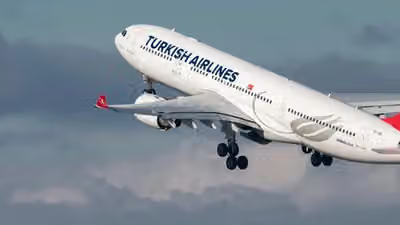
Turkish Airlines says all Iran flights suspended until March 2027
1

Turkish Airlines says all Iran flights suspended until March 2027

2

Trump weighs Iran options; Tehran signals Hormuz leverage

3
ANALYSIS

Iran factories face deepening raw material shortages

4

Economic crisis puts Iran’s coal miners at greater risk

5

Flying to or from Iran? What to know as US pressure squeezes air links

Banner

Spotlight

  • Flying to or from Iran? What to know as US pressure squeezes air links

    Flying to or from Iran? What to know as US pressure squeezes air links

  • Iran factories face deepening raw material shortages
    ANALYSIS

    Iran factories face deepening raw material shortages

  • Will shutdowns forced by US blockade damage Iran’s oil wells?
    ANALYSIS

    Will shutdowns forced by US blockade damage Iran’s oil wells?

  • Tehran sees ‌Beijing as potential bridge to Washington
    ANALYSIS

    Tehran sees ‌Beijing as potential bridge to Washington

  • Tehran ‘ashamed’ as Iranians struggle to make ends meet

    Tehran ‘ashamed’ as Iranians struggle to make ends meet

  • Iran faces postwar winter with major gas capacity still offline
    ANALYSIS

    Iran faces postwar winter with major gas capacity still offline

Banner
Banner
•
•
•

More Stories

Iranian hardliners talk up nuclear weapons before Pezeshkian's UN trip

Sep 22, 2026, 13:56 GMT+1
•
Behrouz Turani
100%
President Masoud Pezeshkian waves as he boards his plane in Tehran before departing for New York on September 22, 2026.

Iranian hardliners spent the day before President Masoud Pezeshkian left for the UN General Assembly talking publicly about nuclear weapons, leaving the treaty that restrains them, and preparing for a long war with the United States.

The statements came within hours of each other, from MPs, a Tehran city council official and military figures, and they map the mood in the hardline camp on the eve of the president's departure.

It came as Donald Trump said he was willing to meet Pezeshkian in New York while warning that "something big" could happen to Iran.

Kamran Ghazanfari, a hardline MP, told Didban Iran that if the existence of the Islamic Republic came under serious threat, the new supreme leader could reconsider the question of nuclear weapons. Some MPs favor a nuclear deterrent to end the recurring threats against Iran, he said, though any decision would rest with senior officials and the Supreme National Security Council.

Parviz Sarvari, deputy chairman of Tehran city council, said he would welcome news that Iran had moved toward building nuclear weapons for deterrence. Membership of the Non-Proliferation Treaty had brought Iran no benefit, he said, while its adversaries threatened it from a position of nuclear superiority.

The push has gone beyond words. Hossein-Ali Haji-Deligani, an MP, submitted a triple-urgency bill for Iran's withdrawal from the NPT, arguing that membership had become more costly since the IAEA Board of Governors referred Iran to the UN Security Council. Similar proposals have circulated for months and the leadership of parliament has kept them off the floor. Haji-Deligani said the presidium has now acknowledged receipt of this one.

Military figures spoke the same day. Army commander Amir Hatami said the armed forces were at full readiness. Esmail Kowsari, of parliament's national security committee, said Iran's growing capabilities would eventually push American forces out of the region.

Revolutionary Guards spokesman Hossein Mohebbi said the war with the United States and Israel was not over and that the Guards had prepared for a long one, citing assessments that Washington may be considering fresh strikes.

What the day was for

Three things were happening at once.

The first is the argument about the last war. The ceasefire that ended the 12-day conflict left hardliners needing it not to look like a defeat at home, and insisting the war is unfinished keeps the account open.

The second is pressure on Pezeshkian. The NPT bill and the nuclear talk arrived alongside renewed parliamentary criticism of his government for allowing IAEA inspectors access, in a dispute over how far Iran should engage Washington and the monitors.

The third is the IAEA referral and the threat of snapback sanctions, which is the immediate cause of the NPT bill and the reason the timing is not a coincidence.

The language stayed inside limits. Ghazanfari attached any reconsideration of weapons to an existential threat. Sarvari's endorsement was of a hypothetical. Neither said Iran should build a bomb now, and neither Mojtaba Khamenei nor the Supreme National Security Council has said anything on the question.

The risk is how it reads elsewhere. Open parliamentary discussion of leaving the NPT and of nuclear contingencies is the kind of material Washington and Israel have previously cited as evidence that Iran is moving toward a weapon, and the United States struck Iranian nuclear sites during the last war. On the same day, the Guards said they expected it to happen again.

Iran offers to reopen Hormuz within seven days if US lifts Hormuz blockade

Sep 22, 2026, 13:34 GMT+1
100%
Iranian President Masoud Pezeshkian reviews an honor guard before leaving Tehran for New York to attend the United Nations General Assembly, on September 22, 2026.

Iram offers to reopen Hormuz within seven days if the United States begins easing military pressure, said reports citing a senior Iranian official, as President Masoud Pezeshkian headed to New York and the military portrayed negotiations as another form of warfare.

The proposal has already been delivered to Washington through mediators and calls for renewed negotiations aimed at permanently ending hostilities, Kyodo News and Reuters reported on Tuesday, citing senior Iranian officials.

Iran wants the United States to begin lifting its blockade of Iranian ports and halt military operations related to the strait. In return, Tehran would reopen the waterway within seven days and return to negotiations, according to the reports.

One official said Iran’s delegation at the UN General Assembly had full authority to revive diplomacy with Washington and discuss the details of an agreement through intermediaries. The initiative was approved by Supreme Leader Mojtaba Khamenei and the Supreme National Security Council, Kyodo reported.

The official nevertheless ruled out a meeting between Iranian President Masoud Pezeshkian and US President Donald Trump in New York, leaving mediators as the likely channel for any immediate exchange.

“There is a possibility of moving toward an agreement,” the official told Kyodo, while saying Washington would need to demonstrate “seriousness and commitment.”

Pezeshkian left Tehran for New York on Tuesday saying he would use the General Assembly to defend Iran’s position, describe the suffering of its people and address what he called the erosion of trust caused by Washington’s conduct.

“We will use this opportunity in the best possible way to convey Iran’s message of victimhood to the international community,” he said before departing.

Foreign Minister Abbas Araghchi, who arrived in New York ahead of Pezeshkian, said Iran remained in a “state of war” following US-Israeli attacks and subsequent developments. He described the UN gathering as an opportunity to present Tehran’s case while criticizing the organization’s failure to maintain international peace and security.

“The question of restoring trust is important and provides an opportunity to discuss with the world how trust in the United Nations was lost and how it can be restored,” Araghchi said.

The conditional proposal on Hormuz places that argument about trust at the center of the latest diplomatic effort. Tehran is signaling that it could quickly ease one of the war’s most damaging economic disruptions, but only after Washington takes the first step.

That sequencing reflects how Iranian officials now describe diplomacy itself. IRGC spokesperson Hossein Mohebbi said Tuesday that negotiations should not be understood as reconciliation or peace but as an extension of the conflict by other means.

“If the country’s interests require it, negotiations can be part of the battle while we remain prepared for combat,” Mohebbi said. “One war is fought with weapons; in negotiations, the war is fought with words, arguments and diplomatic methods.”

Mohebbi said the IRGC was preparing for a prolonged conflict, although it assessed that Iran’s adversaries lacked the capacity to begin another war. “The war is not over,” he said.

Parliament Speaker Mohammad Bagher Ghalibaf offered a similar formulation, arguing that diplomacy should convert military strength into political gains rather than amount to surrender. But other political figures sought to narrow Pezeshkian’s room for maneuver. Lawmaker Mohammad Rostami said any direct negotiations with Trump would be unacceptable, calling the US president the “killer of our martyred leader.”

Pezeshkian also faced criticism from lawmaker Mojtaba Yousefi and former senior IRGC commander Hossein Kanani-Moghadam, who said he should have considered staying away from the General Assembly. Their remarks underscored the domestic resistance the president could face if the diplomatic opening advances beyond indirect contacts.

The value of Tehran’s Hormuz offer will partly depend on whether the United States sees seven-day reopening as a meaningful concession or merely a reversal of disruption Iran helped create. The economic pressure around the waterway also continues to change.

Saudi Arabia restarted its East-West oil pipeline and could resume crude exports from the Red Sea port of Yanbu later Tuesday, Reuters reported. Drone attacks had forced the pipeline to shut on September 13, limiting a key alternative to Hormuz. Its return, even initially at a low rate, could reduce some of Tehran’s leverage by restoring another route for Saudi exports.

China is also emerging as a potential source of pressure. Beijing has offered to help Washington press Iran over the war in return for US concessions on arms sales to Taiwan, Reuters reported, citing sources familiar with discussions between the US and China ahead of a meeting between Trump and Chinese President Xi Jinping. The report did not specify what measures China might take against Tehran.

Yet Beijing simultaneously opposed US sanctions affecting Iranian airlines. China’s Foreign Ministry criticized unilateral measures lacking authorization from the UN Security Council after the US Treasury secretary warned that countries providing Iranian carriers with fuel, credit or other services could lose access to the US dollar system.

Iran Air said it had received no official orders from Turkey, Azerbaijan or Iraq to suspend services to Istanbul, Baku and Najaf. Iraq’s Transport Ministry likewise said flights to and from Iran were continuing normally.

Iranian test-takers head abroad as exam access shrinks

Sep 22, 2026, 12:11 GMT+1
100%
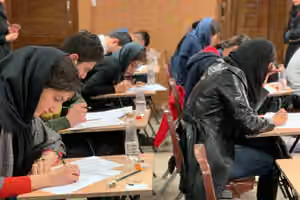
A language test center in Iran.

Iranian applicants are turning to costly overseas trips and alternative exams after access to international tests narrowed, compounding difficulties caused by internet disruption, payment restrictions and the falling value of the rial.

Students and language teachers described cancelled exams, disrupted preparation and growing reliance on overseas testing in interviews with Iranian newspaper Etemad.

TOEFL and GRE testing inside Iran stopped after the US Treasury Department suspended an authorization covering certain educational services involving Iran on August 24. Applicants have also faced restrictions affecting PTE and Duolingo, although the rules differ between providers.

“The morning she arrived at the center, they told her the test would not be held because of sanctions,” Homa, a language teacher identified only by her first name, said of a student who travelled from Gilan province in northern Iran. “That Saturday, all I could hear was students crying, some of whom had only a few weeks until their test date.”

  • Iranians tell of shrinking paths to study abroad

    Iranians tell of shrinking paths to study abroad

Some candidates had already paid for transportation and accommodation before learning their exams would not take place. Others were approaching university deadlines with little time to find alternatives.

Exam trips become a new expense

Applicants are increasingly looking to Armenia, Turkey and other nearby countries, feeding an informal business offering what Homa described as “exam tours.”

Intermediaries arrange appointments, foreign-currency payments, transportation and accommodation, sometimes allowing applicants to leave Iran, sit an exam and return within 24 or 48 hours.

Applicants travelling overland and sharing accommodation can spend around 300 million rials, about $130 at an open-market rate of roughly 2.3 million rials to the dollar. More expensive trips can reach 1 billion to 1.5 billion rials, or about $435 to $650, Homa estimated.

Those sums compare with a government-set minimum base wage of about 166 million rials, or $72, a month. With standard allowances, the minimum monthly package for a single worker is around 218 million rials, or $95.

Telegram groups have become information hubs for testing centers, accommodation and foreign payments. Homa said some operators also offer to manipulate internet or computer settings to make applicants inside Iran appear to be abroad, potentially exposing them to cancelled scores or blocked accounts.

Few alternatives without travel

Switching exams can mean losing months of specialized preparation and does not necessarily eliminate the need to travel.

IELTS is in a different position because it is jointly owned by the British Council, Australia's IDP and Cambridge University Press & Assessment rather than a US testing organization. The suspension of General License G therefore does not directly apply to it.

IELTS testing inside Iran, however, had already ended on January 31, 2026, after IDP cited separate “financial and regulatory factors” outside its control. Iranian applicants seeking the test must therefore also travel abroad.

Tabassom, identified only by her first name, had spent nine months preparing for PTE as part of plans to obtain an Australian work visa. She now expects to switch to IELTS.

100%
Students take an exam at a testing center in Iran.

“I spent an average of 150 million rials ($65) a month on language training,” Tabassom said. “Over nine months, I spent nearly one billion rials ($435) just on classes and training. I had reached the point where I was going to take the exam in another month and a half, but now I have to switch to IELTS and start preparing again.”

Domestic problems compound the disruption

The testing restrictions have landed on applicants already dealing with economic and infrastructure problems inside Iran.

Tabassom said internet outages had already disrupted contact with her immigration lawyer before the problems surrounding PTE forced her to change plans.

  • Iran sanctions reach education: Duolingo blocked, TOEFL and GRE in doubt

    Iran sanctions reach education: Duolingo blocked, TOEFL and GRE in doubt

Applicants with sufficient resources can respond by travelling abroad or paying for additional preparation. Others may have to borrow money or delay their plans. Homa said some students had sold gold or household belongings or taken loans to continue pursuing testing and migration.

For Iranians seeking to study or work abroad, the challenge is no longer only achieving the required score, but finding an affordable way to reach the examination room.

Journalist ties tanker attacks to oil middlemen, drawing treason accusations

Sep 22, 2026, 10:24 GMT+1
•
Maryam Sinaiee
100%
Vessels in the Strait of Hormuz, as seen from Musandam, Oman, August 3, 2026.

Iranian investigative journalist Yashar Soltani says the middlemen who move Iran's sanctioned oil revenues had a financial motive to wreck the June deal with Washington, and that the tanker attacks weeks later served it. Hardline outlets have answered with accusations of treason.

Speaking on an online program last week, Soltani said networks built to evade oil sanctions stood to lose from the June memorandum between Tehran and Washington, because implementing it would have cut their role in oil sales.

Three Saudi and Qatari tankers were attacked in the Strait of Hormuz less than three weeks after the memorandum was signed. Soltani said the attacks served to derail the agreement and prevent sanctions on Iranian oil from being lifted for good, keeping the networks in business.

The people he described as trustees are not the traders who sell the oil, he said, but the intermediaries who move the money. He named Ruhollah Razavi, son-in-law of Majid Motaghifar, spokesman for the hardline Paydari Party, as one of four who control much of the trade.

The margins are the point. Moving the proceeds of a single tanker carrying about $90 million of oil costs roughly $4 million through these intermediaries, Soltani said. Through SWIFT, the international banking system Iran is cut off from, it would cost about $500.

He also said the four had run monthly debts to the government in the hundreds of millions of dollars while using the money for other business, putting the monthly average attributed to Hossein Shamkhani, son of the late security chief Ali Shamkhani, at about $800 million.

Iranian outlets have recently named Razavi, Shamkhani and two others as the network's main trustees, and asked how they were chosen and how the system works.

The backlash

Fars News Agency, affiliated with the Revolutionary Guards, said Washington had violated the memorandum, particularly its provision on the Strait of Hormuz, and rejected any suggestion that Iran bore responsibility for its collapse.

"Recent reports, including material published by Yashar Soltani and affiliated media, seek to switch the roles of victim and culprit and portray Iran as responsible for the failure of the memorandum," Fars wrote. "The narrative that vigilantes broke the agreement is simple and attractive, but when placed alongside the successive violations by the United States, it falls apart."

Tasnim, also linked to the Guards, called it performative justice-seeking. "If a nation is told that the war with the United States and Israel is not the product of the wickedness and crimes of these two regimes, but rather the result of the mischief of some people inside the country seeking to continue benefiting economically, what incentive will remain there for unity?" it asked.

The state broadcaster's political program Be Vaght-e Iran argued on social media that no commercial network could have carried out the attacks whatever its motive.

"Trustees have neither a military structure, nor anti-ship cruise missiles, nor links to the command levels of the IRGC and army," the post said. "This type of narrative is not only unprofessional, but also a dangerous and disturbing game aimed at discrediting the defenders of the country's security who have stood by this land for years."

A military analyst in an accompanying video said that while the United States had violated the memorandum, only Iran's wartime command, the Khatam al-Anbiya Central Headquarters, could have ordered missile strikes.

The accusations

Hardline users have accused Soltani of serving those who want to pressure Iran's armed forces.

Ehsan Hosseini, who edits the hardline publication Khat-e Energy, said Soltani was trying to swap one set of trustees for another: "The project Yashar Soltani has launched is not against the trustees; it seeks to oust some and replace them with other trustees, those who failed to return $13 billion in oil revenues and caused the January protests."

Majid Shakeri, an adviser to parliament speaker Mohammad-Bagher Ghalibaf, called the revelations a propaganda campaign by one group of trustees against another. Both groups, he said, had contributed to two wars and to last year's protests, and anyone attributing Iran's response to the American violation to this rivalry deserved a "field trial for wartime treason."

Journalist Davoud Modarresian put the blame on the government, which he said had neither the nerve to leave the dollar-based financial order nor the ability to control the trustees.

"By implementing currency shocks and releasing the dollar exchange rate in December, they pushed the economy to the brink of collapse and created the conditions for the enemy's military greed," he wrote.

Not all of it was hostile. "If oil is sold without obstruction or sanctions by the ministry under the memorandum, and its money returns through transparent channels, the profits of the trustees and the IRGC will be cut," one user wrote, arguing that this pointed to collusion between the two.

Iran diplomacy intensifies at UN as Hormuz crisis keeps pressure on region

Sep 22, 2026, 04:36 GMT+1
100%
Commercial vessels are seen in waters near the Strait of Hormuz. (Photo: ISNA)

Diplomatic efforts around the Iran war intensified in New York as Western and regional governments pushed to restore Hormuz shipping, curb Houthi attacks and lay the groundwork for renewed talks with Tehran.

The push gathered pace around the UN General Assembly, where Qatar said it was trying to secure even a short-term agreement between Iran and the United States that could reopen negotiations. Doha said restoring navigation through Hormuz and removing the threat of military action would be necessary for meaningful talks.

Iranian Foreign Minister Abbas Araghchi, meanwhile, arrived in New York and spoke by phone with UN Secretary-General Antonio Guterres about the General Assembly agenda and efforts to advance international peace and security, according to the IRGC-affiliated Tasnim news agency.

The diplomacy is taking place as Persian Gulf Arab states increasingly discuss not only how to stop the fighting but what a future security arrangement with Iran could look like. Qatar and the United Arab Emirates have called for greater regional dialogue, with Qatar advocating a common security framework involving Tehran and Persian Gulf states. The Financial Times reported that Saudi Arabia has also discussed a possible non-aggression pact with Iran. The FT described the war as prompting Persian Gulf states to reassess their approach to regional security.

That effort is closely tied to the disruption around Hormuz, which has become one of the war’s central economic pressure points. French President Emmanuel Macron said after meeting US President Donald Trump in New York that France and the United States would work together to protect critical Middle East energy infrastructure and freedom of navigation through the strait. They would also seek a moratorium on strikes against energy infrastructure. Macron had warned earlier that disruption around Hormuz and attacks on alternative routes were putting global energy markets under severe pressure.

Washington is also looking beyond the immediate shipping disruption. The Trump administration has proposed contributing $5 billion to a fund to rebuild damaged regional energy infrastructure and reduce reliance on Hormuz, with eight Middle Eastern partners asked to provide matching contributions for a potential $10 billion fund. The Wall Street Journal reported that some regional officials questioned whether rebuilding could begin safely without a peace agreement with Tehran, given the risk of renewed attacks.

The economic consequences are already being felt beyond Iran. Iraqi Prime Minister Ali al-Zaidi said Tehran had prevented Iraqi tankers from passing through Hormuz despite Baghdad considering Iran a regional partner, and said Iraq had lost about $60 billion in revenue since the war began. US Central Command, meanwhile, said its forces had redirected 110 commercial vessels as part of Washington’s blockade against Iran.

Pressure is also spreading westward toward the Red Sea. Britain agreed to provide Saudi Arabia with limited defensive air-to-air refueling support after intensified attacks by Yemen’s Iran-backed Houthis, while G7 foreign ministers meeting in New York called on Iran to stop arming and supporting the group. They warned that continued Houthi attacks threatened civilian shipping, international trade and wider stability.

At the same time, Tehran has continued to signal military readiness. An IRGC deputy commander said Iran was strengthening its missile, drone, cruise missile, cyber, electronic warfare and air-defense capabilities, underscoring the tension between the diplomatic activity in New York and the continuing risk of renewed escalation.

The diplomatic push is unfolding as the war continues to disrupt shipping through the Strait of Hormuz, strain regional energy supplies and widen security concerns across the Middle East.