Will shutdowns forced by US blockade damage Iran’s oil wells?

The sharp fall in Iran’s oil loadings is forcing it to curb production, raising costs beyond lost sales, from restarting aging wells to maintaining reservoir pressure and protecting shared fields. But could the shutdowns cause lasting damage?
Iranian officials often speak about oil as if the only question were whether crude can be sold today or tomorrow. In that telling, if exports stop, the oil simply stays underground until sanctions or a blockade ease, after which production can resume from where it left off.
Oil Minister Mohsen Paknejad said earlier this month that Iran’s oil exports did not stop “even for an hour” during the 40-day war. He had previously said there was not even a single day of production decline during that period.
Even if those claims are accurate for the war itself, they do not answer a more important question about what followed: how much production must be shut in when exports collapse and storage fills, and what will it cost to bring those wells and facilities back?
Read the full article here.


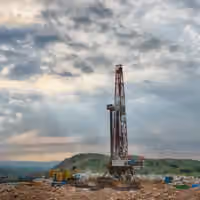




The sharp fall in Iran’s oil loadings is forcing it to curb production, raising costs beyond lost sales, from restarting aging wells to maintaining reservoir pressure and protecting shared fields. But could the shutdowns cause lasting damage?
Iranian officials often speak about oil as if the only question were whether crude can be sold today or tomorrow. In that telling, if exports stop, the oil simply stays underground until sanctions or a blockade ease, after which production can resume from where it left off.
Oil Minister Mohsen Paknejad said earlier this month that Iran’s oil exports did not stop “even for an hour” during the 40-day war. He had previously said there was not even a single day of production decline during that period.
Even if those claims are accurate for the war itself, they do not answer a more important question about what followed: how much production must be shut in when exports collapse and storage fills, and what will it cost to bring those wells and facilities back?
Energy intelligence firm Kpler estimated Iranian oil loadings fell from about 1.83 million barrels per day in March to around 255,000 bpd in August. It also estimated crude production dropped from about 3.24 million bpd to 1.755 million bpd, while inventories at terminals, refineries and other onshore storage sites increased.
Some Iranian crude may still be discharged in China, but much of that oil had already left Iran before the blockade intensified and remained for a time on tankers in Asian waters. Selling those cargoes is not the same as moving fresh crude out of Iranian wells and export terminals.
When exports fall, producers can initially divert crude into onshore storage, refineries and tankers. But storage is finite. Once it fills, the pressure moves upstream, forcing the National Iranian Oil Company to reduce production from some wells or shut them altogether.
An oil field is not an underground warehouse
An oil reservoir is sometimes imagined as an underground lake that can simply be tapped, closed and reopened months later.
In reality, oil sits within porous rock and networks of natural fractures. Its movement toward a producing well depends on reservoir pressure, rock properties, fluid composition and the way the field is managed.
That means shutdowns do not affect every well in the same way.
Some conventional Middle Eastern reservoirs can tolerate short shutdowns without serious damage. In certain fractured reservoirs, temporarily reducing output may even allow pressure to recover and oil to migrate from the rock matrix into fractures.
Robin Mills, a researcher at Columbia University’s Center on Global Energy Policy, has argued that production shutdowns are unlikely to cause catastrophic or permanent damage across most of Iran’s oil industry.
He has pointed to Iran’s relatively rapid production recovery after previous declines caused by sanctions and the Covid-19 pandemic.
That distinction matters. There is little basis for claiming that shutting production will inevitably destroy Iran’s oil wells.
But recoverable does not mean free, immediate or risk-free.
Iran has many mature fields and aging wells. Ahvaz, Marun, Gachsaran and Aghajari, among the country’s most important producing areas, have been in operation for decades.
Low-pressure wells, or wells producing large volumes of water alongside crude, may fail to flow naturally after a prolonged shutdown. Restarting them can require pumping, nitrogen injection, chemical treatment or other well-servicing operations.
During a shutdown, mineral scale, asphaltenes and other heavy compounds can accumulate around the wellbore, in production tubing or in flow lines.
Corrosion, sand and solids deposition, pump failures and unwanted flows between zones with different pressures are also recognized risks.
An analysis by the Society of Petroleum Engineers’ Reservoir Advisory Committee on prolonged shut-ins warned that corrosion, deposits, pump damage and plugging can leave some wells requiring repairs, stimulation or recompletion before they return to production.
For weak-performing wells, remediation can also become expensive enough to call their economics into question.
None of those costs appears in a simple calculation of barrels that were not sold.
Rotating shutdowns also cost money
NIOC has experience managing production cuts during earlier rounds of sanctions.
One option is to rotate shutdowns among wells rather than take an entire field offline, reducing the amount of time any single well remains idle.
That can limit the risks, but it requires continuous monitoring of reservoir pressure, fluid composition, gas injection, corrosion, pumps and surface facilities.
Repeated shutdowns and restarts, changes in chemical injection and the recalibration of processing equipment also add to operating costs.
In other words, not producing oil still costs money.
If falling oil revenues squeeze maintenance budgets, what begins as a manageable shutdown can develop into a far more expensive repair problem.
The question is therefore not whether every shut well will be lost. It is how many will return without additional work, how long the others will take to restart and how much that process will cost.
Gas injection links the oil problem to Iran's gas crisis
Many of Iran’s mature oil fields rely on gas injection to maintain reservoir pressure and improve recovery.
Kpler has estimated historical gas injection into Iranian oil fields at about 4.8 billion cubic feet per day. Even before the current crisis, Iran was injecting less gas than its reservoirs required.
That problem could become more acute.
Gas production from South Pars also produces condensate. If Iran becomes unable to export, store or consume enough of that condensate, it may eventually have to reduce gas output.
The government would then face harder choices over how to allocate gas among households, power plants, industry, exports and injection into oil reservoirs.
Lower gas injection does not destroy a well overnight. But over time, it can reduce reservoir pressure and potentially lower ultimate oil recovery.
A crisis that begins with crude exports can therefore feed back into oil production through constraints on condensate and natural gas.
This part of the cost rarely features in official statements.
Iranian officials emphasize continued exports and efforts to circumvent restrictions, but disclose little about how much gas, equipment and investment is needed to maintain reservoirs while production is being curtailed.
Shared fields create another risk
Not all Iranian fields can be treated in the same way.
Azadegan and Yadavaran are shared with Iraq, Forouzan with Saudi Arabia and Salman with the United Arab Emirates, with production taking place from different parts of connected geological structures.
A reduction in Iranian output does not mean crude immediately flows across a border toward a neighboring country’s wells. Reservoir behavior is more complicated and depends on geology.
But if Iran reduces production and development for an extended period while the other side continues drilling and extracting oil, Iran’s economic position in those shared resources can weaken.
Oil left underground in such fields is not necessarily being preserved exclusively for Iran to produce later.
Continued extraction across the border can, in some reservoirs, reduce Iran’s future recoverable share or economic opportunity.
The real cost of shutting production
The impact of a forced production cut cannot be measured by lost sales alone.
It also includes the cost of storing crude, maintaining idle wells, carrying out repairs and restarts, any loss in future productive capacity or reservoir recovery, and missed opportunities in shared fields.
There can be broader consequences as well.
Lower gas production would put more pressure on power generation, petrochemical feedstock and industrial consumption, forcing the government to make increasingly difficult choices over scarce energy supplies.
A prolonged blockade and collapse in exports therefore affects more than the Islamic Republic’s immediate oil revenue.
If wells and facilities are not adequately maintained, part of the cost can persist long after exports recover.
Paknejad can point to uninterrupted exports or production during a limited period, but more important questions remain unanswered.
How many Iranian wells are now producing at full capacity? How many have been throttled back or shut? How has gas injection changed? How much is being spent to manage shut-ins, maintain equipment and eventually restore production?
Without those figures, claims of continued production offer only a partial picture of the state of Iran’s oil industry.
Most Iranian wells may eventually be recoverable. But shutting them is neither cost-free nor necessarily quick to reverse.
The longer production remains constrained, the more maintenance, reservoir management and restart costs may accumulate — costs whose full scale cannot be known without far greater transparency about the condition of Iran’s wells and fields.
Iranian officials and media are increasingly looking to China as a possible diplomatic bridge to Washington, as Foreign Minister Abbas Araghchi’s second wartime visit to Beijing coincides with preparations for President Xi Jinping’s talks with Donald Trump next week.
Chinese Foreign Minister Wang Yi told Araghchi on Wednesday that Beijing was ready to play a “constructive role” in resolving international disputes and urged Iran and the United States to rebuild their negotiating mechanism and hold substantive consultations on unresolved issues.
Araghchi appeared to attach considerable weight to the talks, writing on X afterwards that decisions made in consultation with Chinese partners would “decide future strategic balance in the region, with immeasurable knock-on effects.”
His visit came ahead of Xi’s planned meeting with Trump in Washington on September 24, where the Iran war and China’s economic ties with Tehran are expected to be among the issues discussed.
China has not publicly offered to mediate directly between Tehran and Washington. But its diplomatic weight, relations with both countries and ties across the Middle East have prompted growing speculation in Iran that Beijing could assume a larger role.
China also has experience mediating between Iran and a major regional rival. In 2023, Beijing brokered an agreement that restored diplomatic relations between Iran and Saudi Arabia after years of hostility.
Ahmad Bakhshayesh-Ardestani, a member of parliament’s National Security Committee, told Fararu that previous mediators such as Qatar and Pakistan had not been completely neutral and had been influenced by Washington. China, he argued, carried greater political weight and could provide stronger guarantees.
Beijing, he said, “can play a different role from previous mediators.”
Moderate daily Shargh made a similar argument, pointing to China’s position as a permanent member of the UN Security Council and its extensive economic relations with Arab states as well as close ties with Tehran.
“This multilayered network of relations allows Beijing to pursue the Hormuz issue on two levels: dialogue with Tehran on the one hand, and engagement with the United States and other powers influencing regional security on the other,” Shargh wrote. “This is the difference that separates Araghchi’s visit to Beijing from an ordinary diplomatic trip.”
Nour News, which is close to Iran’s Supreme National Security Council, said Tehran supported regional peace initiatives involving countries ranging from Pakistan and Qatar to China and Russia, while insisting that such diplomacy did not mean abandoning what it described as Iran’s right to defend itself.
The outlet argued that Beijing, conscious of the Strait of Hormuz’s geopolitical importance, was seeking to improve conditions for diplomacy rather than pressing Tehran to abandon its positions.
Some Iranian media and analysts have suggested China could also help bring Iran and Arab states into a broader regional arrangement rather than confining its role to US-Iran diplomacy.
Wang said Wednesday that China supported dialogue between Iran and regional countries based on respect for territorial sovereignty and national security. He also said the existing Middle East security architecture needed to be reformed and strengthened.
Farda News, which is close to parliament speaker Mohammad-Bagher Ghalibaf, interpreted Wang’s remarks as an attempt to link the immediate security crisis to a broader mechanism for dialogue between Iran and the Gulf Cooperation Council.
Jalal Sadatian, a former director general of the Foreign Ministry’s East Asia Department, told Khabar Online that Tehran should seek Beijing’s help in persuading Saudi Arabia and other Arab states to participate in a wider regional agreement involving the Strait of Hormuz.
International affairs analyst Sabah Zanganeh similarly told ILNA that China could broaden existing diplomatic efforts to include Iran, Iraq and GCC states, rather than limiting them to temporary arrangements between individual countries.
“Such an action is necessary and must certainly go beyond a temporary action between two countries,” he said.
Beijing’s diplomatic backing for Tehran was also visible at the United Nations on Thursday, when China and Russia vetoed a US-backed resolution that would have extended the mandate of a panel of experts monitoring sanctions on Iran. The resolution received 11 votes in favour, two against and two abstentions.
Iranian conservatives portrayed the veto as evidence of a changing international order. Rouydad24, however, cautioned against equating the end of the monitoring mechanism with the lifting of sanctions, noting that Washington retains extensive economic pressure tools outside the UN framework.
For now, Beijing’s public position remains more cautious than some of the expectations being voiced in Iran: China has offered to play a constructive role in diplomacy, but has stopped short of announcing itself as a mediator between Tehran and Washington.
Iran is racing to restore gas infrastructure before winter after losing about a third of its pre-war production capacity, a reconstruction challenge that could force Tehran into difficult choices between keeping homes warm, power plants running and industry supplied.
Iranian officials say attacks have knocked out about 230 million cubic metres a day of gas-production capacity, compared with pre-war output of roughly 650 million cubic metres a day. That is just over a third of pre-war production.
Tehran has begun trying to claw some of that capacity back. Officials have said roughly 100 million cubic metres a day could be restored in the coming months, still less than half the capacity reported lost.
But restoring production is only part of the problem. Rystad Energy estimated in April that repairing damage to Iran’s energy infrastructure could cost as much as $19 billion, affecting gas processing, refining and export facilities.
That figure covers physical repairs rather than the wider economic consequences of lost production, disrupted exports and industrial shutdowns. Rystad has also identified shortages of critical equipment and workers as major obstacles to recovery.
Winter could provide the first major test of whether Iran can repair enough of its energy system quickly enough to prevent wartime damage from developing into a broader economic crisis.
A system already under pressure
Iran entered the war with an energy system already struggling to match supply with demand.
The US Energy Information Administration has said sanctions slowed development of the country’s natural-gas infrastructure and that limited storage capacity left Iran poorly equipped to manage seasonal swings in consumption.
In 2022, residential and commercial consumers accounted for 33% of Iran’s gas consumption, industry including petrochemicals for 27%, and electricity generation for another 28%, according to the EIA.
Household and commercial gas consumption rises during winter, while demand from the electricity sector is highest during summer.
The loss of production capacity therefore leaves Tehran having to allocate a reduced supply among households, power stations, petrochemical plants and other industrial users.
The problem is not simply how much gas Iran has underground. Gas reserves alone do not guarantee reliable supply: the country also needs functioning processing plants, pipelines and storage facilities, as well as electricity, maintenance, equipment and skilled workers to keep the system operating.
Damage beyond gas
Reduced gas supplies to power plants could constrain electricity generation, while restrictions on industrial users could hit petrochemicals and energy-intensive sectors such as steel, aluminium and cement.
That means the eventual cost of the damage cannot be measured solely by the reconstruction bill. Lower production can also translate into weaker industrial output and exports at a time when Tehran needs resources to finance repairs.
Iran's broader energy sector is already under severe financial pressure. The war and US naval blockade have sharply curtailed Iranian oil exports, leaving tens of millions of barrels stranded in storage and depriving Tehran of crude export revenue.
The combination creates the risk of a cycle in which energy shortages constrain economic activity while reduced revenues make restoring the energy system more difficult.
A longer-term problem
The war has also magnified structural weaknesses that predate the conflict.
South Pars, which Iran shares with Qatar, is the country's largest non-associated natural-gas field and the centre of its gas industry. But the EIA had already warned before the war that without additional investment Iran could struggle to satisfy domestic demand while meeting its export commitments.
Sanctions have restricted access to foreign investment, technology and specialised equipment, leaving Tehran with an existing infrastructure challenge before US and Israeli attacks added an urgent reconstruction burden.
Rystad said delays in procuring critical equipment were likely to determine how quickly damaged energy infrastructure could be restored, while shortages of workers were another major obstacle.
The winter test
For Tehran, the immediate question is how much of the reported 230 million cubic metres a day of lost gas capacity can be restored before colder weather drives household demand higher. How severe the remaining deficit becomes will depend on demand, further repairs and whether additional infrastructure is damaged.
Tehran may have to balance household heating against industrial production and electricity generation while trying to rebuild infrastructure under sanctions.
Rystad's $19 billion estimate gives a sense of the potential physical repair bill. The larger test is whether Iran can restore enough of the system to prevent damaged gas infrastructure from feeding through into electricity shortages, industrial disruption and further economic pressure.
The coming winter should provide the clearest indication yet.
Four years after Mahsa “Jina” Amini’s death in Iran’s morality police custody sparked the Woman, Life, Freedom uprising, teenagers who watched her name become a rallying cry have grown up amid repression but beyond many of the social and political boundaries of pre-2022 Iran.
A girl who was just entering adolescence when the Woman, Life, Freedom protests began is now approaching adulthood. The past four years have been part of the period in which her understanding of society, government and freedom has taken shape.
Women burning their headscarves, nighttime chants from apartment windows, protests in schools and universities, young people knocking turbans off clerics’ heads and protesters standing up to security forces all became part of the memories that accompanied that generation into adulthood.
One of the most enduring changes is visible on the streets.
Many women now appear without mandatory hijab in streets, universities, cafes, shopping centers and on public transport. Some ride bicycles and motorcycles without covering their hair.
The Islamic Republic has responded to this defiance with arrests and summonses, warning text messages, vehicle seizures, restrictions on bank accounts and SIM cards, surveillance cameras and the closure of businesses.
Human rights organizations say tens of thousands of women have faced security or judicial action over their clothing during the past four years.
Abandoning mandatory hijab has become one of the clearest forms of collective disobedience to emerge from 2022, continuing in parts of society despite the security and legal costs.
As the fourth anniversary of Amini’s death approached, a coalition of Iranian Kurdish political groups called for a general strike on September 16, urging people to close shops and markets and stay away from work.
From Mahsa Amini’s death to prison and executions
Mahsa “Jina” Amini, a 22-year-old woman from Saqqez in Iran’s Kordestan province was detained by the morality police in Tehran on September 13, 2022. She was taken to hospital and died three days later.
Her gravestone bears the words: “Dear Jina, you will not die. Your name will become a symbol.”
Her father, Amjad Amini, wrote on September 14, ahead of the fourth anniversary of her death, that her name had “gone beyond our small home.”
The family, he said, was still waiting for the truth to emerge.
“The sealed secret that you and all the loved ones resting in this earth carry with you will not remain hidden forever,” he wrote.
Amini’s name quickly became a rallying cry for protests that began in Saqqez and Kordestan, spread to Tehran and then swept across Iran. The Kurdish slogan “Jin, Jiyan, Azadi” and its Persian equivalent, “Woman, Life, Freedom,” became the uprising’s defining chant.
“Death to the dictator,” “This is the final message, the target is the entire system,” “Poverty, corruption, high prices — we will go on until overthrow,” and “Don’t call it a protest, it’s called a revolution” were also heard on the streets, reflecting the political direction the protests had taken.
Supreme Leader Ali Khamenei and the Islamic Republic itself became the direct targets of many of the slogans.
The uprising also quickly became a global cause. Artists, athletes, academics, human rights activists and political figures around the world voiced support, carrying Amini’s name and the slogan Woman, Life, Freedom far beyond Iran’s borders.
The authorities answered the protests with lethal force, widespread injuries and mass arrests.
Human rights organizations have put the number of people killed in the uprising at more than 550. Many more were wounded, while shotgun pellets blinded dozens of protesters in one or both eyes.
Judiciary chief Gholam-Hossein Mohseni-Ejei said in May 2025 that more than 90,000 cases had been opened in connection with the 2022 protests, including cases involving schoolchildren, university students and teachers.
The crackdown continued in the courts after large street gatherings subsided.
Execution, imprisonment, flogging, internal exile, fines, travel bans and restrictions on social rights were among the punishments handed down to protesters and activists linked to the uprising.
Mohsen Shekari, Majidreza Rahnavard, Mohammad Mehdi Karami, Mohammad Hosseini, Saleh Mirhashemi, Saeed Yaghoubi, Majid Kazemi, Milad Zohrevand, Mohammad Ghobadlou, Reza Rasaei, Mojahed Korkor, Mehran Bahramian, Mehrab Abdollazadeh, Abdoljalil Shahbakhsh and Aref Khoshkar were among those executed in cases connected to the 2022 protests.
Others remain at risk of execution.
Among them is Ali Zarei Dozdarehsi, who suffered an eye injury from shotgun pellets during the uprising. After spending time in Germany, he returned to Iran, was arrested and was later sentenced to death by a Revolutionary Court.
Dozens of other protesters have also received death sentences or still have cases under review.
Golrokh Iraee, Nasim Simiyari, Hamid Ghareh-Hassanlou, Farzaneh Ghareh-Hassanlou and Hossein Mohammadi are among hundreds of political prisoners connected to the Woman, Life, Freedom uprising who have faced restrictions in prison, including being denied phone calls, family visits or furlough.
For some, much of the past four years has been spent behind bars, even as Iranian society outside prison has moved through new protests and new changes.
A generation that says ‘We are not going back’
The children and teenagers of 2022 have grown older. Some are now at university, some have entered the workforce and others have left Iran.
What many share is the experience of growing up in a society that lived through one of the most widespread uprisings in the history of the Islamic Republic.
Schools themselves became protest sites in 2022. Students chanted slogans, pulled down images of Islamic Republic officials from classroom walls and girls removed their headscarves.
Universities saw weeks of demonstrations, sit-ins and confrontations with security forces.
For a generation that witnessed those scenes during formative years, politics became tied to the street, the school, the university and everyday life.
German-American political thinker Hannah Arendt linked freedom to the human capacity to begin something new. In her thought, political action emerges among others in the public sphere, and revolutions are among the moments when the possibility of a “new beginning” becomes visible.
For the teenagers of 2022, an experience of that kind unfolded on a mass scale before their eyes: people who often did not know one another chanted the same slogans, supported each other and joined collective action in schools, universities, neighborhoods and streets.
Four years later, this generation lives in a society where repression continues. But the experience of 2022 has not been erased from its political memory.
What Woman, Life, Freedom gave the protests that followed
The 2022 uprising did not topple the Islamic Republic, but it changed the language and horizons of protest.
Woman, Life, Freedom entered Iran’s political vocabulary alongside slogans calling for the overthrow and end of the Islamic Republic.
Women stood at the center of a nationwide uprising. School students emerged as a visible force in protest, and acts of disobedience moved from demonstrations into everyday life.
Some of the behaviors that took shape during those months continued in the years that followed.
Rosa Luxemburg, the Marxist revolutionary and theorist, viewed the defeats of revolutionary movements as links in a historical chain that could help prepare the ground for future victories.
After the failed January 1919 uprising in Berlin, she treated the experience and political understanding gained through defeat as part of a revolutionary movement’s accumulated strength.
The protests that followed 2022 began from a point that Woman, Life, Freedom had already reached. Opposition to the Islamic Republic as a whole, and demands for its overthrow, remained present in later protest slogans.
January 2026 offered one of the clearest examples.
Protests that began over economic grievances rapidly spread across the country, with political slogans against the Islamic Republic becoming a major feature.
Estimates of those killed ranged from the government’s official figure of 3,117 to more than 36,500 in Iran International’s reporting. Tens of thousands were wounded, while around 100,000 people were arrested, summoned or interrogated.
For the generation that had experienced 2022, January 2026 became a second encounter with a nationwide uprising and a bloody crackdown within only a few years.
A generation carrying the memory of several generations
Iran’s teenagers and young adults now stand at the end of a much longer history of protest and repression: women’s protests against compulsory hijab in March 1979, the executions of the 1980s, the July 1999 university dormitory crackdown, the 2009 Green Movement, the protests of January 2018 and the bloody November 2019 crackdown.
Many learned about those events through their families, photographs, books and news reports.
Woman, Life, Freedom and the January 2026 protests, however, belong to their own lived experience.
That distinction has helped shape this generation’s political memory.
Images of protesting women, schoolgirls, young people in the streets, families demanding justice and political prisoners now sit alongside images of those killed, wounded and executed.
A girl who was just entering adolescence in September 2022 is now approaching adulthood carrying memories of Amini, protest, repression and disobedience — memories now layered alongside the stories earlier generations carried from March 1979, the 1980s, July 1999, the Green Movement and November 2019.
Four years after Amini’s death, Woman, Life, Freedom remains part of this generation’s memory: in the school and the street, in experiences of repression and defiance, and in the picture of freedom and Iran’s future that it carries into adulthood.
Above all, this generation has seen that the path to political change in Iran runs through the street, collective action and effective organization.
Iranian newspapers that agree on almost nothing agreed on Monday that the Muscat talks had collapsed. Kayhan, Shargh and Donya-ye Eghtesad all reported it, and the argument has already moved to what Tehran does next.
Kayhan on the hard right, and Shargh and Donya-ye Eghtesad on the pragmatic and pro-reform side of the divide, all reported that the talks in Oman had effectively broken down, leaving Tehran without an immediate way out and its economy exposed to worsening inflation, shortages and a lurching currency.
The meeting had been meant to give Iran a diplomatic opening. Foreign Minister Abbas Araghchi was due to present maps for a "managed transit corridor" through the Strait of Hormuz, and to seek regional endorsement of an Iran-Oman "phased framework," a temporary joint corridor and mine-clearance plan.
It did not happen. Fars News, affiliated with the Revolutionary Guards, reported that the postponement had been a joint decision by Tehran and Muscat, taken at the request of unnamed "certain regional countries."
Behind that phrasing sat a refusal. Saudi Arabia and Bahrain did not attend, and the Arab monarchies of the Persian Gulf declined to endorse Iran's transit proposal. They were being asked to back a plan for safe passage through Hormuz at a moment when Iran-aligned Houthi forces were expanding strikes on Saudi Arabia's East-West pipeline and fortifying coastal artillery at Bab el-Mandeb after taking the port of Mokha.
Washington's position was its own obstacle. It rejected treating the shipping question in isolation, insisting any transit arrangement be tied to broader nuclear concessions. Tehran's answer was that normal shipping requires an immediate halt to US tanker interdictions and the release of $24 billion in frozen Iranian assets under the Islamabad framework. Neither side moved.
The argument in Tehran
With the diplomatic route stalled, the argument inside Iran has turned to force, and the failure in Oman has sharpened it.
Kayhan, other Guards-aligned outlets and figures in the ultraconservative Paydari Front are pressing to abandon proportional retaliation altogether and to strike all Western-aligned shipping if a single Iranian vessel is hit.
They have paired this with a push to treat calls for referendums or ceasefires as treason, to cast economic hardship as an ideological duty, and to demand full withdrawal from the Non-Proliferation Treaty after the IAEA referred Iran to the UN Security Council.
Reformist and moderate figures in the administration argue instead for keeping the channels through Qatar and Oman open and putting economic survival first. But this is a dispute over method, not over the system either camp is defending: one faction would answer the blockade with escalation across the Persian Gulf and Red Sea, the other fears that combining a naval blockade abroad with intensified repression at home would leave Iran isolated on both fronts at once.
That repression is already visible. Police and the Revolutionary Guards have increased street patrols and moved additional forces into Tehran and Isfahan ahead of the anniversary of the 2022 Woman, Life, Freedom protests, which began in mid-September.
The economy behind the argument
The deadlock feeds directly into the crisis that produced the talks in the first place.
Point-to-point inflation is nearing 90 percent, and on the open market the rial is at 2.3 million to the dollar. Against a minimum monthly wage now worth about $72, the volatility alone makes household budgeting impossible.
The sharpest damage is in medicine. Container backlogs at Bandar Abbas, Iran's main southern port, have choked domestic pharmaceutical production and caused acute shortages of essential drugs. Out-of-pocket medical costs have more than doubled, pushing low-income households to abandon treatment. In call-ins to Persian-language television abroad, viewers have described selling household belongings to pay for care.
The government's own remedies have added to the strain. It has raised petrol prices and drawn on the central bank's foreign currency reserves, steps that have deepened the erosion of public trust rather than eased it.
The postponement, then, does more than delay a meeting. It removes Tehran's nearest diplomatic exit at a moment when the hardline factions are pressing for wider retaliation across the Persian Gulf and the Red Sea, and when the economy can least absorb what that would cost. Whatever Iran's rival camps decide, it is private businesses and urban households that will carry it.