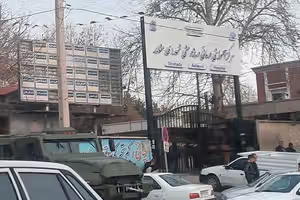
Second Sunni cleric killed in Iran in less than a week
Sunni Baluch cleric Molavi Yousef Gorgij was killed by unknown assailants outside his home in Zahedan, Iranian state media reported on Monday, the second killing of a Sunni cleric in Iran in less than a week.
State-run Mehr News described Gorgij as a pro-government Sunni cleric and blamed what it called “Zionist mercenaries” for the killing, without providing evidence or further details.
Zahedan Governor Rakhshani-Nasab said Gorgij had been active in opposing “divisive elements and Zionism”.
Some local Iranian outlets separately said the attack was attributed to Jaish al-Adl, a Sunni Baluch militant group that has carried out attacks on Iranian security forces, though no claim of responsibility was immediately reported.
The IRGC Ground Forces’ Quds Base blamed what it called “terrorist groups” for the killing, saying the attack came after Revolutionary Guards forces had dismantled several “terrorist teams” in Sistan-Baluchestan.
The killing comes after a weekend of violence in Iran’s restive southeast. Heavy fighting between security forces and unidentified gunmen spread across parts of Saravan on Saturday, with attacks reported on military vehicles and dozens of security personnel killed or wounded, according to the Baluch rights group Haalvsh. The gunshots also continued on Sunday night.
It also follows the Sept. 9 killing of Sunni Kurdish cleric Mamosta Mohammad Nezhati in West Azerbaijan province. The Revolutionary Guards blamed what it called “Zionist-American Kurdish separatist groups” for that attack and said Nezhati had a history of cooperation with Basij organizations.
Mohammad Nezhati
The Revolutionary Guards blamed what it called “Zionist-American Kurdish separatist groups” for that attack and said Nezhati had a history of cooperation with Basij organizations.
In July, Sunni Baluch Friday prayer leader Molavi Mohammad Anvar Rigi was also killed by unidentified gunmen in the southeastern border town of Mirjaveh.
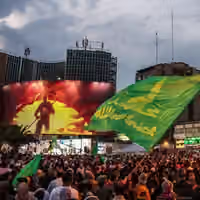
Crowds gather during protests in Mashhad, northeastern Iran, Jan. 8, 2026.
An Iranian court has handed down a death sentence to a man detained in connection with the January 2026 protests in the northeastern city of Shandiz, the US-based Human Rights Activists News Agency (HRANA) reported on Sunday.
Hossein Rasouli-Nasab was sentenced by the Mashhad Revolutionary Court on charges including “moharebeh,” or waging war against God, HRANA said.
The rights group said authorities had alleged that he committed moharebeh through participation in the destruction of public property and setting fire to religious centers. He was also accused of assembly and collusion against national security.
A source close to his family told HRANA that a mosque and a Quranic center caught fire during protests in Shandiz on January 8 and 9, and that Rasouli-Nasab’s case was opened in connection with those events.
Rasouli-Nasab was arrested during the January protests along with several other people, HRANA said. He was later transferred to Vakilabad Prison in Mashhad, where he remains held.
His case comes amid mounting concern from rights groups over the use of the death penalty against people detained in connection with the nationwide protests.
Human Rights Watch and the Abdorrahman Boroumand Center said in a joint report published on September 10 that Iranian authorities announced the executions of 29 people arrested in connection with the December 2025-January 2026 protests between March 18 and the end of August. Several were 18 or 19 years old, and five were executed in public.
The groups said that in 16 of those cases authorities did not allege that the defendants had killed anyone. Instead, some were executed over allegations including blocking streets, damaging public property and other acts that rights groups said did not meet the threshold for capital punishment under international law.
Human Rights Watch said the proceedings were often extremely fast, in some protest-related cases taking just over five weeks from arrest to execution, and said convictions were based in some cases on torture-tainted confessions and vague national security charges.
Amnesty International has separately accused Iranian authorities of “weaponizing the death penalty to repress dissent.”
Last week, Iran International reported that 18 prisoners held at Dastgerd prison in the central Iranian city of Isfahan were facing possible death sentences over unrest and a fire at the facility.
Last month, UN human rights chief Volker Türk said executions and death sentences in Iran had risen since March, with more than 100 other people facing similar charges and the death penalty.
Members of Iran’s Islamic Revolutionary Guard Corps (IRGC) operate at computer stations in an undated image (Photo: Screengrab)
Anthropic said Iranian paramilitary and security units used Claude to surveil thousands of Iranians and identify opposition and diaspora accounts, while a separate MEK-linked operation used the AI to impersonate an activist and profile people inside Iran.
The findings are detailed in Anthropic’s September threat report, published Thursday, which examines malicious uses of Claude disrupted between December 2025 and August 2026.
Anthropic said it identified and banned 16 Claude accounts operated by two linked units associated with Iranian paramilitary and domestic security agencies. One was a seven-department organization with offices across Iranian provinces that claimed to have surveilled and profiled 6,388 Iranians in a single year and maintained an identity-record database on Iranian nationals.
The group used Claude to help build a front end for what Anthropic assessed was likely a government-controlled surveillance case-management system and to analyze 155,216 tweets. A separate Qom-based unit used Claude as an engineering tool to develop domestic surveillance capabilities, including a malicious Firefox extension called “al-Najm al-thāqib” that was deployed to harvest user identities from major social media platforms.
Anthropic said both units fed information into a centralized system called “Arman.” Files on individuals included national ID numbers, beliefs, criminal records, social media accounts and an “action” tab. The company assessed with high confidence that the units were associated with Iranian paramilitary domestic security entities and said it found evidence they responded to taskings from senior government officials.
The tools built with Claude included a messenger de-anonymizer, a system linking phone numbers to identities, a national-ID phishing page, a Telegram mass-reporting bot and a Firefox identity harvester disguised as a prayer-times utility. One unit also ran a social-network analysis pipeline that identified 39 Iranian opposition and diaspora accounts.
Anthropic said a separate actor operating alongside one of the units used Claude’s custom-skills feature to clone the voices of three Iranian writers and prepare propaganda narratives in advance for the succession to Iran’s Supreme Leader.
MEK-linked influence operation
The report also detailed a separate influence operation Anthropic linked to the exiled opposition group People’s Mojahedin Organization of Iran, or MEK, and the National Council of Resistance of Iran, which is the group’s political front.
The network impersonated a real activist by cloning his personal Telegram account and directing Claude to read about 8,400 of his posts to reproduce his writing style. The AI-assisted account was then used to hold live political conversations with his contacts, who Anthropic said appeared unaware they were communicating with an AI-assisted impersonator.
Anthropic said at least four people running the campaign worked for official NCRI media outlets. The operation scraped more than 500 social media channels to build profiles of people inside Iran, grouping them by city, age, occupation, political alignment and arrest history. It also analyzed about 51,944 archived messages to create psychographic dossiers on dozens of individuals.
The network used AI-generated avatars with Persian audio to promote NCRI President Maryam Rajavi’s ten-point plan, presenting them as ordinary Iranians without disclosing that they were synthetic. Automated Instagram networks coordinated posts for different audiences, while early content deliberately avoided mentioning the Mojahedin so the material appeared to come from independent sources.
Anthropic said the campaign also targeted monarchist groups and the Pahlavi camp, including through a fabricated video attacking a member of the Pahlavi family and “Neither Shah Nor Sheikh” messaging intended to strengthen the MEK’s position within the Iranian opposition.
The company said the operation used a shared Claude-based agent platform called “Viktor,” with common doctrine, approved sources and instructions for avoiding detection. It banned the accounts involved, but said it could not independently determine how much genuine engagement the network attracted.
Anthropic’s report also detailed other Iran-linked uses of Claude, including state-aligned propaganda campaigns, efforts to track US naval forces, surveillance tools targeting Iranians and intelligence gathering on people in Israel and the Jewish diaspora.
The company said it banned accounts tied to the operations and shared some of its findings with government and industry partners.
Images from Tehran’s Tehranpars neighborhood show special police unit vehicles and forces deployed in the courtyard of a boys’ primary school.
Tehran’s governor has called for schools used by other state bodies to be returned before students begin the new academic year, months after military and security forces deployed at schools during the US-Israeli war.
Mohammad-Sadegh Motamedian did not identify which institutions were using the schools or disclose how many educational facilities had yet to be returned to the Education Ministry.
“These educational spaces must be handed over to the Education Ministry before the start of the school year, and where there are challenges, the relevant institution should inform the province so alternative space can be provided and the issue resolved,” Motamedian said.
The Revolutionary Guards, Basij paramilitary force and police used schools to station personnel during and after the war.
Dozens of schools used during war
An Iran International investigation published in March found that security and military forces moved personnel, weapons and equipment into at least 70 civilian sites across 17 provinces during the US-Israeli strikes from March 2 to 14.
A police vehicle is seen parked in the courtyard of a school in Iran during the US-Israeli war in March 2026.
Nearly half of the locations – 34 – were primary or secondary schools. Other sites included hospitals, stadiums, universities, mosques, parks and government offices.
Footage from several cities showed security vehicles, personnel or military equipment on school grounds.
‘Schools offered greater security’
Journalist Ali Hossein Ghazizadeh said schools offered forces large courtyards, numerous rooms and locations among residential buildings at a time when military bases were being targeted.
“Being in schools provides greater security for them,” Ghazizadeh told.
Schools were particularly useful for relocating personnel after bases and other facilities were struck, and their location among civilian buildings provided additional protection, Ghazizadeh said.
The use of educational facilities did not necessarily end with the fighting, Ghazizadeh said, adding that Iran International had received information indicating that some institutions sought to retain schools for longer-term use.
Civilian protection concerns
Schools are generally protected as civilian objects under international humanitarian law but can lose that protection if their use makes them military objectives. Attacking forces remain bound by rules including distinction, proportionality and precautions to limit civilian harm.
Iranian officials have denied using civilians as shields and accused Israel of targeting civilian infrastructure during the conflict.
The Israeli military confirmed to Iran International in March that it had identified Iranian forces deploying personnel and weapons at civilian sites, including schools, mosques and stadiums.
A building burns during protests in Iran in January 2026, as people gather nearby.
An Iranian protester shot in the leg during January’s demonstrations remains unable to walk after 23 operations, with further treatment ahead, medical bills mounting and concerns for his safety persisting months after the shooting.
“Despite all these surgeries, I am still confined to my home,” the protester, whose identity and place of residence are being withheld for security reasons, told Iran International. “I am married, and during this time we have faced many problems paying for my treatment.”
His family eventually sold their car to help cover his medical bills, the protester said. Doctors have told him that regaining the ability to walk could take at least another year.
The account reflects the prolonged physical and financial consequences facing some people wounded during the protests, with Iran International receiving multiple accounts of injured demonstrators struggling to obtain treatment and pay medical expenses months later.
23 operations and more treatment ahead
The gunshot caused extensive damage to the protester’s leg, requiring doctors to perform muscle and skin grafts during a series of operations.
An injured Iranian protester’s leg during treatment following a gunshot wound. The protester told Iran International he has undergone 23 surgeries and remains unable to walk.
“About a month has passed since the skin graft, and the Ilizarov device that was fitted to my leg at the beginning of treatment is due to be put back on for about three months,” the protester said.
An Ilizarov apparatus is an external bone-fixation system using metal rings, rods and wires to gradually reposition sections of bone. It can be used to treat severe damage or the loss of part of a bone.
Doctors also attached a vacuum-assisted device to the wound for several months to promote new tissue growth, the protester said.
Infection, nerve damage and numbness later forced doctors to remove some of the repaired tissue and perform a muscle graft about six months after the shooting, according to the protester.
“I asked people who were able to help, but in the end, with great difficulty and even by selling our car, we tried to cover the costs,” he said.
Security fears complicate hospital treatment
Fear of arrest or identification at hospitals has complicated treatment for some protesters wounded during demonstrations, prompting some to seek medical care covertly or at home.
“After one of the surgeries, because there were many security officers in the emergency department, the doctor helped me leave the hospital,” the protester said.
Hospital staff recorded the cause of his injuries as a traffic accident, and his doctor later helped take him to Tehran to continue undergoing surgery, the protester said.
“I really do not know how to thank the medical staff,” he added. “They cooperated extensively and tried to make sure nothing else happened to me.”
Protester recounts January 8 shooting
Security forces initially fired pellets toward demonstrators before a live round struck his leg at close range on the evening of January 8, the protester said.
“My whole body is covered with pellet marks. The bullet hit my leg from close range,” he said. “When I was shot, they dragged me along the ground while I was in a very bad condition. I will never forget that night.”
Security personnel insulted him and tried to remove his clothing after he was wounded, according to his account.
“I held tightly onto my trousers, and they struck my hands with their boots,” he said. “My entire body was bruised, and I even thought my ribs were broken.”
The officers then put him on a motorcycle, the protester said.
“One of them said, ‘Don’t hit him here, take him farther up,’” he said. “I thought they meant they were going to finish me off. I passed out from fear.”
The injured Iranian protester undergoes treatment with an external fixation device after suffering a gunshot wound to the leg during demonstrations on January 8.
The protester said he regained consciousness alone in a dark alley, where an elderly couple found him and helped him reach a hospital.
“At first, I thought I was dead,” he said. “Then an elderly woman and man found me. They were like angels to me and helped me get to the hospital.”
The protester said he had joined the demonstrations knowing that doing so could put his life at risk.
People look at the new Apple devices on display during Apple's event at the Steve Jobs Theater in Cupertino, California on September 9, 2026.
Maryam Azimi, who has written of being driven blindfolded to court in Mashhad in an intelligence vehicle, thinking those were the last minutes of her life, introduced the new iPhone's camera technology at Apple's global launch on Tuesday.
Azimi, identified in Apple's prerecorded presentation as an image-quality engineer, presented a feature called Apple Reference Image during the segment on the iPhone 18 Pro's camera, which the company described as its most advanced to date.
Her appearance drew notice among Iranians for two reasons: her role in developing imaging technology at one of the world's largest companies, and her public opposition to the Islamic Republic, including her account of her own detention.
In a post on January 9, as protests spread across Iran, Azimi shared footage from the Vakilabad area of Mashhad and described being driven along the same street years earlier, blindfolded, in the back of an intelligence vehicle on her way to court.
"At the time, I did not know where we were going and thought these were the final minutes of my life," she wrote.
As the vehicle approached Park Square, she said, an interrogator told her to remove the blindfold, hold her head up and behave naturally. It was the hour she should have been in class at a nearby university. Looking out of the window, she recognized a close friend driving past.
"It felt like a dream," she wrote. "She was going toward her home, the safest place in the world, and I was a prisoner of the demon, with death before my eyes every second."
In the same post she praised those confronting the authorities as people seeking to "take back their rights from the bloodthirsty Islamic government," wrote that "now Vakilabad, Mashhad, Khorasan and all of Iran smell of freedom," and closed with the words Woman, Life, Freedom, the slogan of the uprising that followed Mahsa Amini's death in morality police custody in September 2022.
In a separate post in English after the January killings, addressed to non-Iranian friends and colleagues, Azimi described "the grief, the anger, the helplessness, the not-knowing," listed five Iranian human rights organisations and asked readers to donate.
Azimi's University of British Columbia profile records a bachelor's degree in computer engineering from Ferdowsi University of Mashhad in 2009 and a master's in electrical and computer engineering from UBC in 2014.
The feature she presented on Tuesday captures digitally signed data from the camera sensor and produces an unalterable reference image against which a finished photograph can be checked, in the manner of a digital negative.
Apple said it was intended for photojournalists, photographers and anyone seeking to distinguish an authentic image from one edited or generated by artificial intelligence.