Iran students go without as elite schools charge billions
Some Iranian schools are charging billions of rials for pools, therapy and small classes as students elsewhere reuse old bags and go without uniforms, shoes and stationery because their families cannot afford them ahead of the new school year.
Annual tuition at some private and international schools in the affluent districts starts at around 4 billion rials ($1,710) and can reach 10 billion rials ($4,275), Tabnak reported.
Iran’s monthly base wage for workers is 166.25 million rials ($71) this year, meaning the highest annual tuition is equivalent to about five years of base wages.
The schools advertise landscaped grounds, educational play areas, smart classrooms, therapy sessions, dedicated servers, swimming pools, music, sports and instruction in several foreign languages, according to the report.
Some decline to disclose their fees over the telephone, telling prospective parents they must visit in person.
Students work at computers in a classroom in Iran. Annual tuition at some private and international schools can reach 10 billion rials, equivalent to about five years of Iran’s monthly base wage.
Some Iranian schools are charging billions of rials for pools, therapy and small classes as students elsewhere reuse old bags and go without uniforms, shoes and stationery because their families cannot afford them ahead of the new school year.
Annual tuition at some private and international schools in the affluent districts starts at around 4 billion rials ($1,710) and can reach 10 billion rials ($4,275), Tabnak reported.
Iran’s monthly base wage for workers is 166.25 million rials ($71) this year, meaning the highest annual tuition is equivalent to about five years of base wages.
The schools advertise landscaped grounds, educational play areas, smart classrooms, therapy sessions, dedicated servers, swimming pools, music, sports and instruction in several foreign languages, according to the report.
Some decline to disclose their fees over the telephone, telling prospective parents they must visit in person.
One parent wrote online that his daughter's 10th-grade school charged 5.6 billion rials ($2,395) in tuition and another 1.35 billion rials ($577) for transportation, bringing the annual bill to nearly 7 billion rials ($2,990) before additional expenses.
The parent said the tuition had increased by 2 billion rials ($855) in a year, while transportation costs had risen 40%.
Some schools also seek foreign passports or citizenship as a condition of admission, Tabnak reported. At one primary school examined by the outlet, a second-grade class had just four pupils, with girls and boys studying together and separated only for swimming lessons, according to the school manager. Schools in Iran generally educate girls and boys separately.
Three notebooks for the school year
Messages sent to Iran International by students and parents show a markedly different experience as families prepare for the new academic year.
An 11th-grade student said the family had not bought a new uniform, school bag, shoes or most stationery.
“I didn’t buy a new uniform that fits me, a new bag, shoes or even stationery,” the student told Iran International. “I only bought three notebooks, and even those came to nearly 4 million rials. That’s it. With things the way they are, I’m too embarrassed to ask my parents for more.”
A father and daughter shop for school supplies at a stationery market in Iran.
A father in Saqqez, Kordestan province, said his daughter would return to school with a backpack she had already used for three years.
“I couldn’t buy my daughter a school uniform this year,” the father told Iran International. “Her backpack is from three years ago. This year she bought two pens, correction fluid and one notebook.”
A 12-year-old girl in Ahvaz said her family could not afford the stationery she needed.
“I am a 12-year-old girl and we don’t have money for stationery,” she told Iran International. “Today, I went shopping and an ordinary pack of 12 colored pencils was 3.5 million rials.”
Getting into school brings another bill
The financial burden extends beyond stationery and clothing, according to other messages sent to Iran International.
One parent said his daughter had gained admission to a selective school, but registration cost more than 210 million rials, with another 300 million rials requested as an initial payment for transportation.
“Now I don’t know whether I should thank my child for studying and getting accepted or be upset because of costs I can’t afford,” the parent told Iran International.
A 12th-grade student said supplementary study books cost close to 20 million rials apiece.
“If I calculate all of them together, it comes to around 80 million to 100 million rials, and I really feel too embarrassed to ask my father for anything else,” the student told Iran International.
Another parent said the price of entrance-exam preparation books increased substantially between ordering and collection.
The family was initially asked to pay 90 million rials, but a month later the seller requested another 40 million rials because the books had become more expensive, taking the total to 130 million rials.
“Prices in Iran now go up by the second, and we are being crushed under high prices and inflation,” another citizen told Iran International.
Basic school costs multiply
The messages correspond with broader reports showing sharp increases in the cost of preparing a child for school.
A student points to writing in a notebook at a school in Iran.
A basic basket of supplies for a primary-school student has reached 150 million rials in some estimates, compared with around 38.5 million rials last year, local media reported earlier this month.
Twelve notebooks that cost around 3.5 million rials last year now cost approximately 15 million rials, according to the report.
One stationery shopkeeper told Shargh daily that customers were increasingly choosing cheaper products over quality.
“People aren't paying much attention to quality this year,” the shopkeeper said.
A mounted machine gun deployed in Khorramabad, western Iran, on Monday, September 7, ahead of a fuel price increase.
Iranian security forces deployed around fuel stations and on streets across the country as a gasoline price increase took effect, with people warning of further pressure on household budgets and rising prices for other goods and services.
Messages, videos and accounts sent to Iran International described deployments of police, special units and Basij forces in Tehran, Mashhad, Shiraz, Karaj, Isfahan, Tabriz, Birjand, Khorramabad, Khomein, Abadan and Qeshm.
Reports of slower internet connections also emerged from several cities, including Tabriz and Babol.
Petrol prices doubled on Monday for drivers buying fuel outside their monthly subsidised quota, rising from 50,000 to 100,000 rials a litre, about 2.3 to 4.5 US cents. The government announced the increase two days earlier.
Monthly subsidized allocations remain unchanged. Motorists can buy 60 liters at 15,000 rials per liter, about 0.7 cents, and another 50 liters at 30,000 rials, about 1.3 cents.
The dollar figures are negligible. The wages are the point. Average monthly pay in Iran is around 250 million rials, about $113 at Tuesday's rate, and many workers earn closer to 200 million, or roughly $90 a month.
Security forces gather around fuel stations
Several residents of Mashhad told Iran International that security forces appeared around petrol stations on Sunday, hours before the new price took effect.
“On Monday evening, I passed three gas stations. Several police vehicles were stationed outside each one, and at one station there were large numbers of Basij motorcyclists and special unit forces,” one resident said.
Another Mashhad resident described police and special units positioned at fuel stations across the city.
Video sent to Iran International from Khorramabad in western Lorestan province showed security personnel, vehicles and motorcycles deployed around the city, including what appeared to be a mounted machine gun.
Fuel supplies had already faced disruptions over the previous three weeks in areas including Razavi Khorasan, South Khorasan, Tehran and Alborz provinces.
Citizens in early September reported station closures, long lines, restrictions on purchases and waits of about two hours to obtain 10 liters of gasoline.
A Birjand resident said some filling stations had closed and displayed notices blaming “technical problems,” while police were positioned at others.
Similar deployments were described in Shiraz, where a local reported a large security presence around Maali-Abad early Tuesday, and in Karaj, particularly Fardis, Gohardasht and Mehrshahr.
A resident of Khomein in Markazi province also described a long line and numerous police officers at a fuel station on Shohadaye Daneshjoo Street.
Special units deploy in Tehran
Several Tehran residents reported increased security deployments from Monday evening, including in Shahr-e Rey and Salsabil neighborhoods.
“The station was heavily secured. Special units and the Basij were constantly moving around, and the streets were crowded,” a resident who visited a fuel station near Ferdowsi Square in central Tehran around midnight said.
Another who went to a station on Pirouzi Street in the east described long vehicle lines with special units positioned nearby.
People in Isfahan and Abadan also reported armed police at filling stations. In Qeshm, a resident said armed personnel were deployed around major squares on Monday evening and that a confrontation occurred at the entrance to a filling station in Dargahan.
Two messages from Tabriz described a large security presence alongside deteriorating internet service.
“The city of Tabriz is full of special units. The forces are armed, and heavy equipment can also be seen,” one said.
A Babol citizen also reported slower mobile and fixed internet connections, though the reason for the disruption could not be established.
Gasoline prices carry particular political sensitivity in Iran. A sudden increase and rationing in November 2019 triggered demonstrations across dozens of cities that quickly expanded into nationwide anti-government protests.
Security forces killed around 1,500 people during the crackdown, according to a Reuters tally at the time. Thousands were arrested and authorities imposed a nationwide internet shutdown.
Government defends higher gasoline price
First Vice President Mohammad Reza Aref defended the new rate, arguing that even 100,000 rials per liter remains far below the government's cost of importing gasoline.
Imported gasoline costs the government more than 700,000 rials per liter, equivalent to about 30 cents, Aref said. Imported fuel would gradually be sold at prices closer to its cost, he added.
The government's figures for what petrol costs to produce have not held up well to examination. In November 2025, after officials put the cost at 340,000 rials a litre, about 15 cents at current rates, Iran International went through the refineries' own financial statements. They showed operating costs, excluding the value of the crude going in, of around 35,000 rials a litre, roughly 1.6 cents, a tenth of the official figure.
A general view of a gas station in Iran
Economist Mousa Ghaninejad has estimated actual gasoline consumption inside Iran at about 70 million liters a day and argued that much of the remainder recorded as consumption is smuggled out of the country.
Iranians warn of knock-on price increases
Thousands of people responding to an Iran International question about the fuel increase focused on its potential impact beyond filling stations, warning that transportation costs could push up food prices, fares and other everyday expenses.
“100,000 rials for a liter of gasoline may just be a number for some people, but for people it means another step toward making life harder,” one respondent wrote.
Another said petrol was not the problem on its own, and pointed to food. A five-liter container of cooking oil that used to cost 22 million rials, about $9.90, now sells for 40 million, roughly $18.
On a monthly wage of 200 million rials, that is a fifth of a month's pay for one container of oil.
“We buy everything at expensive dollar-linked prices, but our base salary is only $100. Where in the world can you see something like this?” one person wrote.
Another said wages would have to rise alongside prices, since households could not absorb repeated increases on incomes that had barely moved.
For younger respondents the loss was smaller and more particular. "The feeling of going on a trip is gone. Going out for a 10-minute drive is gone. We young people said goodbye to small pleasures a long time ago," one wrote.
A scene of protests in Arak, Markazi province, on January 8, 2026
Donald Trump’s question about when Iranians would rise against the Islamic Republic drew thousands of responses arguing that fear of renewed repression, doubts over US policy and insufficient outside support are holding back another uprising.
“This time you fight. Help from the people is on its way,” one Iran International audience told the US president, turning back on Trump a phrase he used during earlier anti-government protests.
Trump asked the question on Truth Social on Tuesday night while rejecting an ABC News report that he was seeking to bring Iran into negotiations.
“I’m not trying to force Iran to the bargaining table... I couldn’t care less if they sign a worthless, to them, agreement,” Trump wrote.
“I like our position now much better, with almost total control of the Hormuz Strait, and their economy totally collapsing. They are just playing out the inevitable. When are the Iranian people going to rise up and fight?” Trump added.
Thousands of responses sent to Iran International pointed to a common argument: Iranians have repeatedly confronted the Islamic Republic, but many are reluctant to return to the streets without greater confidence that its forces can no longer suppress them and that outside powers will not change course.
‘People have been fighting for 47 years’
Several respondents pointed to successive waves of anti-government protests in Iran and the heavy costs borne by demonstrators.
“The people of Iran fought and rose up a thousand times beyond their capacity. Now it is time for other countries to help them,” one wrote.
“The people of Iran have been fighting for 47 years,” another told Trump.
Others pointed to protesters who took to the streets on January 8 and 9, asking when people who confronted government forces without weapons would receive meaningful assistance.
Some respondents said further negotiations between Washington and the Islamic Republic would undermine Iranians seeking political change.
“This government does not represent the people. Negotiating with the killers of the people is a mistake. Help so that the people themselves can finish the job,” one respondent wrote.
Fear of another crackdown
The prospect of another crackdown featured prominently in the messages, with people arguing that the capacity of security forces would have to be weakened before another uprising could succeed.
One described reducing the strength of forces used against demonstrators as the most important condition for renewed street protests.
“No matter how brave you are, if you know you will be killed by snipers, it is foolish to fight empty-handed,” another respondent wrote, referring to Trump’s previous calls for Iranians to protest.
On March 15, Trump said: “The protesters have no guns. And I know you’re a brave person, but I don’t think you’d be protesting. And so I think it’s very hard for them to protest. I fully understand it.”
Another person said ordinary people could not be treated as “cannon fodder,” adding that an uprising without a plan would be a mistake.
Several respondents said people would return to the streets when they believed the authorities’ ability to suppress demonstrations had been sufficiently weakened. Others pointed to disabling checkpoints and disrupting security structures as steps that could change the balance.
A scene of protests in Tehran on January 8, 2026
“Mr. Trump, continue the naval blockade and add a land blockade. Give [Benjamin] Netanyahu a free hand to destroy the system of repression, and then the people of Iran are ready to overthrow the Islamic Republic,” another one wrote.
Some also called for increased pressure on the Islamic Republic and clearer international backing for exiled Prince Reza Pahlavi during a potential transition.
Trump’s ‘help is on its way’ message returns
A separate strand of responses focused on mistrust of Washington and concern that Trump could encourage another uprising only to resume negotiations with the Islamic Republic.
“We are afraid that we will come out and you will negotiate with the mullahs’ regime again,” read a message.
“The people of Iran will rise when you do not negotiate with this murderous regime,” another wrote.
Trump had urged Iranians to continue protesting during demonstrations in January and told them that “help is on its way,” a message several respondents invoked in answering his latest question.
“When you said help was on its way, people came into the streets, but you sat down and made a deal with the government.”
The respondent added that if Iranians returned to the streets, they would do so “to fight and regain their own freedom,” rather than to advance US strategy.
A woman fills her car with gasoline at a fuel station in Iran.
Iranians pushed back against a senior government official questioning cheap gasoline, contrasting fuel subsidies with low wages and soaring living costs as the US dollar traded around a historic 2.1 million rials on Monday.
“Give us a $3,000 salary and sell gasoline for 750,000 rials ($0.36) a liter. No problem,” one person wrote in response to Mohammad Jafar Ghaempanah, President Masoud Pezeshkian’s executive vice president.
Ghaempanah questioned the sustainability of selling gasoline for 15,000 rials per liter, less than one US cent at the current exchange rate, when he put its value at 700,000 rials ($0.33).
“You cannot buy gasoline that costs 700,000 rials per liter for 15,000 rials. No sound mind accepts this,” Ghaempanah said.
His comments drew responses comparing gasoline prices with wages, food, cars and the exchange rate, with several people questioning why international pricing should apply to household costs but not incomes.
An average monthly income of around 200 million to 250 million rials amounts to just $95 to $119 at an exchange rate of 2.1 million rials to the dollar, sharpening the contrast between earnings and prices increasingly measured against international market rates. At that income level, gasoline priced at Ghaempanah’s 700,000-rial ($0.33) valuation would make a 50-liter tank cost 35 million rials ($16.67), equivalent to about 14% to 18% of a month’s income.
‘Income in rials, expenses in dollars’
A worker writing from Tabriz turned Ghaempanah’s argument back on the government, questioning why wages remained so low if selling gasoline below its assessed value was unsustainable.
A man counts US dollar banknotes outside a currency exchange in Tehran, Iran.
“We workers also ask why a worker whose wage should actually be $4,000 is paid $100,” the person wrote.
Another response focused on the exchange rate, questioning why Iranians must pay more than 2.1 million rials for one US dollar while the government objects to selling domestically produced gasoline for 15,000 rials per liter.
“You can’t have income in rials and expenses in dollars,” another person wrote.
Others compared wages with what they described as the poverty line.
“You can’t have a salary of 200 million rials ($95) when the poverty line is 1.5 billion rials ($714),” one person wrote.
Cars and food enter the comparison
Cars were another recurring point of comparison, with people questioning the gap between domestic vehicle prices and those in international markets.
“But we can buy a car worth five billion rials ($2,381) for 50 billion rials ($23,810)?” one person wrote.
Another called for cars to be offered at international market prices if officials want to apply similar logic to energy, saying consumers should not have to depend on Iranian and Chinese manufacturers.
Food prices also featured prominently in the reactions.
“It’s possible to make 400,000-rial rice cost six million rials, three-million-rial meat cost 30 million rials, and a two-billion-rial salary become 200 million rials. But gasoline has to become more expensive,” one person wrote.
Ghaempanah said food prices had risen 123%. The latest figures cited from the Statistical Center of Iran also put point-to-point food inflation above 128%, almost twice the roughly 67% rate for non-food goods.
Other messages described households cutting back on basic purchases as prices rise.
One person said their 75-year-old father, a pensioner receiving 160 million rials ($76) a month and paying rent, could no longer afford meat or chicken and had long since stopped buying fruit.
Another said they wanted to buy apples for their son but could not afford the price of 1.5 million rials ($0.71) per kilogram.
Government says budget deficit drives money printing
Ghaempanah also said the government’s budget imbalance forces it to create money to cover shortfalls, contributing to inflation.
“Because our budget is unbalanced, we are forced to print money. When money is printed, it itself creates inflation,” Ghaempanah said.
A woman walks past a currency exchange displaying foreign exchange rates in Tehran, Iran.
The executive vice president attributed 67% of inflation to the banking sector, arguing that lenders issue loans that are not repaid and accept collateral without sufficient underlying value.
Banks then seek money from the Central Bank to cover their deficits, prompting further money creation, according to Ghaempanah.
He also described Iran’s economic conditions as poor and said ordinary people were bearing the greatest pressure.
“The bitter reality is that the country’s economic conditions are not good and the greatest pressure is being placed on the people,” Ghaempanah said.
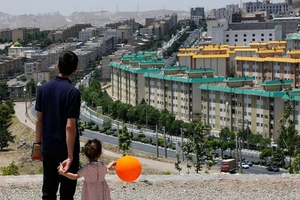
Two men look out over residential buildings in Tehran, Iran.
Forty-four percent of respondents to an Iran International Instagram poll said they would not buy a home in Iran even if they could afford one, with comments citing economic insecurity, emigration plans and concerns about keeping their wealth in the country.
Around 20,400 people participated in the online poll, with 44% saying they would not invest in property in Iran even if they could afford to do so. Only around half said they would buy a home.
Of those who participated, 67% were men and 33% women.
People aged 25 to 34 made up the largest group of respondents at 36.6%, followed by those aged 35 to 44 at 30.1%. People aged 45 to 54 accounted for 12.8%, while those aged 18 to 24 made up 11.4%.
Participants also left around 2,000 comments explaining their choices, offering a broader picture of the considerations shaping their decisions.
The responses centered on attachment to Iran, hopes for political change, plans to emigrate, economic hardship and concerns over the security of their savings.
‘If I had enough money, I wouldn't be in Iran’
For many of those opposed to buying a home, having enough money would provide an opportunity to leave Iran rather than invest more heavily in the country.
“If I had enough money, I wouldn't be in Iran at all,” one respondent wrote.
“Having enough money in this situation means having the best life abroad,” another wrote.
The responses mirror the findings of an earlier Iran International Instagram poll in which 83% of participants said they would leave Iran if given the opportunity.
Around 100,000 people participated in that poll over 24 hours. Thousands of comments cited economic problems, social restrictions, political conditions and uncertainty over the future among the reasons for wanting to emigrate.
Some participants in the latest poll associated remaining in Iran with insecurity, sanctions, inflation, power outages and difficulties meeting basic needs, saying they would rather put their money into a more stable country.
One described owning a home as inseparable from the wider conditions in which a person lives.
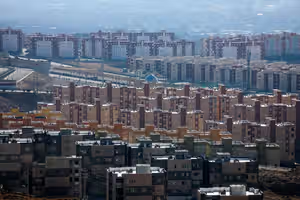
Residential and high-rise buildings across the Tehran skyline, Iran.
“A home needs a blue sky above it, a thriving tree with bright green leaves in its yard, air without lead coming through its windows, a meal in its kitchen that doesn't come with guilt or selling your dignity, and peace of mind because you feel safe,” the respondent wrote.
“Home is where I can look at the stars at night without waking up the next morning choked with sadness and humiliation.”
Gold and currency offer a way out
Others focused on the financial risks of property ownership.
Unlike in previous years, when buying a home was widely viewed as a relatively secure investment for the future, some said they would now prefer to keep their wealth in gold or foreign currency because those assets are more liquid and easier to take out of the country.
“Investing in a bankrupt economy is certainly a mistake because prices are unrealistic, artificial and like a hollow bubble,” one respondent wrote.
Housing has for years served as a means of preserving wealth in Iran's chronically inflationary economy, and property can provide protection against inflation over the longer term.
But international reporting has also documented a move toward assets that can be carried and quickly converted into cash during periods of uncertainty.
The Associated Press described the trend as a turn toward “portable wealth” during the 12-day war, while the World Gold Council recorded a sharp increase in investment demand for gold in Iran in 2025.
The poll comes as Iranians continue to contend with high inflation. Iran's Statistical Center put year-on-year inflation in July at nearly 88%.
‘I wouldn't trade Iran for anywhere’
For respondents who said they would buy a home, attachment to Iran and a sense of national identity emerged as leading reasons.
Some described owning a home as more than a financial investment, linking it to family, personal history and their connection to the country.
“Yes, I wouldn't trade Iran for anywhere in the world,” one wrote.
“Iran is our mother; you don't abandon your mother when times are difficult,” another wrote.
Others said the country's problems would not persuade them to build a life elsewhere.
“Iran is my first and last choice. I believe good days are ahead of us,” one participant wrote.
Some would buy only after political change
A number of respondents made their willingness to buy a home conditional on political change, greater freedoms or improvements in the country's circumstances.
“When Iran is free, 100%,” one wrote. “After Iran is free, yes, but not under these conditions,” another wrote.
Others questioned the premise of the poll itself, saying the prospect of having enough money to purchase a home was increasingly detached from the economic reality facing many people.
They pointed to difficulties paying for food, rent, medical treatment and other daily necessities, describing home ownership as an unattainable aspiration.
“We are renters, and we'll take the dream of buying a home to the grave,” one respondent wrote.
The findings follow another Iran International Instagram poll in which 90% of respondents said they did not want to marry or have children.