Iran-backed Hezbollah launches drones at Israeli troops in Lebanon
Hezbollah launched two explosive-laden drones overnight toward Israeli troops operating near the Ali al-Taher ridge in southern Lebanon, the Israeli military said on Thursday.
Israeli forces shot down one of the drones, while contact was lost with the second, the military said, adding that no Israeli troops were injured.
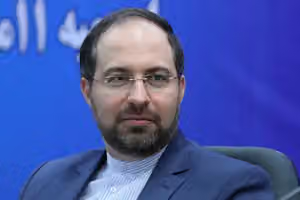
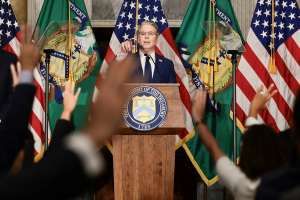
Abolfazl Shekarchi, spokesman for Iran’s armed forces, speaks at an event in Tehran.
The Iranian general who has threatened Persian-language journalists abroad as potential military targets has a history of incendiary attacks on critics and was among officials who initially dismissed reports that Iran had shot down Flight PS752.
Abolfazl Shekarchi, a brigadier general and senior spokesman for Iran’s armed forces, said on Wednesday journalists working for Persian-language media abroad could be placed on a list of military targets.
“Media outlets such as Iran International, BBC Persian and Radio Farda are directly connected to Mossad, the US Central Intelligence Agency and other foreign intelligence services and receive support from them,” he said.
He called the employees of the Persian-language outlets “soldiers of Israel and the United States,” adding: “They can be included in the bank of military targets because, from our perspective, these are not media outlets.”
He provided no evidence for the accusations.
The remarks extend years of military and ideological rhetoric from Shekarchi against people and organizations Iranian authorities consider hostile, from protesters and opponents of compulsory hijab to foreign officials and media organizations.
PS752 reports called ‘absolute lies’
Iran's Revolutionary Guards shot down Ukraine International Airlines Flight PS752 shortly after takeoff on January 8, 2020, killing all 176 people aboard.
Reports that an Iranian surface-to-air missile had brought down the Boeing 737 were “absolute lies” and “ridiculous,” Shekarchi said as evidence pointing to a missile strike emerged.
Abolfazl Shekarchi, spokesman for Iran’s armed forces, speaks on a program about the 12-day war, with centrifuge replicas forming the backdrop, September 24, 2026.
Shekarchi portrayed the reports as psychological warfare against Iran, while Iranian authorities initially attributed the crash to a technical problem.
Iran's armed forces acknowledged three days after the disaster that its air defenses had shot down the passenger plane, saying it had been mistakenly identified as a hostile target during a period of heightened confrontation with the United States.
The admission triggered protests in Iran and abroad and accusations that authorities had sought to conceal responsibility for the disaster.
Shekarchi's categorical denial became one of the most prominent official responses to early reporting on PS752 before the armed forces acknowledged that an Iranian missile had brought down the aircraft.
His latest accusations against foreign-based Persian-language media employ a similar framework, casting journalism and information as components of an enemy operation.
Protesters and hijab opponents
Shekarchi has also directed security and military rhetoric at domestic dissent.
During nationwide protests in 2022, Shekarchi described demonstrators as deceived and accused the United States of seeking to manufacture deaths to sustain the unrest.
The protests spread across Iran following the death in morality-police custody of Mahsa Amini, a 22-year-old woman detained over compulsory hijab rules.
His rhetoric had already extended to opponents of compulsory hijab.
Participants in a campaign encouraging women to appear in public without mandatory head coverings, along with artists supporting them, were “forces of Satan,” Shekarchi said.
Thousands detained over coronavirus information
Shekarchi also played a public role in the authorities' response to information circulating during the coronavirus pandemic.
Around 3,600 people had been detained by police and the Basij over what authorities characterized as rumors or false information about the outbreak, with more than 1,100 judicial cases opened, Shekarchi said in April 2020.
The figures showed the scale of the authorities' effort to police information about the pandemic as questions mounted over infection and death figures.
Shekarchi also drew criticism after minimizing coronavirus deaths among military personnel and healthcare workers.
The deaths of four doctors, nurses and paramedics were “not a number” of significance, Shekarchi said during the early months of the pandemic.
The coronavirus outbreak became another period in which Iranian authorities treated the dissemination of information as a security matter, with people detained or prosecuted over online material about the disease.
Threats beyond Iran
Shekarchi's rhetoric has also targeted Israeli and US officials and personnel abroad.
Israel's destruction was Iran's “greatest aspiration,” Shekarchi said in 2021, presenting it as an objective from which the Islamic Republic would not retreat.
Even tourist and recreational locations around the world would not necessarily provide safety for American and Israeli officials targeted by Iran, Shekarchi warned in March.
“From now on, based on the information we have on you, tourist destinations, resorts, and recreational and leisure venues around the world will no longer be safe for you.”
Abolfazl Shekarchi, spokesman for Iran’s armed forces, visits a news agency in Tehran.
Earlier, responding to threats by US President Donald Trump against Iran's leadership, Shekarchi said an attack on Supreme Leader Ali Khamenei would prompt Iran to “set their world on fire” and leave its adversaries without a safe haven.
“Trump knows that if a hand is raised against our leader, not only will we decisively and courageously cut off that hand, but we will set their world on fire, give them no respite and leave them no safe haven.”
His latest remarks extend such language explicitly to journalists working outside Iran.
A former senior Iranian official living in Toronto played a “critical” role in generating government revenue that helped fund Iran's military, weapons production and armed groups in the Middle East, Global News reported, citing Canadian government documents.
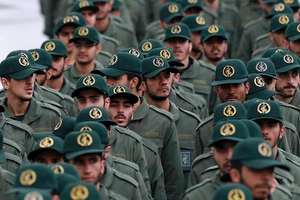
The documents, released in redacted form by Canada's Immigration and Refugee Board at the request of Global News, include a Canada Border Services Agency assessment that said Abbas Omidi's senior role in Iran's mining sector benefited the government's ability to finance the Islamic Revolutionary Guard Corps and armed groups abroad.
“As a result of his power and influence, the subject directly benefited the Iranian economy and the government’s ability to continue to fund terrorism and human rights abuses throughout the world,” the CBSA said.
The agency said Omidi was “critical in the Iranian government’s continued ability to draw in mining revenue and fund the military, weapons manufacturing, and terrorism, both foreign and domestic.”
The assessment was written in 2024 and formed part of hundreds of pages disclosed in Omidi's deportation case, Global News reported.
Omidi's lawyer did not respond to requests for comment from Global News. At his deportation hearing, Omidi acknowledged serving as a deputy director general in Iran's Ministry of Industry, Mines and Trade but said his role was mainly technical.
CBSA links mining revenue to IRGC funding
The CBSA said Iran's mining sector was closely tied to the military and the IRGC and provided revenue that helped Tehran support armed groups in the region.
“The abundant amount of wealth generated from the mining industry allows the Iranian regime and specifically, the IRGC, to continue to be a state sponsor of terrorism,” the CBSA report said.
The agency said the IRGC provided financing, training, weapons, technology and other support to groups including Lebanon's Hezbollah, Hamas, Palestinian Islamic Jihad, the Popular Front for the Liberation of Palestine and Iraqi group Kata'ib Hezbollah.
Canada lists the IRGC as a terrorist entity.
The CBSA said Omidi “directly and significantly impacted and benefited the Iranian economy and the government’s ability to continue to fund its military, weapons production, and terrorism and human rights abuses throughout the world.”
Global News said the allegations about Omidi's role in revenue used to support armed groups were contained in the CBSA assessment but were not raised during his deportation hearing.
Deportation case centers on senior government role
The CBSA is seeking to deport Omidi on the grounds that he was a senior official in Iran's government, Global News reported.
Canada moved in 2022 to bar senior Iranian government officials from entering or remaining in the country after Tehran's crackdown on anti-government protests.
Omidi arrived in Canada as a visitor in 2022 after serving in Iran's mining and trade ministry. The CBSA said he had “exerted significant influence on the exercise of government power,” according to Global News.
His deportation hearing began in March. The Immigration and Refugee Board said on Wednesday that the hearing had concluded and that a decision was expected in the fall.
Omidi had sought to keep the proceedings closed to the press, but the board rejected the request after Global News challenged the move.
Commercial vessels are seen near a port along the Strait of Hormuz amid heightened tensions over shipping through the waterway.
Iranian officials acknowledged mounting economic strain on Wednesday, and in the same breath restated their conditions for reopening the Strait of Hormuz, as Donald Trump said he was in no hurry to resume talks.
The US president told Al Jazeera he had set no deadline for ending a conflict now in its seventh month.
"I have no time schedule, none," he said, calling economic warfare and military strikes against Iran "both effective."
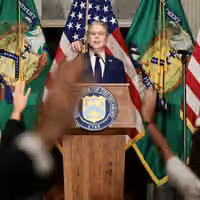
His remarks followed Monday's launch of Operation Economic Outcast, a Treasury campaign that named nearly 60 Iran-linked individuals, entities and vessels and widened the threat of secondary sanctions against anyone still doing business with Tehran.
Iran points to economic toll
Iranian officials are now describing the pressure in language they avoided for months.
President Masoud Pezeshkian said Iran was facing "the worst conditions of an economic war." Executive Vice President Mohammad Jafar Ghaempanah said domestic gasoline production was insufficient and the US naval blockade was preventing imports.
“Continuing on this path is impossible,” Ghaempanah said.
Tehran is fighting the campaign diplomatically as well. Foreign Minister Abbas Araghchi called on the United Nations to condemn Operation Economic Outcast as "economic terrorism," saying its purpose was to sever Iran's lawful economic ties through secondary sanctions and exclusion from the US financial system.
The confrontation has also pulled in Beijing. China said on Tuesday that its economic cooperation with Iran was conducted within international law and should not be disrupted, rejecting what it called illegal unilateral sanctions.
Parliament Speaker Mohammad-Bagher Ghalibaf welcomed that position, saying Iran-China ties "need no one's permission."
Hormuz remains the leverage
While conceding the economic damage, it also showed no sign of softening its position on the Strait of Hormuz.
Revolutionary Guards spokesperson Hossein Mohebi said Iran and Oman had reached understandings on their respective shares of the strait's waters and revenues after about a month of talks.
That went further than the joint Iranian-Omani statement issued on Tuesday, which announced an interim framework for a temporary shipping corridor and joint mine-clearing but said nothing about revenues. A senior Iranian source told Reuters on Wednesday that no final agreement had been reached.
The effect on shipping was visible the same day. An Indian tanker attempting the southern route through the strait turned back after an Iranian warning, according to the Revolutionary Guards-affiliated Fars news agency, which said the route had carried no traffic in the previous 24 hours.
Mohebi set the price plainly. "If the United States stops obstructing and returns to the memorandum, we can reopen the Strait of Hormuz within the framework of the understanding reached," he said. Otherwise, he said, it stays closed.
Diplomacy continues in parallel
Regional governments are still working to keep a route open.
Qatar's prime minister and foreign minister, Sheikh Mohammed bin Abdulrahman Al Thani, travels to Tehran on Thursday for talks on reducing tensions and creating conditions for dialogue.
Qatar said the discussions would cover freedom of navigation in the strait and efforts to restore the conditions that prevailed before February 28, when the 40-day war began.
Washington continues to describe a negotiated outcome as preferable even while expanding the economic campaign.
US Energy Secretary Chris Wright said on Wednesday that the administration's "strong desire" was to end Iran's nuclear program through negotiations and inspections administered by the International Atomic Energy Agency.
"Our number one objective is they will not possess nuclear weapons," Wright said. "If we can do it through negotiation and inspections, that is absolutely the desired way."
He added that Washington was prepared to destroy Iran's nuclear facilities and industrial capacity by military means if necessary.
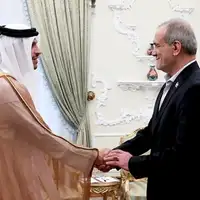
Omani Foreign Minister Badr al Busaidi visited Tehran on August 25, 2026 for talks with his counterpart Abbas Araghchi.
Regional diplomacy around Iran appears to be gathering pace, with Pakistan, Oman and potentially Qatar seeking to turn an emerging agreement over the Strait of Hormuz into a path back to negotiations between Tehran and Washington.
In Tehran, the diplomatic push is already exposing divisions over what comes next.
Pragmatists see the visits as a possible route back to the Islamabad memorandum and negotiations with Washington, while hardliners portray them as an American attempt to escape the pressure Iran has created around Hormuz.
Farda News, a website close to Parliament Speaker Mohammad-Bagher Ghalibaf, said visits by Omani Foreign Minister Badr al-Busaidi and Pakistan’s army chief Field Marshal Asim Munir shared the objective of finding a political solution to the confrontation.
But it stressed that an agreement with Oman would not itself mean reopening Hormuz.
“Tehran insists that a technical agreement with Oman does not mean returning the strait to its pre-war conditions, and that remains tied to the implementation of US commitments under the Islamabad memorandum,” it wrote.
‘American pawn’
Economic daily Donya-ye Eqtesad similarly said the phased agreement could provide a route toward reviving the Islamabad memorandum, easing pressure around the strait and eventually returning Iran and the United States to negotiations.
But hardline Kayhan called the visits a “new phase of the White House deception operation,” arguing that Washington needed Iran back at the negotiating table to escape the energy crisis and deadlock over Hormuz.
It described Munir as an “American pawn” being used to help Washington escape what it called the quagmire of the war and declared the Islamabad memorandum dead.
The competing interpretations follow an unusually concentrated burst of regional diplomacy. Al-Busaidi visited Tehran on Tuesday, a day after Munir, while Qatar’s prime minister is expected in the Iranian capital on Thursday, according to Iranian media.
Diplomatic push
Tehran and Muscat announced after al-Busaidi’s visit that they were working on a phased framework including a temporary maritime corridor through Hormuz and a joint mine-clearance project.
Technical negotiations are continuing over a permanent corridor and the future management of the strait, with the two sides stressing the importance of discussions involving other Persian Gulf states.
After leaving Tehran, al-Busaidi discussed the proposed Hormuz framework with Qatar’s Prime Minister and Foreign Minister Mohammed bin Abdulrahman Al Thani.
Qatar, another mediator between Tehran and Washington, said Tuesday that it continued to support efforts to resolve the crisis.
Former diplomat Jalal Sadatian told Fararu that Oman’s renewed activity should be understood in light of its established mediation role. He said Munir also appeared to have carried a message from Washington aimed at reducing tensions and reopening a channel for talks.
International affairs analyst Jafar Ghanadbashi went further, writing in Arman Melli that the Pakistani and Omani visits were “a very clear sign of America’s view of the current situation and its need for negotiations at this time.”
‘No rush for talks’
But Iranian officials have made clear that progress with Oman does not mean Tehran is ready to reopen the strait.
Deputy Foreign Minister Kazem Gharibabadi said Tuesday that Iran still considered itself to be at war and that the agreement with Oman did not amount to an immediate reopening of Hormuz.
He said reopening depended on an end to the war on all fronts, the lifting of the blockade against Iran and a resolution of the situation in Yemen.
Gharibabadi also challenged US claims about mine clearance in the strait, asking why vessels had not resumed passage if the mines had been removed. He warned that US mine-clearance vessels entering the area would be targeted.
Hossein Mohebi, a spokesman for the Islamic Revolutionary Guard Corps, said Wednesday that negotiations with Oman over the past month had produced mutually acceptable results concerning the two countries’ respective waters and revenues from the strait.
But he accused Washington of obstructing a final agreement and reiterated that reopening Hormuz depended on the United States returning to the Islamabad memorandum.
“If the United States does not accept our conditions, the Strait of Hormuz will not open under any circumstances,” Mohebi said.
President Donald Trump said Wednesday he was “not in a hurry” to resume negotiations with Iran and had “no time schedule” for ending the war. He said both economic warfare and military strikes against Iran were effective.
The competing signals leave regional mediators with a difficult sequencing problem: whether an agreement over Hormuz can create enough room to restart diplomacy before either Tehran or Washington decides it has more to gain by waiting.
Iranian demonstrators gather in a street during a protest in Tehran, Iran, January 8, 2026.
Two more protesters detained during Iran’s nationwide demonstrations in January have been sentenced to death, US-based rights group HRANA reported, amid a rise in executions and capital sentences following the unrest.
Hossein Nazari, 25, was sentenced to death by Branch One of the Revolutionary Court in Mashhad, northeastern Iran, HRANA reported Wednesday. He is being held in the city’s Vakilabad Prison.
HRANA said Nazari was convicted of “contact with hostile governments and groups” and “assembly and collusion to commit a crime against national security.” The sentence was issued in July.
Nazari was arrested by security forces during the January protests and transferred to Vakilabad Prison after interrogation and judicial proceedings.
His case was reported a day after HRANA said Amir Mohammad Majallal Choubari, 22, another protest detainee, had also been sentenced to death.
Majallal Choubari was arrested in Tehran on January 2 during the nationwide demonstrations and transferred to Qezel Hesar Prison in Karaj, west of the capital.
He had previously faced charges at Branch 33 of Tehran’s Public and Revolutionary Prosecutor’s Office, which handles security-related cases.
The charges included “assembly and collusion with the intention of committing a crime against national security,” disrupting public order, attempting to intentionally kill officers by trying to run them over and resisting officers.
Amir Mohammad Majallal Choubari
Continued crackdown
The sentences come amid a sharp increase in executions and the use of capital punishment against protesters and political prisoners.
The US-based Abdorrahman Boroumand Center said Wednesday it had documented 950 executions in Iran since the beginning of 2026, including at least 20 women and 30 protesters. It said 45 executions had been recorded in August so far.
The group said Iran’s use of the death penalty takes place within a judicial system marked by unfair proceedings, lack of transparency and political influence.
It said systematic violations of fair-trial guarantees meant executions could amount to arbitrary deprivation of life under international law.
Iran International reported in late July that rights groups estimated around 100 political prisoners and protesters had received death sentences, while hundreds more faced charges that could carry the death penalty.
UN Human Rights Chief Volker Türk said earlier this month that Iran was using executions to “instil fear among the population and suppress dissent,” while raising concerns about torture-tainted confessions, rushed proceedings and a persistent lack of fair-trial guarantees.