• العربية
  • فارسی
Brand
  • Iran Insight
  • Politics
  • Economy
  • Analysis
  • Special Report
  • Opinion
  • Podcast
  • Live TV
  • Iran Insight
  • Politics
  • Economy
  • Analysis
  • Special Report
  • Opinion
  • Podcast
  • Live TV
  • Theme
  • Language
    • العربية
    • فارسی
  • Iran Insight
  • Politics
  • Economy
  • Analysis
  • Special Report
  • Opinion
  • Podcast
  • Live TV
All rights reserved for Volant Media UK Limited
volant media logo
EXCLUSIVE

Iraq could face heavier costs than Iran if it defies US sanctions, lawmaker says

Aug 25, 2026, 12:38 GMT+1

A new US sanctions campaign against Iran could have a direct impact on Iraq and may carry heavier economic costs for Baghdad if it does not comply, Iraqi lawmaker Jamal Kocher told Iran International on Tuesday.

Kocher, a member of parliament's finance committee, said Iraq could face economic consequences greater than those faced by Iran if Baghdad did not abide by US sanctions.

"Iranian society has faced conditions caused by sanctions for years, while Iraqi society does not have the same readiness to withstand such pressure," Kocher said.

He said Iraq's market depended heavily on Iran and Turkey and that new sanctions could affect trade and imports of Iranian gas in particular.

Kocher said Iraq, despite close political ties with Tehran, remained dependent on a US-influenced financial system for areas including oil revenues, gold imports and banking transactions.

He said that if countries including Russia, China and Pakistan could not break the US sanctions on Iran, Iraq would have little choice but to comply or risk facing broader sanctions itself.

Most Viewed

Iran state TV airs threat against Trump’s son Barron
1

Iran state TV airs threat against Trump’s son Barron

2
PODCAST

Will Iran bend or escalate as US launches economic war?

3

Iran security chief hints at nuclear doctrine shift after US attacks

4
VOICES FROM IRAN

Nine out of ten shun marriage, parenthood in Iran International poll

5
PODCAST

He spent a decade helping vulnerable children. Iran handed him 31 years

Banner
Banner
Banner

Spotlight

  • Iran keeps finding gas. Getting it out is the problem
    ANALYSIS

    Iran keeps finding gas. Getting it out is the problem

  • Who speaks for Iran? Rezaei’s threats fuels divide over war and diplomacy
    INSIGHT

    Who speaks for Iran? Rezaei’s threats fuels divide over war and diplomacy

  • Iran shrugs off US economic war as analysts sound alarm
    INSIGHT

    Iran shrugs off US economic war as analysts sound alarm

  • Tehran mosques used to surveil, shoot at January protesters
    EXCLUSIVE

    Tehran mosques used to surveil, shoot at January protesters

  • Will Iran bend or escalate as US launches economic war?
    PODCAST

    Will Iran bend or escalate as US launches economic war?

  • Iran leader’s absence gives war camp room to shape policy
    ANALYSIS

    Iran leader’s absence gives war camp room to shape policy

•
•
•

More Stories

Tehran mosques used to surveil, shoot at January protesters

Aug 24, 2026, 23:10 GMT+1
•
Mohsen Moheimany, Azadeh Akbari
100%
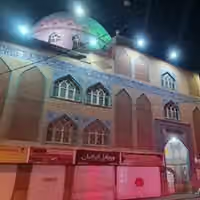
Imam Hussein Mosque, Tehran, Iran.

Iranian security forces used mosques across Tehran to deploy personnel, monitor protesters and support operations during the January crackdown, evidence obtained by Iran International shows.

Intercepted radio communications, video footage and eyewitness accounts point to security forces operating from several mosques in and around the capital on January 8 and 9, when protests drew large crowds and authorities launched a deadly crackdown.

In one intercepted exchange, security personnel discussed deploying forces and equipment inside Imam Hossein Mosque, which Iran International geolocated to the intersection of Sattari and Mokhbari in western Tehran.

Witnesses described security operations around the mosque as electricity was cut in the area and surveillance drones flew overhead.

Other locations identified through footage and witness accounts included mosques along Andarzgoo Boulevard and Qolhak Grand Mosque.

100%
Satellite image showing Imam Hossein Mosque at the intersection of Sattari Highway and Mokhbari Street in western Tehran, Iran.

Witnesses also described security personnel positioned outside some mosques engaging protesters before forces inside emerged to beat and arrest them.

Taken together, the evidence suggests some mosques served not simply as gathering points but as bases from which security forces monitored and confronted protesters.

Shooting from rooftops

Several eyewitnesses described mosque rooftops being used as observation or firing positions.

One witness described several people positioned on the roof of a mosque near Kashani Boulevard in western Tehran on January 8.

“The sound of a stun grenade could be heard,” the witness said. “Once the crowd scattered a little, they started shooting from above.”

In Naziabad in southern Tehran, another witness described protesters coming under fire from elevated positions.

“They were being shot at from the rooftops of mosques and Basij bases,” the witness said.

Witnesses in the area described security forces firing directly at crowds and from elevated positions, with a number of protesters wounded or killed.

Video footage obtained by Iran International also showed surveillance drones flying above crowds during the protests.

Other witnesses described security personnel monitoring protesters with cameras from inside mosques. Some said windows at mosque buildings had been broken to create positions from which weapons could be fired and described seeing weapons fitted with laser sights.

In several areas, witnesses also said security forces pursued protesters who sought refuge in residential buildings or private parking garages, beating some of those sheltering inside and preventing injured protesters from leaving to seek medical treatment.

Iran International was not able to independently verify each of those accounts or determine who was responsible for individual shots seen or heard in footage.

Allegations of fires

Some witnesses alleged that security personnel themselves damaged or set fire to mosques that authorities could subsequently portray as having been attacked by protesters.

One witness also said security forces left gas valves open at a mosque before departing, creating the risk of a fire or explosion.

Iran International could not independently verify those accounts or establish whether any fires at the sites were deliberately started by security forces.

The allegations are significant because Iranian authorities repeatedly portrayed damage to mosques and other religious sites during the January unrest as evidence of violence by protesters.

Civilian sites used in crackdowns

The apparent use of mosques as operational sites in Tehran follows evidence that security forces used other civilian buildings during the January crackdown.

A separate Iran International investigation in neighboring Alborz province found security forces using a public library as an ammunition store and staging point, schools and mosques as gathering places for armed personnel, and the roof of a cinema as a firing position.

There is also precedent for security forces operating from or around religious sites during earlier protests.
Human Rights Watch documented security forces firing on protesters and bystanders from rooftops around Zahedan’s Grand Mosalla prayer hall and Makki Mosque during the September 2022 crackdown known as Bloody Friday.

The United Nations separately documented the use of live ammunition, tear gas and metal pellets against protesters following Friday prayers in Zahedan, with footage analyzed by the UN appearing to show security forces firing from rooftops.

The evidence gathered in Tehran suggests some mosques became part of the security apparatus during the January crackdown: used to assemble personnel and equipment, monitor crowds and, according to multiple eyewitnesses, confront protesters.

Leaked audio: Iran's Basij brace for new protests and fear being named online

Aug 18, 2026, 11:47 GMT+1
100%
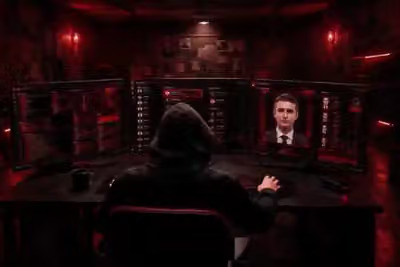
File photo of an IRGC cyber unit at a computer operations center in Iran.

Officials of Iran's Basij militia can be heard on a leaked recording weighing the risk of a new round of protests and the danger that members will be identified online, a rare glimpse of the anxiety inside the force the state sends against demonstrators.

In the audio recording of a closed meeting of the Media and Cyberspace Headquarters in Pakdasht, Tehran province, officials discuss possible new demonstrations, the online identification of Basij members and plans to track anti-government activity and individuals on social media.

The meeting was held amid recent developments including the killing of Hamidreza Rajabzadeh, a Basij member and government-aligned religious singer, as well as growing concern among officials over the role and influence of social media.

The Media and Cyberspace Headquarters is made up of cyber personnel and government supporters operating under the supervision of the Revolutionary Guards.

The concerns raised at the meeting echoed recent remarks by Ebrahim Garmabdari, commander of the Revolutionary Guards in Pakdasht, who said government opponents were using sanctions, infiltration and social media to target the Islamic Republic’s governing structure.

Earlier this week, Iran’s supreme leader appointed Hossein Taeb, a veteran intelligence official, to lead the Basij paramilitary forces, giving the former protest crackdown figure a mandate to expand the paramilitary force’s grassroots intelligence network and use of new technologies.

Concerns over pressure on Basij members

Participants of the meeting raised concerns about mounting social and psychological pressure on government-aligned forces.

Referring to Rajabzadeh’s recent killing, the meeting’s lead speaker described the incident as a warning that pro-government figures could be targeted both offline and online.

He said the pressure was intended to make Basij members, mosque clerics and local base commanders regret or feel ashamed of their affiliation, potentially pushing them to adopt opposition views to avoid social rejection.

Earlier in the meeting, a participant identified as Mr. Shahbazi said the underlying tensions had not subsided and warned that public protests against the government and confrontation with security forces could continue.

Concerns over AI and exposure of Basij members

A significant part of the discussion focused on possible breaches of security systems and the exposure of Basij personnel.

The lead speaker warned that opposition networks could use artificial intelligence to identify Basij members from group photographs and obtain personal details about them for possible retaliation.

He also voiced distrust of participants’ mobile phones, suggesting that apps such as ChatGPT could be listening to their conversation in real time.

Social media blamed for unrest and economic problems

The discussion also turned to social media, with the speaker criticizing filtering policies while also blaming the internet and platforms such as Instagram for a range of political, social and economic problems.

He said blocking Instagram, Telegram and WhatsApp had only increased public anger, but described online platforms as a major factor behind unrest, rising prices, cultural change and even the election of relatively moderate Masoud Pezeshkian.

He also said foreign intelligence services including Mossad were exploiting economic hardship to recruit young people and obtain information through online platforms by offering incentives such as free internet access, servers and VPN configurations.

A 2025 survey by the Iranian Parliament Research Center indicates that the vast majority of Iranians (81%) rely on VPNs to bypass internet censorship.

Order to monitor anti-government activity

The meeting also included what participants described as a “top secret” directive instructing cyber personnel to monitor platforms including Instagram and document protest-related and anti-government activity by residents of Pakdasht.

The meeting leader said the monitoring should apply without exception, instructing personnel to take screenshots even when close relatives posted protest-related content.

He told them to send the screenshots through the Iranian messaging app Eitaa along with identifying information including the person’s father’s name, national ID number, phone number and workplace address so action could be taken against them.

Warning of protests over fuel prices

Toward the end of the meeting, a Pakdasht IRGC cyber official warned of the possibility of widespread and violent protests in the near future, including over increases in fuel prices.

He said that in the “next unrest,” even people who did not own vehicles could take to the streets because of accumulated anger and attack targets including banks, fire trucks, ambulances and, in particular, Basij members.

Mohsen Rezaei’s son among nine identified in $11-billion Iran oil network

Aug 15, 2026, 21:27 GMT+1
•
Mojtaba Pourmohsen
100%

Relatives of some of Iran’s most powerful security figures, including Mohsen Rezaei’s son, were among nine people tied to an oil-sales network that sources say failed to return about $11 billion in proceeds, an Iran International investigation found.

The major corruption network involved in the sale of Iranian oil has been operating within the Islamic Republic’s Intelligence Ministry, according to multiple sources familiar with the matter.

The network was built around trusted intermediaries, known in Iran as “trustees,” who were given oil to sell as part of efforts to circumvent sanctions and were expected to return the proceeds to the state.

Iran International’s investigation found that the nine included the relatives of senior current and former officials, including a son of Supreme National Security Council Secretary Mohsen Rezaei and the sons-in-law of two former intelligence ministers.

On August 9, the Iranian Labour News Agency (ILNA), quoting Hossein Samsami, a member of parliament’s Economic Committee, named one of the trustees who he said had failed to return Iran’s oil revenue: Hossein Aghayari.

A day later, ILNA provided further details, saying Aghayari was born in 1982 and operated in Tehran using Iranian and Afghan passports. It said he had purchased 40 Iranian oil tankers, taken delivery of 90 million barrels of oil, sold it on the market and failed to return the proceeds.

100%

Aghayari has been based in the United Arab Emirates since before the start of the 40-day war. Two oil-industry sources told Iran International that five months ago, he stayed for several days at the Ritz hotel in London using a Dominican passport.

According to the sources, Aghayari’s name and details of his activities were deliberately provided to Iran’s domestic media as part of a security operation intended to conceal the identities of the principal figures in a much larger network of Intelligence Ministry trustees.

The sources identify the leader of the network as a senior Intelligence Ministry official known as Shayan, the ministry’s director-general for fuel and energy. He was dismissed 10 days ago and, according to three sources, is expected to be arrested.

The sources say the group, known as the Shayan Network, was responsible for about $11 billion in oil-sale proceeds not being returned to the state.

How the network operated

Since the administration of former President Ebrahim Raisi took office, Iran’s budget laws have allowed executive agencies and state, military and Social Security pension funds, in coordination with the Oil Ministry, to receive Iranian crude oil and gas condensate for sale as part of efforts to circumvent sanctions and return the proceeds to Iran.

The individuals and companies entrusted with selling the oil and transferring the revenue are commonly known in Iran’s political and economic terminology as “trustees.”

The administration of President Masoud Pezeshkian has continued to use similar mechanisms for oil sales.

According to Iran International’s sources, several large patronage networks emerged around the system, including one operating within the Intelligence Ministry through the cooperation of three figures.

One was Oil Minister Mohsen Paknejad, who previously headed the Oil Ministry’s Fuel Supply Oversight Headquarters.

The other two, according to the sources, were the principal organizers of the alleged network. One was Shayan, the Intelligence Ministry’s director-general for fuel, who had previously served as a senior ministry interrogator in major oil cases.

Sources say that Shayan used his influence over cases ranging from the missing oil rigs scandal to the Crescent case to accumulate considerable wealth.

The third figure was Meysam Darzinejad Rami, director-general of the Intelligence Ministry Pension Fund, through whom the sources say legal cover was provided for the oil sales. He previously headed security at the Execution of Imam Khomeini’s Order (EIKO), the vast economic conglomerate controlled by the office of Iran’s supreme leader.

According to Iran International’s sources, Shayan and Darzinejad built an extensive oil-sales operation around nine influential trustees, one of whom was Aghayari.

Mohsen Fallahian, son of an ex-intelligence minister

One of the best-known members of the alleged network is Mohsen Fallahian, the son of Ali Fallahian, who served as intelligence minister under President Akbar Hashemi Rafsanjani.

100%

Ali Fallahian has been widely accused of being one of the architects of the Islamic Republic’s campaign of assassinations against opponents abroad, including during the period when Shapour Bakhtiar, the last prime minister under Mohammad Reza Shah Pahlavi, was killed in Paris.

Mohsen Fallahian runs a company in Iran called Sepehr Sanat Negin, whose stated business activities were changed to include oil and gas operations in October last year.

Iran International’s sources say Fallahian obtained authorization to establish an oil-storage facility at Shahid Rajaei Port in Bandar Abbas through his father’s influence and subsequently joined the Shayan Network’s oil-selling operation.

According to the sources, Mohsen Fallahian lives in the UAE and trades oil under another identity, “Mohsen A.,” using a Turkish passport. In one instance alone, the sources say, he converted 200 million dirhams in Iranian oil revenue into cryptocurrency and transferred it to a European country.

Ali Rezaei, son of Mohsen Rezaei

Ali Rezaei, son of Iran’s newly appointed security chief Mohsen Rezaei, is also identified by the sources as one of the Shayan Network’s trustees.

Rezaei is married to the daughter of Leili Boroujerdi, a granddaughter of Ruhollah Khomeini. For years, he served as deputy for communications at the Secretariat of the Expediency Discernment Council, effectively serving as his father’s deputy.

100%

Iran International’s sources say Rezaei has for some time been living at the Address Mall hotel in Dubai, where he works as an oil trader. They allege that he is among the Shayan Network trustees who have failed to return hundreds of millions of dollars in oil-sale proceeds.

Ali Bayandorian, a trustee for several networks

Another member of the alleged network identified by Iran International’s sources is Ali Bayandorian, 52, who was born in Tehran and lives on Morvarid Street in Tehran’s Saadat Abad neighborhood, although he spends much of the year in the UAE.

The United States sanctioned Bayandorian in January 2020 over his links to Triliance Petrochemical, a Hong Kong-based broker that the US Treasury said facilitated sales of Iranian petroleum and petrochemical products on behalf of the National Iranian Oil Company.

100%

Iran International’s sources say Bayandorian sells oil and petrochemical products through a network of companies registered in Iran and Southeast Asia. They also allege that he handles financial transactions related to sanctioned oil sales and pays kickbacks to Shayan through an account in the UAE belonging to one of his wife’s relatives, a woman named Neda.

Before joining the Shayan Network, according to the sources, Bayandorian was a trusted intermediary for a network associated with the Supreme National Security Council.

Because he worked with several parallel networks, the sources say, he sometimes failed to pay Shayan’s share on time or in full. Shayan therefore created a rival for him: Ahmad Maroufkhani, chairman of the board of the Oil Products Exporters’ Union, whom the sources describe as one of the Intelligence Ministry network’s second-tier trustees.

Ehsan Sakhaei, son-in-law of Rouhani’s intelligence minister

Ehsan Sakhaei is another person identified by the sources as a trustee in the Shayan Network. He is 51, a Swiss citizen and the son-in-law of Mahmoud Alavi, who served as intelligence minister under President Hassan Rouhani.

According to Iran International’s sources, Sakhaei lives in Dubai’s Vision Tower.

100%

Six years ago, during a Bank Mellat corruption trial, Sakhaei was accused of acting as a fixer who used his father-in-law’s influence to secure multibillion-toman debt write-offs for major bank debtors.

Iran International’s sources say Sakhaei has failed to return several hundred million dollars in proceeds from Iranian oil sales.

Ehsan Tahayori, son of an IRGC brigadier general

Ehsan Tahayori is a well-known Iranian currency dealer who, according to Iran International’s sources, failed to hand over $700 million in Iranian oil revenue in one case alone.

Tahayori, owner of the Arz Iran currency exchange, is the son of IRGC Brigadier General Shams-Ali Tahayor, also known as General Tahayori.

100%

Iran International’s sources identify Tahayori as the principal suspect in a one-billion-dirham fraud involving Iran’s NIMA foreign-exchange system. They also allege that he was released and helped to flee with the assistance of the Intelligence Ministry.

Two sources told Iran International that authorities in the UAE arrested Tahayori during the war and that he is now in prison.

Photographs published earlier and reported to show his luxury cars at his villa in Lavasan had caused controversy in Iran.

Rouhollah Razavi, son-in-law of a Paydari Front spokesman

Another figure identified by the sources is Rouhollah Razavi, the son-in-law of Majid Mottaghifar, spokesman for the hardline Paydari Front.

Iran International’s sources say it was through this political connection that Razavi became one of Shayan’s trusted intermediaries and describe his office in Tehran’s Kamranieh neighborhood as a hub for backroom oil deals.

100%

The sources allege that Razavi has retained more than $1 billion in oil-sale proceeds and provided information about rival trustees in an effort to push them out of the market.

Mohammad-Hadi Momenin, major bank debtor and oil broker

Another trustee identified by the sources is Mohammad-Hadi Momenin, born in 1989.

Iran International’s sources allege that Momenin controls approximately $2 billion in Iranian oil revenue that has not been returned. His name has appeared on the boards of more than 40 companies in Iran.

100%

Last year, when the names of major bank debtors were released, it emerged that Momenin owed Karafarin Bank 743 billion tomans.

The sources say he fled the UAE for Oman during the war and later traveled from there to China, where they say he is refusing to respond to his creditors.

Ehsan Dastgheyb, son of Iran’s ‘Bribery King’

The ninth individual identified by the sources is Ehsan Dastgheyb, son of Abdollah Dastgheyb, a nephew of a former Shiraz Friday prayer leader who is known as Iran’s “Bribery King.”

100%

Ehsan Dastgheyb lives in Dubai and sells fuel oil for the Shayan Network, according to Iran International’s sources. They allege that he, too, has failed to return a large sum of money to Iran.

Network comes under pressure

Following Shayan’s dismissal, Iran International’s sources say both he and Meysam Darzinejad Rami are expected to be arrested and that the network has come under increasing pressure.

The sources say the Shayan Network is only one of several networks of trustees involved in Iranian oil sales and estimate that intermediaries across these networks have collectively failed to return as much as $110 billion in oil revenue.

They also say Oil Minister Paknejad could soon be dismissed, although he has mobilized his political connections in an effort to remain in office.

100%
Iran's oil minister Mohsen Paknejad

On July 24, Tehran prosecutor Ali Salehi said 59 cases had been opened against managers of trustee companies, with 43 reaching the indictment stage. He said 22 defendants had been sent to prison and that Interpol Red Notices were being pursued for 15 fugitives.

The prosecutor did not publicly identify the 15 fugitives, making it impossible from the announcement to determine whether any members of the Shayan Network were among them.

Iran International’s sources expressed doubt that the alleged network would be fully pursued, pointing to the powerful connections of those involved: they include sons and sons-in-law of former intelligence ministers, the son of the secretary of the Supreme National Security Council, and people connected to the Paydari Front and influential clerical families.

According to the sources, the Shayan Network alone was responsible for about $11 billion in Iranian oil-sale proceeds that were not returned to the state.

  • Scandal rocks Iran's secret oil money network as billions go 'missing'

    Scandal rocks Iran's secret oil money network as billions go 'missing'

Iran's president met Mojtaba Khamenei in the back seat of a car

Aug 4, 2026, 14:26 GMT+1
•
Mojtaba Pourmohsen
100%
Iranian President Masoud Pezeshkian

Iranian President Masoud Pezeshkian was taken to a secret Tehran location and allowed only minutes in a dark, tinted-window car with a man presented as Supreme Leader Mojtaba Khamenei, sources familiar with the episode told Iran International.

Pezeshkian could not see the man beside him and later asked whether the voice he had heard had really belonged to the supreme leader, according to the sources.

Their account of the only known meeting between Pezeshkian and the Islamic Republic’s third supreme leader differs sharply from the version the president has told in public.

In mid-May, Pezeshkian told a gathering of trade association representatives that he had spent two and a half hours with the new leader “in a cordial atmosphere.” Iran International’s sources said the encounter lasted only a few minutes, after which the president was asked to leave.

The meeting itself was a concession extracted under pressure. Khamenei's office agreed to it only after repeated requests from Pezeshkian and his threat to resign, the sources said, and the president was informed that, contrary to standard practice, he would not be received at the leader's usual residence.

Instead, his security detail delivered him to an undisclosed location somewhere in Tehran. There he was taken from his own vehicle and seated in the back of a commercial car with tinted windows, where, apparently, Khamenei was already waiting. The spot was dark enough that the two men could not see each other, and Khamenei's guards did not permit a handshake. The conversation was carried entirely by voice.

The treatment reportedly angered Pezeshkian, who regarded it as humiliating. According to individuals in the president's office, he later asked whether the person beside him had in fact been the supreme leader, since he had only heard a voice in the dark.

It is unclear whether the remark was an expression of anger or genuine doubt. Pezeshkian has since requested a second meeting, this time at the leader's residence. The request has so far been denied.

A leader nobody sees

The president's uncertainty lands in a country that has neither seen nor heard its new ruler. In the roughly five months since the Assembly of Experts selected Mojtaba Khamenei to succeed his father, not a single audio recording or video of him has been released.

The silence has become a subject inside Iran's own state-aligned press. On Sunday, the website of the Hamshahri newspaper published a short video claiming that foreign intelligence services could trace any audio recording of the new leader and locate his hideout by measuring acoustic energy, analyzing the frequency signature of the electrical grid and examining background noise. The video added that spy agencies could analyze vocal-tract resonances to determine the extent of his injuries or anxiety, a claim that fed rather than calmed speculation about his condition.

The world's assessments diverge just as sharply. Three weeks ago, US President Donald Trump put the odds that Mojtaba Khamenei had been killed at 90 percent. Israel's prime minister recently said he is alive.

Even the government's own senior figures do not tell one story. "I have not seen Mojtaba Khamenei during this period, and only a limited number of people have met with him," Foreign Minister Abbas Araghchi said in a July interview with the online program The Story of the War. One day later, Pezeshkian said in a speech that the number of meetings with the leader had increased.

A resignation he cannot repeat

The strain between the president and the leader's office has since spilled into the open. In a video circulated on social media on Monday, Mohammad Bagher Kharrazi, a Khamenei family relative by marriage, said the new leader has formally warned that Pezeshkian's next resignation, after 28 threats or attempts, will be his last.

  • Khamenei warns Pezeshkian next resignation will be accepted, in-law says

    Khamenei warns Pezeshkian next resignation will be accepted, in-law says

"He declared it officially," Kharrazi said, "and that is why they packed up, turned down the wick, and stopped threatening to resign."

The warning matches Iran International's earlier reporting. A knowledgeable source said in late May that Pezeshkian had sent a formal letter to the leader's office asking to step down, a resignation driven by what the president described as the Revolutionary Guards' complete control over the running of the country.

A president who cannot resign, then, serves a leader he cannot see. Five months into the new reign, Mojtaba Khamenei remains unseen, unheard and unrecorded, a ruler his own president has met exactly once, in the dark, and still cannot be certain he has met at all.
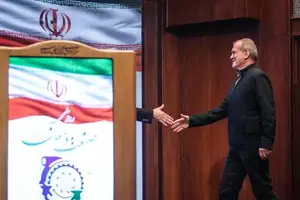
Security forces seized Iran hospital, sent wounded protesters to morgue

Jul 31, 2026, 19:21 GMT+1
•
Farnoosh Faraji
100%

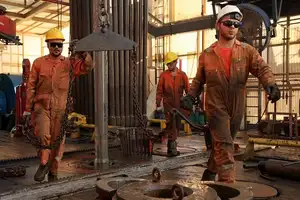
Iranian security forces took control of a hospital in the western city of Khorramabad during January's nationwide crackdown, according to medical staff, transferring dozens of critically wounded protesters to the morgue instead of receiving further treatment.

More than 200 bodies passed through Shohadaye Ashayer Hospital during the crackdown, according to an Iran International investigation based on more than two dozen sources, including medical personnel, eyewitnesses and people close to victims' families, as well as hospital records and videos obtained from inside the facility.

One eyewitness said at least 70 critically wounded protesters who could have been saved were transferred to the morgue instead of receiving further treatment.

Others were removed from treatment wards by security personnel before later reappearing in the morgue with fresh gunshot wounds to the upper body or what staff described as "finishing shots."

Iran International has so far verified the identities of 23 people killed in the city.

Hospital under siege

According to a member of the hospital's medical staff, Shohadaye Ashayer became the only hospital authorized to treat people wounded during the crackdown.

Armed security forces surrounded the hospital while police, intelligence officers and other security personnel operated inside the building. Officers stood over doctors and nurses as they treated patients, confiscated staff mobile phones and prevented them from contacting their families.

Hospital staff were effectively confined inside the facility for three days, the medical worker said. Several employees were arrested, while security forces moved through treatment wards identifying wounded protesters for detention.

Videos obtained by Iran International show dozens of bloodied bodies, many naked or partially unclothed, lying uncovered across the morgue floor and an adjoining room.

Some still had oxygen tubes in their mouths and electrocardiogram pads attached, suggesting they had been receiving treatment before being moved.

Several appeared to have been shot directly in the forehead, while others were covered with pellet wounds. Some had suffered catastrophic head injuries, with parts of their skulls missing. Several bodies also showed severe injuries to the genital area.

Some remained handcuffed despite bearing fatal gunshot wounds.

From operating room to morgue

Eyewitnesses described the hospital as overwhelmed, with blood covering corridors and bodies filling both the courtyard and the morgue. Multiple witnesses estimated that between 200 and 250 bodies passed through the hospital during the crackdown.

A student at Khorramabad University of Medical Sciences who witnessed patients arriving at the hospital described a similar pattern.

According to the student, wounded protesters repeatedly arrived alive on January 8 and 9, only for their deaths to be announced around 20 minutes after they had been taken into operating rooms. The student said the pattern was repeated across numerous patients.

The student also recalled a protester admitted on January 22 with extensive pellet wounds and a severe infection. Before treatment could be completed, security forces removed the patient from the hospital despite objections from the attending physician and took them to an unknown location.

Crackdown beyond the hospital

Witnesses said protests spread across much of Khorramabad on January 8 and 9, drawing tens of thousands of people into the streets.

They described security forces firing military-grade weapons, sniper rifles, shotguns and pellet guns at demonstrators, with several witnesses saying protesters were deliberately shot in the head and chest.

One witness said they personally saw at least five people killed after being struck from behind by bursts of gunfire.

Witnesses said security forces prevented many wounded protesters from reaching medical care, leaving some to bleed to death in the streets. Those who managed to reach Shohadaye Ashayer Hospital remained at risk of arrest, abduction or forced removal.

Witnesses also described an internet shutdown, movement restrictions and the widespread deployment of plainclothes officers, the Basij, the Revolutionary Guards and police units throughout the city.

Families under pressure

Eyewitnesses said bodies accumulated in the courtyard of Shohadaye Ashayer Hospital on January 9 while Basij forces prevented relatives from approaching them.

Some families removed the bodies of loved ones immediately, fearing security forces would seize them.

Among the victims whose identities Iran International has verified was Hossein Yaghmaei, who died after being shot and taken to a nearby home.

Retired municipal employee Hojjat Ahmadian was also among those killed. People familiar with his case said authorities pressured his family to record his death as suicide to avoid losing his pension.