• العربية
  • فارسی
Brand
  • Iran Insight
  • Politics
  • Economy
  • Analysis
  • Special Report
  • Opinion
  • Podcast
  • Iran Insight
  • Politics
  • Economy
  • Analysis
  • Special Report
  • Opinion
  • Podcast
  • Theme
  • Language
    • العربية
    • فارسی
  • Iran Insight
  • Politics
  • Economy
  • Analysis
  • Special Report
  • Opinion
  • Podcast
All rights reserved for Volant Media UK Limited
volant media logo
ANALYSIS

Iran believes time is on its side in Hormuz standoff with US - AP

Aug 8, 2026, 07:49 GMT+1

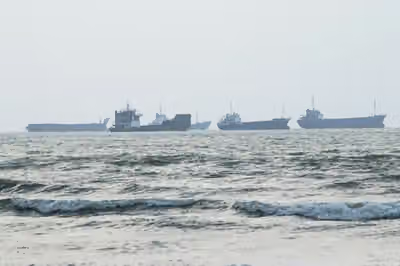
Iran's leaders believe control of the Strait of Hormuz gives Tehran growing leverage over Washington and could eventually force the US to accept a new arrangement for the strategic waterway, the Associated Press reported on Saturday.

Tehran is betting that higher energy prices, pressure on US weapons stockpiles and domestic opposition to the war will make a prolonged confrontation increasingly costly for President Donald Trump, according to the report.

Most Viewed

US imposes new Iran sanctions as officials say Hormuz deal is near
1

US imposes new Iran sanctions as officials say Hormuz deal is near

2
PODCAST

Ending Iran war could expose regime to its greatest threat yet, experts say

3

Mecca pact ties three Sunni powers together as Iran-backed attacks loom

4
INSIGHT

Iran moves to ratify Caspian Sea pact with seabed rights still unsettled

5
ANALYSIS

US miscalculated Iran’s resilience and hurt deal prospects, expert says

Banner
Banner

Spotlight

  • Iran’s reality TV boom abroad captures a generation in limbo
    ANALYSIS

    Iran’s reality TV boom abroad captures a generation in limbo

  • What the Islamic Republic does to its women footballers
    ANALYSIS

    What the Islamic Republic does to its women footballers

  • Iran moves to ratify Caspian Sea pact with seabed rights still unsettled
    INSIGHT

    Iran moves to ratify Caspian Sea pact with seabed rights still unsettled

  • Ending Iran war could expose regime to its greatest threat yet, experts say
    PODCAST

    Ending Iran war could expose regime to its greatest threat yet, experts say

  • US miscalculated Iran’s resilience and hurt deal prospects, expert says
    ANALYSIS

    US miscalculated Iran’s resilience and hurt deal prospects, expert says

  • What the Pentagon learned from the Iran war
    INSIGHT

    What the Pentagon learned from the Iran war

Banner
•
•
•

More Stories

US miscalculated Iran’s resilience and hurt deal prospects, expert says

Aug 7, 2026, 20:25 GMT+1
•
Kambiz Tavana
100%
Paul J. Saunders, President and CEO, Center for the National Interest

Washington likely underestimated Iran’s ability to withstand the initial US-Israeli strikes, making a negotiated settlement harder to achieve and deepening mistrust, foreign-policy expert Paul Saunders told Iran International.

The United States appeared to believe that military force would quickly weaken the Iranian government and compel Tehran to accept an agreement closer to US terms, Paul Saunders, president and CEO of the Center for the National Interest, said in an interview in Washington DC.

“I think the administration probably … overestimated how easy it would be to use force to bring about a successful agreement,” Saunders said.

Washington and Tehran remain divided over efforts to end the conflict, with the Strait of Hormuz at the center of competing military and diplomatic calculations. Recent reports have offered conflicting accounts of whether an agreement to reopen the waterway is imminent.

Strikes complicated diplomacy

“Targeting Iran’s leadership did more than escalate the military campaign,” Saunders said. “It also posed a direct threat to the survival of the Islamic Republic, making it harder for Washington to persuade Tehran to compromise.”

“I think that, from my point of view, it would have been better not to execute the strike on the Iranian leadership,” Saunders said, adding that the decision increased mistrust and left Washington in a weaker position to negotiate after the initial military action.

The US-Iran Memorandum of Understanding, signed in June, was a 14-point interim framework to end hostilities, restore commercial passage through the Strait of Hormuz, remove the US naval blockade and negotiate a final agreement within 60 days.

In July, Iran suspended implementation of its commitments under the MoU, accusing Washington of effectively abandoning its own obligations.

“In order to get a deal, we needed to have a government to negotiate with,” Saunders said. “When that government is really damaged and destabilized … will that new regime be sufficiently powerful that it will be able to make concessions to the United States?”

Trump has described Iran as being under a “third regime,” arguing that successive layers of the country’s leadership were killed in US and Israeli strikes and that the officials now in charge were different and more reasonable than their predecessors.

Iran’s internal response

Saunders said the political effects of the war extended beyond negotiations to Iran’s domestic response. He said it was predictable that Iranian society would rally behind the state when facing an external attack, even if many people remained unhappy with their government.

“Regardless of how angry or frustrated people might be with their own government, the only thing that they actually want less than their own government interfering in their lives … is someone else’s government doing it,” Saunders said.

“The Iranian government is responding to a threat to its survival, while Iranian society is reacting to an external attack. At the same time, the US president and the American public are weighing how much risk and cost the conflict justifies,” he added.

The conflict is important to Washington but not existential for the United States, Saunders said. He added that the administration had shown sensitivity to growing public concern over the costs of continuing the campaign.

Hormuz remains central

The Strait of Hormuz remains central to Iran’s leverage and to efforts to end the conflict. Commercial traffic through the waterway has fallen sharply, while Iran is also bearing substantial economic costs from the disruption.

Saunders said traders had so far expected the strait to reopen, limiting the immediate impact on global oil prices. But he warned that the economic consequences could become far more serious if the disruption persisted and refiners were forced to adapt to reduced supplies.

Iran's energy crisis is political, not seasonal

Aug 6, 2026, 08:27 GMT+1
•
Sogand Sara Fakheri
100%
A woman eats by flashlight during a power outage at a restaurant in Ahvaz, southwestern Iran

In Iran, the authorities call it a scheduled outage. The electricity will be disconnected for two hours. The water may return later in the evening. Families are instructed to adjust their lives to temporary emergencies. But there is no pause button for daily life.

A baby does not stop needing clean water because the pumps have shut down. A patient cannot postpone the use of refrigerated medicine or medical equipment. An elderly person living on the 14th floor cannot simply take the stairs when the elevator stops working. Parents cannot suspend cooking, washing or caring for their children until the state restores the water.

During the brutal Iranian summer, when temperatures in parts of the country exceed 40 degrees Celsius and climb above 50 in the south, air conditioning is not merely a comfort. For children, older people and those with medical conditions, it can become a matter of survival.

The authorities can announce a two-hour power cut. A child's fever, a patient's oxygen machine and a family's need for clean water do not follow that schedule.

Iran's water and electricity emergencies are not separate crises. Water distribution depends on electricity to operate pumping stations and move water through municipal networks, especially into apartment buildings and elevated neighbourhoods. When electricity fails, pumps stop working and water pressure falls. One failing system pulls another down with it.

‘No one to turn to’

Reports from across Iran describe daily electricity cuts lasting for hours alongside recurring water shortages. In Boumehen, east of Tehran, residents reportedly received running water on only two days during one week, and even then for only a few hours.

"We have a sick person at home. We no longer know who to turn to," one resident said.

In Pardis, another city east of Tehran, a resident of a 14-storey building said a four-hour power cut left the elevators out of service. "How are we supposed to climb all these stairs?" he asked.

In Ilam, power cuts reportedly lasted as long as four hours while temperatures reached around 46 degrees Celsius. In Khuzestan, one of Iran's principal oil- and electricity-producing provinces, residents complained that outages had resumed as temperatures crossed 50 degrees.

This is one of modern Iran's deepest contradictions. A country with some of the world's largest oil and natural gas reserves cannot guarantee electricity to its own population. Provinces that generate much of Iran's energy cannot rely on power in their own homes.

Factories lose production hours, small businesses lose income, food and medicine spoil, and families organise their days around outage schedules that are not always accurate.

During the summer they lose electricity; during the winter they face gas shortages. The crisis changes with the season, but it never disappears.

‘Energy imbalance’

Officials describe this as an "energy imbalance," a phrase that makes the problem sound technical rather than political. But Iran's energy crisis was not created overnight.

For years, electricity generation failed to keep pace with demand. Transmission networks deteriorated, renewable energy remained marginal and water systems continued to lose enormous quantities through leakage and decay.

In June 2026, Iran's Parliamentary Research Center reportedly projected a peak summer electricity deficit of roughly 13,600 megawatts.

The government's answer was to ask every Iranian to reduce electricity consumption by ten percent. Once again, citizens were instructed to compensate for failures they did not create.

A family can switch off a lamp. It cannot modernize a power station. A parent can shorten a child's shower. She cannot repair a leaking municipal water network. A shopkeeper can turn off an air conditioner, but he cannot recover decades of lost investment or build the electricity capacity the country requires.

Iran does face genuine environmental pressures. Drought, extreme heat and irregular rainfall have reduced water availability across the country. Climate change is making an already dry region hotter and more vulnerable.

But climate alone cannot explain why so much available water is wasted, why groundwater has been extracted beyond natural recovery or why inefficient agricultural practices remained dominant for decades.

Low efficiency

Even experts quoted by Iran's official news agency acknowledge as much.

Hashem Oraee, head of the Iran Energy Associations Union, estimated that nearly 90 percent of Iran's annual water consumption goes to agriculture, where efficiency remains extremely low.

He also said roughly one-third of the water entering urban distribution networks is lost before reaching consumers.

Iran is not simply running out of water. It is losing the water it still has. The current war did not create this crisis. It struck a system that was already fragile, underfunded and unable to meet national demand.

Iranian electricity officials have said more than 2,000 points across the national grid were damaged during the conflict, reducing available generating capacity by around 4,200 megawatts.

Those figures have not been independently verified, but they indicate the scale of the damage the authorities themselves claim to be facing.

Extended hours

In Bandar Abbas, residents described explosions followed by prolonged electricity cuts. One woman who depends on the internet for her income said she had already been struggling with government-imposed internet shutdowns before longer power cuts placed her work at further risk.

"We always had power cuts, but the hours have now extended," she said.

That distinction matters. The war made the outages longer and more dangerous, but it did not introduce Iranians to blackouts. Years of neglect had already done that.

Inside the home, the consequences are immediate. Refrigerators stop cooling food and medicine. Medical devices fail unless families can afford backup power. Elevators become unusable. Water no longer reaches upper floors when electric pumps stop working. Parents struggle to prepare food, wash clothes, sterilize baby bottles or care for elderly relatives and young children.

The word "outage" suggests a temporary interruption after which normal life resumes. But when electricity disappears every day, when water and power fail together, and when no one knows whether the published schedule can be trusted, the interruption becomes normal life.

Water and electricity are not luxuries. They are the foundations on which healthcare, sanitation, education, industry and family life depend.

Iran did not run out of intelligence, resources or human ability. Its people were deprived of functioning systems because those in power failed to build and maintain them.

Now the lights are going out, the taps are running dry, and ordinary Iranians are once again being asked to bear the cost.

US and Iran seek a new equilibrium neither trusts

Aug 5, 2026, 17:47 GMT+1
•
Behrouz Turani
100%
A banner with a threat against President Trump's life is displayed beneath missiles during a state-organized event in Tehran's Azadi Square, Iran, July 30, 2026

A return to the pre-war status quo between Iran and the United States now appears out of reach for both sides, despite their competing claims of victory.

The negotiations under way are no longer about restoring the relationship that existed before the war, but about finding a new equilibrium that neither side fully trusts.

After two months of naval confrontation, Washington wants Iran to reopen the Strait of Hormuz, while Tehran wants the United States to lift restrictions on its commercial shipping. Neither side publicly acknowledges why they fought so long against what increasingly appear to have been their own strategic and economic interests.

That mutual recognition has created an opportunity for diplomacy, but not necessarily confidence in it.

Iran and Oman announced Wednesday that they had agreed on the geographical coordinates of a proposed commercial shipping corridor through the Strait of Hormuz and were finalizing a joint statement.

The Associated Press, citing two regional officials, reported that Iranian and Omani negotiators had completed a draft agreement and were awaiting final approval from Supreme Leader Mojtaba Khamenei.

CNN, citing a senior Persian Gulf official familiar with the talks, said the chances of reaching a broader US-Iran agreement by Friday remained only "50:50," despite President Donald Trump's repeated predictions that a breakthrough was imminent.

Diplomacy without trust

The fragility of the process is increasingly reflected inside Iran itself.

A member of Iran's negotiating team told reporters in Oman on Wednesday that one of the remaining obstacles was Trump's repeated threats to attack Iran if diplomacy failed.

Accepting a compromise under those circumstances, Iranian officials argue, would expose negotiators to accusations from domestic rivals that they had capitulated under military pressure.

Former chairman of parliament's Foreign Relations and National Security Committee, Heshmatollah Falahatpisheh, warned the same day that the current pause in hostilities had created only a narrow diplomatic window.

If negotiations collapse or stall, he argued, the confrontation is likely to spread beyond the military sphere into the region's civilian economy, trade and security infrastructure.

Former foreign minister Mohammad Javad Zarif echoed those concerns, warning that continued closure of the Strait of Hormuz risked creating a broader regional and international consensus against Tehran, turning one of Iran's principal sources of leverage into a growing strategic liability.

Temporary pause

The debate inside Iran suggests that neither supporters nor opponents of diplomacy expect the current process to produce a durable settlement.

Across state media and security-aligned outlets, the negotiations are presented less as the beginning of a new relationship with Washington than as a tactical pause made possible by regional mediation, particularly Oman, and the temporary framework established under the Islamabad memorandum.

Official messaging continues to reject any suggestion of direct bargaining or political concession to Washington. I

nside Iran's political establishment, resistance to negotiations extends across ultra-hardline factions, conservative clerical institutions and parts of the Revolutionary Guards, all deeply skeptical of engagement with the United States.

For those groups, flexibility over Hormuz or Iran's nuclear program risks weakening deterrence rather than strengthening security.

That institutional skepticism helps explain why every sign of diplomatic progress is accompanied by warnings that the process could quickly unravel.

For both Washington and Tehran, the talks increasingly appear driven less by renewed trust than by recognition that neither side can afford another prolonged confrontation. Whether that recognition proves strong enough to overcome deep political distrust remains the central question.

War or government failure? Record inflation fuels political battle in Iran

Aug 5, 2026, 09:10 GMT+1
•
Maryam Sinaiee
100%

The latest figures released by the Statistical Center of Iran offer the starkest assessment yet of the country's economy, as record inflation intensifies debate over whether the war or government mismanagement is primarily to blame.

Average annual inflation has climbed to a record 62%, while year-on-year inflation has surged to 82%, rapidly eroding household purchasing power.

Food prices remain the principal driver of overall inflation, with annual food inflation staying in triple digits for a sixth consecutive month. In July, food inflation reached 134% nationwide and 140% in rural areas. More than two-thirds of the food items monitored by the statistical agency now exceed what economists describe as crisis-level inflation.

Prices have risen sharply across other sectors as well. Household appliances are estimated to cost 114% more than a year ago, while transportation costs have climbed 103%. Economists warn that a possible gasoline price increase could push food inflation even higher by raising distribution and delivery costs.

War or government policy?

Critics of President Masoud Pezeshkian’s government, many of whom also oppose an agreement with the United States, argue that the inflation surge is rooted entirely in domestic economic policy rather than the recent conflict.

Hojjat Abdolmaleki, labor minister under former president Ebrahim Raisi, dismissed any connection between the war and rising prices.

“The war has had no effect whatsoever on inflation. Inflation has risen steadily throughout the Pezeshkian Administration, and the war’s contribution to these price increases is zero,” he said.

“Virtually all of this inflation is the direct result of misguided policies and government incompetence. Even without the war, the situation would have been the same, perhaps even worse.”

Other economists reject that assessment, arguing that both domestic policy and the conflict have driven prices higher.

Mohammad Sadegh-Alhosseini told the Iranian Students News Agency (ISNA) that domestic policies could account for inflation of between 30% and 50%, but that the increase beyond that range was linked to international tensions and the war.

Mojtaba Yousefi, a member of parliament, also said it was inaccurate to claim that the war had no effect on prices. “But it is equally wrong to attribute all inflation to the war,” he said.

Economists also caution that even an agreement between Tehran and Washington, potentially unlocking frozen assets, easing sanctions, increasing oil revenue and reducing inflation expectations, would be unlikely to bring prices down quickly.

They say chronic budget deficits, entrenched corruption and structural inefficiencies are so deeply embedded that reversing them could take years.

Even if the fighting ends, the cost of rebuilding damaged infrastructure and industry would continue to strain public finances. Conservative politician Mohammad-Reza Bahonar recently estimated reconstruction costs at $200 billion.

Purchasing power continues to collapse

The inflation surge has increasingly affected ordinary Iranians. According to a report by the Iranian Labour News Agency (ILNA), during recent months even basic staples such as chicken, eggs and bread have become unaffordable for many working-class households. Bread prices alone have risen by between 100% and 140% on average.

Official data show that prices of at least eight food items have more than doubled over the past year. Cooking oil has risen 261%, while meat prices have increased 145%.

By comparison, ILNA wrote, the minimum wage has increased by only 60%, while salaries for civil servants, pensioners, nurses and teachers have risen by between 20% and 43%, averaging roughly 30%. As a result, many of these households no longer fit the conventional definition of the middle class, the report argued.

Government food vouchers introduced in January have also lost much of their purchasing power, as authorities have left their value unchanged despite soaring food prices.

Ahmad, a retired civil servant in Tehran, said the vouchers initially allowed him to buy around ten food items. "Now I can only afford three or four."

Social media has also reflected the growing financial strain. Users report increasing numbers of people selling, or even renting out, personal belongings such as electronic devices to cover daily expenses.

  • Economic crisis drives Iranians to sell hair, rent laptops

    Economic crisis drives Iranians to sell hair, rent laptops

Journalist Azadeh Mokhtari wrote: "When advertisements for selling hair, or even renting laptops for online classes, become more common, it means the middle class is being worn away, and the lower-income class is being pushed out of the economy."

Misery index reaches new peak

The deteriorating economic environment is also reflected in Iran's misery index, the combined rate of annual inflation and unemployment.

With annual inflation at 62% and unemployment at 9.1% in the quarter ending in June, the misery index climbed to a record 71.1%, up from 64.2% in the previous quarter. The index stood at 56.6% during the same period in 2021.

The economic burden is not evenly distributed across the country. Several provinces have recorded misery index readings above 100%, with Lorestan registering the highest level at 121.5%.

Economists say the figures reflect not only declining purchasing power and weaker job security but also rising uncertainty that makes long-term financial planning increasingly difficult for households.

Why Afghans still risk death to reach Iran

Aug 4, 2026, 17:34 GMT+1
•
Negar Mojtahedi
100%
The father, a 35-year-old driver with his Afghan family, sits with his young daughter in a pickup van.

"Take care of my sons." Those were the final words of Hayatullah, an Afghan migrant who used his phone to record what would become the last moments of his life in the scorching desert as he tried to reach Iran.

"Pray for me. Mother, I'm dying," he said, pleading with his loved ones to look after his sons, especially Habib.

Hayatullah was among 14 Afghan migrants who died attempting to reach Iran, Afghan officials said, weeks after the vehicle carrying them broke down and they continued the journey on foot.

Why would anyone risk one of the world's deadliest migration routes to reach Iran?

The country is grappling with economic crisis and widespread repression. It has carried out one of the region's largest deportation campaigns against Afghan migrants and offers little prospect of permanent legal status.

"It's not about a choice between safety and danger," Yasin Samim, an Afghan governance and development analyst, told Iran International. "It's about what type of danger."

Samim said conditions inside Afghanistan had become so severe that many people continued to flee despite knowing the risks awaiting them in Iran.

"The fact that they come to Iran shows the severity of the situation and conditions in Afghanistan," he said. "The reasons they leave Afghanistan have not changed."

With the Taliban's return to power, legal pathways to Iran have become increasingly restricted, forcing many low-income Afghans into the hands of smugglers.

"Granting a visa has become a deal of the black market," Samim said, adding that visas can reportedly cost between $1,000 and $1,200—far beyond the reach of many Afghan families.

"The combination of poverty, unemployment and repression leaves people with no alternative," he said. "That is the only choice they have."

Those who cannot afford legal routes often attempt the crossing through Nimruz, one of the main transit corridors into Iran for irregular migration.

The route has become synonymous with one of the deadliest migration paths into the country. Migrants cross vast stretches of unforgiving desert where temperatures regularly exceed 45°C (113°F).

If smugglers abandon them or their vehicle breaks down—as happened in this case—survival quickly becomes a race against dehydration. Many die before reaching help. Others face robbery, exploitation or detention before ever reaching Iran.

Iran has long hosted one of the world's largest Afghan populations despite offering few permanent rights to those who settle there. Before its mass deportation campaign in 2025, an estimated four million Afghans lived in the country, including registered refugees, documented migrants and undocumented workers.

Yet many remained in legal limbo despite spending years—or even decades—in Iran. Children born in Iran to Afghan parents are not automatically granted Iranian citizenship, and for most there is no realistic pathway to becoming Iranian citizens.

"Iran has shut down legal pathways for Afghans in recent years," Omid Memarian, senior Iran analyst at DAWN told Iran International. "Because so many pathways have been blocked, they have to take much riskier ways to be smuggled from Afghanistan to Iran.”

That means the chance of being exploited is higher, Memarian added, and their rights are more likely to be violated.

Tighter restrictions appear to have little bearing on Afghans' calculations. It has only pushed them onto more perilous routes across deserts such as Nimruz, where extreme heat could quickly turn a journey into a death sentence.

"For them, the question is not, 'Let's go to the best ideal country.' The question is, 'Let us get out of here.' ... It's about survival," Memarian told Iran International.

Iran International reached out to the United Nations High Commissioner for Refugees (UNHCR) for comment.

A spokesperson referred us to a statement issued last month warning that Afghanistan is ill-equipped to absorb the growing number of returnees.

The agency said more than six million Afghans have returned since 2023, while nearly half the country's population already depends on humanitarian aid.

It called for returns to be safe, voluntary and dignified, warning that mass deportations risk deepening one of the world's worst humanitarian crises.