An Iranian missile attack on a US military base in Jordan that killed two American soldiers and left another missing highlighted tactics Tehran has used to evade US and allied air defenses, CBS News reported Tuesday.
The report said Iran has used drones and less advanced missiles to overwhelm or distract radar systems before firing more precise missiles capable of changing course near their targets.
The Muwaffaq Salti Air Base had been struck twice in the 48 hours before Friday’s deadly attack, with dozens of US military personnel wounded, according to CBS News.
Israeli officials believe US President Donald Trump is preparing to significantly expand the American military campaign against Iran, the Jerusalem Post reported, citing two Israeli officials.
According to the assessment, a broader campaign targeting Iranian strategic infrastructure and senior government figures would likely prompt Tehran to retaliate directly against Israel, the report said.
Israeli Prime Minister Benjamin Netanyahu held a six-hour security consultation with ministers and senior defense officials on Monday night to assess the situation, the report added.
Netanyahu briefly left the meeting to speak with US Secretary of State Marco Rubio, according to an Israeli official cited by the Jerusalem Post.
US Central Command has hit about 1,000 targets over the past 10 days, the newspaper reported, citing a source familiar with the operation.
A source cited by the Jerusalem Post said the prospect of a diplomatic solution with Iran was now “virtually nonexistent.” Another official cautioned that Trump had previously changed course at the last minute and could still do so again.
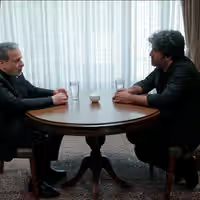
Iran's Parliament Speaker Mohammad Bagher Ghalibaf (left) and hardline lawmaker Hamid Rasaei
A hardline Iranian lawmaker accused parliament speaker Mohammad Bagher Ghalibaf of backing a US deal that blocks revenge for Ali Khamenei’s killing and could paralyze the state, paving the way for a bloodless coup.
Hamid Rasaei said the memorandum negotiated with Washington was fundamentally incompatible with retaliation, accusing Ghalibaf of trying to disguise that contradiction through religious and ideological rhetoric.
“Revenge is fundamentally incompatible with this memorandum,” Rasaei said in an interview with the YouTube channel Hokmran.
“As you can see, Mr. Ghalibaf is tying himself in knots, scrambling to link revenge to the reappearance of the Imam of the Age, because he has signed something that prevents you from taking revenge.”
Ghalibaf led Iran’s negotiating team in talks with the United States and has emerged as the principal defender of the Islamabad memorandum among the Islamic Republic’s senior officials.
The agreement’s first clause commits Iran and the United States to end military operations, refrain from initiating further attacks and avoid the threat or use of force against each other.
Ghalibaf said last month that just as vengeance for the third Shiite imam would be fulfilled through the reappearance of the Imam of the Age, vengeance for the slain supreme leader would be achieved through the “liberation of Jerusalem.”
He later described the liberation of Jerusalem, or Al-Quds, as the “final step of revenge” and said Iran could support its allies through missiles when military action was needed and through negotiations when political pressure was more effective.
By tying revenge to a distant ideological objective rather than an immediate attack on the United States or Israel, Ghalibaf appeared to be seeking a way to preserve the Islamic Republic’s rhetoric of vengeance while containing the escalation that could derail negotiations.
‘Preparing grounds for coup’
Rasaei rejected that formulation, arguing that abandoning immediate retaliation would allow threats against the new Supreme Leader Mojtaba Khamenei to remain in place and prevent him from appearing publicly.
“Those who want revenge removed from the equation so that it never happens—what are they really after?” he said. “They want this threat to continue hanging over your leader. They want your leader to remain unable to appear in public.”
Rasaei argued that continued threats and the leader’s absence could then be invoked to suspend the country’s governing institutions.
“They want the threat to remain in place,” he said. “As long as it does, you cannot convene parliament. They will say there is no security, so parliament should not meet, the judiciary should not function and the government should not operate—just hand everything over.”
“This would become the prelude to a coup without a single shot being fired,” he added. “This is how the groundwork is laid for a very polished coup. There must be revenge. There absolutely must be.”
The accusation reflects widening divisions among the Islamic Republic’s hardliners over whether diplomacy with Washington can be reconciled with demands to retaliate for Ali Khamenei’s death.
Ghalibaf has argued that negotiations and military power are complementary rather than contradictory, saying diplomacy can preserve gains made on the battlefield when it is backed by the ability to fight. His position resembles Washington’s argument that negotiations are most effective when supported by military pressure.
Mojtaba Khamenei, however, has doubled down on the promise of direct revenge. In a message issued after his father’s burial, he described retaliation as a “national demand” that “will most certainly be carried out.” He also warned that those responsible for the killing would lose any hope of dying peacefully in their beds.
Those remarks strengthened hardline demands for action and sharpened the contradiction between Tehran’s continuing negotiations with Washington and its leadership’s public commitment to punish those behind Khamenei’s killing.
Rasaei also attacked Iranian figures who have urged Mojtaba Khamenei to set aside revenge, referring to Fayyaz Zahed, an adviser to former foreign minister Mohammad Javad Zarif.
Zahed said in a recent interview that Mojtaba Khamenei should “put his personal issues aside” and forgo revenge for his father’s blood, adding that such restraint was the meaning of governance.
“Take that foul-mouthed person who spoke up last week and said Agha Mojtaba should put aside his personal animosity—even though they killed his father,” Rasaei said.
Zahed’s remarks drew a backlash from media affiliated with the Revolutionary Guards. Fars News said he had arrogantly advised Khamenei to abandon revenge and argued that the blood of those regarded by the Islamic Republic as martyrs was “not negotiable.”
Rasaei also criticized former president Mohammad Khatami’s call for an “honorable peace,” saying such proposals ultimately amounted to removing revenge from consideration.
He argued that Iran should respond not only to attacks but also to explicit threats, saying Tehran should strike before its adversaries have an opportunity to carry them out.
“A threat should be treated as an attack,” Rasaei said. “We shouldn’t wait for him to do it before responding. The moment he says it, we should strike.”
He ended by questioning whether Iran could negotiate with the same government it had pledged to punish.
“At times, we act as though revenge can somehow be reconciled with negotiations and an agreement,” he said. “But I ask you: how can you reach an agreement with someone against whom you intend to take revenge?”
Saudi Arabia’s cabinet, chaired by King Salman bin Abdulaziz, said on Tuesday it would take decisive measures to protect the kingdom’s security and vessels, the Saudi Press Agency reported.
The cabinet condemned what it called false and baseless accusations by the Houthis and accused the group of joining the regional conflict to advance its agenda, worsening the suffering of Yemenis and threatening regional security.
It reaffirmed support for Yemen’s internationally recognized government, expressed full solidarity with Kuwait, Bahrain and Jordan following Iranian attacks, and called for an immediate halt to military escalation.
US President Donald Trump said Iran would need 20 to 25 years to recover from the damage caused by US strikes and that Washington’s military campaign was not over.
“If we left right now, it would take Iran 20, 25 years to rebuild,” Trump said. “We’re not finished at all.”
“We had a big success. But we’re not leaving tomorrow,” he added.
Iran warned Bulgaria on Tuesday against allowing the United States to use its territory for military operations against Tehran after Sofia moved to station up to eight US tanker aircraft at an air base.
Iranian foreign ministry spokesperson Esmail Baghaei said any activity facilitating US attacks would amount to complicity in “aggression and war crimes.”
He urged Bulgaria not to become “an accomplice of aggressors and lawbreakers,” Iranian state media reported.