Explosions heard in Sirik in southern Iran - state media
Explosions were heard Friday in Sirik, a coastal city in southern Iran’s Hormozgan province, Iran’s semi-official Mehr news agency reported.
Explosions were heard Friday in Sirik, a coastal city in southern Iran’s Hormozgan province, Iran’s semi-official Mehr news agency reported.





The United States used the ceasefire with Iran to replenish weapons and reinforce its warships and aerial refueling aircraft while pursuing negotiations, said Mohsen Rezaei, military advisor to Iran’s supreme leader.
Speaking on the state TV on Friday, Rezaei predicted that if talks resumed, Washington would seek to revise the existing text of the Islamabad MoU and effectively draft a new memorandum of understanding.
However, he said circumstances had changed and Iran could not accept that.
He added that the United States conditioned the release of $12 billion in Iranian assets on loans and the exclusive purchase of goods and food from US companies.
Iran will enter a phase of “full-scale offensive operations” if the United States continues its attacks for another two or three days, Mohsen Rezaei, a military adviser to Iran’s Supreme Leader Mojtaba Khamenei, said Friday on Iranian state television.
Rezaei said Iran would recognize “no political boundaries” in its attacks and warned that the United States should expect waves of Iranian missiles and drones.
He said Tehran had so far refrained from launching a ground offensive and carrying out heavy attacks beyond its borders because it wanted to avoid triggering wider international security crises.
Rezaei also said Iran would not abandon seeking revenge for the killing of its leader, adding that the country’s future security and stability depended on carrying it out.
A confidential directive from Iran’s Supreme National Security Council, obtained by Iran International on Friday, instructed media publishers and editors to limit reporting on damage to civilian infrastructure as the United States reportedly prepares to widen the Iran war.
The directive came a week after the collapse of a ceasefire with the United States and the resumption of fighting in southern Iran and the Strait of Hormuz.
It told media outlets covering attacks on civilian facilities and infrastructure to “refrain from publishing vital information,” avoid creating “fear and alarm among the public,” and withhold details about the extent of destruction or its impact on the delivery of public services.
The council said such information could be used “by the enemy to assess the effectiveness of its attacks.” It instructed media outlets to obtain information through the most senior provincial official responsible for any institution or facility that had been hit.
The directive also ordered media outlets to describe disruptions to public services using phrases such as “the issue is under review and being resolved,” rather than report the extent of the damage or provide specific details about its effect on services.
It said the Health Ministry and emergency services remained the only official and authoritative sources for civilian casualty figures.
The order followed a sixth consecutive night of US strikes on Iran. US Central Command said fighter jets, drones and warships had used precision weapons against dozens of military targets, including coastal surveillance and air-defense sites, military logistics infrastructure and maritime capabilities on Qeshm Island and near Bandar Abbas.
The strikes could expand further. Axios reported on Friday that the Trump administration plans to send dozens more aerial refueling planes to Israel as the US president considers a broader offensive against Iran, potentially targeting power plants, other infrastructure and additional nuclear facilities.
Iranian media reported that five bridges in Hormozgan province were hit, along with the railway station in the coastal city of Bandar Khamir and Iranshahr airport in southeastern Iran.
Iran’s state-run IRNA news agency said seven people were killed in strikes on bridges in Bandar Khamir.
The attacks also damaged power lines in Bandar Abbas and surrounding areas, causing outages, while a tower at the port of Chabahar was brought down. Iran said the tower monitored commercial traffic, while the United States described it as part of an IRGC surveillance network used to target vessels in the Strait of Hormuz.
With major international news organizations lacking permanent bureaus inside Iran, the directive further concentrates wartime reporting in the hands of state-controlled institutions and makes independent verification of attacks, casualties and infrastructure damage more difficult.
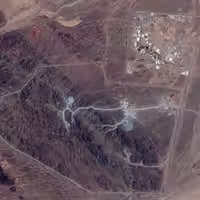
Iran’s state-run Press TV has rejected an Al Jazeera report that satellite imagery showed damage inside the Bushehr nuclear power plant complex following US strikes.
Al Jazeera said Sentinel-2 images taken on July 7 and 12 revealed impact scars within the complex and another apparent strike site in nearby support facilities.
Press TV said an on-site investigation and inquiries with Iranian officials found no evidence that the plant itself had been hit. It said the strikes landed outside the facility’s boundaries and that the darkened area identified in the imagery was green space outside the plant’s operational and sensitive sections.
Iran says the Revolutionary Guard's navy targeted a Thai-flagged ship in the Strait of Hormuz on Friday after the vessel "ignored warnings and attempted to transit without obtaining permission."
A video published by IRGC-affiliated media appeared to show damage to the vessel.