• العربية
  • فارسی
Brand
  • Iran Insight
  • Politics
  • Economy
  • Analysis
  • Special Report
  • Opinion
  • Podcast
  • Iran Insight
  • Politics
  • Economy
  • Analysis
  • Special Report
  • Opinion
  • Podcast
  • Theme
  • Language
    • العربية
    • فارسی
  • Iran Insight
  • Politics
  • Economy
  • Analysis
  • Special Report
  • Opinion
  • Podcast
All rights reserved for Volant Media UK Limited
volant media logo

Bahrain condemns Iranian attack on Saudi, Qatari oil tankers in Strait

Jul 7, 2026, 21:27 GMT+1

Bahrain's Foreign Ministry on Tuesday condemned an Iranian attack on the Saudi oil tanker Wadiyan and the Qatari oil tanker Al-Rukayyat in the Strait of Hormuz, saying the incident endangered the crews of both vessels.

The ministry said the attack threatened international maritime security and global energy supplies, and violated international law and the Islamabad memorandum of understanding.

Most Viewed

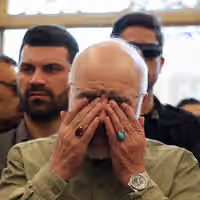
Iran's costly farewell for supreme leader draws backlash
1
VOICES FROM IRAN

Iran's costly farewell for supreme leader draws backlash

2
ANALYSIS

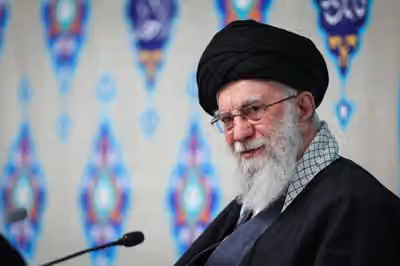
The end of one-man rule? Iran tests life after Khamenei

3

Revenge rhetoric dominates Khamenei funeral despite US talks push

4
INSIGHT

Khamenei funeral struggles to stay on script

5

Commercial ships hit near Strait of Hormuz as Iran-US talks stall

Banner
Banner
Banner

Spotlight

  • Potential state TV shakeup tests Iran’s willingness to rein in hardliners
    ANALYSIS

    Potential state TV shakeup tests Iran’s willingness to rein in hardliners

  • Alleged IRGC plot sought woman to burn kosher shop, German court hears

    Alleged IRGC plot sought woman to burn kosher shop, German court hears

  • The end of one-man rule? Iran tests life after Khamenei
    ANALYSIS

    The end of one-man rule? Iran tests life after Khamenei

  • Iran's costly farewell for supreme leader draws backlash
    VOICES FROM IRAN

    Iran's costly farewell for supreme leader draws backlash

  • Iran’s energy growth slows to a crawl as demand races ahead
    INSIGHT

    Iran’s energy growth slows to a crawl as demand races ahead

  • Tailored Quran verses at Khamenei funeral spark diplomatic debate

    Tailored Quran verses at Khamenei funeral spark diplomatic debate

•
•
•

More Stories

GCC chief condemns Iranian targeting of Saudi tanker

Jul 7, 2026, 20:59 GMT+1


Gulf Cooperation Council Secretary-General Jassim Mohammed Al-Budaiwi condemned what he called Iran’s targeting of the Saudi tanker Wadiyan as it transited the Strait of Hormuz, in a statement Tuesday.

Al-Budaiwi called the attack a “criminal Iranian act” and a dangerous escalation threatening international navigation security and energy supplies.

He said the GCC states fully stood with Saudi Arabia and supported all measures taken by Riyadh to protect its national interests.
Gulf Cooperation Council Secretary-General Jassim Mohammed Al-Budaiwi condemned what he called Iran’s targeting of the Saudi tanker Wadiyan as it transited the Strait of Hormuz.

In a statement on Tuesday, Al-Budaiwi called the attack a “criminal Iranian act” and a dangerous escalation threatening international navigation security and energy supplies. He said the GCC states fully stood with Saudi Arabia and supported all measures taken by Riyadh to protect its national interests.

Iran says Qatar accusation over Hormuz vessel attack ‘perplexing’

Jul 7, 2026, 20:41 GMT+1

Iran’s foreign ministry spokesperson said Qatar’s accusations over an attack on a vessel linked to the country in the Strait of Hormuz were “perplexing” and inconsistent with good neighborly relations, while warning that vessels using uncoordinated routes face risks.

Esmaeil Baghaei said commercial vessels using routes not coordinated with Iran, or tampering with ship-tracking systems, created risks and disrupted Tehran’s efforts to facilitate safe passage through the Strait of Hormuz.

Baghaei said Iran was diligently fulfilling its commitments under the memorandum of understanding regarding measures needed to manage the Strait of Hormuz.

He urged countries in the region and shipping companies to refrain from any actions that contradict the provisions of the memorandum.

US revokes Iran oil waiver after Hormuz tanker attacks - Reuters

Jul 7, 2026, 20:08 GMT+1

The United States is revoking a general license that authorized the sale of Iranian oil after tanker attacks near the Strait of Hormuz, Reuters reported Tuesday citing a US official.

The official said Iran’s actions in the Strait of Hormuz were “wholly unacceptable” to the United States and would be met with consequences.

The US official said negotiators continued to work in good faith toward a final agreement with Iran despite the latest escalation.

Saudi Arabia condemns Iran over attacks on Qatari, Saudi tankers in Hormuz

Jul 7, 2026, 19:35 GMT+1

Saudi Arabia condemned Iran’s targeting of the Saudi tanker Wadyan and the Qatari tanker Al Rekayyat as they transited the Strait of Hormuz, saying the attacks threatened international navigation and global energy supplies.

“The kingdom stresses its demand that Iran immediately stop all actions that threaten the security of the region and the safety of international navigation and energy supplies,” the Saudi foreign ministry said said in a statement on Tuesday.

The ministry said Saudi Arabia held Iran “fully responsible for these attacks, their damage and all their repercussions.”

Potential state TV shakeup tests Iran’s willingness to rein in hardliners

Jul 7, 2026, 19:04 GMT+1
•
Behrouz Turani
Potential state TV shakeup tests Iran’s willingness to rein in hardliners
100%
Iran's state broadcaster's chief Peyman Jebelli (left) and his cultural deputy Vahid Jalili, the brother of hardline politician Saeed Jalili

The looming end of Payman Jebelli’s term as head of Iran’s state broadcaster has become a political test of whether the country’s new leadership is prepared to rein in hardliners accused of hijacking public media.

Iranians frustrated with years of one-sided, hardline coverage by the Islamic Republic of Iran Broadcasting, or IRIB, are increasingly watching the possible leadership change as an early sign of whether the system intends to correct course.

Radical anti-diplomacy factions have long used IRIB, whose chief is directly appointed by the supreme leader, to undermine pragmatist efforts toward a breakthrough with Washington.

That pressure continued even during the weeklong funeral ceremonies for former Supreme Leader Ali Khamenei, when hardline voices on state television kept attacking attempts to shift the country away from wartime confrontation.

As Jebelli’s five-year term nears its end, criticism of his tenure and his ultraconservative Paydari Party allies has moved from reformist circles into more mainstream political commentary.

Jebelli and his cultural deputy Vahid Jalili, the brother of senior conservative politician Saeed Jalili, are widely regarded by critics as key figures behind IRIB’s hardline editorial line, particularly its hostility toward the government’s diplomatic and postwar agenda.

Many Iranians and media analysts now view a possible shakeup at the broadcaster as a signal of whether Iran’s new leadership is willing to curb unilateral rhetoric and restore a degree of institutional balance to state media.

A commentary on the moderate news site Asr-e Iran, headlined “Countdown to the Start of Changes in the IRIB,” said the political fallout over the broadcaster’s recent censorship of Parliament Speaker Mohammad Bagher Ghalibaf had reached senior levels of the establishment.

  • Iran parliament cries censorship after Ghalibaf interview cut short

    Iran parliament cries censorship after Ghalibaf interview cut short

According to the report, the incident is no longer being treated as a routine editorial or executive mistake, but as a threat to national security and internal cohesion at a sensitive moment of postwar realignment.

The outlet said a political “countdown” had begun behind closed doors, pointing to a possible restructuring aimed at ending radical factions’ grip over the state’s most powerful media platform.

Asr-e Iran argued that IRIB had crossed a major political red line by turning a partisan media dispute into a broader governance crisis. It said a publicly funded broadcaster could not be allowed to become “the private clubhouse of an extremist faction” defying what it described as the official consensus of the governing branches.

The commentary said the current management model at IRIB had become an internal obstacle to the state’s strategic direction and called for a purge of the broadcaster’s leadership.

'IRIB deepens state-society divide'

Earlier this week, the pro-reform daily Arman-e Melli also described IRIB’s abrupt censorship of relatively moderate figures, including Ghalibaf, as evidence of a deeper institutional crisis within Iran’s political elite.

The paper accused IRIB’s leadership of being “hijacked by a narrow, radical faction allied with hardline rejectionists” and said the broadcaster was using public media to suppress even official state narratives when they conflicted with factional interests.

By censoring the head of the legislative branch at a time when he is seeking to move the country from wartime footing toward economic reconstruction, the daily argued, IRIB had openly damaged the appearance of internal unity.

Arman-e Melli said the broadcaster had deepened the divide between the state and society and shown that it could not tolerate even the official narrative of a conservative parliament speaker.

In a separate commentary in the same paper, reformist figure Hassan Rasouli offered a broader critique of factional infighting, arguing that public dissent by hardline elements weakens the state’s leverage in international negotiations.

Rasouli called for a temporary freeze on factional rivalry, saying domestic media platforms should serve as pillars of administrative cohesion during a critical geopolitical transition. He argued that projecting strategic stability abroad requires protecting the executive branch from internal sabotage at home.

The debate over IRIB comes as Iran’s new leadership faces growing scrutiny over whether promised or anticipated institutional changes will materialize.

Earlier this week, Judiciary Chief Gholamhossein Mohseni Ejei was reinstated, disappointing many Iranians, particularly human rights advocates who had hoped for change.

If Jebelli and his team are also reinstated at IRIB, public frustration is likely to deepen and reinforce the perception that the system remains unwilling to reform its most unilateral and hardline institutions.