Iran president slams attacks on negotiators, says US MoU has Khamenei backing


Iranian President Masoud Pezeshkian criticized attacks on the country’s negotiating team on Tuesday, saying the MoU with the US was reached in full coordination with Supreme Leader Mojtaba Khamenei.
“Unfortunately, some groups, in line with the psychological operations of hostile media, are trying to weaken this achievement by attacking the negotiating team and questioning national decisions,” he said.
Pezeshkian added that the memorandum of understanding was reached in line with the system’s broad policies and with the support of the Supreme National Security Council.




Comments by an establishment pundit suggesting the Islamic Revolutionary Guard Corps (IRGC) could be dismantled from within have raised an extraordinary question: is Tehran preparing to reinvent one of the pillars of the Islamic Republic?
The idea would have sounded almost unthinkable just months ago.
But the remarks by Mehdi Khorratian, who has close ties to Iran's hardline establishment, have fueled speculation that at least some in Tehran may be considering a major overhaul of the Islamic Republic's power structure.
Experts interviewed by Iran International say the more revealing question is not whether the IRGC disappears—it is what, if anything, replaces it.
Some believe any restructuring would amount to little more than a rebranding designed to preserve the Guard's power while shedding some of its political and economic baggage. Others see the debate as evidence that Iran's leadership understands the country cannot emerge from the recent war unchanged.
Historian Shahram Kholdi argues dismantling the IRGC is far more complicated than simply abolishing a military organization.
"The IRGC is not called the Revolutionary Guard Corps of Iran. It is called the Islamic Revolutionary Guard Corps. That is very important," he said.
The obstacle, he argues, lies in the constitution. Article 150 of the Islamic Republic's constitution establishes the Guard not as a conventional military force but as the institution responsible for "guarding the revolution and its achievements."
That ideological mandate makes outright dissolution highly unlikely.
Instead, Kholdi believes the leadership would preserve the system while adapting its structure.
"They will not allow any disruption in the continuity of the Islamic Republic, but they will turn it into what it has been over the past 30 years: a fully military oligarchy disguised as a theocracy," he said.
Kholdi argues restructuring could also serve a practical purpose. As Western governments continue to designate the IRGC as a terrorist organization, folding it into a broader military structure could make it easier for Iranian officials to participate in future international security arrangements linked to any agreement with Washington while complicating efforts to isolate the organization itself.
"It would actually make things much more flexible for them," he said.
A toxic brand
Political analyst Omid Memarian says the IRGC itself has become a liability.
"The IRGC has become a huge liability, both domestically and internationally," he said.
Domestically, he argues, the Guard has become associated with economic mismanagement, political repression and deep involvement across nearly every sector of Iranian life. Internationally, sanctions and terrorism designations have made the organization increasingly costly for Tehran to defend.
"The brand name has become a liability for Iran more and more over the past few years," Memarian said.
That does not necessarily mean the institution itself is disappearing. Rather, he says, it could signal an effort to package the same power structure differently.
"The same people who created this system are doing the rebranding," he said.
Memarian nevertheless believes the debate reflects something larger than institutional reform.
"There is an unwritten consensus that Iran needs a massive departure from the pre-war era," he said.
The debate is unfolding alongside unusually sharp criticism from ultrahardline figures aligned with Saeed Jalili, who have portrayed the post-war political direction as an internal "coup" against Supreme Leader Mojtaba Khamenei. They accuse figures linked to Parliament Speaker Mohammad Bagher Ghalibaf and President Masoud Pezeshkian of steering the Islamic Republic away from its revolutionary course.
Name change or real change?
For Behnam Ben Taleblu, senior director of the Iran Program at the Foundation for Defense of Democracies, the debate begins with a literary question.
"All of this reminds me of the Shakespeare quote from Romeo and Juliet: 'What's in a name?' What is in the name of the Islamic Revolutionary Guard Corps? Its mission is in the name: to preserve, protect and defend the Islamic Revolution."
He does not believe the IRGC is likely to disappear. Instead, he cautions Western governments against confusing cosmetic changes with genuine reform.
"Real transformation comes with behavior. It comes with substance—not style," Ben Taleblu said.
"The West has to distinguish fake transformation from real transformation."
Whether the organization is renamed or folded into another military structure matters less, he argues, than whether it continues sponsoring militant groups abroad, dominating Iran's economy and serving as the central pillar of the Islamic Republic's security apparatus.
"Substance is whether the entity—whatever it's called—continues to act like the IRGC," he said.
A post-war identity crisis
Ultimately, the debate over the IRGC reflects the broader question confronting the Islamic Republic after the recent war: can the system reinvent itself without changing its fundamentals?
Kholdi believes any restructuring would further entrench military rule beneath a religious façade. Memarian argues the leadership recognizes that the pre-war model is no longer sustainable but doubts the same political elite can fundamentally transform the system they built. Ben Taleblu, meanwhile, warns against mistaking pragmatism for moderation.
"People mistake Ghalibaf's opportunism for moderation," he said.
For now, the discussion reveals less about the imminent disappearance of the IRGC than about the Islamic Republic's search for a model capable of surviving its deepest crisis in decades.
Whether that future involves genuine reform or simply a new name for an old institution remains an open question.
Germany’s foreign ministry said on Tuesday that the US-Iran agreement to halt mutual attacks and continue negotiations was an important step that created an opportunity for diplomacy in a highly fragile situation.
“The priority now is to reach a sustainable solution that ensures safe and free passage through the Strait of Hormuz and, in particular, addresses Iran's nuclear programme, which must never again pose a threat,” the ministry said on X.
Iran’s goal in negotiations should be to secure compensation for losses it has suffered, Assembly of Experts member Mohsen Taheri said on Tuesday.
He said the US was trying to use negotiations to achieve goals it had failed to secure on the battlefield.
“What matters is standing firm on the red lines set by the Leader, and the negotiating team must not retreat from these principles,” he said.
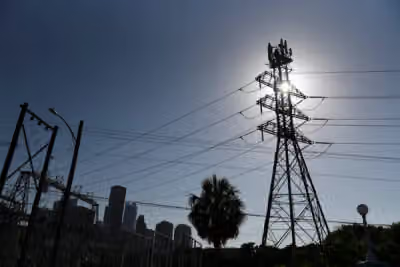
Power was cut to 1,324 high-consumption customers in Iran’s southwestern Khuzestan province on Monday, the provincial electricity distribution company said.
Sattar Nazari, head of the company’s consumption management office, said the province would continue daily monitoring and cut power to high-use customers without leniency to protect the grid.
He added that the cuts affected administrative, commercial, residential and agricultural users after consumption was monitored remotely through smart meters.
Two IRGC members were killed and two others wounded in a shooting in Paveh county in western Iran’s Kermanshah province, the provincial IRGC public relations office said on Tuesday.
The Islamic Revolutionary Guards office described the incident as a “terrorist” attack and said the shooting took place outside a home on Monday evening.
Authorities were investigating the details of the incident and working to identify those behind it, it added.