• العربية
  • فارسی
Brand
  • Iran Insight
  • Politics
  • Economy
  • Analysis
  • Special Report
  • Opinion
  • Podcast
  • Iran Insight
  • Politics
  • Economy
  • Analysis
  • Special Report
  • Opinion
  • Podcast
  • Theme
  • Language
    • العربية
    • فارسی
  • Iran Insight
  • Politics
  • Economy
  • Analysis
  • Special Report
  • Opinion
  • Podcast
All rights reserved for Volant Media UK Limited
volant media logo

Iran crude prices slashed as more shipments leave Hormuz – Bloomberg

Jun 22, 2026, 07:50 GMT+1

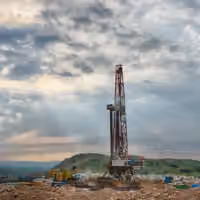
Sellers of Iranian crude to China have cut prices after Iran began shipping millions of barrels out of Hormuz following an interim peace deal with the United States, Bloomberg reported on Monday.

Spot cargoes of Iranian Light crude for July arrival were being offered at discounts of $2.50 to $5 a barrel to Brent benchmark prices, the report said, citing people directly involved in the trade.

That compared with a discount of about $1 a barrel before the deal.

Iran has increased the amount of crude it openly sends through the Strait of Hormuz to the highest level since the war began, as regional shipping activity picked up while Tehran and Washington worked toward a lasting peace deal, Bloomberg said in a separate report.

Around six million barrels of Iranian crude were aboard three US-sanctioned supertankers - Elva, Virgo and Vigor - that entered the chokepoint early Monday, it said, citing ship-tracking data.

The vessels were signaling destinations in waters off Singapore, where Iranian crude is known to be transferred to ships that often deliver the oil to refineries in China, it added.

•
•
•

More Stories

Israel reveals Iranian-designed Hezbollah ‘terror tunnel’ with large drone cache

Jun 21, 2026, 17:47 GMT+1
•
Benjamin Weinthal
Israel reveals Iranian-designed Hezbollah ‘terror tunnel’ with large drone cache
100%
Foreign journalists tour an underground tunnel in Majdal Zoun, southern Lebanon, during an Israeli military media embed.

The Israeli army revealed on Friday that it had discovered an Iranian-financed and -designed Hezbollah tunnel in the heart of Majdal Zoun in south Lebanon that can be used to launch drones into Israel.

The aerial projectiles can reach the densely populated cities of Tel Aviv, Jerusalem, and Haifa, according to an Israeli military official.

The disclosure marks the second time this month that Israel has reported discovering an Iranian-built tunnel for the US-designated terrorist group Hezbollah in Lebanon, and could impact the high-level talks in Switzerland on Sunday between the US and Iranian governments. A central security concern for Israel and Arab Persian Gulf states is the eradication of Iran’s ballistic missile and drone warfare systems.

A weapon inside a Hezbollah tunnel in Majdal Zoun, southern Lebanon. The Israeli military said the underground complex contained more than 50 drones, launch shafts, explosives, and other military equipment.
100%
A weapon inside a Hezbollah tunnel in Majdal Zoun, southern Lebanon. The Israeli military said the underground complex contained more than 50 drones, launch shafts, explosives, and other military equipment.

Israel’s government is deeply worried about Iran securing billions of dollars in sanctions relief from the Trump administration that could be used to finance Hezbollah and its subterranean military outposts across southern Lebanon.

The Israel Defense Forces (IDF) permitted a small number of foreign journalists, including Iran International, to embed with its soldiers in south Lebanon to inspect the tunnel, which contains over 50 attack drones and a room packed with eight tons of mines and bombs.

An IDF spokeswoman said, “This is Iranian equipment and facilities and proof that Hezbollah is another proxy of Iran.” She added that it is “one of the biggest tunnels found in southern Lebanon. Rocket launchers and UAVs were found.”

Intense clashes unfolded between Hezbollah and Israel during the journalistic embed with the IDF. Israel’s military said five soldiers were killed, including the commander of the IDF’s 52 Battalion, Lt. Col. Dor Gadalia Ben Simhon. Israel’s second war with Lebanon since October 2023 began when Hezbollah fired missiles into Israel in response to the joint US-Israel attack on Iran on February 28.

According to the IDF, the tunnel was discovered less than 10 days ago, and the capture of Majdal Zoun resulted in the elimination of eight Hezbollah fighters.

The new tunnel—located a mere 20 meters from a mosque in the center of the town—contains four launch pads to fire the sophisticated attack drones into the Jewish state. “To build a tunnel with a launch site is an Iranian method,” a military spokesman noted. He added that “Hezbollah tunnels are good but not as good [as Iranian].”

The military spokesman said that the “Iranians have a very high ability to build underground. They built tunnels in Iran and in Yemen for the Houthis.”

In early June, the Persian-language spokesman for the Israel Defense Forces (IDF) said, “The Israeli military is revealing an asset from the underground tunnel network of the Hezbollah terrorist organization that was built with the design and financing of the Iranian terrorist regime in the Beaufort Heights.”

The IDF said that the new tunnel is “over 200 meters long and more than 25 meters deep, containing four launch shafts and 12 rooms, including living quarters and rooms used to store explosive devices, anti-tank missiles, and UAVs.”

An IDF spokesman said the tunnel contains “high-level infrastructure and it is Iranian standards.”

Majdal Zoun is located roughly seven kilometers from Israel’s border. The IDF escorted reporters on Humvees for the 35-minute drive to reach the town. According to an IDF military official, the Shiite town had a population of 2,000 and “Hezbollah has great support in the village.” Since cross-border fighting began in October 2023, Majdal Zoun has become a ghost town.

Hezbollah fighters returned to the town to re-open the tunnel after it was sealed by the IDF two years ago. The tunnel and its strategic location on high territory make it a valuable stronghold of Hezbollah’s military apparatus, according to the IDF official.

The IDF official said, “It took them [Hezbollah] ten years to build it [the tunnel].”

The IDF transport of journalists to Majdal Zoun passed the Lebanese coastal town of Naqoura—the location of UNIFIL’s headquarters. An IDF official blasted the UN operation UNIFIL for failing to disarm Hezbollah, as mandated by the United Nations Security Council Resolution 1701.

An attack drone and related equipment inside a tunnel that the Israeli military says was designed and financed by Iran for Hezbollah in Majdal Zoun, southern Lebanon. Israeli officials said the underground facility was used to store and launch UAVs toward Israel.
100%
An attack drone and related equipment inside a tunnel that the Israeli military says was designed and financed by Iran for Hezbollah in Majdal Zoun, southern Lebanon. Israeli officials said the underground facility was used to store and launch UAVs toward Israel.

UNIFIL is an abbreviation for the United Nations Interim Force in Lebanon.

The military official said that “UNIFIL is not helping at all. They are trying to hide their support for Hezbollah. UNIFIL tells Hezbollah about IDF vehicle routes.”

The IDF official said the army recently discovered a Lebanese worker for UNIFIL is also a Hezbollah terrorist. The military official also alleged that a Lebanese hotel serving Hezbollah printed identification badges for both Hezbollah and the UN.

When asked about the IDF allegations, a UNIFIL spokesman told Iran International that “I have no information,” adding that “Since today is a UNIFIL holiday, I can’t do the full check. Not everyone is working—only critical ones.”

Iran’s legal drug market is being hollowed out as shortages feed illicit channels

Jun 20, 2026, 12:43 GMT+1
Iran’s legal drug market is being hollowed out as shortages feed illicit channels
100%

Iran’s official medicine market is being hollowed out as policy instability, currency disruptions and shortages push more patients toward illegal sellers, counterfeit drugs and informal supply networks, industry figures and officials have warned.

The warnings point to a new phase in Iran’s long-running drug crisis. The problem is no longer only that medicines are expensive or hard to find. The formal supply chain itself is weakening, while the black market grows around patients who cannot obtain medicine through pharmacies.

Haleh Hamedifar, head of the Association of Medical Biotechnology Product Manufacturers, told the semi-official ISNA news agency that the main challenge facing Iran’s pharmaceutical industry is not simply a shortage of foreign currency, but “instability in decision-making and lack of coordination in implementation.”

“The pharmaceutical industry cannot be managed with daily decisions, changing circulars and unpredictable processes,” she said.

Hamedifar warned that sudden policy changes disrupt the supply of raw materials, production and distribution, with effects that appear months later “in pharmacies, hospitals and ultimately at the patient’s bedside.”

  • Rising care costs hit Iranians with spinal injuries

    Rising care costs hit Iranians with spinal injuries

Iran says it produces most of the medicines consumed in the country, but domestic production still depends on imported raw materials, equipment, packaging, machinery and spare parts. That leaves even locally made drugs exposed to banking restrictions, currency decisions and import delays.

Hamedifar said recent shifts in currency rules have forced some raw materials out of preferential currency categories and into exchange-rate systems that are not reliably funded. Alternative routes, including the use of export proceeds or privately held foreign currency, were introduced before the administrative infrastructure was ready, she said.

Companies have been forced to amend files, repeat import registrations and restart procedures they had already completed, she said.

“The problem in many cases is not the decision itself, but how it is implemented,” Hamedifar said.

She said outages and errors in government platforms, including disconnects between trade, drug-regulation and banking systems, should not be treated as technical glitches because each delay can postpone the arrival of raw materials and later disrupt drug supply.

Interior Ministry spokesman Ali Zeynivand separately acknowledged that high medicine prices are real and said the government does not deny that internal failures may be part of the problem.

“Part of the problems are caused by the imposed war, another part by the sanctions that already existed, and part may be due to our shortcomings or lack of precision,” he told the Dideban Iran news website. “We do not reject any of these.”

Zeynivand said President Masoud Pezeshkian, himself a physician, is personally sensitive to the issue and that the Health Ministry, Plan and Budget Organization and Central Bank are working on measures to contain the situation. But he cautioned that Iran’s economic problems would not be solved simply by signing a memorandum.

For patients, the consequences are already visible in higher out-of-pocket costs, incomplete prescriptions, empty pharmacy shelves and growing reliance on unofficial sellers.

Mehdi Sanei, an investigator at Iran’s medical crimes prosecutor’s office, told the Iranian daily Shargh that Iran has only one legal medicine market: the official network supervised by the Health Ministry and Food and Drug Administration. Any medicine sold outside that chain is illegal, he said.

  • Shortages of addiction medicines raise fears of relapse in Iran

    Shortages of addiction medicines raise fears of relapse in Iran

“In the field of medicine, there is no such thing as a legal free market,” Sanei said.

He said shortages are the starting point for much of the illegal trade. When patients cannot find medicine in pharmacies, they turn to dealers, Telegram channels, middlemen and informal networks.

“As long as medicine shortages exist, the smuggling market will exist,” he said.

Sanei warned that the illegal drug market is unusually profitable because patients cannot postpone treatment. Families dealing with cancer or chronic illness may sell savings, jewelry, cars or even homes to obtain scarce medicine.

“I do not know of a commodity whose profit is as guaranteed as smuggled medicine,” he said.

He said some black-market medicines are official Iranian-made drugs diverted from the legal system through fake prescriptions, distribution violations or other routes. But he described an even more dangerous trend: the growing presence of counterfeit or unauthorized medicines made inside Iran.

Sanei estimated that more than 80 percent of medicines in the illegal market are now unauthorized domestic products rather than genuine imported drugs.

Those products may be made in illegal workshops with unknown or ineffective materials and fake packaging, he said. Some may contain no active ingredient, contamination or harmful substances.

“People pay heavy costs, and there is no guarantee that what they receive is really medicine,” he said.

The result is a self-reinforcing cycle: shortages weaken the legal market, patients move toward illegal sellers, the black market becomes more profitable, and the official system loses more ground.

“The smaller the legal market becomes, the larger the illegal market becomes,” Sanei said.

Iran's forces beat Baluch women protesting over mines and local resources

Jun 18, 2026, 13:52 GMT+1
Iran's forces beat Baluch women protesting over mines and local resources
100%

Baluch women were beaten during protests over local mining projects in southeastern Iran, renewing attention on the Islamic Republic’s treatment of one of the country’s poorest and most heavily policed minorities.

The incidents were reported in Faryab county in Kerman province and in Taftan county in Sistan and Baluchestan, where residents had gathered to protest mining projects they say have damaged local livelihoods or excluded native communities from the benefits of natural resources.

The Baluch rights group Haalvsh said at least eight Baluch women were injured and six people, including three women, were arrested on Wednesday after forces attacked a protest over a chromite mine in Pashmoki, a village in Faryab county.

According to Haalvsh, residents were protesting what they described as the transfer of mining benefits to people with influence while local communities remain deprived of the economic gains. Videos published by the group show uniformed forces confronting women and other residents, with several women seen being pushed, struck or beaten.

Haalvsh said the detainees had been taken to an unknown location and their families had not received clear information about their condition or whereabouts.

The Pashmoki incident came less than 48 hours after Haalvsh reported another assault on Baluch women protesting activity linked to the Taftan gold mine in Sistan and Baluchestan province.

In that case, women in Sarsiah village said forces insulted, threatened and beat them after they objected to the mine’s impact on local water, farmland and daily life. Haalvsh said one woman was injured in the head after being struck with the butt of a weapon.

The immediate disputes are local, but the anger around them is rooted in a much wider sense of exclusion. Residents say mining projects are damaging water resources, disrupting villages and enriching others while Baluch communities remain poor.

Sistan and Baluchestan has long been one of Iran’s most deprived provinces. Its mostly Sunni Baluch population has faced discrimination, underdevelopment and heavy security pressure under the Islamic Republic. The region has repeatedly seen deadly crackdowns, including the 2022 “Bloody Friday” killings in Zahedan.

Human rights groups have also documented the disproportionate use of executions against Baluch prisoners, especially on drug-related charges. Amnesty International said Baluch people accounted for 29% of Iran’s drug-related executions in 2023 despite making up about 5% of the population. Iran Human Rights said Baluch prisoners represented 17% of drug-related executions in 2024, while forming an estimated 2% to 6% of Iran’s population.

Molavi Abdolhamid, the influential Sunni cleric in Zahedan, has repeatedly criticized the execution of Baluch prisoners. He said in 2023 that many people executed on drug-related charges had been accused of sales worth as little as $15 to $20, and that poverty, unemployment and lack of infrastructure had pushed some people in the region into smuggling fuel, goods or drugs as a lifeline.

That background is why the beatings at the mine protests have resonated beyond the two villages. The images show Baluch women, among the most marginalized voices in Iran, confronting security forces over the basic question of who benefits from the wealth beneath their land.

The Islamic Republic often frames unrest in Baluch areas through the language of security, smuggling or separatism. But the protests in Pashmoki and Sarsiah point to another reality: communities demanding water, livelihood, dignity and a say over local resources, and being met with batons, threats and arrests.

Text of US-Iran memorandum released

Jun 17, 2026, 20:17 GMT+1
Text of US-Iran memorandum released
100%

A senior US official on Wednesday read out a 14-point memorandum of understanding between the United States and Iran that outlines a high-level understanding to halt the war in Iran and open the Strait of Hormuz.

The agreement defers many of the most difficult issues, including how to wind down Iran's nuclear program, until a final deal is reached, and paves the way for a broader 60-day negotiation period due to begin in Switzerland on Friday.

The document, titled "Islamabad Memorandum of Understanding between the United States of America and the Islamic Republic of Iran," was read out to reporters by the US official as follows:

1. The United States of America and the ​Islamic Republic of Iran and their ⁠allies in the current war, by signing this MoU (Memorandum of Understanding), declare the immediate and permanent termination of military operations on ‌all fronts, including in Lebanon, and undertake from now on not to initiate any war or any military operation against each other, and to refrain from the threat or use of force against each other, and ensuring the territorial integrity and sovereignty of Lebanon. The final deal will confirm the permanent termination of the war on all fronts, including in Lebanon, and other provisions of this paragraph.

2. The United States of America and the Islamic Republic of Iran undertake to respect each other's sovereignty and territorial integrity, ​and to refrain from interfering in each other's internal affairs.

3. The United States of America and the Islamic Republic of Iran commit to negotiating and achieving the final deal ‌in maximum 60 days extendable with mutual consent.

4. Immediately upon the signing of this MoU, the United States of America will begin the removal of its naval blockade and any disturbances or impediments against the Islamic Republic of Iran, and will fully end the naval blockade within 30 days. During this period, the traffic of vessels will be in proportion to the numbers of pre-war traffic being restored by the Islamic Republic of Iran. The United States of America further undertakes to remove ‌its forces from the proximity of the Islamic Republic of Iran within 30 days after the final deal.

5. Upon the signing of this MoU, the Islamic Republic of Iran will make arrangements using its best efforts for the safe passage of commercial vessels with no charge for 60 days only from the Persian Gulf to the Sea of Oman and vice versa. The traffic of commercial vessels will immediately start ⁠and, considering the need for removing the technical and military obstacles and de-mining by the Islamic Republic of Iran, will be instated within 30 days. The Islamic Republic of Iran will conduct dialog with the Sultanate of Oman to define the future administration and maritime services in the Strait of Hormuz, in discussion with other Persian Gulf littoral states in line with ‌the applicable international law and ​the sovereign rights of coastal states of the Strait of Hormuz.

6. The United States of America undertakes with regional partners to develop a definitive, mutually agreed plan with at least USD 300 billion for the reconstruction and economic development of the Islamic Republic of ​Iran. The mechanism for the implementation of this plan will be finalized as part of final deal within 60 days. All required licenses, waivers, and permissions needed for the relevant financial transactions will be granted by the ⁠United States of America.

7. The United States of America undertakes to terminate all types of sanctions against the Islamic Republic of Iran, including the United Nations Security Council resolutions, ‌i.e. IAEA Board of Governors resolutions, and all unilateral US sanctions, primary and secondary, in an agreed upon schedule as part ​of the final deal. The Islamic Republic of Iran and the United States of America acknowledge the critical importance of the sanctions termination issue above mentioned and express their intentions to immediately address these issues in the negotiations in order to achieve mutual agreement on them.

8. The Islamic Republic of Iran reaffirms that it shall not procure or develop nuclear weapons. The United States of America and the Islamic Republic of Iran have agreed to resolve the disposition of stockpiled enriched material pursuant to ‌a mechanism that will be mutually agreed upon, in accordance with the schedule mentioned in paragraph seven with the minimum methodology to be down blending on site under the supervision of the ​IAEA. The two parties also agreed to discuss the issue of enrichment and other mutually agreed matters related to the Islamic Republic of Iran's nuclear needs, based on a satisfactory framework being agreed upon in the final deal. The final deal will confirm the provisions of this paragraph. The United States of America and the Islamic Republic of Iran acknowledge the critical importance of the nuclear issues above mentioned and express their intention to immediately address these issues in the negotiations in order to achieve mutual agreement on them.

9. Pending the final deal, the United States of America ​and the Islamic Republic of Iran agree to maintain the status quo. The Islamic Republic of Iran will maintain the current status quo of its nuclear program and the United States of America will not impose any new sanctions and will not deploy additional forces in the region.

10. The United States of America undertakes that immediately upon the signing of this MoU and until the termination of sanctions, US Department of Treasury will issue waivers for the export of Iranian crude oil, petroleum products, and derivatives, and all associated services, including banking transactions, insurances, transportation, etc.

11. The United States of America undertakes to make fully available for use the frozen or restricted funds and assets of the Islamic Republic of Iran. Upon the implementation of this MoU, the United States of America and the Islamic Republic of Iran will mutually agree on the procedures related to the release of these funds during the negotiation. Such funds, whether retained in the original account or transferred, shall be made fully usable for payment to any ultimate beneficiary designated by the Central Bank of the Islamic Republic of Iran. The United States of America undertakes to issue all necessary licenses and authorizations accordingly.

12. The United States of America and the Islamic Republic of Iran agree that an executive mechanism will be ⁠established to monitor the successful implementation of this MoU and the future compliance of the final deal.

13. After signing this MoU, and subject to the beginning of the ⁠implementation of paragraphs 1,4,5,10 and 11 of this MoU, and ​the continuing implementation of these measures, the United States of America and the Islamic Republic of Iran will start negotiations regarding the final deal exclusively on the other paragraphs.

14. The final deal will be endorsed by a binding UNSC resolution.

Toronto shooting probe uncovers trail leading to Tehran

Jun 17, 2026, 20:12 GMT+1
•
Mahsa Mortazavi
Toronto shooting probe uncovers trail leading to Tehran
100%
Law enforcement personnel survey the scene outside the U.S. Consulate after shots were fired, in Toronto, Ontario, Canada, March 10, 2026. Picture taken with a mobile phone.

A Toronto police operation targeting suspects linked to the March attack on the US Consulate has uncovered what investigators believe is a far-reaching network connecting a series of shootings across the Greater Toronto Area to actors operating beyond Canada's borders.

According to confidential information obtained by Iran International from police sources, investigators have identified a traceable logistics, supply and equipment pipeline linking suspects in the Toronto shootings to individuals and networks originating in Tehran.

The findings have raised concerns among investigators that criminal groups in Canada may have been used to facilitate operations tied to broader geopolitical objectives.

The revelation comes as Toronto police continue to investigate a network allegedly responsible for dozens of shootings across the GTA.

The investigation intensified following an early-morning raid in which Constable Marc Pinizzotto was killed during an exchange of gunfire. Ballistic testing later linked firearms recovered at the scene to 27 separate shootings, according to Toronto Police.

Police Chief Myron Demkiw said investigators uncovered a recurring pattern in which teenagers and low-level gang members were allegedly recruited through encrypted messaging applications such as Telegram, WhatsApp and Signal to carry out attacks for payment.

In some cases, the recruits were allegedly instructed to film the shootings as proof that the assignments had been completed.

Among those charged is 18-year-old Sheldon Tracy-Stewart, who was wounded and arrested during the raid. Another suspect, 19-year-old Zara Jabbi, remains at large.

The Toronto investigation has unfolded alongside a separate U.S. terrorism case involving Mohammad Baqer Saad Dawood al-Saadi, an Iraqi national charged in New York.

According to U.S. court documents, prosecutors allege that al-Saadi played a role in coordinating attacks linked to Iranian interests abroad.

Federal investigators say he acknowledged in a recorded conversation that associates connected to his network carried out the shooting at the US Consulate in Toronto, allegedly in retaliation for US actions against the Islamic Republic.

The allegations have not been tested in court.

The emerging picture has also renewed attention on an armed attack targeting Iranian-Canadian activist Salar Gholami in Toronto earlier this year.

In the early hours of March 1, gunmen fired at a sports club owned by Gholami, a prominent opposition activist whose facility has served as a gathering place for anti-government events and demonstrations. At least 17 rounds struck the building.

Gholami believes the attack should be examined alongside the broader network now under investigation. Security footage, he said, showed a young masked gunman whose profile resembled the recruits allegedly used in other GTA shootings.

Authorities have not publicly linked the attack on Gholami's club to the wider investigation. But members of Canada's Iranian community argue that threats against dissidents deserve closer scrutiny as investigators work to determine the full extent of the network's operations.

Most Viewed

Hardliners accuse negotiating team of ignoring Supreme Leader's objections
1

Hardliners accuse negotiating team of ignoring Supreme Leader's objections

2

Hardliner reveals ‘top-secret’ Khamenei objections to US talks on state TV

3

Israel reveals Iranian-designed Hezbollah ‘terror tunnel’ with large drone cache

4

Iran’s legal drug market is being hollowed out as shortages feed illicit channels

5

Illegal adoptions expose Iran’s hidden baby-selling market, child advocate warns

Banner
Banner
Banner

Spotlight

  • Iran's postwar rallies become flashpoint in diplomacy debate
    INSIGHT

    Iran's postwar rallies become flashpoint in diplomacy debate

  • MoU's forgotten casualty is the Iranian people
    OPINION

    MoU's forgotten casualty is the Iranian people

  • Iran may get a lifeline, but major obstacles remain
    ANALYSIS

    Iran may get a lifeline, but major obstacles remain

  • Can Iran rebuild ties with Arab neighbours without a US deal?
    INSIGHT

    Can Iran rebuild ties with Arab neighbours without a US deal?

  • Trump says Iran is 'finished', experts say Tehran won big
    PODCAST

    Trump says Iran is 'finished', experts say Tehran won big

  • A US-Iran deal alone won't rescue Iran's oil economy
    ANALYSIS

    A US-Iran deal alone won't rescue Iran's oil economy