• العربية
  • فارسی
Brand
  • Iran Insight
  • Politics
  • Economy
  • Analysis
  • Special Report
  • Opinion
  • Podcast
  • Iran Insight
  • Politics
  • Economy
  • Analysis
  • Special Report
  • Opinion
  • Podcast
  • Theme
  • Language
    • العربية
    • فارسی
  • Iran Insight
  • Politics
  • Economy
  • Analysis
  • Special Report
  • Opinion
  • Podcast
All rights reserved for Volant Media UK Limited
volant media logo

Inside the Iranian missile base hit by Israel near Najafabad

Jun 8, 2026, 20:30 GMT+1

Videos showing explosions, smoke and possible missile impacts in areas near Najafabad in central Iran appear to point to Israeli attacks on the Ahmad Kazemi complex, one of the Revolutionary Guard's most important missile bases.
Citizens who sent the videos to Iran International described the locations as the mountains near Najafabad or areas around Vilashahr, Khomeini-Shahr and Homayoun-Shahr.

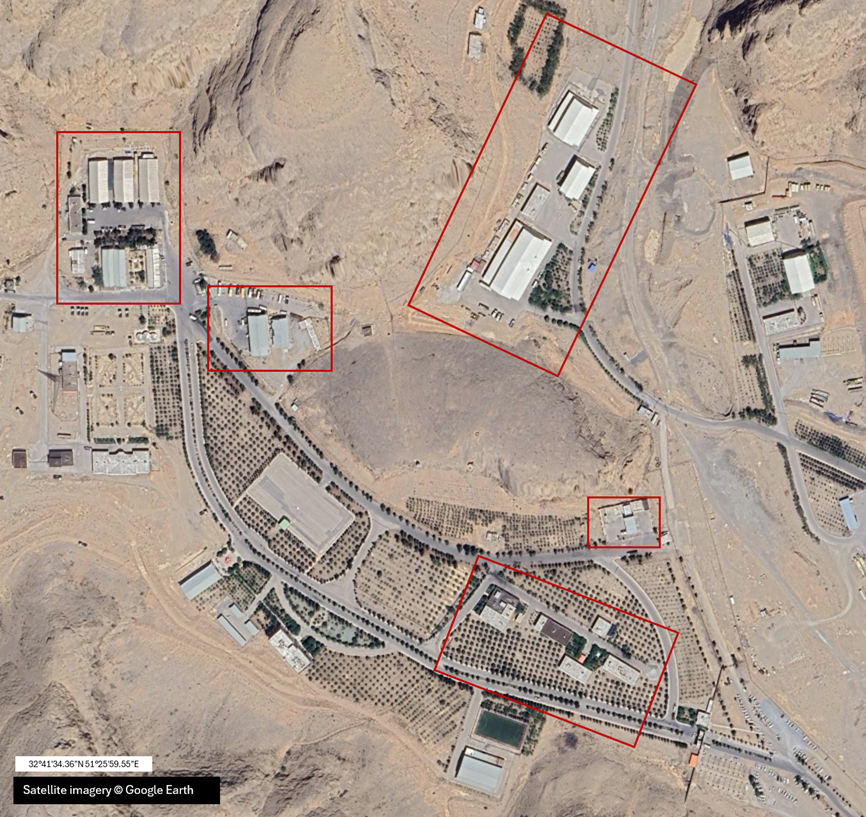
The Ahmad Kazemi facility is located in that same area, five kilometers west of Khomeini-Shahr, 1.5 kilometers north of Vilashahr and seven kilometers northeast of Najafabad.

Officially named after Ahmad Kazemi, a late commander of the IRGC Air Force, the roughly two-square-kilometer complex is used for the production, assembly and storage of the IRGC’s strategic missiles.

Iranian state media usually describe such sites as “missile cities.”

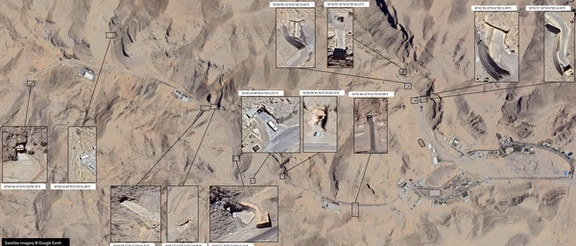
A cluster of 12 tunnel entrances can be seen at the complex in aerial images.

100%

The site’s storage capacity has reportedly been estimated at up to 2,000 missiles, though that refers to its overall capacity. After two wars, it is unclear how many missiles actually remain there.

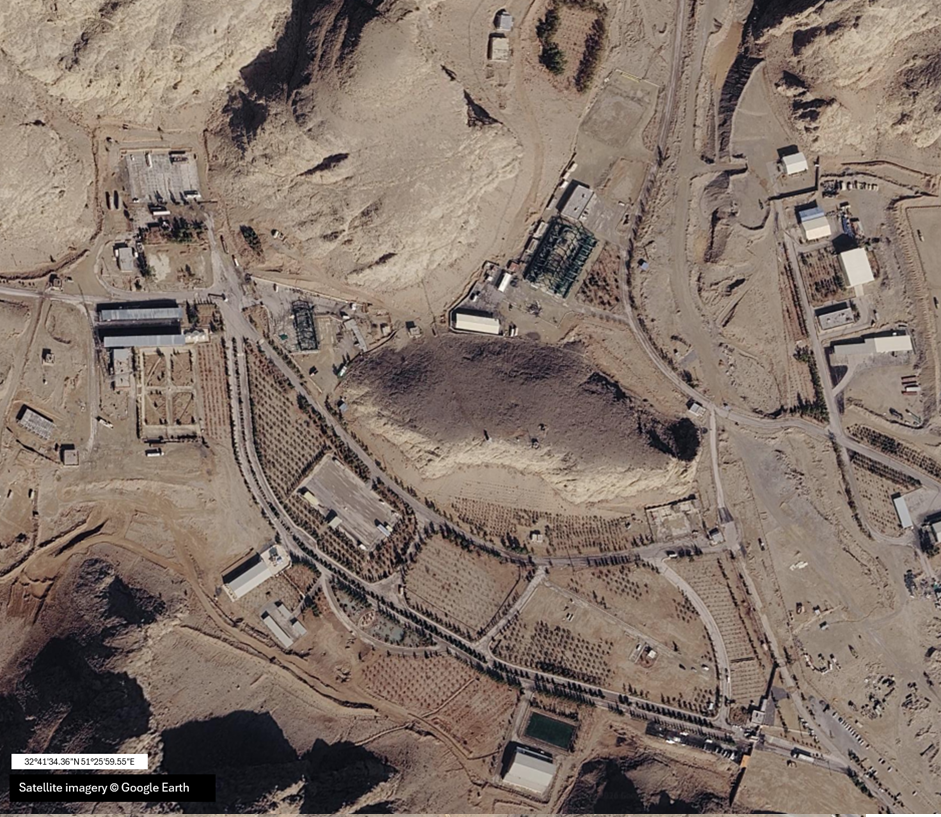
Prepared berms for deploying launchers and missile transport frames are visible across the complex.

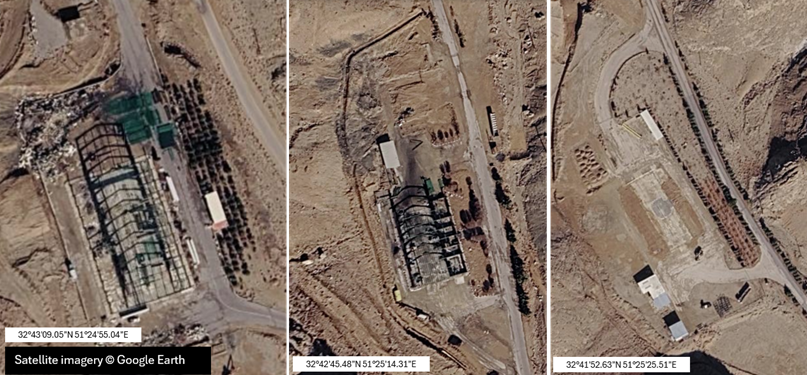
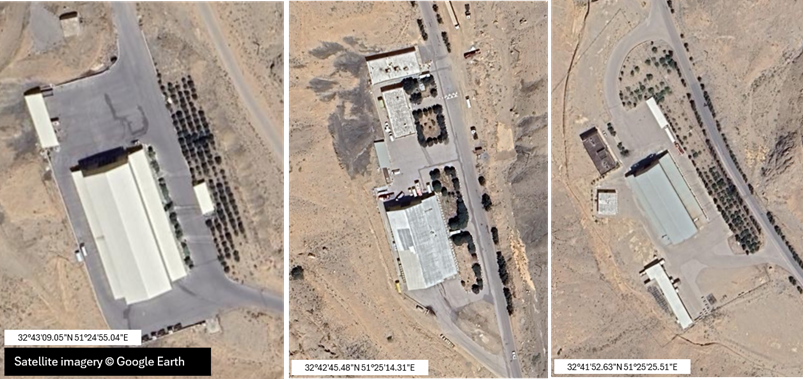
A comparison of images from before the 12-day war in July 2024 and after it in December 2025 shows that large parts of the base were destroyed during that conflict.

(To compare the images below, move the slider from right to left or vice versa.)

After
After
Before
Before
Drag to compare

During the clashes on Sunday night and Monday morning, June 8, there were reports both of missile launches from the area and of explosions at the site following Israeli attacks.

The Nuclear Threat Initiative (NTI) has described the complex as Iran’s largest missile assembly and production facility.

The Ahmad Kazemi complex was built in the late 1980s with assistance from North Korea and China. Solid and liquid fuels, missile components, Shahab missiles and Chinese-made Silkworm and M-class missiles are assembled and produced there.

During both the 12-day war in 2025 and the 2026 war, known as the 40-day war, powerful explosions were repeatedly reported in the area.

Aerial imagery partly revealed the extent of the damage after the 12-day war.

(To compare the images below, move the slider from right to left or vice versa.)

After
After
Before
Before
Drag to compare

During the 2026 war, multiple reports were published about attacks on the base, including on March 13, 2026, and March 27, 2026.

Most Viewed

Delayed burial, absent successor: Questions over post-Khamenei Iran
1

Delayed burial, absent successor: Questions over post-Khamenei Iran

2

Student protests over university entrance exam rules continue across Iran

3
ANALYSIS

From banks to blockchains: US opens new front in Iran sanctions

4
INSIGHT

Iran turns to LA-based singer for state-backed religious event

5
INSIGHT

What Israel hit at Iran's Karoon Petrochemical and why it matters

Banner
Banner

Spotlight

  • 'Nothing is over':  Iran-Israel conflict enters a new phase
    ANALYSIS

    'Nothing is over': Iran-Israel conflict enters a new phase

  • Delayed burial, absent successor: Questions over post-Khamenei Iran

    Delayed burial, absent successor: Questions over post-Khamenei Iran

  • Iran turns to LA-based singer for state-backed religious event
    INSIGHT

    Iran turns to LA-based singer for state-backed religious event

  • From banks to blockchains: US opens new front in Iran sanctions
    ANALYSIS

    From banks to blockchains: US opens new front in Iran sanctions

  • Can Trump crack Iran's negotiating playbook?
    PODCAST

    Can Trump crack Iran's negotiating playbook?

  • Explained: Iran's frozen assets around the world

    Explained: Iran's frozen assets around the world

•
•
•

More Stories

What Karoon Petrochemical produces and why it matters

Jun 8, 2026, 11:50 GMT+1
What Karoon Petrochemical produces and why it matters
100%
Photo published by Tasnim News Agency, affiliated with Iran’s Revolutionary Guards, shows damage following the June 8 attack on the Karoon Petrochemical Complex.

A strike on the Karoon Petrochemical complex in southwestern Iran on Monday put the spotlight on a key industrial facility with roles in both civilian production and sectors tied by Israel and Western governments to Iran's military capabilities.

Officials in Khuzestan province said the facility was hit during Israeli attacks, with reports indicating damage to chlorine-related units and storage facilities. Any prolonged disruption could affect both domestic supply chains and exports from one of Iran's most important petrochemical hubs.

Karoon is located in Mahshahr, home to a concentration of petrochemical facilities that form a major pillar of Iran's non-oil economy.

Links to the IRGC

Karoon is owned by Persian Gulf Petrochemical Industries Company (PGPIC), Iran's largest petrochemical holding group.

The United States sanctioned PGPIC and dozens of affiliated companies in 2019, saying the group generated billions of dollars that helped finance the Islamic Revolutionary Guards Corps and its construction arm, Khatam al-Anbiya.

According to the US Treasury, PGPIC subsidiaries worked with Khatam al-Anbiya through engineering, construction and financing contracts worth hundreds of millions of dollars. Washington said revenue from the petrochemical sector provided an important source of funding for the IRGC's military activities.

The Guards have long maintained a significant presence in Iran's energy and industrial sectors through a network of companies, contractors and affiliated organizations that oversee major infrastructure projects and benefit from export revenues.

Role in missile-related industries

Petrochemical facilities are primarily civilian enterprises, but some of their products can have military applications.

Chemical compounds produced in Mahshahr and other petrochemical centers such as Assaluyeh can be used as precursor materials in the production of propellants and other components associated with missile programs.

During previous operations targeting industrial facilities in the Mahshahr area, Israel said sites in the region were involved in producing materials used by Iran's missile program.

Israeli military officials said on Monday that one of their objectives was to destroy infrastructure used to manufacture raw materials essential for ballistic missile production.

The dual-use nature of petrochemical production means facilities can simultaneously support civilian industries while supplying materials that may have military applications.

Critical supplier for domestic industry

Despite scrutiny over military links, Karoon remains one of the most important suppliers to Iran's civilian manufacturing sector.

The company is the region's only producer of isocyanates, advanced chemical compounds used in the production of polyurethane materials.

These products serve as the foundation for a wide range of industrial and consumer goods, including insulation, adhesives, coatings, automotive components, footwear, furniture and household appliances.

Karoon receives feedstock such as benzene and toluene from neighboring petrochemical plants and combines them with chlorine, carbon monoxide and hydrogen to produce isocyanates and related products.

The facility's strategic importance increased after the implementation of the HYCO (Hydrogen and Carbon Monoxide) project, which enabled domestic production of carbon monoxide and hydrogen and reduced dependence on imported supplies.

Impact on supply chains and exports

Industry experts say damage to chlorine production units could have consequences beyond the immediate facility.

Chlorine is essential for the production of phosgene, a key intermediate chemical used in manufacturing isocyanates. Any interruption to chlorine supplies can halt downstream production, affecting multiple industries dependent on polyurethane products.

  • Strikes on petrochemical hubs leave Iran short of plastics

    Strikes on petrochemical hubs leave Iran short of plastics

The effects could extend throughout the Mahshahr industrial zone, disrupting manufacturers that rely on Karoon's output.

Karoon also serves export markets. The company ships products including aniline to India and sells other chemical products to customers in Turkey, Russia and neighboring countries.

Those exports have helped Iran maintain a regional presence in specialty chemical markets while generating valuable foreign currency earnings.

A strategic target

The strike illustrates how Iran's petrochemical sector occupies a position at the intersection of economic and security concerns.

For Tehran, facilities such as Karoon support industrial self-sufficiency, exports and employment. For Israel and Western governments, parts of the sector are viewed as supporting broader military and missile-related capabilities through financial links to the IRGC and the production of dual-use materials.

As a result, major petrochemical complexes have become increasingly significant targets in a confrontation that extends well beyond the battlefield and into the infrastructure underpinning Iran's economy and defense industries.

Delayed burial, absent successor: Questions over post-Khamenei Iran

Jun 7, 2026, 09:28 GMT+1
•
Masoud Kazemi
Delayed burial, absent successor: Questions over post-Khamenei Iran
100%
An empty seat and a portrait of Iran's slain Supreme Leader Ali Khamenei are seen at a venue in Tehran

One hundred days after former Supreme Leader Ali Khamenei was killed in an attack on his office in Tehran, the Islamic Republic has yet to bury the man who led the country for more than three decades.

The delay has become one of the most unusual and politically sensitive aspects of Iran's post-war transition. While senior military commanders and officials killed in the same conflict have already been buried, repeated promises of a massive funeral for Khamenei have so far gone unfulfilled.

Tehran municipal officials spoke of plans for a multi-day funeral procession later this month. Ceremonies, they said, are expected to span several cities before Khamenei's final burial in the religious city of Mashhad.

  • Iranians react with joy and disbelief to Khamenei's death

    Iranians react with joy and disbelief to Khamenei's death

The prolonged delay sits awkwardly alongside Shi'ite religious tradition, which generally favors the prompt burial of the dead. Classical jurisprudence encourages hastening burial except in exceptional circumstances, such as uncertainty over death or concerns about preserving life. Several contemporary clerics have similarly argued that unnecessary delays should be avoided if they risk disrespecting the deceased.

The absence of a funeral has fueled speculation about the condition of Khamenei's remains following the strike that killed him. Iranian media reports about other officials who died in the same attack described bodies recovered weeks later and identified only through DNA testing after suffering extensive damage.

Officials have released no information about the condition or location of Khamenei's remains.

Security concerns and a missing successor

The unanswered questions surrounding the burial have merged with another mystery: the continued absence of Khamenei's successor.

Mojtaba Khamenei, who assumed leadership following his father's death, has not appeared publicly since the attack. Officials insist he survived and suffered only minor injuries, but reports and rumors about more serious wounds have persisted.

Iranian slain Supreme Leader Ali Khamenei stands before coffins draped in Iranian flags during a memorial ceremony for military commanders and officials killed in the Iran-Israel conflict, in Tehran.
100%
Iranian slain Supreme Leader Ali Khamenei stands before coffins draped in Iranian flags during a memorial ceremony for military commanders and officials killed in the Iran-Israel conflict, in Tehran.

If alive and active, Mojtaba Khamenei would rank among Israel's most prominent targets. Any large public appearance could present significant security risks.

That reality complicates what would ordinarily be a defining moment for a new leader. A funeral for a supreme leader is not merely a religious ceremony; it is also a display of political continuity. The absence of the successor from such an event would be difficult to explain, while his appearance could expose him to risks the authorities may be unwilling to accept.

The politics of a funeral

There is also a political dimension to the delay. The Islamic Republic has a long history of using such ceremonies for political messaging. An example was the funeral of Qassem Soleimani, the former commander of the Revolutionary Guards' Quds Force.

The funeral procession, held for several days, passed through Kadhimiya, Baghdad, Najaf, Karbala, Ahvaz, Mashhad, Tehran and Qom before Soleimani was ultimately buried in Kerman.

  • Why Khamenei’s funeral keeps changing

    Why Khamenei’s funeral keeps changing

State media and Iranian officials said millions of people attended the ceremonies and repeatedly used images from the events in official messaging.

The publicity surrounding the funeral largely overlooked the deaths of 56 mourners, who were killed in a stampede during the burial ceremony in Kerman.

Officials have shown they hope for a similarly turnout for Khamenei. Yet organizing a funeral on that scale in the aftermath of war presents obvious logistical and security challenges.

For now, the result is an unusual limbo. One hundred days after Khamenei's death, Iran has formally selected a successor but has yet to publicly introduce him. It has promised a historic farewell for its former leader but has yet to hold one. And it continues to confront questions that neither official statements nor public ceremonies have managed to answer.

Can Trump crack Iran's negotiating playbook?

Jun 5, 2026, 21:20 GMT+1
•
Negar Mojtahedi
Can Trump crack Iran's negotiating playbook?
100%
US President Donald Trump points his finger during a cabinet meeting in the Cabinet Room at the White House, in Washington, D.C., US, May 27, 2026.

As US-Iran talks stall over Tehran's demand for billions of dollars in frozen assets, the Trump administration faces a familiar challenge: whether it can force a deal before Iran's long-standing strategy of delay reshapes the terms of negotiation.

A senior Iranian official told CNN on Friday that a potential agreement hinges on Washington releasing $24 billion in frozen Iranian funds, warning the United States would enter a "dark corridor" if it resumes military action.

The comments came as Iran also tied the future of a broader peace arrangement to developments in Lebanon, Hezbollah and the reopening of the Strait of Hormuz.

For President Donald Trump, the standoff is testing whether his mix of pressure, unpredictability and military force can break a negotiating playbook that has frustrated successive US administrations.

"The Islamic Republic gets a vote here too," Jason Brodsky, policy director at United Against Nuclear Iran, told Eye for Iran. "The Iranian regime plays a much longer game than the United States does in terms of its strategic patience and strategy."

Brodsky said Iran has historically used prolonged negotiations to wear down international demands, pointing to how the original US position of zero enrichment eventually gave way to the 2015 nuclear deal's limited enrichment framework.

But he argued Trump has changed the baseline by demonstrating a willingness to use force.

"For the first time in decades, the Islamic Republic is not enriching uranium," Brodsky said, crediting US and Israeli military action with changing the facts on the ground.

Can Trump outlast Tehran's long game?

Former US diplomat Alberto Fernandez said Trump may possess an advantage previous administrations lacked: the ability to walk away from a deal while maintaining pressure.

"No deal is better than a bad deal," Fernandez said, arguing that Trump could refuse sanctions relief, maintain the blockade and preserve the threat of future strikes if Tehran refuses to compromise.

Still, there are concerns that Iran's strategy may be working in more subtle ways. Tehran has long relied on protracted negotiations to buy time, lower demands and secure concessions incrementally.

Daily Mail special correspondent David Patrikarakos warned that if Iran secures a limited nuclear agreement without restrictions on missiles or regional activity, it could still claim victory.

"If what Iran gets is a ring-fenced nuclear deal, then honestly, it's a defeat and it is a win for the Iranians," he said.

The question is whether Trump can sustain pressure long enough to force a broader agreement—or whether domestic politics, oil prices and regional tensions ultimately push Washington toward a narrower deal.

Is Iran's leverage shrinking?

That question extends beyond the nuclear file.

In Lebanon, President Joseph Aoun delivered a rare public rebuke to Tehran this week, accusing Iran of using his country as a "bargaining chip" in its confrontation with Washington and Israel.

"You are not trying to help us," Aoun told CNN. "The people of Lebanon are paying the price for the sake of your own interest."

He also directed a message to Iran's Islamic Revolutionary Guard Corps: "It's not your country, it's our country."

The comments reflect growing frustration among Lebanese officials who argue their country has paid the price for regional conflicts driven by outside powers.

May Farhat, Iran International's correspondent in Beirut, said Hezbollah is facing one of the weakest periods in its history after major military and political setbacks.

"There is little doubt that Hezbollah is going through one of the most difficult periods in its history," Farhat told Eye for Iran.

She pointed to the killing of senior commanders, the loss of Hassan Nasrallah, tighter border controls and new Lebanese restrictions on Iranian access as evidence that the balance of power inside Lebanon is shifting.

For the first time in years, Lebanese authorities have suspended direct Iranian flights, tightened visa requirements for Iranian citizens and moved to limit Tehran's influence over strategic infrastructure and border crossings.

The weakening of Hezbollah matters because it potentially reduces one of Tehran's most important sources of regional leverage at a moment when Iran is attempting to negotiate from a position of strength.

The Strait of Hormuz represents another test of Iran's leverage.

For decades, the Islamic Republic has used the threat of disruption in the waterway as one of its most powerful strategic tools. But according to Homayoun Falakshahi, who leads Kpler's crude oil analysis team, that leverage may already be eroding.

Falakshahi said oil tanker traffic through the Strait of Hormuz has fallen dramatically since the war and the US blockade on Iranian ports. Before the conflict, roughly 30 oil tankers transited the waterway daily. Today, the average is closer to one or two.

More importantly, he argues that the crisis is accelerating efforts by Gulf states to reduce their dependence on the strait altogether.

Abu Dhabi is already expanding export capacity through Fujairah on the Gulf of Oman, while other producers are exploring alternative routes.

"Five years from now, that leverage that the Islamic Republic currently has probably will not exist anymore," Falakshahi said.

He believes Iran may be overestimating the long-term value of its position.

"They always overplay their hand," he said.

While the disruption of the Strait of Hormuz has demonstrated Tehran's ability to shake global energy markets, Falakshahi argues that the strategy ultimately hurts Iran's own interests by damaging China, its most important oil customer and strategic partner.

"I don't think they have the upper hand," he said. "Even though they want everyone to believe that they have."

For now, Iran is testing the limits: in Lebanon, in the Persian Gulf, at sea and at the negotiating table.

Trump may have disrupted Tehran's playbook. But whether he has cracked it will depend on whether pressure produces a durable agreement—or simply another pause in a decades-long confrontation.

Iran turns to Iraq’s Umm Qasr as new hub to bypass US blockade

Jun 5, 2026, 06:50 GMT+1
•
Farnaz Davari
Iran turns to Iraq’s Umm Qasr as new hub to bypass US blockade
100%
A view of Umm Qasr Port is seen after protesters blocked its entrance, south of Basra, Iraq October 30, 2019.

More than 50 days into the US blockade of Iran’s southern ports, Iraq’s Umm Qasr has emerged as a new hub for Iran-bound cargo, trade sources say, as Tehran’s first major workaround through Oman’s Khasab grows slower, busier and more expensive.

The Iraqi port is now being used to move some Iran-bound cargo, including cars, after shipments are first transferred from ports in the United Arab Emirates on vessels flying non-Iranian flags, sources with knowledge of the matter Iran International.

The shift adds a new layer to Iran’s effort to keep trade moving through indirect routes after the US blockade, which began on April 13, closed the main passages in the Strait of Hormuz to Iranian ships and vessels linked to the Islamic Republic.

Iran International previously reported that the small Omani port of Khasab, on the Musandam Peninsula near the mouth of the Strait of Hormuz, had become one of the main alternatives for moving goods into Iran.

Cargoes that once moved through standard UAE-Iran channels have been transferred from Emirati ports to Khasab, then loaded onto Iranian vessels bound for ports on Iran’s southern coast.

But trade sources said the route has become slower in recent weeks as demand has risen.

The number of vessels gathering in Khasab has increased, while the port’s limited capacity has made loading and transfers more time-consuming and more expensive than in the first days after the ceasefire, the sources said.

Oman, which had previously imposed limited restrictions or charges on some cargoes, has also introduced new costs for certain goods in recent weeks.

One trade source said some shipments, including cars, are now subject to charges based on the value of the goods.

Against that backdrop, Umm Qasr, Iraq’s main Persian Gulf port, has become a complementary route.

How the new route works

Sources told Iran International that cars have been among the cargoes moved from Umm Qasr toward Iran. There is no confirmed information on whether other categories of goods are being transferred through the same route.

In this method, cars or other Iran-bound cargo are first shipped from docks in the UAE, including Dubai, to Umm Qasr under flags other than Iran’s.

From there, the cargo can move into Iran by land or by water.

On the land route, shipments travel from Umm Qasr to Basra, then to Iran's Shalamcheh border crossing, before reaching Khorramshahr and other destinations in Iran.

On the water route, vessels heading for Khorramshahr must enter the Shatt al-Arab, known in Iran as the Arvand River, and continue from there to Iranian piers.

Some cargoes can also move from Umm Qasr through Khor Abdullah toward southern Iranian ports, including Bandar Lengeh, according to the information obtained by Iran International.

Khasab, however, remains attractive to many traders despite congestion and higher costs.

One reason is that goods can reach Oman by both land and sea.

Some shipments can be moved from the UAE into Oman overland, and trade sources say monitoring of certain cargoes traveling by land to Oman is less strict than on fully maritime routes.

The Umm Qasr route is different.

Cargoes moving from the UAE to the Iraqi port generally have to be loaded at official docks in Dubai or other Emirati ports, where trailers and containers pass through scanning systems and face more stringent controls.

Umm Qasr’s location still makes it useful for Iran’s trade network.

The port lies about 60 kilometers south of Basra and is one of Iraq’s most important Gulf terminals. A significant share of Iraq’s imports of basic goods, including grain and sugar, moves through the port, which connects Iraq to Gulf trade routes.

Its proximity to Basra, the Shalamcheh crossing and Iran’s Khuzestan province has made it a practical option for shipments headed toward southwestern Iran.

Iranian local officials had previously referred to the use of this route.

Javad Kazem-Nasab Al-Baji, deputy governor of Khuzestan for economic affairs, said in May during a meeting with the head of Iran’s customs administration that agreements had been reached for the entry of basic goods and relief items through Iraq’s Umm Qasr port.

But the route also carries risks. The IRGC Navy recently targeted a commercial vessel at Umm Qasr, calling it “American-Israeli.” The IRGC said the attack was carried out in retaliation for a US strike on the Iranian vessel Lian Star.

The incident showed that even alternative routes through Iraq are not insulated from the military and security tensions surrounding the blockade.

For traders and transport intermediaries, however, pressure on Iran’s traditional maritime routes has made even more complicated and risky options part of the calculation.

Tehran hardliners demand escalation as Trump says talks are progressing

Jun 4, 2026, 22:37 GMT+1
•
Maryam Sinaiee
Tehran hardliners demand escalation as Trump says talks are progressing
100%
CCTV footage shows fire and smoke rising following a strike on Kuwait International Airport, in Kuwait City, Kuwait June 3, 2026, in this screengrab from a video.

Iranian officials and hardline media are signaling a tougher stance toward Washington after the most serious US-Iran military exchange in weeks, even as President Donald Trump says negotiations are progressing and an Iran deal may still be within reach.

The latest escalation began early Wednesday, when the United States struck an Iranian telecommunications tower on Qeshm Island. Iran responded by announcing attacks on US military facilities in Kuwait and Bahrain.

Kuwaiti authorities said an Iranian drone struck Kuwait International Airport, killing one person and injuring dozens of others. The IRGC, however, denied targeting the airport.

The confrontation has put new pressure on the 56-day ceasefire between Washington and Tehran, with President Trump seeking to preserve the truce while Iranian hardliners argue that recent military action has strengthened Tehran’s position.

Trump keeps talks alive

Despite the latest confrontation, Trump has publicly remained optimistic about diplomacy, saying talks are progressing well and suggesting that an agreement could be reached by the end of the week.

He has described the latest American strike as severe but framed Iran’s response as retaliatory, a distinction that appears intended to leave space for diplomacy.

According to the Wall Street Journal, Trump privately told advisers that he wants to preserve the current ceasefire and would only consider resuming large-scale military operations if American service members are killed.

The message has left Washington in a delicate position: seeking to deter further Iranian attacks while avoiding steps that could collapse the ceasefire and end the negotiations altogether.

Iran’s rhetoric hardens

In Tehran, however, the public messaging has moved in the opposite direction.

Iran’s English-language Press TV argued that the country’s period of restraint had ended and described recent military action as part of a doctrine of “qualitative asymmetry,” under which Iranian responses would not necessarily remain proportional to the original attack.

The article said any hostile action by the United States, regardless of scale, could trigger a significantly broader Iranian response.

Hardline political figures have echoed that argument.

Kamran Ghazanfari, a former hardline lawmaker, accused officials of limiting the armed forces because of what he described as fruitless negotiations. He said Iran should respond to attacks with significantly greater force rather than seek compromise.

“Under no circumstances should we back down before the enemy, and if they hit one of our ships, we must hit three or four of theirs,” he said.

Such statements reflect growing pressure from hardliners who believe recent military action has strengthened Tehran’s position and that negotiations should not be allowed to restrain Iran’s military options.

Araghchi warns regional states

Foreign Minister Abbas Araghchi also adopted a sharper tone Thursday, saying Iran had previously warned regional countries about allowing the United States to use military bases on their soil.

His comments followed Iranian attacks on US military facilities in Kuwait and Bahrain, which Tehran announced after the United States struck an Iranian telecommunications tower on Qeshm Island in the early hours of Wednesday.

The exchange marked the most serious confrontation between Washington and Tehran since the ceasefire came into effect and immediately raised questions about its durability.

Kuwaiti authorities said an Iranian drone struck Kuwait International Airport, killing one person and injuring dozens of others. The IRGC denied targeting the airport.

A spokesperson for the force claimed that damage to the passenger terminal was caused by a malfunction involving a US-supplied Patriot missile system, arguing that interceptor missiles had fallen on the facility after failing to stop incoming Iranian projectiles.

Washington denied that Iranian missiles successfully struck American military installations. Iranian media outlets, however, published satellite images they said showed damage to a shelter used for drones and aircraft at Kuwait’s Ali Al Salem Air Base.

Iranian state media and IRGC-affiliated outlets have also dismissed photographs that purportedly show damage to Kuwait Airport, describing them as fabricated images intended to support what they called a false narrative.

Regional alarm grows

The attacks have deepened concern among regional governments that the ceasefire could unravel.

Pakistan’s Foreign Ministry condemned the Iranian missile and drone attacks on Kuwait and Bahrain, warning that escalating hostilities could derail efforts to resolve the conflict through peaceful means.

Islamabad called on both sides to exercise maximum restraint and noted that formal negotiations between Tehran and Washington, which Iran suspended after recent US military actions, have not yet resumed.

The Pakistani statement underscored the widening regional stakes of the confrontation. While Trump has continued to emphasize the possibility of a deal, Iran’s suspension of direct message exchanges through mediators has left the diplomatic track vulnerable to further military escalation.

Lebanon adds pressure

Developments in Lebanon have added another layer of uncertainty.

Iran has linked continued negotiations with Washington to ceasefires across all regional fronts. But despite an earlier truce arrangement, Israel launched new attacks in southern Lebanon on Thursday.

Hezbollah Secretary-General Naim Qassem criticized agreements reached by the Lebanese government and said the group remains committed only to a complete cessation of Israeli attacks, a formal ceasefire and a full Israeli withdrawal from Lebanese territory.

The IRGC reinforced that position, saying a comprehensive ceasefire, including in Lebanon, remains a prerequisite for ending the broader regional conflict.

Some Iranian media outlets, including Iran View 24, have argued that Israeli military activity in Lebanon is intended not only to violate ceasefire arrangements but also to test Iran’s deterrence and the resilience of allied groups across the region.

Risk of unraveling

The longer talks remain unresolved, the greater the risk that military incidents and hardline pressure could overtake diplomacy.

Canada-based analyst Shahir Shahid Saless argued in a post on X that as negotiations drag on and Iranian leaders gain confidence from recent attacks on US positions in Kuwait and Bahrain, Trump may eventually reconsider his commitment to the ceasefire.

His assessment points to the central danger facing both sides: Trump is still signaling that he wants a deal, but Tehran’s public posture is becoming less conciliatory, and the ceasefire now depends not only on the US-Iran track but also on events in Kuwait, Bahrain and Lebanon.

For now, both governments continue to leave room for diplomacy. But the latest exchange has narrowed that room, giving hardliners in Tehran more space to argue that military pressure, not negotiation, is what has shifted the balance.