Bahrain activates sirens, urges residents to seek shelter
Bahrain’s Interior Ministry said on Tuesday sirens were sounded and urged citizens and residents to remain calm and move to the nearest safe place, according to an official post on X.



Tanker Trackers said on Tuesday the tanker LEXIE (IMO 9203277), which it described as part of Iran’s sanctioned oil network, has shipped tens of millions of barrels of Iranian crude since 2019.
The vessel is the same tanker US Central Command said it disabled on Tuesday after it attempted to sail toward an Iranian port and ignored repeated warnings, according to earlier CENTCOM statement.
Iranian activist Motahare Goonei said on Tuesday she has grown up with the “horrific consequences of war” and is still struggling with its impact, adding that ordinary Iranians did not start the conflict and warning against attempts to “bury the truth” or shift responsibility away from what she described as the real warmonger.
"I was in prison throughout the entire Twelve-Day War. During the recent war as well, I was staying at my father's house, located in the most militarized area of Tehran. It's stating the obvious, but I'll say it anyway," she posted on X. "I was raised amidst the horrific consequences and aftermath of war, and I still grapple with them to this day. But the people of Iran did not start this war—so now is not the time to play games and sidestep the real warmongers, burying the truth in the process! We are all hostages!"
US forces disabled an oil tanker bound for an Iranian port in the Persian Gulf after its crew ignored repeated warnings and failed to comply with instructions from American forces, US Central Command said on Tuesday.
CENTCOM said a US aircraft fired a Hellfire missile into the engine room of the Botswana-flagged M/T Lexie, preventing the unladen vessel from reaching Iran's Kharg Island. The military said the tanker had disregarded multiple warnings over a 24-hour period while transiting international waters.
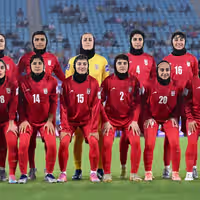
Iran's national football team has received visas for its World Cup preparations in Mexico, but the US visas needed for its group-stage matches have yet to be finalized, Iranian sports outlet Varzesh 3 reported on Tuesday.
The visa documents for Iran's delegation have been delivered to Iran's embassy in Ankara, the report said.
Last month, Reuters reported, citing an Iranian football federation official that the team attended visa appointments in Ankara.
Varzesh 3 said the visa issue had been one of the main concerns for Iran's football federation in recent months and had led to the team's camp being moved from Tucson, Arizona, to Tijuana, Mexico.
US Secretary of State Marco Rubio said on Tuesday his country is determined to prevent individuals affiliated with Iran's Islamic Revolutionary Guard Corps (IRGC) from entering the country as part of Iran's delegation for the 2026 FIFA World Cup.
The World Cup will be hosted by the United States, Canada and Mexico.
Iran is grouped with New Zealand, Belgium and Egypt, with its matches scheduled for June 16, June 21 and June 27.
Iran began its current training camp in Antalya, Turkey, on May 18 and beat Gambia 3-1 in a friendly last Friday.
The camp is scheduled to end on Thursday with a match against Mali before the team prepares to travel to Mexico, Varzesh 3 said.
Israel's new Mossad chief Roman Gofman took office Tuesday with a clear message: the campaign against Tehran is far from over, as Israel's outgoing spy chief and prime minister openly framed regime change in Iran as an achievable goal.
Gofman assumed leadership of Israel's intelligence agency with a vow to continue Mossad's covert campaign against Iran and its allies.
Israel's actions against Iran and its regional network had altered the balance of power in the Middle East, Gofman said at a welcoming ceremony.
"But the task is not yet complete. The heart of the Mossad lies in covert operations against its targets. We will safeguard that mission at all costs."
Standing beside him, Prime Minister Benjamin Netanyahu made the intent clearer, declaring that Iran's ruling system was destined to disappear.
"This regime of terror, whose fate is to pass from the world — and we will help it reach that destination — will not again threaten us with nuclear bombs and thousands of deadly ballistic missiles," he said.
The message echoed the farewell address of outgoing Mossad chief David Barnea, who publicly framed regime change in Tehran as a possible objective.
"Regime change in Iran is a possible and achievable goal," Barnea said. "This is a possible mission, and it is clear that this will require determination, patience, and adherence to the goal."
That is the agency Gofman now inherits: one openly encouraged by Israel's leadership to keep Iran at the center of its covert war, and possibly to think beyond containment.
A soldier takes the reins
Unlike several previous Mossad directors, Gofman is not a career intelligence officer. Born in Belarus in 1976, when it was part of the Soviet Union, he immigrated to Israel with his family in 1990 and built his career in the military before serving as Netanyahu's military secretary.
His appointment has generated debate in Israel because he comes from outside the traditional Mossad establishment. Supporters see him as a battle-tested commander with firsthand experience confronting Iran and its allies, while critics question whether a close Netanyahu confidant without a traditional intelligence background should lead the country's premier spy agency.
Gofman also arrives with a reputation for personal bravery.
"He is a very brave man," Alex Winston, a news editor at The Jerusalem Post, told Iran International.
Winston pointed to Gofman's actions on October 7, when he rushed to join the fighting after learning of the Hamas attacks.
Security camera footage later released online showed him fighting Hamas at a junction in southern Israel before being wounded and evacuated for treatment.
"He literally got in his car, went downstairs to fight Hamas terrorists," Winston said.
Despite the questions surrounding his appointment, Winston believes Gofman's years of service and battlefield experience have prepared him for the role.
"The fate of Israelis around the world and the Jewish people around the world is now in his hands," he said.
What it means for Iran
For Israeli analysts who closely follow Iran, Gofman's appointment signals continuity, and perhaps escalation.
"Roman is a very hard guy against Iran," Beni Sabti, an Iran researcher at the Institute for National Security Studies (INSS), told Iran International.
Sabti believes Gofman's upbringing in the Soviet Union shaped his views toward authoritarian regimes.
"We have to remember that he comes from Russia and his culture and childhood is full of experience from Soviet Union that seems so similar like the Iran regime," he said.
According to Sabti, Gofman's years as military secretary gave him an unusually close view of Israel's strategy toward Tehran. "He knows maybe more than anyone about the operations, about how Iranians think, what should Israel do."
Sabti expects Gofman to focus not only on Iran's nuclear and missile programs but also on Tehran's network of regional proxies, particularly Hezbollah.
"He has a knife between his teeth," Sabti said, using a Hebrew expression for someone relentless and aggressive.
The researcher predicted Gofman would seek to expand covert operations, intelligence gathering and agent recruitment while increasing pressure on Iran's regional activities and financial networks. He also expects the new Mossad chief to place a strong emphasis on countering Hezbollah and disrupting Iran's proxy network across the region.
Winston said confronting Tehran and preventing it from rebuilding its regional influence will remain the agency's top priority.
"We definitely have to deal with this problem. This is the utmost priority," Winston said.
"That's going to be his goal. That's his priority."
For some Iranians, Mossad has become more than an intelligence agency.
Sogand Fakheri, an Israeli-Iranian actress from the TV show Tehran, which chronicles Mossad agents inside Iran, said she regularly hears from Iranians looking for ways to help efforts against the Islamic Republic.
"A lot of Iranians inside Iran sent me messages for so long that they want to help the Mossad and how can they do it," Fakheri, who is also an Iran analyst at the Jerusalem Center for Security and Foreign Affairs (JCFA) told Iran International.
"People want to join, people want to help the Mossad, people want to cooperate with anyone who would come to help them."