• العربية
  • فارسی
Brand
  • Iran Insight
  • Politics
  • Economy
  • Analysis
  • Special Report
  • Opinion
  • Podcast
  • Iran Insight
  • Politics
  • Economy
  • Analysis
  • Special Report
  • Opinion
  • Podcast
  • Theme
  • Language
    • العربية
    • فارسی
  • Iran Insight
  • Politics
  • Economy
  • Analysis
  • Special Report
  • Opinion
  • Podcast
All rights reserved for Volant Media UK Limited
volant media logo

CENTCOM says Abraham Lincoln carrier group at ‘peak readiness’

May 22, 2026, 07:20 GMT+1

US Central Command said US Navy fighter jets launched from the aircraft carrier USS Abraham Lincoln in the Arabian Sea as its carrier strike group enforced the US blockade against Iranian ports.

CENTCOM said in a post on X that the Abraham Lincoln Carrier Strike Group was maintaining “peak readiness” during the operation.

Most Viewed

How Iran’s blackout warps online picture of public opinion
1
INSIGHT

How Iran’s blackout warps online picture of public opinion

2
INSIGHT

Calls for pragmatism grow in Iran but rulers appear unmoved

3

Hardliners attack Pezeshkian over talks and wartime candor

4
INSIGHT

The strange afterlife of Iran’s firebrand president

5

Rights group warns Iranian ex-MMA champion faces imminent execution

Banner
Banner

Spotlight

  • Why oil giant Iran struggles to supply gasoline
    ANALYSIS

    Why oil giant Iran struggles to supply gasoline

  • Iran can build missiles but can't afford chicken
    INSIGHT

    Iran can build missiles but can't afford chicken

  • The strange afterlife of Iran’s firebrand president
    INSIGHT

    The strange afterlife of Iran’s firebrand president

  • State-backed rallies in Iran add matchmaking stalls to push marriage drive

    State-backed rallies in Iran add matchmaking stalls to push marriage drive

  • Families help identify more victims linked to Alghadir hospital
    SPECIAL REPORT

    Families help identify more victims linked to Alghadir hospital

  • Iranian influencer’s ‘40 days of motherhood’ sparks debate on foster care

    Iranian influencer’s ‘40 days of motherhood’ sparks debate on foster care

•
•
•

More Stories

European tech shares hit highest level since 2000 despite Iran war

May 22, 2026, 07:17 GMT+1

European AI-linked stocks have rallied sharply even as the Iran war weighs on the region’s broader markets and economic outlook, Reuters reported.

Research from TS Lombard showed two baskets of AI-related European shares accounted for more than two-thirds of the positive performance in European stocks over the past month and a half.

“The performance of our EU AI baskets since April is on par with the Nasdaq, just a touch behind Taiwan,” TS Lombard’s Davide Oneglia said. “Look through macro chaos and don’t ignore European AI winners.”

One TS Lombard basket covering semiconductor supply-chain firms such as ASML, Infineon and STMicroelectronics has risen about 20% since the start of April.

Another basket focused on AI infrastructure, including data centers and firms such as Schneider Electric and Prysmian, is up around 22%.

The rally comes as the Iran war has darkened the outlook for European equities, with euro zone economic activity falling in May at its sharpest rate in more than two-and-a-half years.

Reuters said the STOXX 600 has fallen just over 2% since the Iran war began on February 28, while European tech shares have surged 10% and this week reached their highest level since 2000.

Iran calls attack on Pasteur Institute ‘flagrant war crime’

May 22, 2026, 04:59 GMT+1

Iranian foreign ministry spokesman Esmail Baghaei cited a warning published in The Lancet saying damage to Iran’s Pasteur Institute from US and Israeli attacks threatens both national and regional health security.

The medical journal described the institute as a pillar of Iran’s public health infrastructure, warning that its loss would pose “a real, immediate, and dangerous threat to public health.”

“Attacking a century-old scientific and public health institution is not merely an attack on a building; it is an assault on people’s right to health, science, and life,” Baghaei wrote on X.

Navy secretary says US paused some Taiwan arms sales during Iran war

May 22, 2026, 04:42 GMT+1

Acting US Navy Secretary Hung Cao said the United States paused some weapons sales to Taiwan during the war with Iran in order to preserve munitions needed for “Epic Fury.”

Speaking during a Senate hearing, Cao said foreign military sales to Taiwan had been temporarily halted while the administration ensured adequate supplies for the conflict.

Republican Senator Mitch McConnell criticized the pause, calling the situation “really distressing.”

Why oil giant Iran struggles to supply gasoline

May 22, 2026, 04:14 GMT+1
•
Umud Shokri

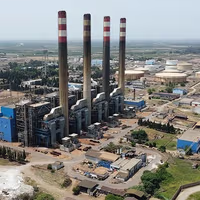
Iran’s worsening gasoline shortage is becoming a test of whether Tehran can still sustain basic economic stability under war conditions.

For years, Tehran portrayed fuel self-sufficiency as proof that sanctions had not crippled the energy sector. But recent comments by officials suggest the country was already facing a daily shortfall of roughly 20 million liters before the latest war.

MP Reza Sepahvand recently said production stands at around 105 million liters a day while consumption is closer to 135 million.

War damage, disrupted imports and pressure on petrochemical units have now pushed a long-running structural problem into public view.

Why a producer runs short of gas

Iran may hold vast oil reserves and operate sizable refineries, but that does not automatically guarantee enough gasoline for domestic use.

Much of the country’s refining system depends on aging infrastructure, limited maintenance and technology constrained by years of sanctions, leaving production increasingly out of step with demand.

Fuel consumption is also on the rise. Expanding cities, heavy reliance on private cars and millions of older, fuel-inefficient vehicles place constant pressure on supply.

Cheap subsidized gasoline also encourages overuse, while large price gaps with neighboring countries fuel widespread smuggling that pulls millions of liters out of Iran each day.

The crisis is tied to politics as much as energy. Subsidies help keep fuel affordable and reduce public frustration, but they also deepen waste, smuggling and financial pressure on the state.

Iranian leaders know reforms are necessary, yet past fuel-price increases have triggered unrest, leaving the government trapped between avoiding social anger and managing a system that is becoming harder to sustain.

How war made things worse

The latest war has turned a chronic imbalance into a more immediate stress test. Strikes on energy infrastructure and disruption around the Strait of Hormuz have affected refining, storage, distribution and imports.

Even when refineries are not completely knocked offline, damage to depots, logistics networks and supporting industrial units can sharply reduce the amount of usable gasoline reaching consumers.

One overlooked issue is Iran’s reliance on petrochemical components for gasoline blending.

When refineries cannot produce enough high-quality gasoline, producers blend in octane-boosting components to improve fuel performance. These can include aromatic-rich streams such as benzene, toluene and xylenes, as well as additives such as MTBE.

Such components are widely used in global fuel production because they raise octane levels. The difference lies in regulation.

Many countries tightly restrict substances such as benzene because of health and environmental risks. Iran’s heavier reliance on petrochemical blending can worsen pollution if quality controls weaken or blending exceeds safer limits.

Higher levels of benzene and aromatics increase harmful emissions, especially in congested cities such as Tehran, where air quality is already poor. MTBE also carries environmental risks, particularly for groundwater contamination.

Damage to petrochemical facilities therefore matters for two reasons: it can reduce the supply of components Iran needs to stretch gasoline production while also increasing pressure to rely on lower-quality blending practices to keep fuel flowing.

Either outcome creates problems: tighter supply or worsening health and environmental costs.

When will it really bite?

Before the war, Iran managed the imbalance through imports, rationing, fuel cards, blending and informal restrictions. Those measures helped prevent a full public breakdown but never solved the underlying problem.

If the reported daily shortfall of 20 to 30 million liters persists, shortages could become more visible within weeks or months, especially during peak summer demand.

Longer queues, tighter quotas, regional outages, rising black-market prices and growing pressure on transport and agriculture are among the most likely consequences.

Recent public comments by lawmakers suggest officials are no longer able to present the issue as a temporary inconvenience.

War damage has made repairs and imports more difficult, while years of overworking refineries, postponing maintenance and relying on imports and petrochemical blending left little room to absorb new shocks.

Partial recovery of refining and distribution capacity may be possible within one or two months if damage is limited and supply routes remain open. Full normalization would likely take far longer because the deeper causes are structural: rising demand, old vehicles, sanctions, smuggling, weak investment and distorted pricing.

Iran’s gasoline shortage is therefore not only an energy problem but also a governance problem.

For ordinary Iranians, the consequences are increasingly visible in longer fuel lines, higher unofficial prices, rising transport costs and worsening air pollution: exposing the widening gap between official claims of resilience and economic reality.


Iran can build missiles but can't afford chicken

May 22, 2026, 04:10 GMT+1

As food prices spiral and farms shut down across Iran, even establishment figures are openly questioning how a country capable of producing precision missiles cannot manufacture affordable cars or keep chicken within reach of ordinary families.

Former Industry Minister Mostafa Hashemitaba says the crisis is rooted not only in consumer markets but across the country’s collapsing production chain, from fertilizers to poultry farming.

Writing in Sharq on May 20, Hashemitaba said the price of a 50-kg bag of triple-phosphate fertilizer had jumped within months from three million rials to 70 million rials, a nearly 24-fold increase. Other fertilizers, he added, rose by more than 1,100 percent over the same period.

The result, he argued, has been the shutdown of farms and poultry operations, feeding directly into soaring prices for fruit, vegetables and meat.

Read the full article here.