• العربية
  • فارسی
Brand
  • Iran Insight
  • Politics
  • Economy
  • Analysis
  • Special Report
  • Opinion
  • Podcast
  • Iran Insight
  • Politics
  • Economy
  • Analysis
  • Special Report
  • Opinion
  • Podcast
  • Theme
  • Language
    • العربية
    • فارسی
  • Iran Insight
  • Politics
  • Economy
  • Analysis
  • Special Report
  • Opinion
  • Podcast
All rights reserved for Volant Media UK Limited
volant media logo

Iran accuses German chancellor of ‘hypocrisy’ over nuclear facility attacks

May 18, 2026, 21:47 GMT+1

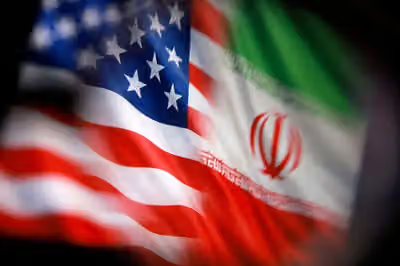
Esmaeil Baghaei, spokesperson for Iran’s Foreign Ministry on Monday addressed German Chancellor Friedrich Merz on X, accused Western governments of “hypocrisy” for not condemning US and Israeli strikes on Iran’s secured nuclear facilities.

"The hypocrisy is obvious. Open attacks by the United States and the Israeli regime on Iran’s secured nuclear facilities do not provoke condemnation, but rather excuses and justifications. Yet when a supposed false-flag operation takes place—one whose authorship even the UAE has refused to officially attribute to Iran—those same voices suddenly invoke the solemn language of “international law” and “regional security," Baghaei said.

Most Viewed

Iran’s president defends US talks as he lays bare economic strain
1

Iran’s president defends US talks as he lays bare economic strain

2

Pezeshkian says Iranians must accept inflation as country is in war

3

Amnesty says Iran drove global surge in executions in 2025

4

Trump holds off planned Iran strike as Arab allies buy Tehran time

5

IRGC-linked propaganda posts targeted across platforms, Europol says

Banner
Banner

Spotlight

  • Iran finds a new weapon beneath Hormuz
    ANALYSIS

    Iran finds a new weapon beneath Hormuz

  • Iran state TV rifle displays stir unease over domestic intimidation

    Iran state TV rifle displays stir unease over domestic intimidation

  • Two years after Raisi’s crash: Iran has no sanctuary
    ANALYSIS

    Two years after Raisi’s crash: Iran has no sanctuary

  • Can Iran’s economy survive a twin squeeze from blockade and blackout?
    PODCAST

    Can Iran’s economy survive a twin squeeze from blockade and blackout?

  • China’s Iran balancing act grows more costly
    ANALYSIS

    China’s Iran balancing act grows more costly

  • Tehran media sees rising risk of war as US talks stall
    INSIGHT

    Tehran media sees rising risk of war as US talks stall

•
•
•

More Stories

Iran will force adversaries into ‘retreat and surrender’, Rezaee says

May 18, 2026, 21:36 GMT+1

Mohsen Rezaee, a military adviser to Iran’s Supreme Leader and former IRGC commander said on Monday that Iran would compel its adversaries into “retreat and surrender.”

“It sets a deadline for a military strike and then cancels it itself, with the vain hope of making the Iranian nation and officials surrender. The iron fist of the powerful armed forces and the great Iranian nation will force them to retreat and surrender,” he posted on X, referencing President Trump’s earlier post on Truth Social.

Iran must negotiate in good faith or face renewed attacks, White House says

May 18, 2026, 20:54 GMT+1

The White House said on Monday that Iran must surrender its enriched uranium stockpile as part of any agreement with Washington, warning Tehran that President Donald Trump “does not bluff” and retains all military options if negotiations fail.

“This enriched uranium that they possess, they can’t keep it,” White House principal deputy press secretary Anna Kelly told Fox News, calling the issue one of Trump’s “red lines” in talks with Tehran.

“President Trump has been very clear that enriched uranium must be turned over,” Kelly said. “He does not bluff.”

She said Iran had been “decimated militarily,” “strangled economically” and left “more isolated than ever before,” arguing Tehran should “get serious and make a deal with the United States before it’s too late.”

Kelly also warned that the US military posture remained unchanged despite the current pause in hostilities, saying Washington still had “all of the same military assets in place” as before Operation Epic Fury and other recent operations targeting Iran’s military infrastructure.

“If he feels that the Iranians are not negotiating in good faith, surely he’s going to make any decision that he feels is best for U.S. national security,” she said.

Trump says he called off planned Iran strike after Arab leaders’ appeal

May 18, 2026, 20:03 GMT+1

US President Donald Trump said on Monday he called off a planned military attack on Iran scheduled for Tuesday after the leaders of Qatar, Saudi Arabia and the United Arab Emirates urged him to hold off as “serious negotiations” were underway.

Trump said Qatar’s Emir Sheikh Tamim bin Hamad Al Thani, Saudi Crown Prince Mohammed bin Salman and UAE President Mohammed bin Zayed had asked him to delay the attack because they believed a deal could be reached that would be “very acceptable” to the United States, the Middle East and beyond.

“This Deal will include, importantly, NO NUCLEAR WEAPONS FOR IRAN!” Trump said.

Trump said that, out of respect for the three Persian Gulf leaders, he had instructed Defense Secretary Pete Hegseth, Joint Chiefs of Staff Chairman Gen. Daniel Caine and the US military not to carry out the scheduled attack.

But he warned that the order could be reversed quickly if talks fail.

“I have further instructed them to be prepared to go forward with a full, large scale assault of Iran, on a moment’s notice, in the event that an acceptable Deal is not reached,” Trump said.

Pezeshkian says Iran will not retreat from ‘legal rights’

May 18, 2026, 19:49 GMT+1

“Under no circumstances will (Iran) retreat from the legal rights of the people and the country,” Iranian President Masoud Pezeshkian said on X, referring to Iran’s position in talks with the United States.

“Dialogue does not mean surrender,” Pezeshkian added.

“The Islamic Republic of Iran enters into dialogue with dignity, authority, and the preservation of the nation’s rights,” he said.

Iran’s president defends US talks as he lays bare economic strain

May 18, 2026, 19:38 GMT+1

Iran’s president on Monday defended negotiations with the United States as he acknowledged the economic pressure, fuel shortages and war damage facing the country, pushing back against hardliners who oppose further dialogue.

“As for those who chant that we should not negotiate — if we do not negotiate, what should we do? Fight until the end? We negotiate with dignity,” Masoud Pezeshkian said in an address to an event held in Tehran.

“It is not logical to say we will not negotiate,” he said. “We are capable of defending the nation’s rights with the people’s backing. We must speak logically and receive a logical answer.”

His comments come amid a fragile ceasefire in the six-week war between Iran and the US and Israel, with Pakistan-mediated efforts to reach a final deal unsuccessful despite exchanges of US and Iranian proposals.

Hardline figures have opposed further talks without major US concessions. Mohammad Ali Jafari, a former commander-in-chief of Iran’s Revolutionary Guards, said Monday no further negotiations should take place unless Iran’s conditions were met.

Alaeddin Boroujerdi, deputy head of parliament’s National Security Committee, said Sunday talks would be futile unless sanctions were lifted and blocked Iranian assets were released.

Adversaries exploit division

Pezeshkian tied the push for talks with the United States to a broader call for national unity, warning that Iran’s adversaries could exploit internal divisions more effectively than military attacks.

“We stand with dignity against foreigners, we negotiate, and we will defend the nation’s rights,” he said.

“We will stand against any aggression with unity and cohesion,” he added. “They cannot occupy the country with missiles and bombs, but they can with division and conflict. We must try to ensure that this unity and cohesion is not broken.”

Reports of divisions among Islamic Republic officials have emerged on multiple occasions since the war began. On March 28, reports pointed to serious disagreements between Pezeshkian and Ahmad Vahidi, the Revolutionary Guards commander who is now said to be the most powerful figure in the force.

Informed sources told Iran International at the time that the dispute stemmed from “the handling of the war and its destructive consequences for people’s livelihoods and the country’s economy.”

Three days later, Iran International received reports that Pezeshkian was frustrated at being placed in a “complete political deadlock” and that he had even been stripped of the authority to appoint replacements for government officials killed during the war.

Acknowledging damage, hardship after war

Pezeshkian said officials must be honest about the pressure Iran faces and should not claim the country has escaped harm.

“It is not the case that we have not been harmed,” he said.

He said Iran had sustained damage to energy and industrial infrastructure following Israeli-US airstrikes.

“We must take on a war footing,” he said. “They hit 230 million cubic meters of our gas; they hit our power plant, petrochemical facility and Mobarakeh Steel.”

“One cannot claim that we have no problems and that they are being destroyed,” he added.

He said Iran would not back down but must manage the country with prudence.

“One cannot say the enemy is being destroyed and we are flourishing,” he said. “They have problems and we also have problems. We will by no means bow our heads.”

The acknowledgment contrasted with Iran’s public victory narrative after the ceasefire, even as the country's economy had been battered, prices had risen and factories, power plants, railways, airports and bridges had been destroyed.

Oil exports squeezed as fuel shortfall deepens

Pezeshkian said Iran was under mounting economic pressure, with oil exports constrained.

“They closed the route and we are not exporting oil either,” he said. “We cannot export oil easily. Saying that we have not encountered any problem is one of those statements.”

He added that strikes on Iran's gasoline production facilities had deepened the country's fuel shortfall, with daily output at 100 million liters against demand of 150 million liters.

“Our gasoline production capacity has decreased. They hit it,” he said.

Reuters reported that the US naval blockade of Iranian ports had cut Iran’s oil exports by more than 80% over April 13-25 compared with the same period in March, leaving growing volumes of crude stranded on tankers.

Iran exported 1.84 million barrels per day of crude in March, before the US military began blocking shipping traffic in and out of Iranian ports.