Two medical staff detained on security charges in Iran

Iranian security forces arrested a doctor and an anesthesia nurse from a hospital in Najafabad, in central Iran, on Saturday on security-related charges, Iran International has learned.

Iranian security forces arrested a doctor and an anesthesia nurse from a hospital in Najafabad, in central Iran, on Saturday on security-related charges, Iran International has learned.
The arrests of Dr. Pedram Hadipour and nurse Sobhan Nourian took place at the Montazeri Hospital in Najafabad. The specific nature of the security charges against the medical professionals was not immediately disclosed.
The arrests follow the circulation of graphic footage from the same hospital following protests on Jan. 8 and 9. Those images showed the bloodied bodies of dozens of casualties in various sections of the medical facility.






India and Pakistan condemned on Tuesday Iran’s attacks on the United Arab Emirates, calling for restraint and a return to diplomacy.
Indian Prime Minister Narendra Modi said attacks that injured three Indian nationals were unacceptable, adding that targeting civilians and infrastructure must stop.
“India stands in firm solidarity with the UAE and reiterates its support for the peaceful resolution of all issues through dialogue and diplomacy,” he wrote on X.
Prime Minister Shehbaz Sharif also strongly condemned the attacks and expressed full solidarity with UAE President Mohammed bin Zayed in a post on X.
“Pakistan stands firmly with our Emirati brothers and sisters as well as with the Government of the United Arab Emirates at this difficult time,” he wrote.
He said it was essential that the ceasefire be upheld to allow space for diplomacy and called for dialogue to achieve lasting peace and stability in the region.
The United Arab Emirates came under attacks from Iran’s drones and missiles on Monday, causing a fire at the Fujairah Oil Industry Zone.
Abu Dhabi “condemned in the strongest terms the renewed terrorist, unprovoked Iranian attacks targeting civilian sites and facilities.”
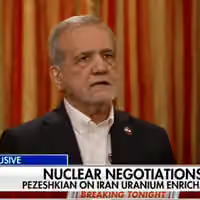
Exclusive information obtained by Iran International points to a growing clash between Iran’s President Masoud Pezeshkian and its military leadership over Monday’s escalation in the Persian Gulf and attacks on the United Arab Emirates.
According to sources familiar with Tehran’s deliberations, Pezeshkian has expressed strong anger at actions by the Islamic Revolutionary Guard Corps, led by Ahmad Vahidi, describing missile and drone strikes on the UAE as “completely irresponsible” and carried out without the government’s knowledge or coordination.
Pezeshkian is said to have described the IRGC’s approach to escalating tensions with regional countries as “madness,” warning of potentially irreversible consequences.
Amid a worsening situation and the risk of the country sliding back into war, Pezeshkian has requested an urgent meeting with Mojtaba Khamenei to press for an immediate halt to IRGC attacks on Gulf states and to prevent further escalation.
He is expected to argue that a narrow window remains to salvage the ceasefire through urgent diplomatic action, and that he should be allowed to signal to international mediators Tehran’s readiness to return to negotiations.
The tensions come as diplomatic efforts to preserve the ceasefire continue, but with a widening gap between military and political approaches inside Iran’s leadership.
At sea, accounts of recent developments remain sharply contested. US officials say commercial ships are continuing to transit and that Iranian threats have been contained.
The IRGC, however, has denied that any passage is taking place and warned that “violating vessels” would be stopped, while Iranian media reported that ships were forced to turn back.
President Donald Trump has stopped short of declaring the ceasefire breached, saying recent exchanges were “not heavy firing” and that “ships are moving.”
In Iran’s power structure, major security and military decisions are ultimately taken at the highest levels of the system and in coordination with key state bodies, underscoring the significance of the president’s request.
Sources close to the presidency, who shared the information with Iran International, say Pezeshkian is deeply concerned about potential international reactions and believes the country cannot withstand a new full-scale war.
He has warned that continued unilateral attacks could trigger heavy US retaliation against critical energy and economic infrastructure—an outcome he reportedly said could lead to widespread destruction and an irreversible collapse in livelihoods.
The political deadlock comes as some observers warn that divided command on the battlefield risks pushing the Islamic Republic toward what they describe as “military self-destruction.”
Exclusive information obtained by Iran International suggests an unprecedented surge in tensions between Iran’s government and military leadership.
According to the information, President Masoud Pezeshkian has expressed strong anger at actions by the Islamic Revolutionary Guard Corps, describing missile and drone strikes on the United Arab Emirates as “completely irresponsible” and carried out without the government’s knowledge or coordination.
Pezeshkian is also said to have called the approach of escalating tensions with regional countries “madness,” warning of potentially irreversible consequences.
The claims, which could not be independently verified, point to growing friction at the top of Iran’s political and military establishment as the conflict intensifies.
Iran's security agents secretly buried the body of Iranian-Swedish citizen Kourosh Keyvani in the Khavaran area outside Tehran after he was executed in March on charge of spying for Israel, sources familiar with the matter told Iran International.
The sources said Keyvani was executed on the morning of March 18 without his family being informed, and his body was buried on March 23 in Khavaran.
Keyvani’s family later tried to mark the unmarked gravesite by placing stones nearby, but authorities removed them to prevent the burial location from being identified, the sources told Iran International.
Khavaran, in southeast Tehran, is known as a burial site associated with executed political prisoners, including victims of Iran’s 1988 mass executions. Families of those buried there have long accused authorities of preventing them from marking graves or holding public mourning ceremonies.
Iran's security agents secretly buried the body of Iranian-Swedish citizen Kourosh Keyvani in the Khavaran area outside Tehran after he was executed in March on charge of spying for Israel, sources familiar with the matter told Iran International.
The sources said Keyvani was executed on the morning of March 18 without his family being informed, and his body was buried on March 23 in Khavaran.
Keyvani’s family later tried to mark the unmarked gravesite by placing stones nearby, but authorities removed them to prevent the burial location from being identified, the sources told Iran International.
Khavaran, in southeast Tehran, is known as a burial site associated with executed political prisoners, including victims of Iran’s 1988 mass executions. Families of those buried there have long accused authorities of preventing them from marking graves or holding public mourning ceremonies.
Sources said Keyvani had been arrested on June 16, 2025, in Kordan, a mountainous village in Alborz province, west of Tehran and near the city of Karaj.
One source said Keyvani had a strong interest in motorcycling, especially jumping with motorcycles, and was riding in Kordan on the day of his arrest.
The source said security agents confiscated his phone during the arrest and used landscape photos he had taken in the area as evidence in the case, alleging links to Mossad and opposition groups.
Iran's judiciary-linked Mizan news agency on March 18 announced that Keyvani had been executed after his death sentence was upheld by the Supreme Court. Mizan alleged that Keyvani had passed “images and information of sensitive locations” to officers of Israel’s Mossad intelligence agency.
At the time, Swedish Foreign Minister Maria Malmer Stenergard expressed deep regret over the execution and said the Swedish government sympathized with Keyvani’s family in Sweden and Iran. She added that the legal proceedings leading up to the execution did not meet the standards of due process.
Sources told Iran International that on the night before the execution, Keyvani was summoned via loudspeaker without prior notice and held in solitary confinement until morning.
After Keyvani's detention, his family had no information about his condition or whereabouts for around 40 days. He was held in solitary confinement for nearly eight months and was told he would be released if he accepted the charges and made a "forced confession," according to the sources.
According to forced confessions later published by Iranian state media, Keyvani said he had been forced into espionage because of financial need and residency issues.
But sources indicated to Iran International that he had lived in Sweden for around 10 years and did not face financial difficulties. The sources also described him as intelligent and fluent in six languages.
Keyvani was among the latest in a series of executions in Iran of people accused of espionage for Israel, a pattern that has intensified since the 12-day war in June 2025. The executions have continued during and after the 2026 US-led war.
Iran has one of the highest execution rates in the world and has long used the death penalty in national security cases, including allegations of spying.
Following the conflict, rights groups and international media have reported a sharp increase in arrests and executions on such charges.