• العربية
  • فارسی
Brand
  • Iran Insight
  • Politics
  • Economy
  • Analysis
  • Special Report
  • Opinion
  • Podcast
  • Iran Insight
  • Politics
  • Economy
  • Analysis
  • Special Report
  • Opinion
  • Podcast
  • Theme
  • Language
    • العربية
    • فارسی
  • Iran Insight
  • Politics
  • Economy
  • Analysis
  • Special Report
  • Opinion
  • Podcast
All rights reserved for Volant Media UK Limited
volant media logo

Canada condemns Iran’s unprovoked attacks on UAE

May 5, 2026, 05:35 GMT+1

Canada condemned Iran’s missile and drone attacks on the United Arab Emirates and renewed calls for de-escalation and diplomacy in the region.

“Canada strongly condemns Iran’s unprovoked missile and drone attacks on the United Arab Emirates,” Prime Minister Mark Carney wrote in a post on X.

Carney said Canada stood with UAE President Mohammed bin Zayed and the people of the United Arab Emirates.

He also praised defensive efforts to protect civilians and civilian infrastructure.

Most Viewed

Tehran's familiar battle lines return over deal with US
1
INSIGHT

Tehran's familiar battle lines return over deal with US

2

Khamenei shifts responsibility for MoU as Iran, US implement Hormuz terms

3

US says Iran deal will end enrichment, destroy uranium stocks, cap missiles

4
ANALYSIS

Why some think a weakened Iran could emerge stronger

5
ANALYSIS

A fragile compact: ambiguities that could undermine US-Iran MoU

Banner
Banner
Banner

Spotlight

  • Can Iran rebuild ties with Arab neighbours without a US deal?
    INSIGHT

    Can Iran rebuild ties with Arab neighbours without a US deal?

  • Tehran divided over what Khamenei MoU message really meant
    INSIGHT

    Tehran divided over what Khamenei MoU message really meant

  • Trump says Iran is 'finished', experts say Tehran won big
    PODCAST

    Trump says Iran is 'finished', experts say Tehran won big

  • A US-Iran deal alone won't rescue Iran's oil economy
    ANALYSIS

    A US-Iran deal alone won't rescue Iran's oil economy

  • Iran's Qatar power link exposes a deeper energy dilemma
    ANALYSIS

    Iran's Qatar power link exposes a deeper energy dilemma

  • A fragile compact: ambiguities that could undermine US-Iran MoU
    ANALYSIS

    A fragile compact: ambiguities that could undermine US-Iran MoU

•
•
•

More Stories

New Zealand says Iran breached ceasefire with attacks on UAE

May 5, 2026, 05:23 GMT+1

New Zealand condemned on Tuesday Iran’s latest attacks on the United Arab Emirates, saying they violated the ceasefire and risked derailing peace negotiations.

“Iran’s actions violate the ceasefire and are unhelpful for peace negotiations,” Foreign Minister Winston Peters wrote in a post on X.

He urged Tehran to de-escalate, honor the ceasefire and respect international law, including protections for civilians and civilian infrastructure.

“The conflict will not be resolved through drones and missiles,” Peters said.

South Korea holds meeting on Hormuz ship fire, crew safe

May 5, 2026, 05:14 GMT+1

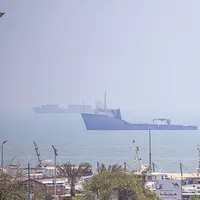
South Korea’s Blue House convened a meeting on Tuesday to discuss a fire on a Korean-operated ship in the Strait of Hormuz, MoneyToday reported.

The meeting was led by Presidential Chief of Staff Kang Hoon-sik, the report said.

All 24 crew members aboard the HMM NAMU, including six South Korean nationals, were safe and unharmed, according to South Korea’s Foreign Ministry.

The ministry said the fire had been fully extinguished and no additional damage was reported.

WSJ editorial says Iran has effectively ended ceasefire

May 5, 2026, 04:41 GMT+1

An editorial by The Wall Street Journal argues that Iran has effectively ended the ceasefire through its actions in and around the Strait of Hormuz.

The paper’s editorial board said recent attacks on shipping and military targets amount to a breach of the truce’s “spirit,” even if it has not been formally declared over.

The argument contrasts with more cautious language from officials, who have described the ceasefire as fragile or under strain rather than broken outright.

The editorial calls for a firmer response, reflecting a broader debate in Washington over how to interpret Iran’s actions and whether the current level of escalation constitutes the end of the truce.

South Korea says cause of Hormuz ship fire unclear pending inspection

May 5, 2026, 04:22 GMT+1

South Korea’s Foreign Ministry said the cause of a fire aboard a South Korean-operated vessel in the Strait of Hormuz will only be determined after the ship is brought to port and inspected.

“The exact cause of the accident would be figured out after the vessel is towed and its damage is assessed,” the ministry said, according to Reuters.

A fire had earlier been reported in the engine room of the bulk carrier.

According to South Korea’s Yonhap news agency, the vessel was anchored in waters near the United Arab Emirates in the Strait of Hormuz when the explosion occurred.

Tehran media break silence on war’s toll on livelihoods

May 5, 2026, 04:10 GMT+1
•
Behrouz Turani
Tehran media break silence on war’s toll on livelihoods
100%
People check the latest rates outside a currency exchange in Tehran, Iran, May 2, 2026

Iranian media are now openly discussing the war’s impact on livelihoods—a subject largely avoided until recently, when journalists resorted to indirect language to navigate censorship.

As a fragile ceasefire holds despite exchanges of fire near the Strait of Hormuz, concern has grown about the risk of unrest driven by soaring prices.

The pharmaceutical sector has been among the hardest hit, with some medicine prices reportedly rising nearly six-fold.

“We have a choice between no medicine or making it available at a high price,” Mahmoud Jamalian of parliament’s Health Committee said, according to Asr Iran.

Warnings have also begun to surface about how the state may respond.

Hardline analyst Mostafa Khoshcheshm said on state television that protests over rising prices could be treated as collaboration with foreign powers seeking to destabilize Iran—an indication of how quickly economic grievances could be securitized.

Moderate daily Sharq wrote that after damaging infrastructure, the war is now eroding economic relations and household livelihoods, adding that uncertainty surrounding the conflict is further weakening the economy.

Beyond prices, the disruption has spread across key sectors. Damage to infrastructure and prolonged internet restrictions have slowed or halted parts of the digital economy, while supply chains have come under strain, compounding pressure on businesses and households.

Economist Hossein Raghfar said the government’s handling of the crisis raises serious concerns, warning that continuing current policies will fuel public dissatisfaction.

He argued that frustration over economic conditions—visible during the January unrest—and the state’s inability to address it had weakened the country internally.

Raghfar criticized the use of scarce foreign currency on car imports and said authorities acted too late to halt exports of eggs, rice and meat to stabilize domestic prices.

“Unfortunately, the government is nowhere to be seen these days,” he said, contrasting the current response with the eight-year war with Iraq.

Asked about solutions, Raghfar said Iran still has the capacity to withstand sanctions but lacks the political will to use it. He called for investment in domestic production and urged reallocating funds to revive key sectors.

Another moderate daily, Etemad, reported that workers are emerging as the primary victims of the war and economic strain, with layoffs, unpaid wages and rising poverty becoming widespread.

In Fars Province, between 20 and 100 workers have reportedly been dismissed per workplace; in Rasht, at least 2,000 have lost their jobs in two months.

The Labor Ministry estimates the conflict has cost more than one million jobs, affecting up to two million people directly or indirectly.

Economist Vahid Shaghaghi-Shahri said chronic inflation, temporary contracts and a large informal labor market had already left workers highly vulnerable.

With war, recession and sanctions converging, he urged the government to prioritize “protecting livelihoods and preventing mass unemployment” as an urgent national priority.